
A low “deep sleep” score has a special way of ruining a morning. The app says 7%, the graph looks thin, and suddenly the search bar fills with natural remedies for deep sleep: melatonin, magnesium, chamomile, tart cherry juice, pink noise, valerian, glycine.
The first useful distinction is also the one most marketing copy blurs. Deep sleep means slow-wave sleep, also called N3 sleep. Many natural sleep aids do something else: they may help you feel sleepy sooner, shift circadian timing, make bedtime more pleasant, or improve subjective sleep quality. Those are not useless outcomes. They are just not the same as increasing slow-wave sleep.
Most adults spend about 10–20% of total sleep in deep sleep, and that proportion tends to decline with age, with substantial individual variation.[1] So a single low reading is not automatically a crisis, and an older adult should not assume they need the same deep-sleep percentage as a younger adult. If the number is persistently low, though, it can be a reasonable prompt to examine the levers that actually touch sleep architecture: timing, light, exercise, body temperature, alcohol, and stress.
One more caution before changing anything: consumer wearables estimate sleep stages; they do not measure brain waves the way a sleep lab does. They can still be useful for patterns, especially when you compare your own nights against your own baseline. But if the device is turning bedtime into a performance review, it is worth reading more on what a sleep tracker watch can and cannot tell you about your sleep before treating the percentage as a diagnosis.
What actually matches the biology of deep sleep
Slow-wave sleep is not something the body usually produces because a bedtime product feels calming. It is more strongly supported by the conditions that make the brain and body ready to consolidate sleep: a stable circadian signal, enough sleep pressure, a cooling core temperature, and fewer substances or stress responses interfering with the first half of the night.
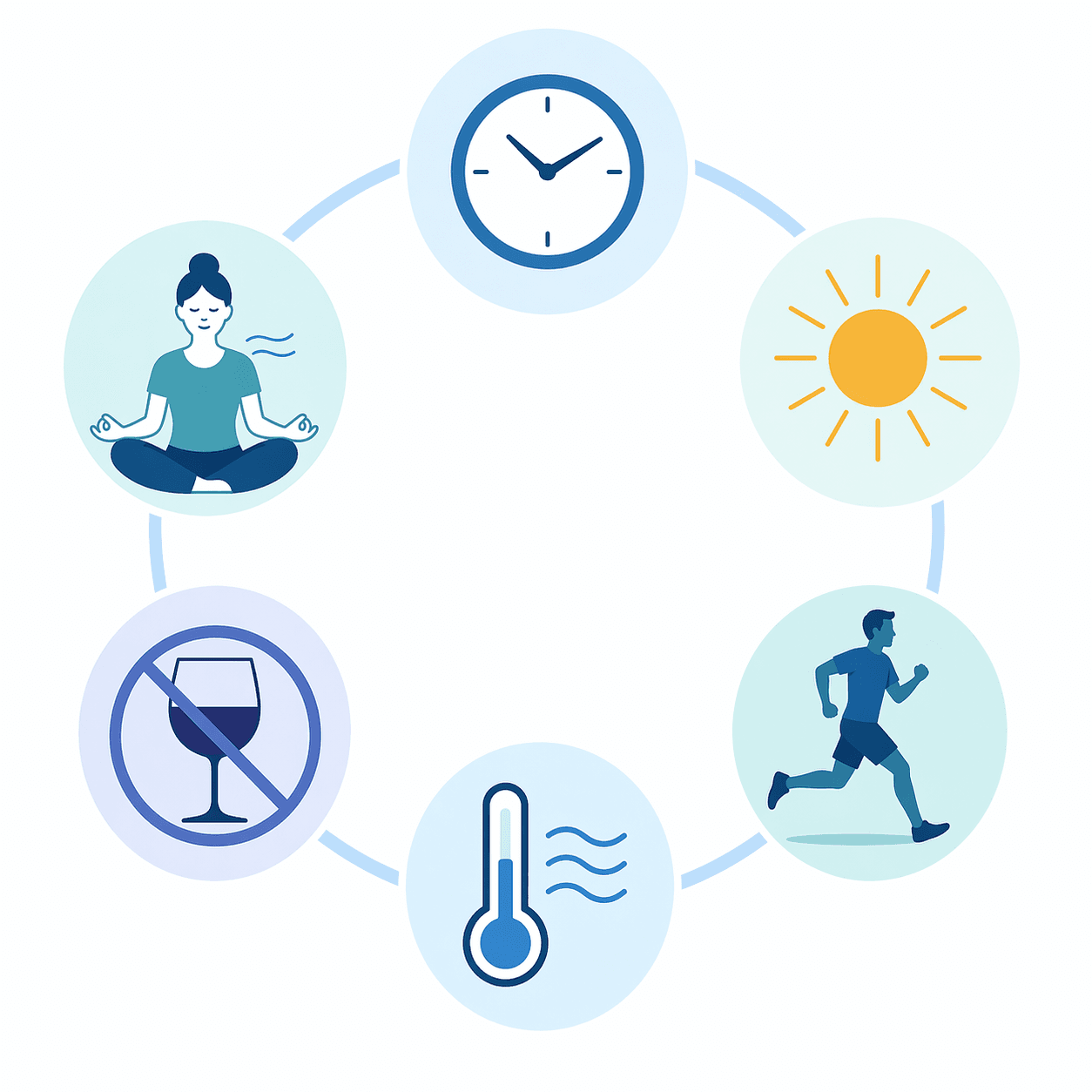
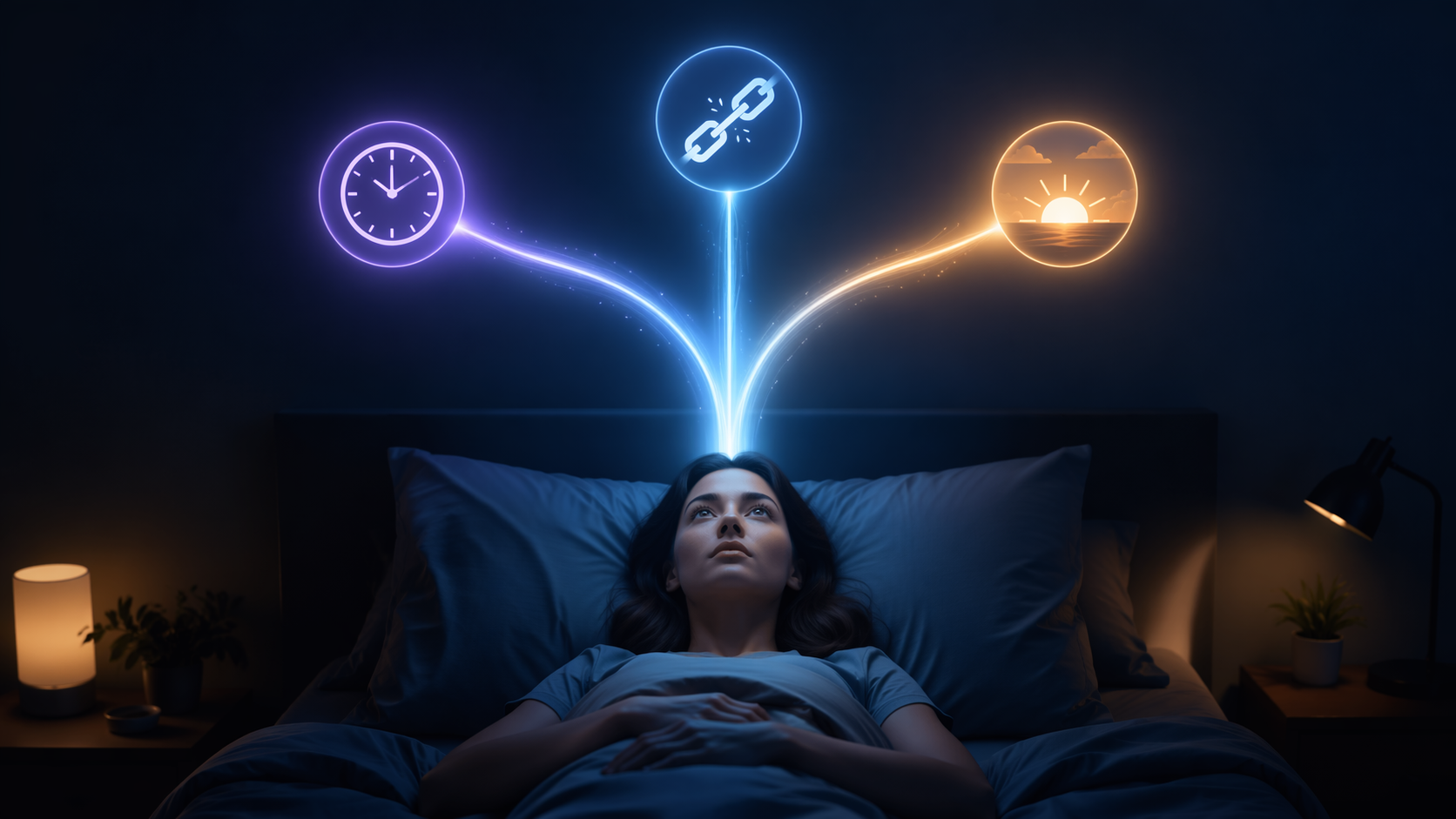
That is why the most credible natural remedies for deep sleep look less like a supplement shelf and more like a day-night rhythm: consistent wake and bedtimes, morning light, exercise timed well, a cool bedroom, alcohol avoidance, and a deliberate way to come down from stress.
| Lever | Why it matters for deep sleep | How to apply it |
|---|---|---|
| Consistent sleep-wake timing | Stabilizes the circadian system so the body knows when to build and release sleep pressure. | Keep wake time and bedtime as regular as practical, including weekends. |
| Morning light | Strengthens the daytime circadian signal that helps nighttime sleep timing. | Get outdoor light within 30–60 minutes of waking when possible. |
| Moderate aerobic exercise | One of the more reliable behavioral ways to increase slow-wave sleep. | Exercise regularly, but finish intense workouts at least 3 hours before bed. |
| Body cooling | Supports the core temperature drop involved in sleep onset and deep sleep. | Aim for a cool room, roughly 60–67°F / 15–19°C. |
| Alcohol avoidance | Alcohol can make sleepiness arrive faster while suppressing slow-wave sleep and fragmenting the night. | Avoid alcohol close to bedtime, especially within 3–4 hours. |
| Stress downregulation | Reduces physiological arousal that competes with sleep consolidation. | Use a repeatable wind-down practice rather than relying only on willpower in bed. |
Start with timing, because deep sleep dislikes randomness
A consistent sleep schedule is not glamorous, which is probably why it gets skipped in favor of capsules and teas. But irregular timing asks the body to guess when the night is supposed to begin. Deep sleep is concentrated more heavily in the earlier part of the night, so a drifting bedtime or inconsistent wake time can make the window for consolidated slow-wave sleep less reliable.
The practical version is not perfection. It is reducing the size of the swings. A steady wake time usually carries more weight than a perfectly controlled bedtime, because it anchors the next day’s light exposure, meals, activity, and sleep pressure. If the tracker shows poor deep sleep after late nights, that may be less a mysterious deficiency than a scheduling signal.
Morning light is a deep-sleep intervention by way of the clock
Morning light does not pour deep sleep directly into the brain. It strengthens circadian timing. Getting light within 30–60 minutes of waking is recommended as a way to help set the body’s daily rhythm, which can support sleep timing later that night.[2] That distinction matters: the goal is not to feel instantly relaxed. The goal is to make nighttime arrive more clearly to the nervous system.
Outdoor light is usually more potent than indoor light, even on cloudy mornings. If mornings are chaotic, the minimum viable habit can be simple: step outside after waking, take the first drink of water or coffee near daylight, or walk for a few minutes before opening the laptop. The tracker result to watch is not just that night’s deep-sleep percentage; it is whether sleep timing becomes less erratic over several weeks.
Exercise helps, but timing decides whether it helps tonight
Moderate aerobic exercise is one of the more reliable natural ways to support slow-wave sleep.[3] It increases sleep pressure, supports metabolic regulation, and gives the body a clearer contrast between daytime activation and nighttime recovery. For many people, the deep-sleep benefit is less about one heroic workout and more about regular movement accumulated across the week.
The timing caveat is real. Intense workouts close to bedtime can keep heart rate, body temperature, and arousal elevated, so guidance commonly places harder exercise at least 3 hours before bed.[3] That does not mean evening movement is forbidden. A walk, mobility work, or gentle stretching may be perfectly compatible with sleep. The point is to avoid treating a late high-intensity session as a guaranteed deep-sleep upgrade just because exercise is generally beneficial.
Cool the room because the body needs to cool itself
Deep sleep is easier to enter when the body can drop core temperature. This is where the bedroom environment stops being cosmetic. A room target around 60–67°F, or about 15–19°C, is commonly recommended to support sleep.[4][3] Some people need a slightly different setting because of bedding, hormones, climate, a bed partner, or medical conditions, but a warm room is a plausible reason a tracker keeps showing restless, shallow sleep.
Cooling does not have to mean suffering under thin blankets. The useful combination is a cool room with enough bedding to feel safe and comfortable. A warm shower or bath earlier in the evening can also help some people because heat at the skin can be followed by cooling as the body sheds heat. If temperature is the obvious weak spot, a deeper setup guide can help: sleep environment optimization is usually a better next click than another supplement review.
Alcohol is the natural-looking disruptor people underestimate
Alcohol is tricky because it can appear to solve the wrong problem. It may make falling asleep feel easier, but it can suppress slow-wave sleep in the first half of the night and fragment sleep later.[3][2] For someone watching deep sleep on a wearable, that is exactly the kind of mismatch that creates confusion: sleepiness at bedtime does not guarantee better sleep architecture.
The cleanest experiment is not a lifetime vow. It is a controlled comparison: avoid alcohol, especially within 3–4 hours of bedtime, for long enough to see whether your baseline changes.[2] If deep sleep rises, wake-ups fall, or resting heart rate looks calmer, the lesson is more useful than any generic rule. If nothing changes, alcohol may not be the main driver for you, but at least it has been tested instead of guessed.
Stress regulation is not a vibe; it is arousal control
Stress interferes with deep sleep because the body cannot easily shift into consolidated recovery while it is still mobilized. This is the least tidy lever, because no one can schedule a stressful email to arrive at a convenient circadian phase. Still, a repeatable wind-down routine can reduce the amount of negotiation happening in bed.
The routine does not need to be elaborate. It can be a written shutdown list, dimmer lights, a breathing practice, a few minutes of stretching, or a boring audio track that does not keep the brain chasing plot. The key is that it happens before bed, not after 45 minutes of frustration under the covers. If stress is chronic and insomnia is established, this is also where self-experimentation should give way to better care: CBT-I is considered a first-line treatment for chronic insomnia and is designed to improve sleep patterns and sleep consolidation.[5]
The remedies people search for are not all aiming at deep sleep
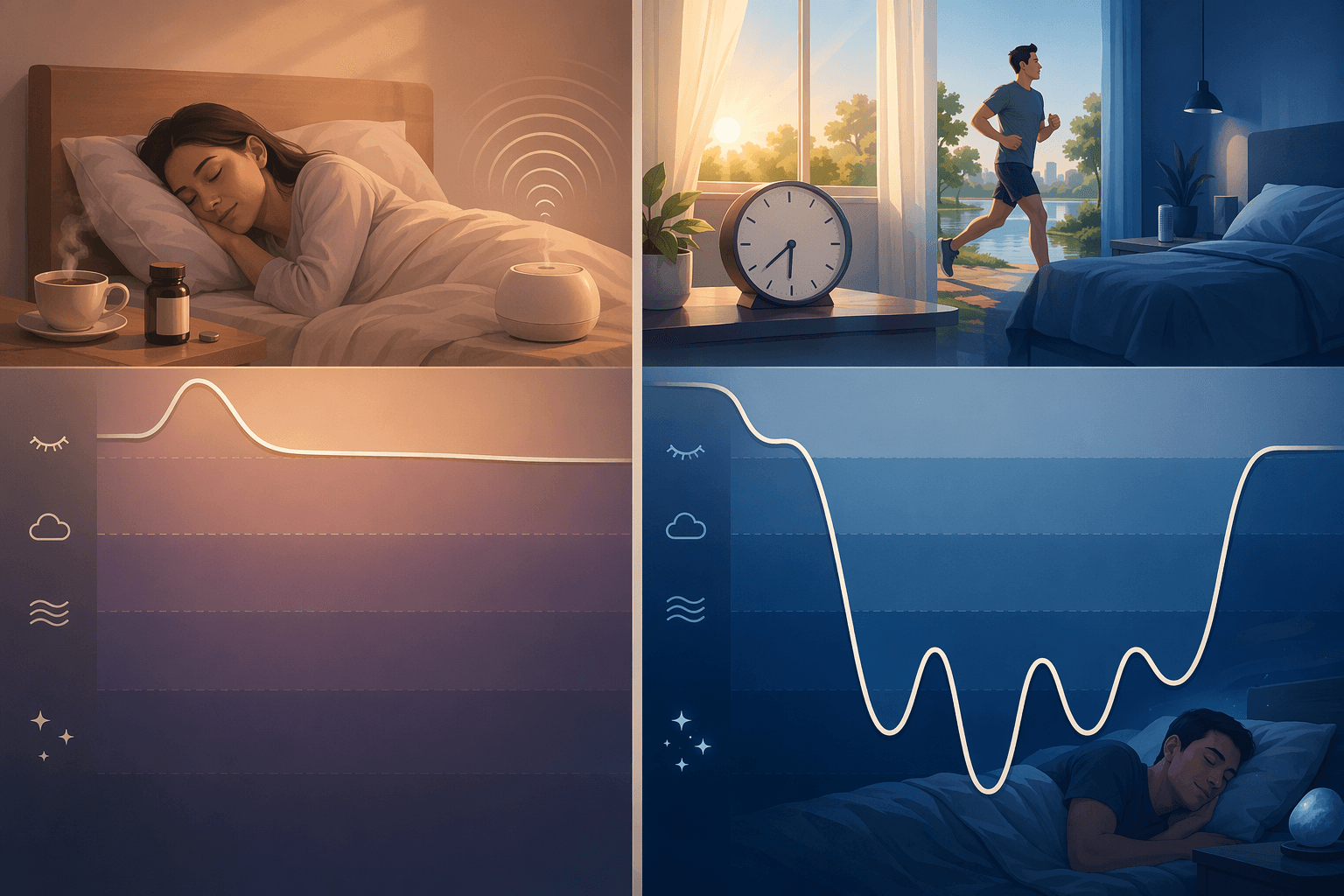
Once the biology is clear, the supplement shelf becomes easier to read. A product can be useful and still not be a deep-sleep remedy. The question is not “does it help sleep?” but “did it measurably affect slow-wave sleep, delta activity, N3 sleep, or sleep architecture?”
Melatonin: timing tool, not a deep-sleep percentage tool
Melatonin has a legitimate role, especially when the problem is circadian timing or sleep onset. It is often discussed for helping people fall asleep or shift sleep timing, but it does not appear to increase deep sleep percentage in most adults.[2][3] That matters for the person whose bedtime is fine but whose app says deep sleep is low. Taking melatonin for that specific target is a category mistake unless a clinician has identified a timing problem it can actually address.
White noise, pink noise, and comfort aids
Noise can be useful when the sleep problem is environmental disturbance: a partner, traffic, neighbors, a pet, or a house that clicks and hums at the wrong times. White noise or pink noise may help by masking interruptions or creating a more stable sound environment. That is different from showing that it reliably increases deep sleep percentage. If it prevents awakenings, it may indirectly protect the night, but the claim should stay that narrow.
Chamomile and tart cherry: pleasant does not mean N3-specific
Chamomile is a good example of how a modest finding can get stretched. A systematic review of medicinal plants for insomnia found chamomile had modest benefits for daytime function and sleep latency in some contexts, while effects on sleep architecture were inconsistent.[6] In plain terms: chamomile tea may be a reasonable wind-down ritual, but calling it a proven way to increase deep sleep goes beyond the measurement.
Tart cherry juice has a similar problem in deep-sleep conversations. It is usually discussed around melatonin content, sleep duration, or general sleep quality rather than a clear, replicated increase in slow-wave sleep. If someone enjoys it and it fits their nutrition needs, fine. But if the specific complaint is “my app shows low N3,” tart cherry juice is not where the evidence is strongest.
The conditional category: magnesium, glycine, and valerian
Some natural aids deserve more careful treatment than a yes-or-no list. Magnesium, glycine, and valerian are interesting because they have plausible pathways or some sleep findings, but the evidence often concerns insomnia symptoms, subjective sleep quality, or physiological conditions around sleep rather than a clean increase in deep sleep percentage.
Magnesium is most compelling when deficiency is part of the story
Magnesium is commonly marketed for sleep because it is involved in nervous system function and muscle relaxation. The more defensible claim is narrower: it may be more relevant when someone has low intake, deficiency risk, or a medical reason magnesium status is poor. That is not the same as saying magnesium reliably increases deep sleep in already-sufficient adults.
This distinction saves people from chasing a supplement response their body may not need. If leg cramps, dietary insufficiency, medications, or clinician-identified deficiency are in the picture, magnesium may be worth discussing with a health professional. If the only evidence is a wearable’s N3 estimate, magnesium should not jump ahead of timing, light, exercise, cooling, alcohol removal, and insomnia treatment.
Glycine has small-study intrigue, not a universal promise
Glycine is more interesting than many trendy sleep aids because small randomized trials using around 3 grams near bedtime have reported modest improvements in subjective sleep quality and hypothermic effects that could plausibly support sleep.[7] The cooling angle is biologically relevant: if glycine helps the body move toward a lower core temperature, it points in a direction that makes sense for deep sleep.
But plausibility is not proof of a meaningful deep-sleep percentage increase for most users. The studies are small, and the outcomes are not always the same thing a wearable user is trying to change. Glycine belongs in the “possibly useful, modest, and worth being precise about” category, not the “fix your deep sleep score” category.
Valerian is the most intriguing, and still mixed
Valerian earns a longer look because some trials have reported increased slow-wave, or delta, activity during NREM sleep. That is closer to the deep-sleep target than studies that only ask whether someone fell asleep faster. A systematic review on medicinal plants for insomnia reported valerian findings that included changes in slow-wave activity, while also noting that other randomized trials found no significant difference from placebo.[6]
The uncertainty did not disappear in broader over-the-counter reviews. A 2025 scoping review of randomized controlled trials on OTC insomnia products found valerian and melatonin had the strongest safety data among products reviewed, but the findings still do not justify treating valerian as a guaranteed deep-sleep intervention.[8] It is a candidate with mixed evidence, not a winner.
That is probably the right emotional temperature for valerian: curious, not credulous. It may be worth discussing with a clinician or pharmacist, especially for interactions, sedation, pregnancy, liver concerns, or other medications. It should not be stacked casually with alcohol or other sedatives because a sleep score looked disappointing.
How to use your tracker without letting it run the night
The best use of a wearable is pattern detection, not verdict delivery. If deep sleep looks low, compare similar nights: alcohol versus no alcohol, late workout versus earlier workout, warm room versus cool room, irregular bedtime versus stable timing. Try to change one major variable at a time for long enough to see a pattern. Otherwise, the graph becomes a pile of guesses.
Also watch outcomes the device does not own: daytime sleepiness, mood, concentration, blood pressure discussions with your clinician, snoring, morning headaches, and whether you are lying awake for long periods. A low deep-sleep estimate with good daytime function is a different problem from a low estimate plus chronic insomnia, loud snoring, gasping, or severe fatigue. For the broader question of whether the device is actually improving behavior, see can a sleep tracking wearable actually improve your sleep.
A practical hierarchy is enough. First, make sure you are not overinterpreting one imperfect stage estimate. Then stabilize wake time and morning light. Add regular moderate exercise, finished early enough that the body can cool down. Make the bedroom cool. Remove alcohol close to bed. Build a wind-down routine that lowers arousal before you are already frustrated. Use supplements only for narrow purposes: melatonin for timing, chamomile for ritual, magnesium when status is relevant, glycine with modest expectations, valerian with caution and mixed evidence. If insomnia is chronic, or symptoms suggest a sleep disorder, CBT-I or clinical evaluation belongs ahead of another “deep sleep” product.
References
- Slow-Wave Sleep: An Overview — Sleep Foundation
- Beyond White Noise: True Methods for Enhancing Deep Sleep Stages — Ubie Doctor's Note
- Here's How To Get More Deep Sleep and REM Sleep — Cleveland Clinic
- Natural Sleep Aids: Home Remedies to Help You Sleep — Johns Hopkins Medicine
- Sleep problems and insomnia self-help guide — NHS
- Medicinal Plants for Management of Insomnia: A Systematic Review — PMC
- Natural Sleep Aids: Which Are the Most Effective? — Sleep Foundation
- Over-the-counter products for insomnia in adults: A scoping review of randomised controlled trials — Sleep Medicine, ScienceDirect, 2025
Comments
Join the discussion with an anonymous comment.