
Mechanism explainer
Why fans fail at 40°C and how to sleep without AC
At 40°C, a standard fan can stop cooling you and instead add heat to your body. Learn the sleep-thermoregulation science behind this threshold and evidence-based strategies to fall asleep without air conditioning.
If you are searching for how to sleep in a 40 degree heatwave without AC, start with the object most people reach for first: the fan. At 40°C/104°F, a standard electric fan is no longer reliably a cooling device. New Scientist reported in 2026 that UK government guidance advises turning fans off above 35°C/95°F, while World Health Organization guidance puts the caution point at 40°C/104°F; CDC pregnancy guidance uses a lower 90°F/32°C threshold for fans not being a primary cooling method, which is the clue that this is not one universal number for every body in every room. At 15% humidity and 45°C, a fan almost certainly adds heat rather than removing it. [1]
That does not mean every fan becomes dangerous the second a thermometer touches 40°C. Humidity, sweating, age, pregnancy, medications, hydration, and the actual temperature of your skin all shift the risk point. But it does mean the usual advice—point a fan at yourself and hope for the best—has crossed into a zone where it needs to justify itself.
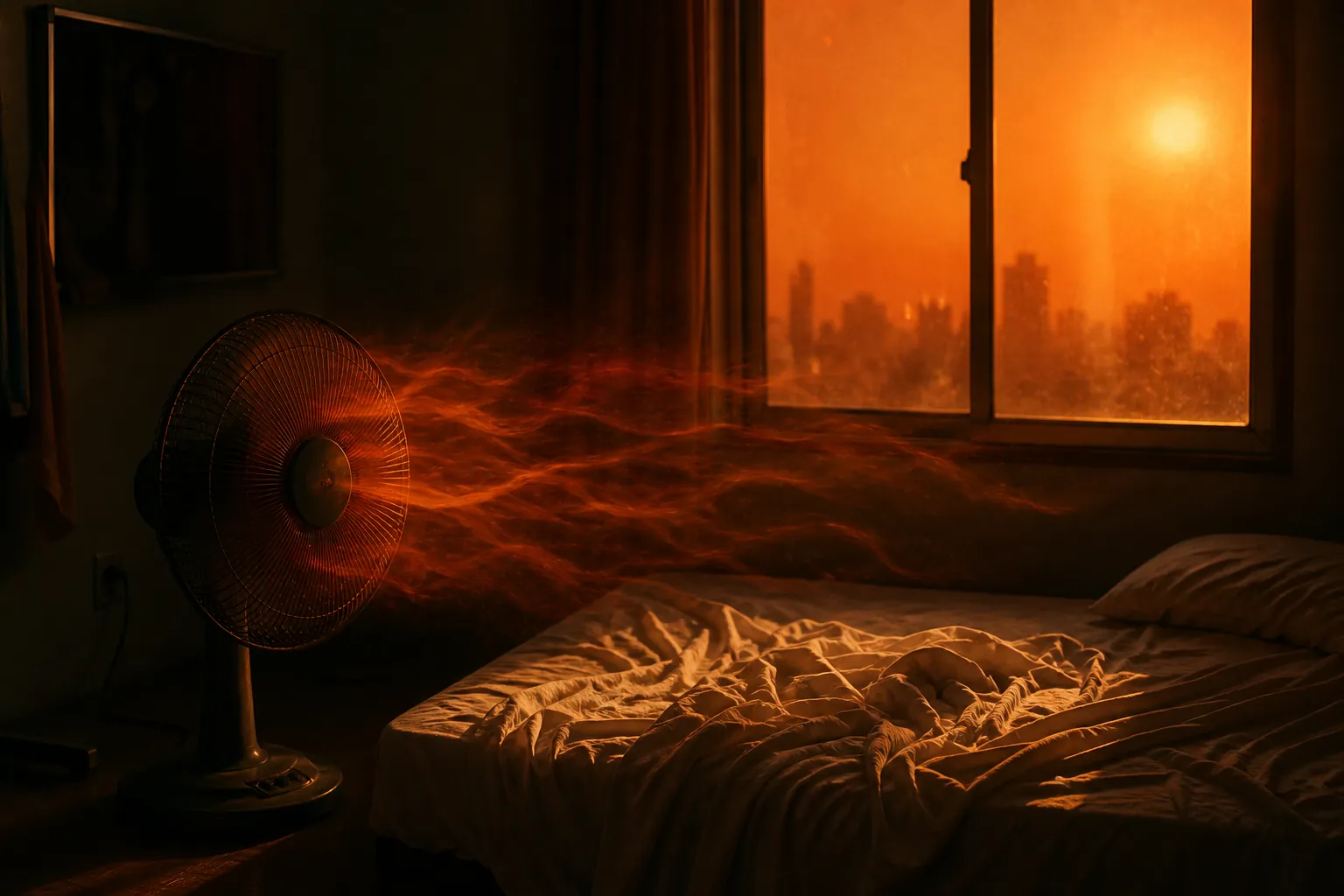
Why a fan can turn against you
A fan does not make air colder. It moves air across skin. On an ordinary warm night, that can help because moving air strips away the thin layer of warmer, humid air around you and speeds evaporation from sweat. Evaporation removes heat from the body.
At 40°C, the calculation changes. If the air moving over you is hotter than your skin, the fan can push heat toward the body by convection. Evaporation may still help if sweat can evaporate efficiently, especially in dry air, but the fan is now doing two things at once: helping water leave your skin and delivering hotter air to it. For an older person, a pregnant person, or someone whose medication reduces sweating or heat tolerance, that trade-off can stop being safe earlier.
This is why “just run a fan” is bad emergency advice. It skips the part that matters: whether the fan is helping heat leave the body or merely making a dangerous room feel less still.
Extreme heat blocks the temperature shift sleep needs
Falling asleep is not just a brain decision. It depends on heat moving out from the body’s core toward the skin and then into the environment. One well-cited benchmark is a roughly 1.5°C distal-to-proximal skin temperature gradient: the hands and feet warm relative to the trunk as blood vessels open near the surface, making it easier to lose heat and initiate sleep. In extreme heat, that gradient flattens, which can delay sleep onset. Sleep-permissive vasodilation also depends on a skin microclimate in the range of about 31–35°C; above that range, initiation of non-REM sleep is impaired. [2]
That is the useful reason hot bedrooms feel so unfair. You can be exhausted and still wide awake because the room is not allowing the body to complete the heat-loss sequence that normally precedes sleep. A thin sheet can reduce insulation. A fan can increase air movement. Neither one necessarily restores the gradient if the whole room is sitting near or above body-surface temperature.
The numbers also explain why some common fixes feel good for a minute and then fail. A cold blast, a frozen surface, or a fan pointed at dry skin may create a brief sensation. The better question is whether the action keeps heat moving away from the body long enough for sleep pressure to win.
Older bodies get less margin
The bedroom temperature that allows decent sleep for older adults is nowhere near 40°C. In a 2023 study of community-dwelling older adults covering 10,903 person-nights, the optimal bedroom temperature range was 20–25°C. Sleep efficiency fell by about 1% for each 1°C rise above 25°C, and the decline accelerated above 30°C. [3]
That study’s participants were relatively high-functioning and largely college-educated, so the results should not be stretched into a perfect estimate for every older household. If anything, the limitation argues for caution: people with fewer resources, more illness, less control over housing, or less ability to relocate may have less room to adapt than the study group did. For a more focused safety path, see how older adults can sleep safely during a heat dome.
For tonight, the dose-response is the point. If sleep efficiency is already measurably dropping above 25°C and worsening faster above 30°C, a 40°C room is not a “try harder” situation. It is a heat-exposure problem that happens to be occurring at bedtime.
Use mechanisms, not heatwave folklore
A bad 11 p.m. bedroom does not need a beautiful routine. It needs a way to move heat out of the room, move heat off the body, or buy a small cooler window long enough to fall asleep. Sort the options that way.
| What you are trying to do | Actions that match the mechanism | Where it can fail |
|---|---|---|
| Move hot indoor air out | Use a fan as an exhaust at a window; open another window or door where cooler air can enter | Fails if outside air is just as hot, there is no safe second opening, or the room has no cooler source to draw from |
| Increase evaporative cooling | Damp clothing, misting skin, a cool shower, or a lightly damp sheet used carefully | Fails in very humid air or when the person cannot sweat normally |
| Cool small contact points briefly | Cold socks, chilled pillowcase, cool cloths at wrists, neck, or feet | Useful for comfort and sleep onset, but not enough if core heat keeps rising |
| Reduce avoidable heat load | Avoid alcohol; reduce unnecessary electronics or cooking heat near bedtime | Does not make a 40°C room safe by itself |
Air movement: stop aiming hot air at your body
When the fan is still useful, use it to change the room, not just to blast the sleeper. If outdoor air is cooler than indoor air, or one part of the home is cooler than the bedroom, put the fan in a window blowing outward. Then open another window or door on the cooler side. The outgoing fan creates negative pressure, pulling cooler air through the other opening and pushing accumulated hot indoor air out.
The Happy Sleeper describes this exhaust-window method as more effective than pointing a fan inward, with a reported 5–10°F room-temperature reduction when the setup can draw cooler air from another opening. [4]
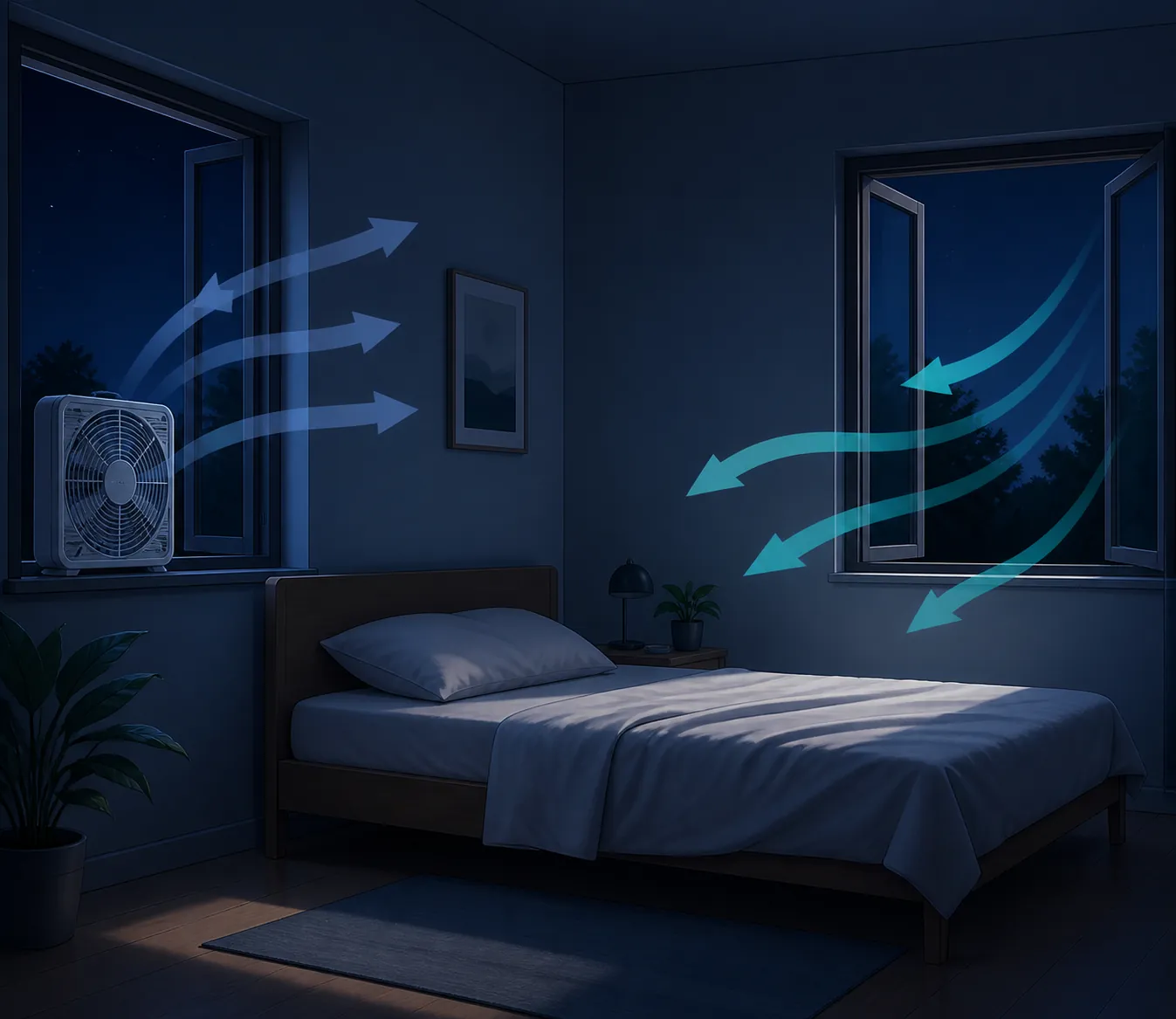
This is not the same as sleeping in front of a hot fan. Exhausting air is a room strategy. Pointing the fan at skin is a body strategy. At lower temperatures, those may overlap. Around 40°C, especially for higher-risk people, they need to be separated.
If the outside air is cooler only for a short part of the night, use that window aggressively: exhaust hot indoor air, draw cooler air across the home if you can do it safely, then close blinds or curtains again when the sun and outdoor temperature climb. If there is only one safe window, a fan blowing outward during the coolest period may still clear built-up heat better than recirculating it around the bed.
For broader myth-busting beyond the 40°C fan problem, the companion guide to heat wave sleep myths that do not work is the better continuation.
Evaporation: damp is often better than icy
If air movement alone is unreliable, evaporation becomes the practical workhorse. Damp clothing, a misting bottle, or a lightly damp cloth can help because water takes heat with it as it evaporates from the skin or fabric. The European Insomnia Network’s heatwave sleep recommendations include damp clothing for evaporative cooling, cool rather than cold showers before bed, and avoiding alcohol. [5]
The shower detail matters. A cold shower sounds decisive, but cold exposure can constrict blood vessels near the skin. That makes you feel chilled at the surface while reducing the body’s ability to dump core heat outward. A cool shower is less dramatic and more useful: it lowers skin temperature without telling the body to protect its core heat.
Afterward, do not immediately rebuild a heat trap. Wear loose, damp, breathable clothing if it feels tolerable. Mist exposed skin. Use a damp cloth at the neck, wrists, or feet. If you use a fan at all, use the lowest effective airflow and pay attention to whether it is helping evaporation or simply pushing hot air at you. In humid conditions, evaporation slows, so the same damp-shirt trick may feel clammy rather than cooling.
Avoid heavy wet bedding. A drenched towel or blanket can become insulation once it stops evaporating well. The target is a thin layer of moisture that can keep leaving the body, not a swamp wrapped around it.
Timing and small-area cooling: buy the first hour of sleep
On a 40°C night without AC, the whole room may not become comfortable. The more realistic target is to use the coolest available window to reduce heat before bed, then cool the places that strongly affect sleep onset: feet, hands, neck, face, and the pillow area.
The Red Cross UK’s night-time heatwave advice includes practical small cooling steps such as using cool socks and a cold pillowcase. [6] These are not magic. They are temporary contact cooling. Temporary can still matter if it gets you through the first part of sleep before the room warms again or before discomfort wakes you.
If you have freezer space, chill a pillowcase or cloth rather than trying to freeze the bed. Keep a barrier between skin and anything icy. If you have water but no freezer, use cool wet socks or a damp cloth and let evaporation do the work. If the outdoor temperature dips before dawn, that may be the better sleep window than the usual bedtime; pre-cool the room or your body then, rather than spending the coolest hours sealed inside a stored-heat box.
The usual bedding advice belongs in a much smaller box. Thin sheets help because they reduce insulation. Loose clothing helps if it lets sweat evaporate. Sleeping naked is not automatically better if sweat pools against a mattress and cannot evaporate. Fabric choice matters less than whether heat and moisture can leave.
Alcohol is worth removing from the night, not because this is a full sleep-hygiene lecture, but because it can worsen sleep and interfere with the body’s heat handling during a heatwave. When the room is already hostile, do not add another avoidable load.
For lighter room-cooling ideas outside a true heat emergency, the Super El Niño sleep FAQ has a broader warm-night angle. In a 40°C bedroom, keep judging every trick by heat transfer, not by how tidy it sounds.
Who should lower the threshold for leaving the room
Some people should treat 40°C fan advice as too generous. Older adults are less able to adjust to sudden temperature changes, and chronic medical conditions can increase heat risk. [7] Medications can also change heat tolerance by affecting sweating, fluid balance, alertness, or thermoregulation. [8]
Pregnancy deserves the same caution. The lower fan threshold used in CDC pregnancy guidance is not a contradiction of the 40°C discussion; it is a reminder that the same room can be more dangerous for one body than another. [1]
Hormonal thermoregulation can also make heat feel less negotiable. If hot flashes, night sweats, or perimenopause symptoms are part of the problem, the discussion of Miami heat and perimenopause sleep goes deeper into that narrower thermostat problem.
The practical rule is simple enough to use late at night: if the person in the bed cannot reliably sweat, drink, move, communicate discomfort, or relocate without help, do not wait for the bedroom experiment to prove itself. Their margin is smaller.
When sleep is no longer the right goal
There is a point where the task stops being “how do I fall asleep?” and becomes “how do I reduce heat exposure?” If the room is still near 40°C, if the fan is only moving hot air, if damp cooling is not working, or if a higher-risk person is getting weaker, more confused, dizzy, or unable to cool down, bedtime troubleshooting has run out of road.
Move to the coolest safe part of the building. Use an exhaust fan setup only if it is actually drawing in cooler air. If the home cannot be cooled, leave for a cooling center, a cooled public building, a neighbor or family member’s home with AC, or another locally available safe place. For severe symptoms or a person who cannot be safely moved without help, seek medical help rather than continuing to adjust bedding and fans.
A 40°C bedroom is not a character test. If heat cannot leave the room and heat cannot leave the body, the correct intervention is distance from the heat.
References
- You should turn off fans when it's too hot — but how hot is too hot? — New Scientist, 2026.
- The Temperature Dependence of Sleep — Frontiers in Neuroscience, 2019.
- Nighttime Ambient Temperature and Sleep in Community-Dwelling Older Adults — Science of the Total Environment, 2023.
- How To Cool a Room With No Air Conditioning! — The Happy Sleeper.
- How to deal with sleep problems during heatwaves: practical recommendations — European Sleep Research Society.
- Keep cool at night during a heatwave — British Red Cross.
- Heat and Older Adults — Centers for Disease Control and Prevention.
- Heat and Medications – Guidance for Clinicians — Centers for Disease Control and Prevention.
Supports these guides
Spot an error or have clinical feedback?
Because this article covers clinical, medication, or safety information, we use a moderated correction channel instead of open public comments. Let us know if something about “Why fans fail at 40°C and how to sleep without AC” needs a closer look.
Send feedback on this article