
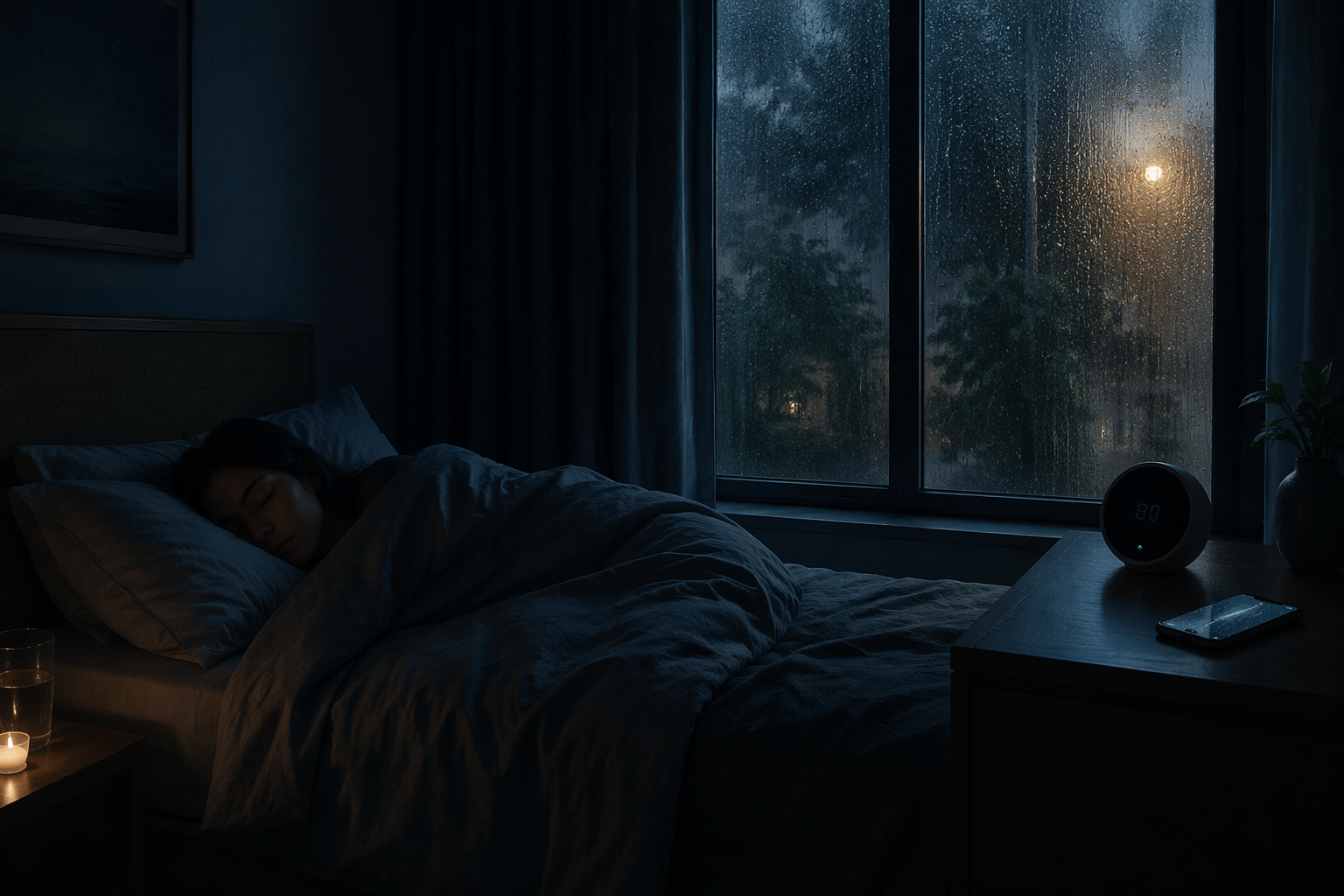
Heavy rain can make sleep feel unmistakably better at first. The room darkens. Outdoor traffic softens behind a sheet of sound. The air may cool enough that the bed finally stops feeling warm. Then morning arrives, and the story is less tidy: your tracker shows poor REM, your nose feels stuffy, or you remember waking at 3 a.m. to a room that felt damp instead of cozy.
That contradiction is the real question behind heavy rain and sleep quality. Rain is not one sleep variable. It changes sound, light, temperature, humidity, and sometimes pressure at the same time. Some of those changes help you fall asleep. Some can work against sleep continuity or sleep architecture. The useful question is not whether rain is “good” or “bad” for sleep, but which part of the storm is helping you and which part may be costing you recovery.
| Rain-related channel | How it may help | How it may interfere |
|---|---|---|
| Sound | Masks sudden noises and may feel calming | Continuous broadband noise may reduce REM sleep |
| Light | Cloud cover and darker evenings can support melatonin timing | Relying on storms for darkness leaves the room inconsistent |
| Temperature | Rain often cools the sleep environment | Too much cooling can wake some sleepers |
| Humidity | Mild moisture may feel comfortable to some people | High indoor humidity can feel clammy and may increase wakefulness |
| Barometric pressure | May be noticeable for pressure-sensitive people | Evidence is less direct and it is harder to control indoors |
The Rain-Sound Problem: Calming Is Not the Same as Restorative
Rain sounds can be genuinely soothing. They are steady enough to cover small disruptions: a passing car, a hallway door, a neighbor’s television. That masking effect matters because sleep is easily disturbed by sounds that are irregular, meaningful, or sudden. A stable sound bed can make the room feel less vigilant.
There is also a plausible nervous-system explanation for why rain feels relaxing. A 2017 Brighton & Sussex Medical School fMRI study reported that natural sounds were associated with a shift toward parasympathetic, “rest-and-digest” activity and more outward-focused attention, along with lower physiological stress markers.[1] That finding fits the lived experience: rain can make the body feel less braced.
The mistake is turning that calming response into a blanket claim about better sleep quality. Sleep onset, perceived calm, deep sleep, REM sleep, and next-morning alertness are related, but they are not the same outcome. A sound that helps you drift off can still alter what happens later in the night.
That distinction became harder to ignore after a 2026 Penn Medicine controlled lab study. In 25 healthy adults aged 21 to 41 who slept in the lab for 7 nights, continuous broadband noise at about 50 dB, a level compared with moderate rainfall, reduced REM sleep by approximately 19 minutes per night.[2] The sample was small, the setting was artificial, and the result should not be treated as a universal rule for every bedroom. Still, it directly challenges the casual advice that all-night rain audio is harmless because it sounds natural.
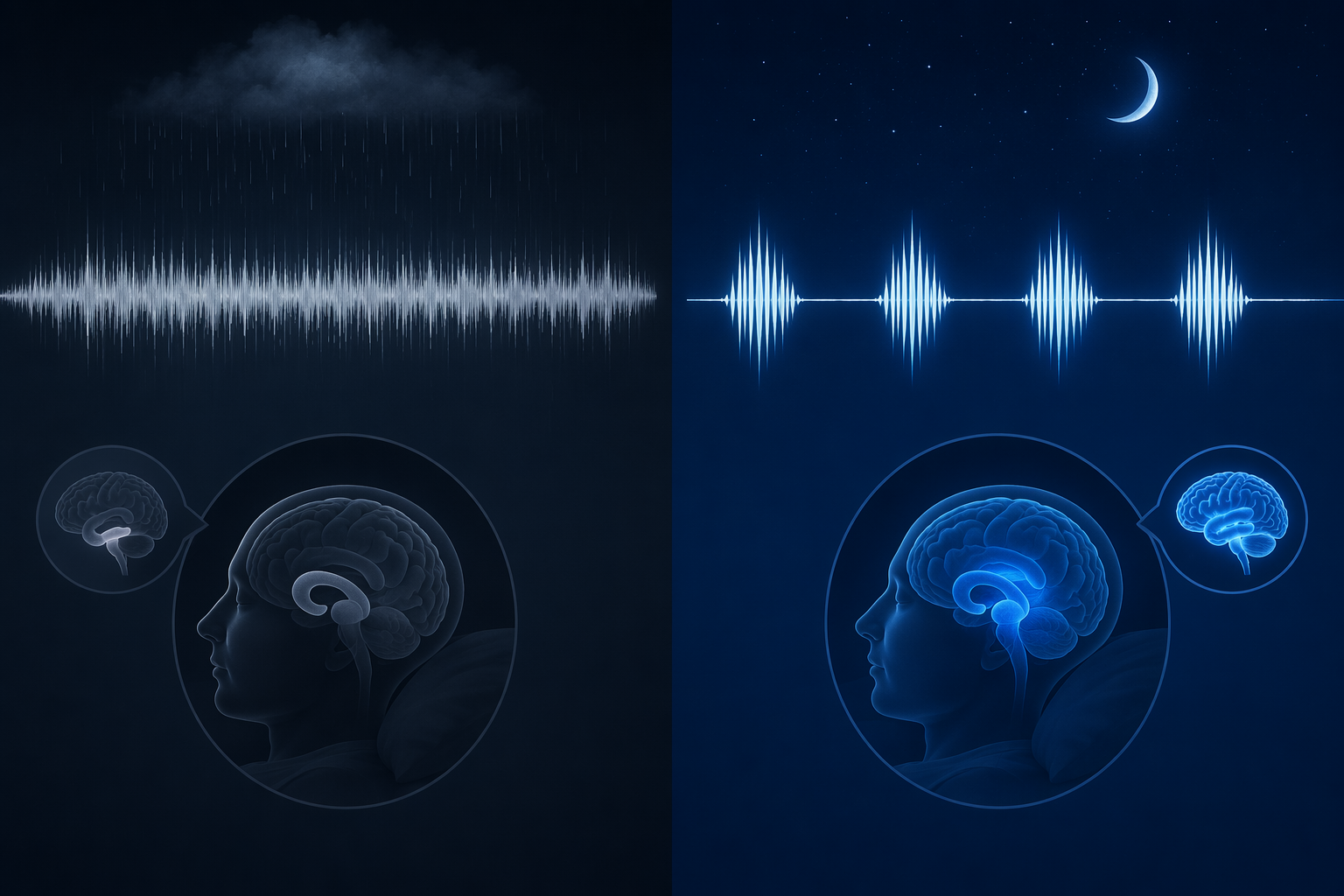
REM is not just a decorative sleep stage. It is one reason a rainy night can feel confusing: you may fall asleep quickly, spend the first part of the night feeling deeply settled, and still wake feeling mentally flat if later sleep was less consolidated. The Penn result does not prove that every real storm reduces REM. It does suggest that steady broadband sound, especially when played continuously through a speaker or phone app, deserves more caution than most cozy-rain advice gives it.
Why Timed Pink Noise Research Does Not Justify All-Night Rain Audio
A lot of rain-sound advice borrows credibility from pink-noise studies, but the most cited benefits do not come from simply playing a rain track until morning. In a 2017 Northwestern study of older adults, pink-noise pulses were precisely timed to slow brain-wave oscillations during deep sleep; the intervention was not continuous background sound.[3] That timing is the point, not a technical footnote.
Rain sounds, nature sounds, pink noise, white noise, and broadband noise overlap in casual language, but they are not interchangeable in sleep research. A timed acoustic pulse during deep sleep is a different exposure from a phone app playing synthetic rainfall beside the bed for eight hours. One is trying to reinforce a sleep-stage rhythm. The other is changing the acoustic environment all night.
This does not mean rain audio is useless. It means the most defensible use is narrower: use it when it solves a real sound problem, keep it low, and avoid assuming that more hours equals more benefit. If the rain track masks a barking dog or street noise while you fall asleep, a sleep timer may preserve the advantage without turning the sound itself into the overnight exposure.
The Stronger Rain Benefit May Be Cooler Air
The most reliable reason heavy rain often helps sleep may have less to do with the romance of rainfall and more to do with temperature. Sleep tends to be easier when the body can shed heat. Rain frequently arrives with cooler air, and that can move a bedroom closer to the commonly recommended sleep range of about 60 to 67°F.[4]
Large weather-and-sleep datasets point in the same direction: nighttime temperature is one of the more powerful environmental predictors of sleep disruption. In a 2017 Science Advances analysis, a 1°C deviation from average monthly nighttime temperature was associated with about 3 additional nights of insufficient sleep per 100 people.[5] That kind of study cannot tell you what happened in your bedroom on one stormy Tuesday, but it does show why rainy-night cooling can matter at population scale.
The practical move is simple: let rain help the room cool when it actually does. If the outdoor air is cool and safe to use, ventilation before bed may help. If opening a window brings in dampness, pollen, noise, or security concerns, the same goal can come from HVAC settings, lighter bedding, or a fan that moves air without chilling the sleeper. The target is not a heroic cold room; it is a stable room that lets the body downshift.
Rain Also Darkens the Sleep Space
Heavy rain often brings darker skies before bedtime and less sharp morning light through the window. That can help people who struggle with a too-bright bedroom, especially in summer evenings or urban rooms with reflective surfaces outside. Darkness is one of rain’s quieter advantages: it reduces the work your room has to do.
But storm darkness is unreliable design. A room that only becomes sleep-friendly when clouds arrive will be inconsistent the rest of the week. Blackout curtains, dim evening lighting, and covering small LEDs do not need the weather to cooperate. They reproduce one of rain’s benefits without importing the whole storm.
Humidity Is Where a Cozy Night Can Turn Clammy
The same storm that cools and darkens the room can push moisture in the wrong direction. Indoor humidity is commonly recommended around 30% to 50% for sleep comfort, while levels above 60% are more likely to feel damp and have been linked with more wakefulness and reduced slow-wave sleep.[6] That is the bedroom trade-off many rain-loving articles leave out.
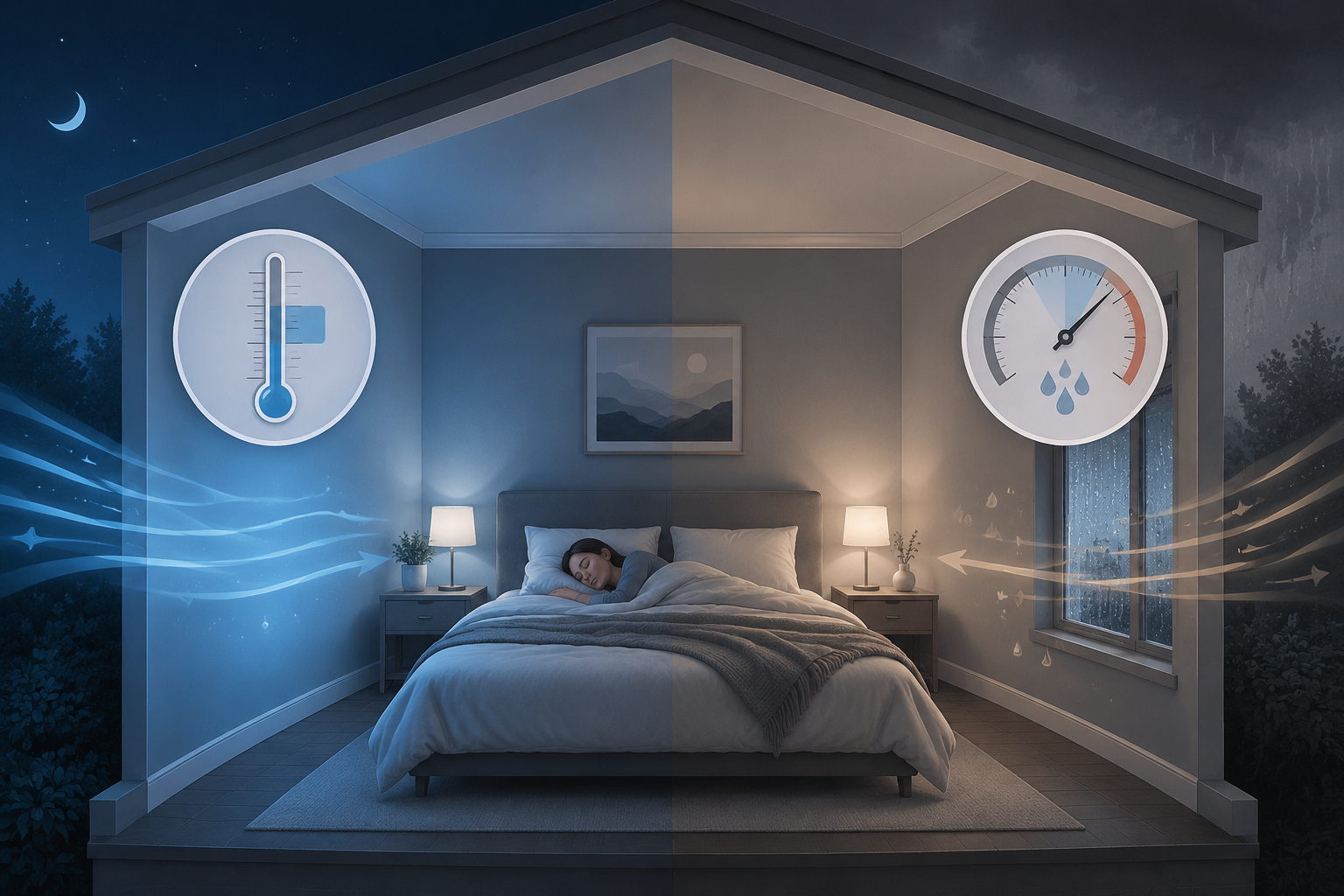
Humidity changes the feel of bedding and breathing. Sheets may feel slightly damp. A room can feel warmer than the thermostat suggests because sweat evaporates less efficiently. Some sleepers notice congestion or a heavier feeling in the air. None of that requires dramatic flooding or visible condensation; the room only has to drift far enough from comfortable.
A small hygrometer is more useful here than guessing. If rainy nights reliably leave you clammy, the answer is not necessarily to make the room colder. It may be to close windows during the wettest part of the storm, run air conditioning or a dehumidifier if available, use breathable bedding, or move laundry and other moisture sources out of the bedroom. Cooling helps until dampness starts carrying the night.
Pressure and Negative Ions Deserve a Smaller Role
Some people feel weather changes in their bodies: headaches, sinus pressure, joint discomfort, or a vague heaviness before a storm. Barometric pressure may be part of that experience for some sleepers, but it is not the most actionable part of the rain-and-sleep picture. You can adjust sound, light, temperature, and humidity tonight. You cannot tune the local pressure system.
Negative ions also come up in rain-and-mood discussions, but the evidence is too preliminary to make them central to sleep advice. If rain feels fresh or emotionally settling, that comfort is real as an experience. It just should not crowd out the variables that are easier to measure and adjust.
How to Keep the Benefit Without Importing the Downside
On the next heavy-rain night, treat the bedroom as a system instead of asking the sound alone to do all the work. The goal is to keep the channels that support sleep onset and continuity while reducing the ones that interfere later.
- Use rain sound for masking, not as proof of better sleep. If real or recorded rain helps you fall asleep, keep it low and consider a timer rather than all-night playback.
- Do not treat continuous rain audio as the same thing as timed pink-noise research. The better-known pink-noise benefits used pulses synchronized to deep sleep, not uninterrupted sound.
- Let the room cool when rain brings the temperature into a comfortable range, but avoid overcooling if you wake chilled or tense.
- Measure humidity if rainy nights leave you stuffy, sweaty, or clammy. A hygrometer can tell you whether the room is drifting into a damp range.
- Make darkness independent of weather. Curtains, dim lights, and covered electronics reproduce one rain benefit on clear nights too.
The most useful personal test is not whether you like rain. Many people do. The better test is what kind of rainy night you are having. If you fall asleep faster and wake refreshed, the cooling, darkness, and masking may be working in your favor. If you fall asleep easily but wake unrested, congested, clammy, or mentally dull, the sound duration, humidity, or disrupted REM may be part of the cost.
Heavy rain can be sleep-friendly, especially when it cools and darkens the bedroom and softens unpredictable noise. It is not automatically restorative. The same storm can raise humidity, keep the room acoustically busy, and reshape sleep in ways you only notice the next morning. The next rainy night, notice which channel is doing the work: the cooler air, the darker room, the masking sound, the damp bedding, or the app still playing long after the weather has moved on.
References
- Nature sounds alter brain activity and physiological stress response, Brighton & Sussex Medical School, 2017, link
- Pink Noise Reduces REM Sleep and May Harm Sleep Quality, Penn Medicine, 2026, link
- Pink noise synced to brain waves deepens sleep and boosts memory in older adults, Northwestern University, 2017, link
- The Best Temperature for Sleep, Sleep Foundation, link
- Nighttime temperature and human sleep loss in a changing climate, Science Advances, 2017, link
- The Best Humidity for Sleep, Sleep Foundation, link

Comments
Join the discussion with an anonymous comment.