
The Core Question: How Accurate Is the Sleep Number Smart Bed for Sleep Tracking?
The Sleep Number smart bed is a significant investment, and for many buyers, the built-in SleepIQ tracking technology is a primary reason for the purchase. The promise is compelling: a bed that learns your sleep patterns, adjusts firmness automatically, and provides a daily SleepIQ score without wearing a ring, watch, or band. But how much of that data can you actually trust?
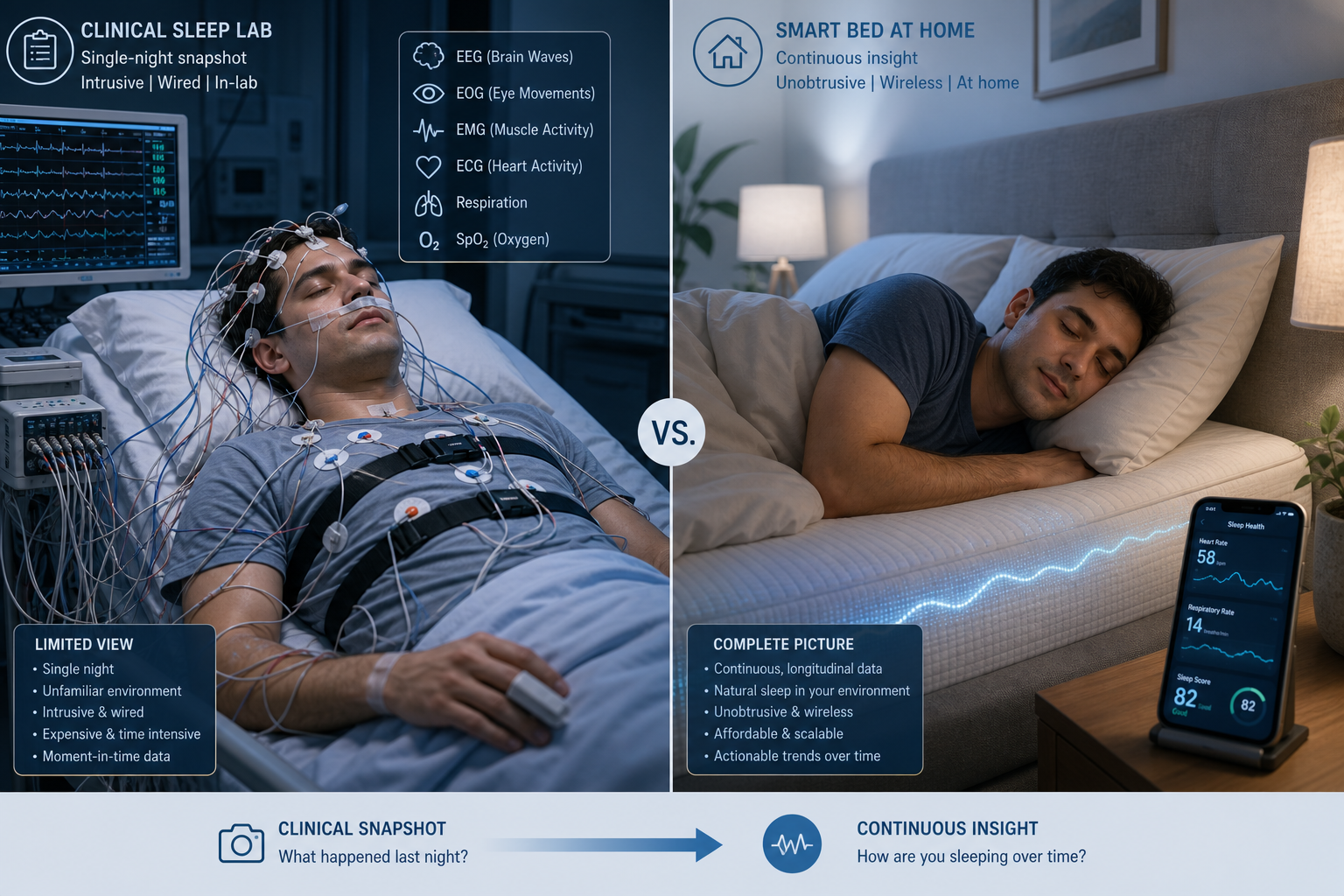
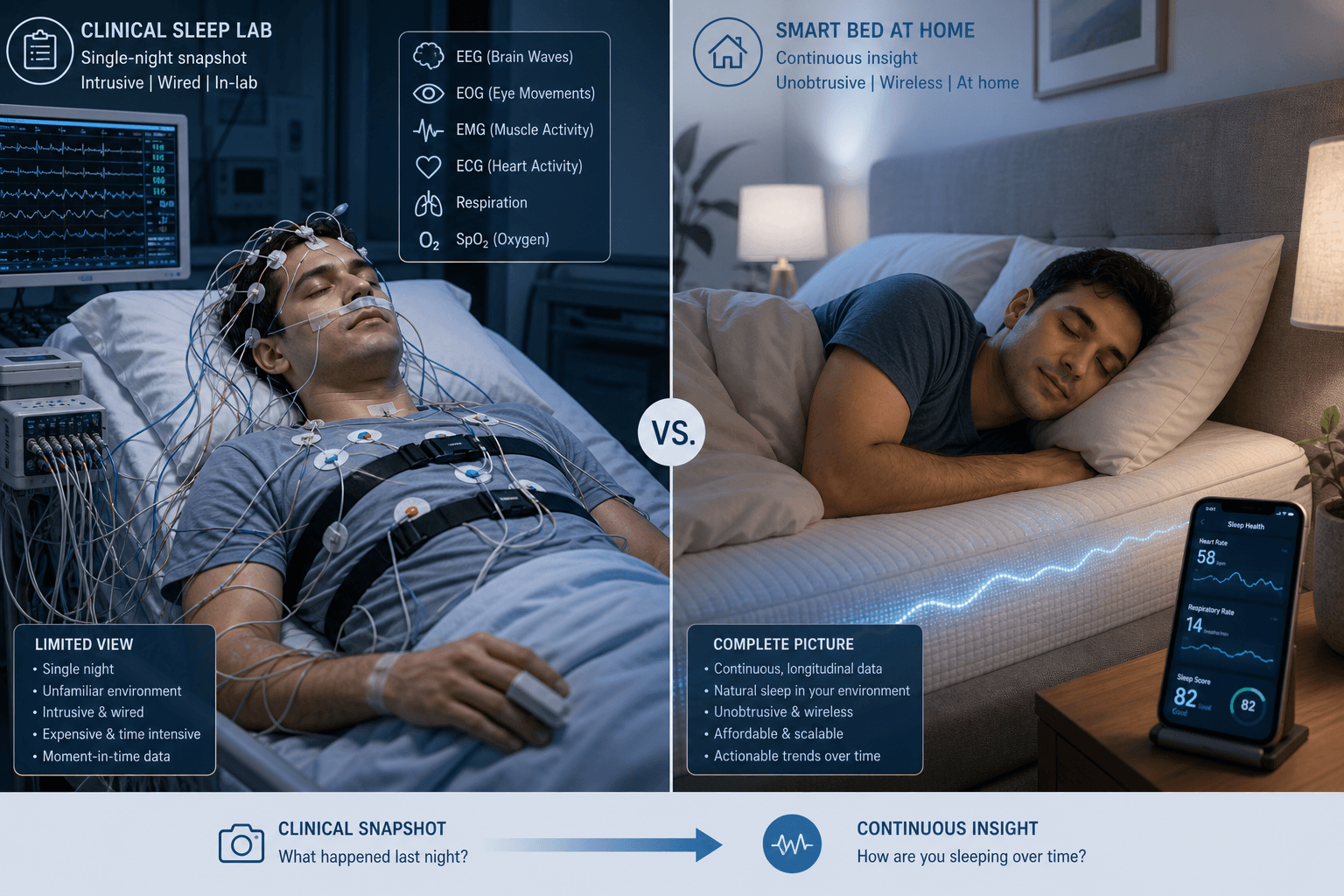
This article cuts through the marketing to examine the peer-reviewed science behind the Sleep Number bed's tracking accuracy. The central finding is a study published in Sensors (2022) that validated the bed's technology against polysomnography (PSG), the clinical gold standard for sleep measurement. The results show strong performance for heart rate and breathing rate but reveal meaningful limitations in wake detection and demographic biases that every user should understand.
The bottom line: the Sleep Number bed is a capable longitudinal trend-tracker, not a diagnostic device. Knowing the difference is essential for interpreting your SleepIQ score correctly.
The Validation Study: What the Peer-Reviewed Research Found
The most rigorous evaluation of Sleep Number's tracking technology comes from a 2022 study published in Sensors, a peer-reviewed journal. Researchers compared the Sleep Number smart bed against full in-lab PSG in 45 participants aged 22 to 64, with 55% of the group being women. Each participant spent a single night in a sleep lab while the bed and the PSG system recorded data simultaneously.
The study reported two levels of correlation for heart rate and breathing rate: epoch-by-epoch (matching every 30-second window) and overnight mean (the average across the entire night). The results are summarized below.
| Metric | Epoch-by-Epoch Correlation (r) | Overnight Mean Correlation (r) | Bias |
|---|---|---|---|
| Heart Rate | 0.81 | 0.94 | −0.15 beats/min |
| Breathing Rate | 0.71 | 0.96 | 0.09 breaths/min |
The overnight mean correlations of r=0.94 for heart rate and r=0.96 for breathing rate are strong, indicating that the bed reliably tracks your average cardiorespiratory state across a full night. The bias is negligible — less than one beat per minute and less than one breath per minute off from the PSG reference.
For sleep/wake detection, the study reported the following performance against PSG:
| Metric | Value |
|---|---|
| Sensitivity (correctly detecting sleep) | 0.94 |
| Specificity (correctly detecting wake) | 0.48 |
| Overall Accuracy | 0.86 |
| Area Under the Curve (AUC) | 0.86 |
| Adjusted Kappa | 0.74 |
The study also found that the bed's sleep/wake detection performance was comparable to ActiGraph wrist actigraphy, a research-grade wearable used in sleep studies. The adjusted kappa for the smart bed was 0.45, while actigraphy devices typically range from 0.42 to 0.49. This places the bed's sleep/wake detection in the same ballpark as a validated research tool — but actigraphy itself is known to overestimate sleep time compared to PSG.
How SleepIQ Works: Ballistocardiography and Deep Neural Networks
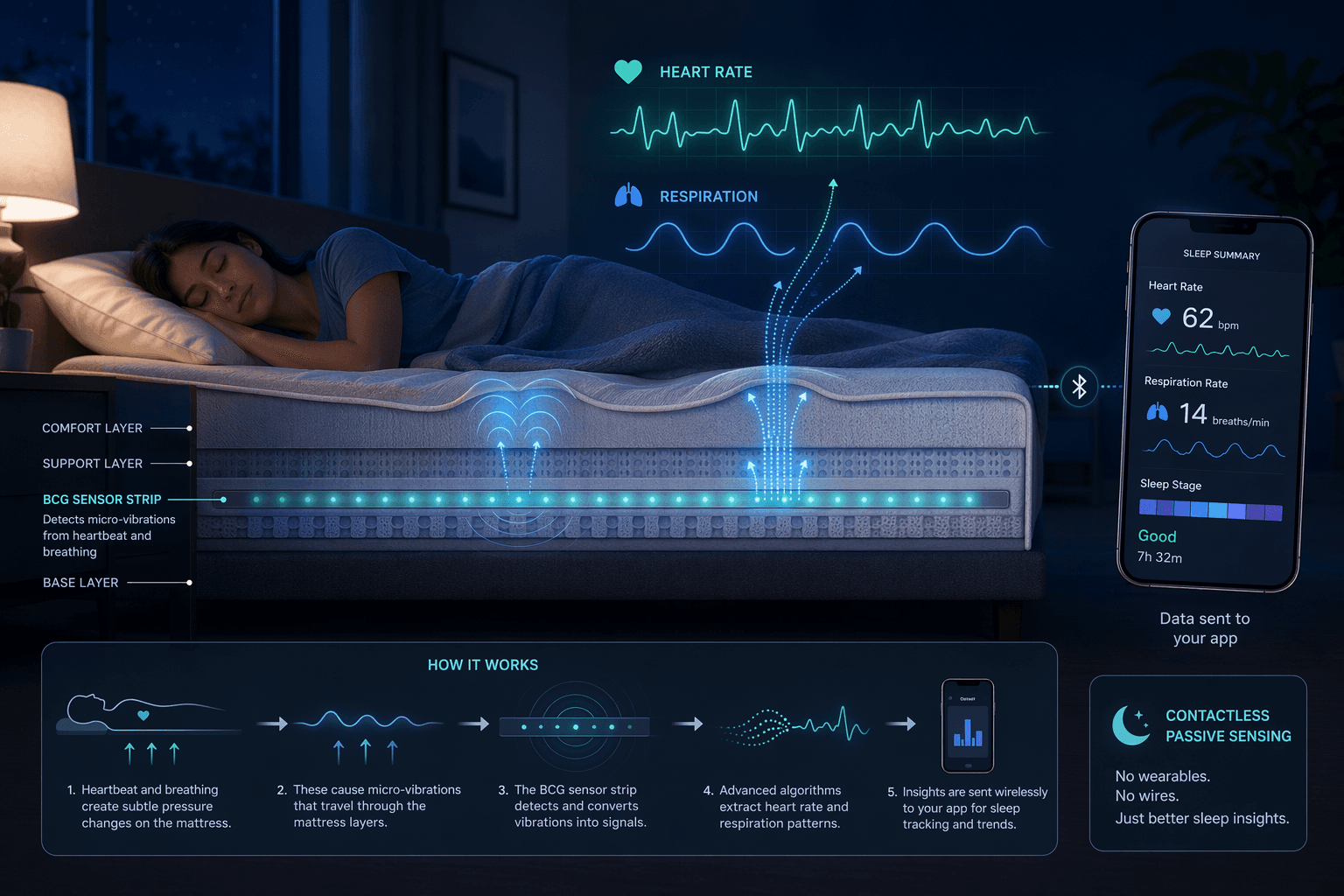
Unlike wearable trackers that use photoplethysmography (PPG) to measure blood flow through the skin, the Sleep Number bed uses a technology called ballistocardiography (BCG). A sensor strip embedded in the mattress detects the micro-vibrations produced by your heartbeat and breathing as they travel through your body and into the bed. The sensor samples these vibrations at 1,000 times per second.
The raw BCG signal is then processed by a deep neural network — a type of artificial intelligence — that was trained on over 1,000 hours of PSG data. The network learns to distinguish the subtle patterns of heartbeat and breathing from the background noise of body movements, mattress creaks, and environmental vibrations.
A critical distinction: the Sleep Number bed does not measure sleep stages (light, deep, REM) in the way that an EEG-based PSG system does. It estimates sleep/wake state indirectly by analyzing cardiorespiratory patterns. When your heart rate and breathing rate are stable and regular, the algorithm classifies you as asleep. When they become variable or elevated, it classifies you as awake. This is why the bed struggles with wake detection — lying still while awake produces a cardiorespiratory pattern that looks very similar to sleep.
Known Limitations: Where the Data Falls Short
The validation study and real-world testing have identified several important limitations that affect how you should interpret your SleepIQ data.
Poor Wake Detection (Specificity 0.48)
This is the most significant limitation. The bed correctly identifies sleep 94% of the time (sensitivity), but it correctly identifies wakefulness only 48% of the time (specificity). In practical terms, this means the bed will frequently overestimate your total sleep time by counting periods of quiet wakefulness as sleep. A 30-night CNET test confirmed this behavior, noting that the bed can mistakenly record time spent watching TV or reading in bed as sleep.
Accuracy Degradation with Higher BMI and in Women
The validation study found statistically significant associations between lower heart rate concordance and both higher BMI (p=0.0436) and female sex (p=0.0471). The BCG signal is a mechanical measurement — it relies on vibrations traveling through the body and into the mattress. Body composition and anatomy affect how those vibrations propagate, which can reduce the signal-to-noise ratio for certain individuals.
No Sleep Stage Differentiation
The Sleep Number bed does not report time spent in light sleep, deep sleep, or REM sleep. It only estimates sleep/wake state. If you are interested in sleep architecture — how much deep sleep you get, how long your REM cycles are — you will need a wearable device like the Oura Ring or Apple Watch, which use accelerometry and heart rate variability to estimate sleep stages.
HRV Values Are Not Interchangeable with Wearables
The CNET 30-night comparison revealed a critical difference in how heart rate variability (HRV) is calculated. The Sleep Number bed reports HRV using the SDNN method (standard deviation of normal-to-normal intervals), while the Oura Ring uses the RMSSD method (root mean square of successive differences). In the test, Sleep Number reported an average HRV of 124, while Oura reported 64. Both numbers may be internally consistent, but they are not comparable. If you switch between devices, you cannot directly compare HRV values.
How Sleep Number Compares to Wearable Sleep Trackers
For readers evaluating whether to rely on a smart bed versus a wearable, the comparison depends on which metrics matter most to you.
| Feature | Sleep Number Smart Bed | Oura Ring | Apple Watch | Fitbit |
|---|---|---|---|---|
| Heart Rate (overnight mean) | r=0.94 vs. PSG | r=0.90+ vs. PSG (varies by study) | r=0.90+ vs. PSG (varies by study) | r=0.85+ vs. PSG (varies by study) |
| Breathing Rate | r=0.96 vs. PSG | Reported, less validated | Reported, less validated | Reported, less validated |
| Sleep Stages | No | Yes (light, deep, REM) | Yes (light, deep, REM) | Yes (light, deep, REM) |
| Wake Detection (Specificity) | 0.48 | ~0.60-0.70 (varies) | ~0.60-0.70 (varies) | ~0.50-0.60 (varies) |
| Form Factor | Contactless (bed) | Finger ring | Wristwatch | Wristband |
| Requires Charging | No (plugged in) | Every 4-7 days | Daily | Every 4-7 days |
The CNET 30-night test provides a useful real-world data point. Over 30 nights, the Sleep Number bed and Oura Ring 4 reported nearly identical average total sleep time: 7 hours 36 minutes for the bed and 7 hours 35 minutes for the ring. Average resting heart rate was 53 bpm (bed) versus 52 bpm (ring), and both devices tracked average breath rate at exactly 17 breaths per minute. These results suggest that for basic longitudinal metrics, the two devices converge.
However, the bed's sleep/wake detection accuracy is comparable to ActiGraph wrist actigraphy (kappa 0.45 vs. 0.42-0.49), which is a research-grade tool but is itself known to overestimate sleep time. The bed is not more accurate than a good wearable for sleep/wake detection — it is roughly equivalent, with the same limitations.
What SleepIQ Data Is Good For — and What It Is Not
Understanding the boundaries of the Sleep Number bed's tracking capabilities is essential for using the data effectively.
Good For: Longitudinal Trend Tracking
The bed excels at tracking changes over weeks and months. If your average resting heart rate rises by 5 bpm over a month, or your breathing rate becomes more variable, those trends are likely real. The strong overnight mean correlations (r=0.94 for HR, r=0.96 for BR) mean that the bed's nightly averages are reliable enough to detect meaningful shifts in your cardiorespiratory health.
- Monitoring how your sleep responds to changes in routine, exercise, or diet.
- Observing the effect of alcohol, caffeine, or late meals on heart rate and breathing rate.
- Tracking recovery after illness or travel.
- Identifying long-term trends in total sleep time (with the caveat that wake time may be overcounted).
Not Good For: Clinical Diagnosis or Sleep Disorder Detection
The American Academy of Sleep Medicine (AASM) has stated that consumer sleep technology is "not a substitute for medical evaluation" and is generally not FDA-cleared for diagnosis. The Sleep Number bed cannot diagnose sleep apnea, insomnia, restless legs syndrome, or any other sleep disorder. Its poor wake detection (specificity 0.48) means it cannot reliably measure sleep efficiency, which is a key metric for insomnia assessment. Its lack of sleep stage data means it cannot identify the fragmented sleep architecture characteristic of many sleep disorders.
Practical Recommendations for Interpreting Your SleepIQ Score
If you already own a Sleep Number bed or are considering one for its tracking features, here is how to use the data wisely.
- Focus on trends, not single-night scores. A single night's SleepIQ score can be thrown off by a restless hour of reading in bed. Look at 7-day or 30-day averages for heart rate, breathing rate, and total sleep time.
- Be aware of the wake detection blind spot. If your SleepIQ score seems higher than your perceived sleep quality, the bed may be counting quiet wakefulness as sleep. Cross-reference with a sleep diary for a few weeks to calibrate your expectations.
- Do not compare HRV values with wearable devices. The SDNN method used by Sleep Number produces numbers that are systematically higher than the RMSSD method used by Oura and many other wearables. Stick with one device for HRV tracking.
- Consider your demographic context. If you are female or have a higher BMI, be aware that the bed's heart rate and breathing rate data may have lower concordance with your true physiological state. Use the trends cautiously.
- Use the bed for what it does best: passive, long-term monitoring. The advantage of the Sleep Number bed over wearables is that you never have to remember to charge it, put it on, or sync it. It collects data every night automatically. That consistency is valuable for spotting long-term changes.
The Sleep Number smart bed is a legitimate sleep tracking tool with published, peer-reviewed validation behind its core cardiorespiratory metrics. But it is not a magic window into your sleep health. Its strengths are longitudinal heart rate and breathing rate tracking. Its weaknesses are wake detection, demographic biases, and the absence of sleep stage data. Used within those boundaries, the SleepIQ data can be a useful addition to your sleep awareness toolkit — just do not expect it to replace a clinical evaluation.


Comments
Join the discussion with an anonymous comment.