
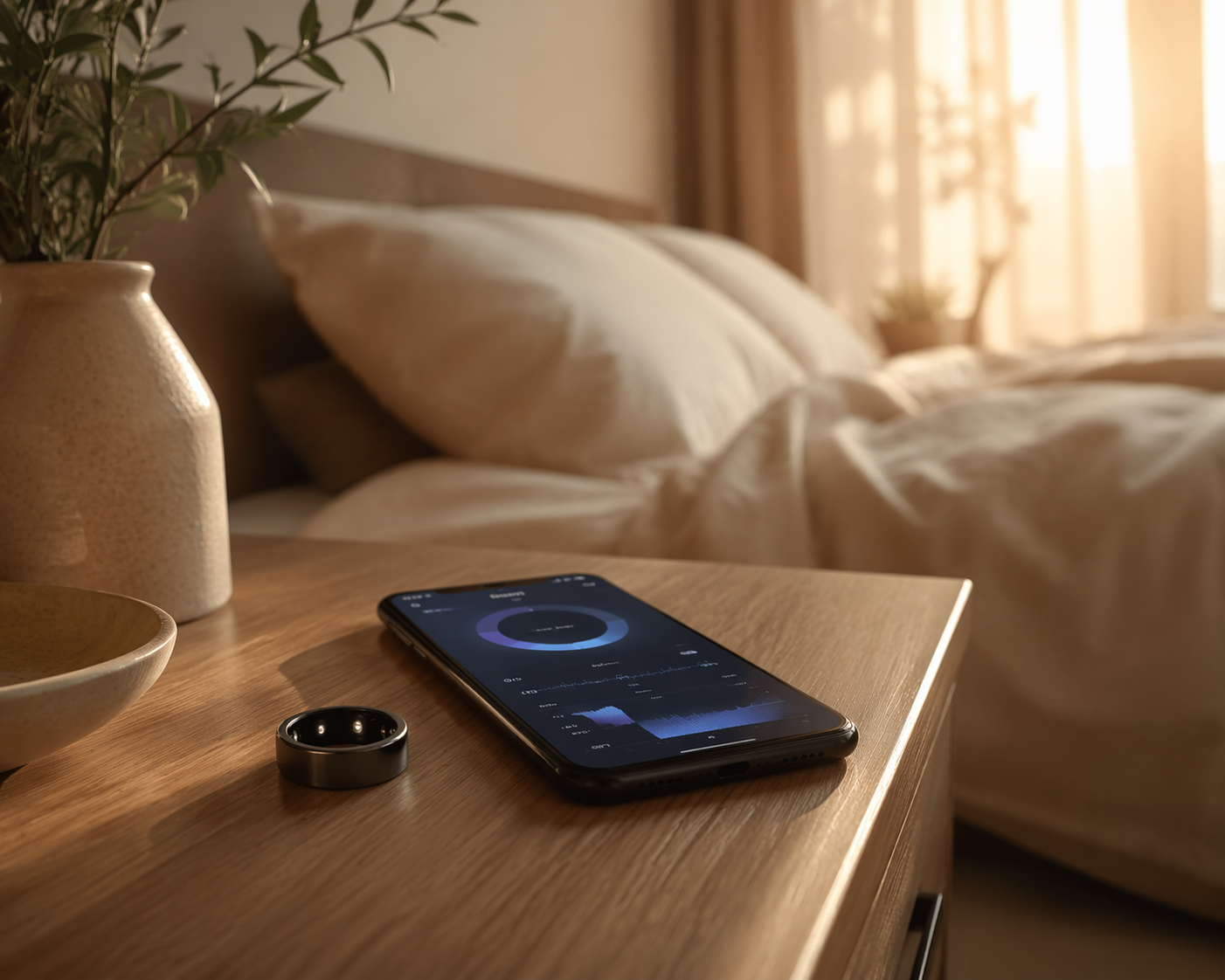
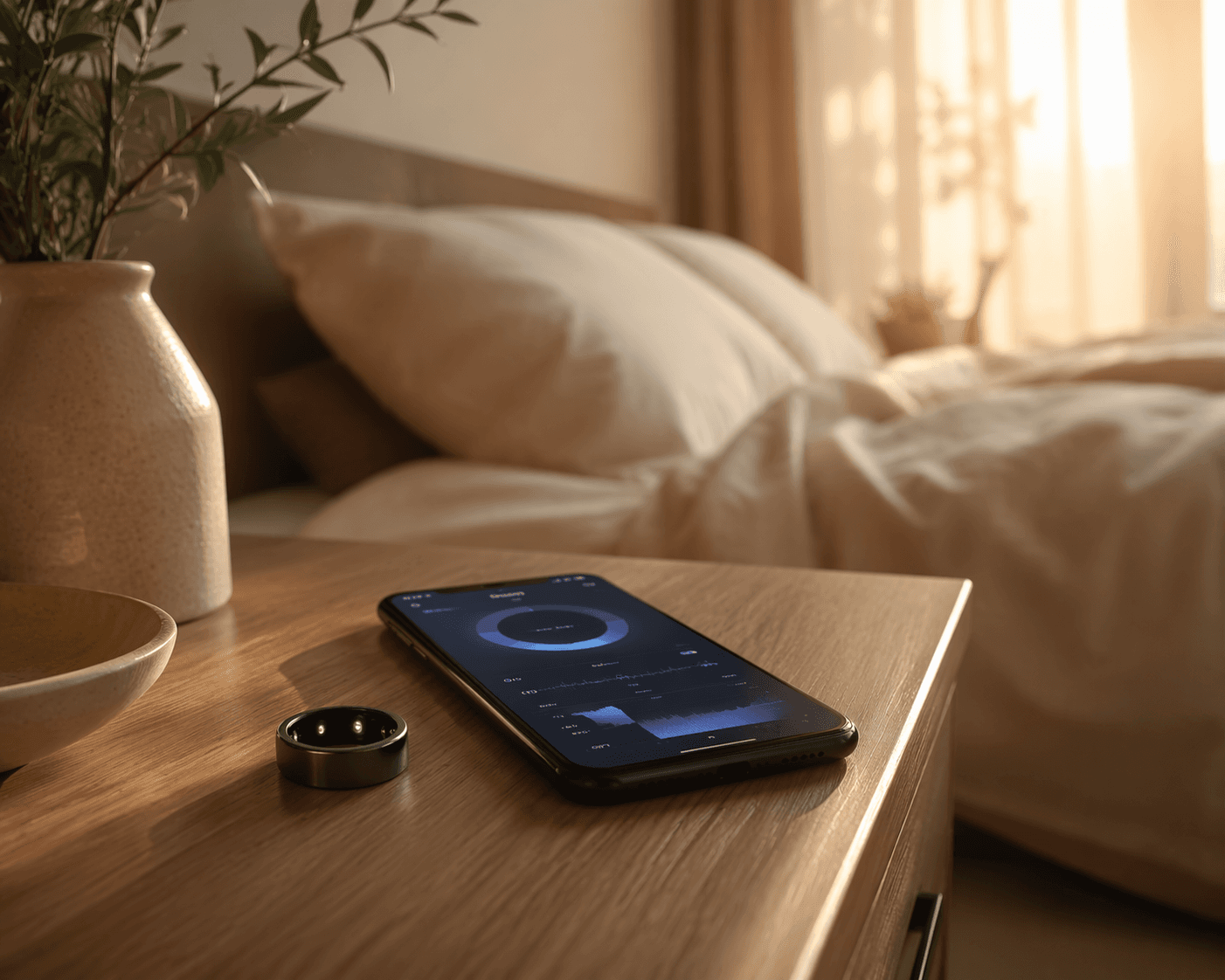
The Oura Ring sleep score is easiest to misread at the moment it seems most actionable: first thing in the morning. Oura labels 85+ as optimal, but the score is a composite trend signal rather than a nightly verdict, and a perfect 100 is meant to be rare, not a daily target [1]. The exact weighting behind the 0–100 number is proprietary, so users can inspect the parts but not independently reconstruct the recipe.
That distinction matters because a bad number can talk you out of a good night. When the score starts deciding how you feel about sleep, the pattern Baron and colleagues described in 2017 becomes easy to recognize: repeated checking, distress over imperfect metrics despite adequate sleep, and treating tracker data as the whole explanation for daytime fatigue [2].
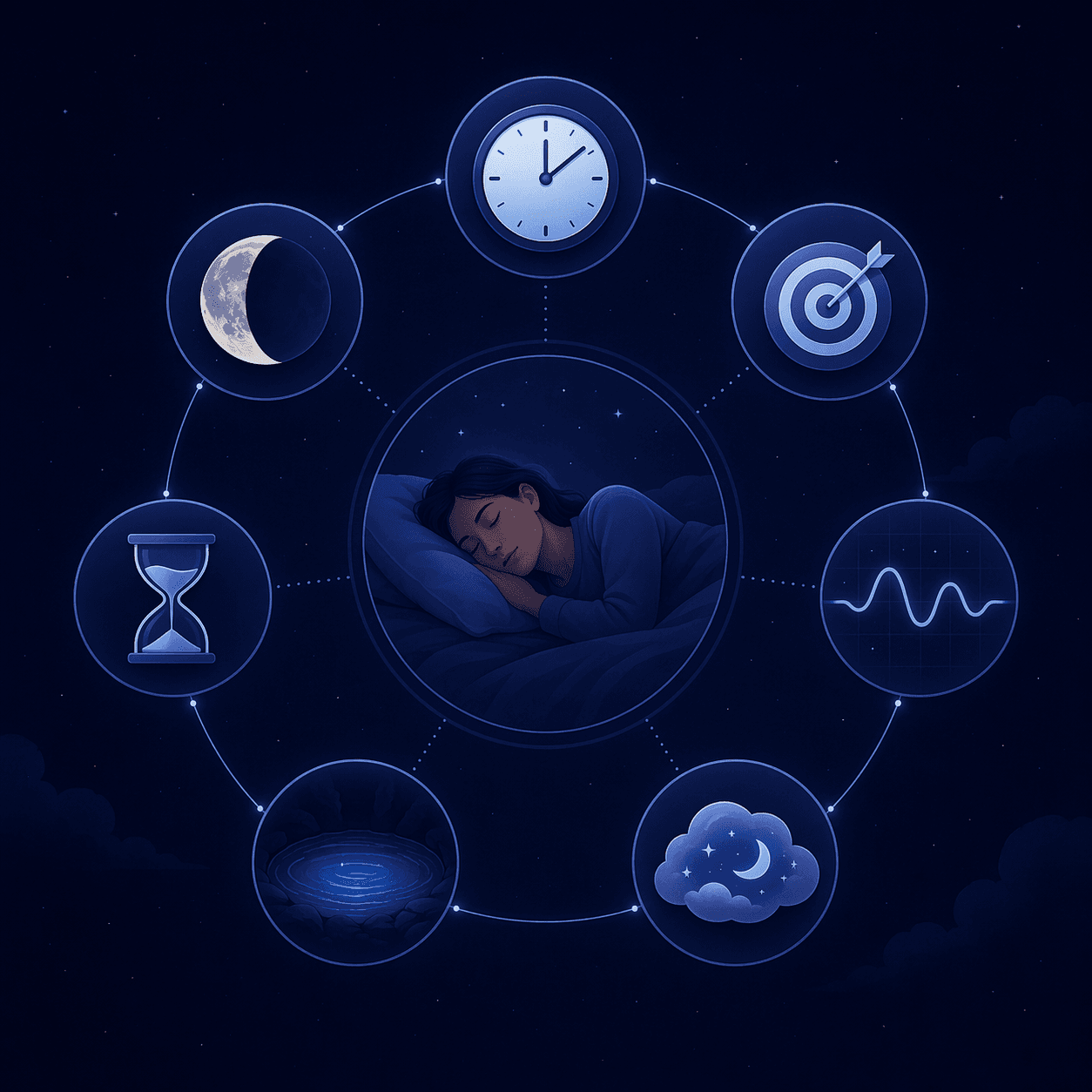
The seven contributors behind the score
The seven contributors are most useful when you treat each one as a separate question, not as seven different ways of asking whether you were a good sleeper.
| Contributor | What it is asking | Oura anchor | Common misread |
|---|---|---|---|
| Total Sleep | Did you get enough sleep? | 7–9 hours [1] | A short night is not automatically a bad one, and a long one is not automatically restorative. |
| Efficiency | How much of your time in bed was actually spent asleep? | 85% or higher is the floor for top scores, with the highest scores above 90% [1] | Quiet wakefulness can make efficiency look better than the night really felt. |
| Restfulness | How much movement or fragmentation broke up the night? | Fewer than 3 restless periods per night is optimal [1] | A still body is not always a deeply asleep body, and some movement is normal. |
| REM Sleep % | Did REM look roughly plausible? | 20–25%, or about 90+ minutes [1] | One night at the edges is a trend cue, not proof that your REM is broken. |
| Deep Sleep % | Did deep sleep look roughly plausible? | Varies by age; about 90 minutes for younger adults, about 45 minutes for older adults [1] | Older adults are not failing if their deep sleep is lower than a younger adult's. |
| Latency | How long did it take to fall asleep? | 15–20 minutes is ideal [1] | Very fast can reflect sleep debt; very slow can reflect hyperarousal. |
| Timing | Did your sleep land in a circadian-friendly window? | A midpoint between midnight and 3 a.m. scores highest [1] | A late bedtime is not automatically bad, but consistency matters more than one dramatic night. |
Latency, restfulness, efficiency, and stage percentages are where people overread
Latency is supposed to answer a narrow question: how long did it take to fall asleep. Oura's own ideal range is 15–20 minutes [1]. Faster than that can mean you were sleep-deprived enough to drop quickly; slower can reflect stress, a racing mind, or a bedtime that simply came too early for your sleep drive. What it does not do is tell you which explanation is true on its own.
Restfulness is easier to use well because it points to fragmentation rather than moral failure. Fewer than 3 restless periods per night is the public anchor Oura gives users [1], but the real question is whether the night felt broken enough to matter the next day. Not every movement is a problem, and not every quiet stretch was truly restorative.
Efficiency is where quiet wakefulness becomes a trap. If someone is reading in bed, watching TV, or otherwise awake but still, the ring can misread that stillness as sleep, which inflates efficiency for some insomnia patterns. That is one reason the number can flatter a fragmented night instead of exposing it. In the 2025 Charité sleep-lab study of patients with diagnosed sleep disorders, four-stage accuracy fell to 53.18%, and REM was overestimated by about 31 minutes on average; the paper reported no competing interests, which gives it unusual weight among validation studies [3].
REM and deep sleep percentages are best treated as plausibility checks, not knobs to turn. Oura's own anchors are 20–25% REM, or roughly 90+ minutes, and deep sleep that varies by age, around 90 minutes for younger adults and around 45 minutes for older adults [1]. A single night a little low or high is more likely to be noise or context than a sign that the body has stopped working.
The broader validation literature is useful, but it also has limits. A 2025 systematic review and meta-analysis found publication bias for sleep onset latency, with p=0.03, which means positive latency findings are probably easier to publish than disappointing ones [4]. That is another reason to read the score as a trend tool, not a courtroom exhibit.
Read Sleep Score with the rest of the app, not against it
The daily scores are easiest to misattribute when they are separated. Sleep, Readiness, and Activity are meant to describe different parts of the same day, so a low Activity day can complicate next-morning Readiness, and a poor Sleep Score can do the same. If the body feels tired, the answer is not always buried inside one sleep number.
For a deeper look at the measurement side, see the site's PSG validation analysis.
How to use the ring without letting it use you
The least obsessive routine is also the most useful: look for patterns, tag likely drivers, and decide whether a change holds up over a week or two.
- Start with 7-day rolling Trends, not the single morning score.
- Use Tags for caffeine timing, evening screen use, exercise, meal timing, or any other habit you actually want to test.
- Compare what the data shows with how rested you feel in real life.
- Change one variable at a time if you want any chance of knowing what helped.
- Treat the score as a question starter, then close the app.
That is also where Oura's own 2026 orthosomnia guidance lands: use the data compassionately, not punitively [5]. The app's bedtime windows and Rest Mode can support that mindset, but they do not remove the risk that a user will keep checking for reassurance and end up less settled than before.
When helpful feedback turns into checking behavior
- Opening the app before getting out of bed.
- Feeling disappointed by a score below 85 even when you feel rested.
- Fixating on deep sleep percentage as if it were a dial you can control directly.
- Assuming a rough day must be explained by one night’s score.
Those are warning signs of orthosomnia as a behavioral pattern, not a formal psychiatric diagnosis [2]. The healthier use of the Oura Ring is narrower and less dramatic: let the score point to one weekly adjustment, then let lived sleep, not the number, decide whether the change was worth keeping.
References
- Your Oura Sleep Score & How To Interpret It — Oura Blog, 2026
- Orthosomnia: Are Some Patients Taking the Quantified Self Too Far? — Journal of Clinical Sleep Medicine, 2017
- Performance of wearable finger ring trackers for diagnostic sleep measurement in the clinical context — Scientific Reports, 2025
- The Oura Ring Versus Medical-Grade Sleep Studies: A Systematic Review and Meta-Analysis — OTO Open, 2025
- Stressed About Sleep Data? Orthosomnia, Explained — Oura Blog, 2026

Comments
Join the discussion with an anonymous comment.