
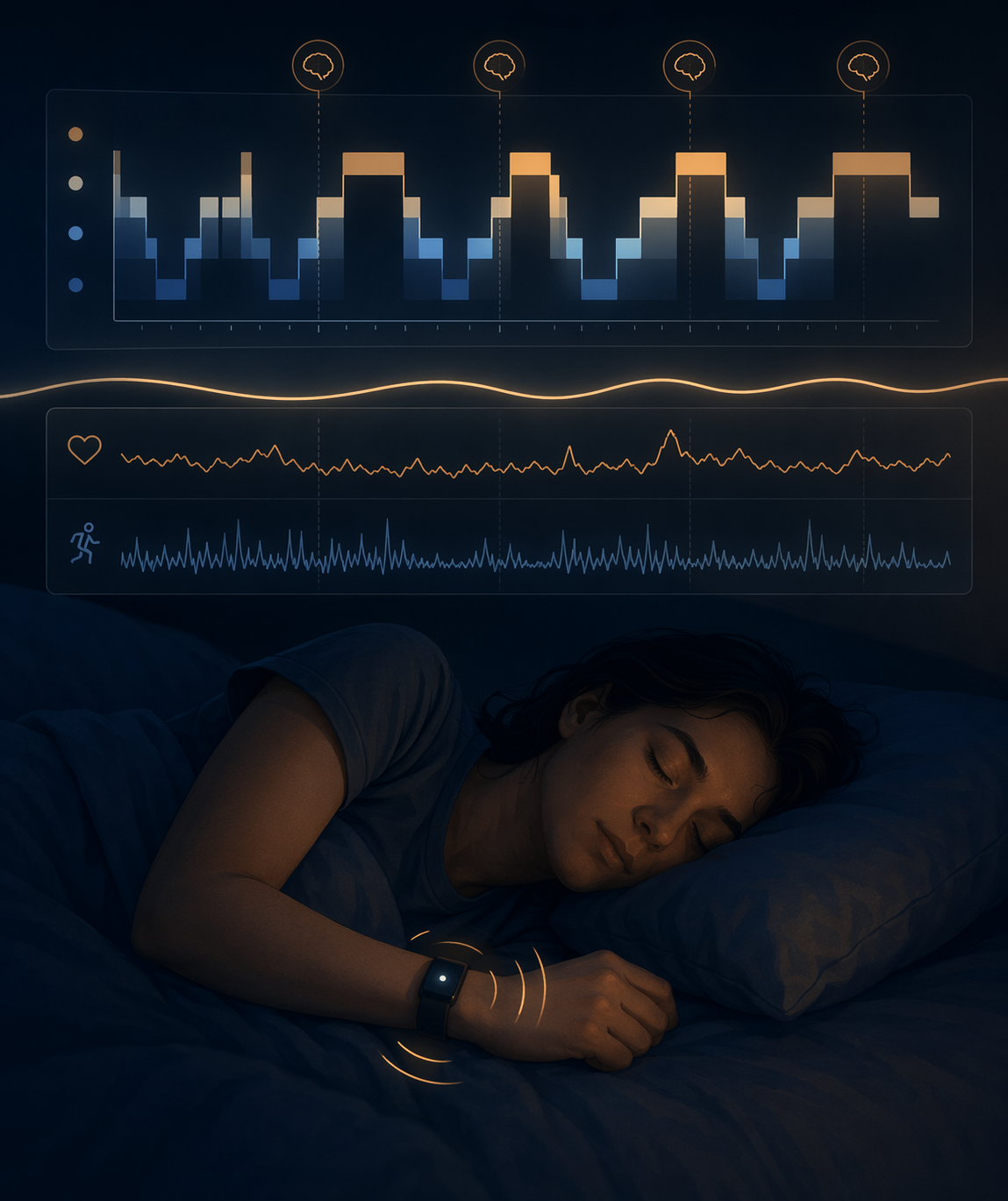
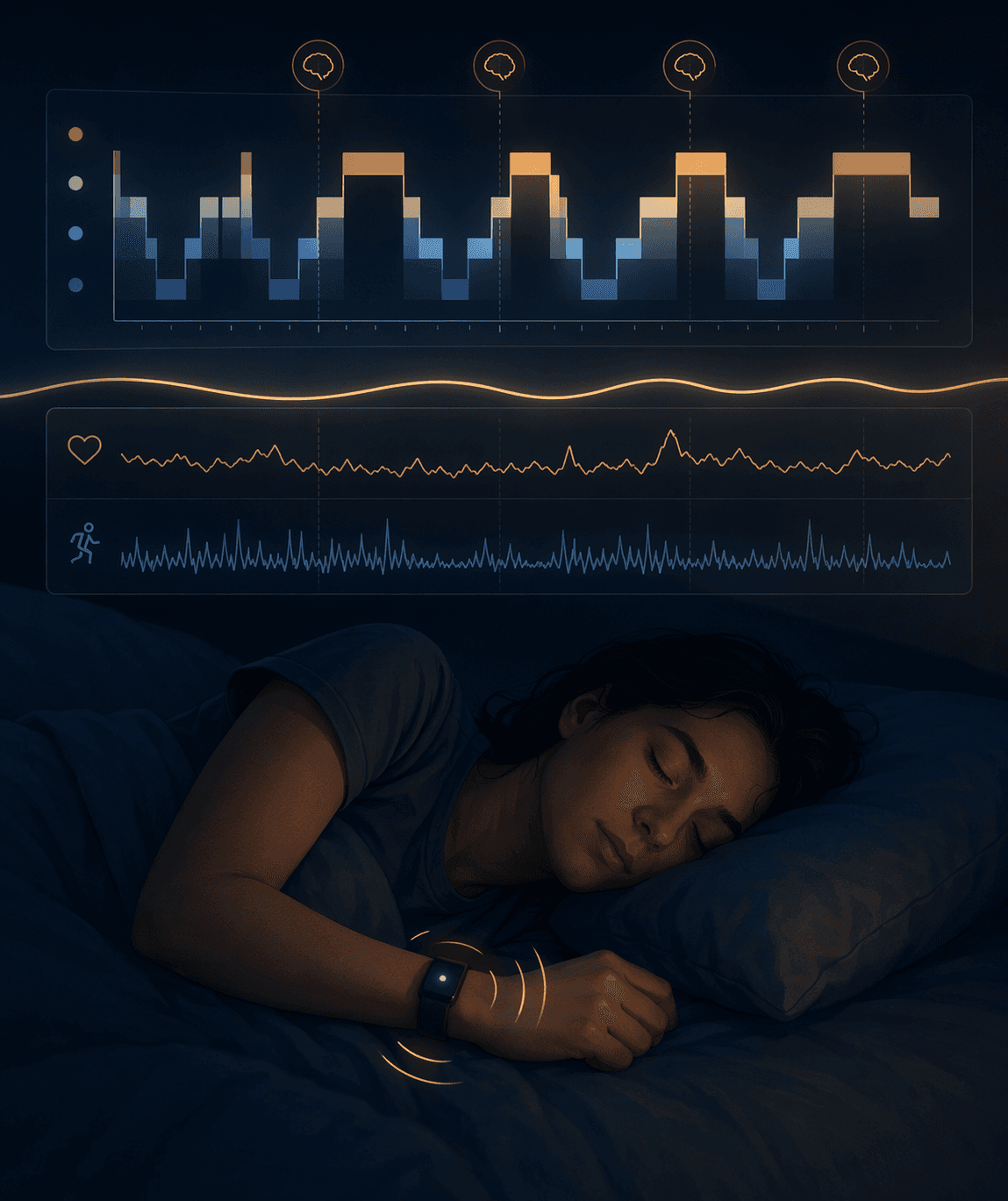
Smart sleep devices can be useful without being as certain as their dashboards look. They are generally better at showing sleep timing, routines, movement patterns, and changes over weeks than at telling you whether last night contained exactly the right amount of REM or deep sleep. They also cannot diagnose insomnia, sleep apnea, restless legs syndrome, narcolepsy, or any other sleep disorder. That line matters because the device on your finger or wrist may feel intimate enough to be medical, while still working mostly from indirect clues.
Johns Hopkins Medicine puts the core limitation plainly: consumer trackers “don’t measure sleep directly” and often use “inactivity as a surrogate for sleep.” Still wakefulness can therefore be counted as sleep, and quiet time in bed can become a falsely reassuring score.[1] That does not make the data useless. It means the data needs to be read as an inference, not as a miniature sleep lab.
The Measurement Problem Comes First
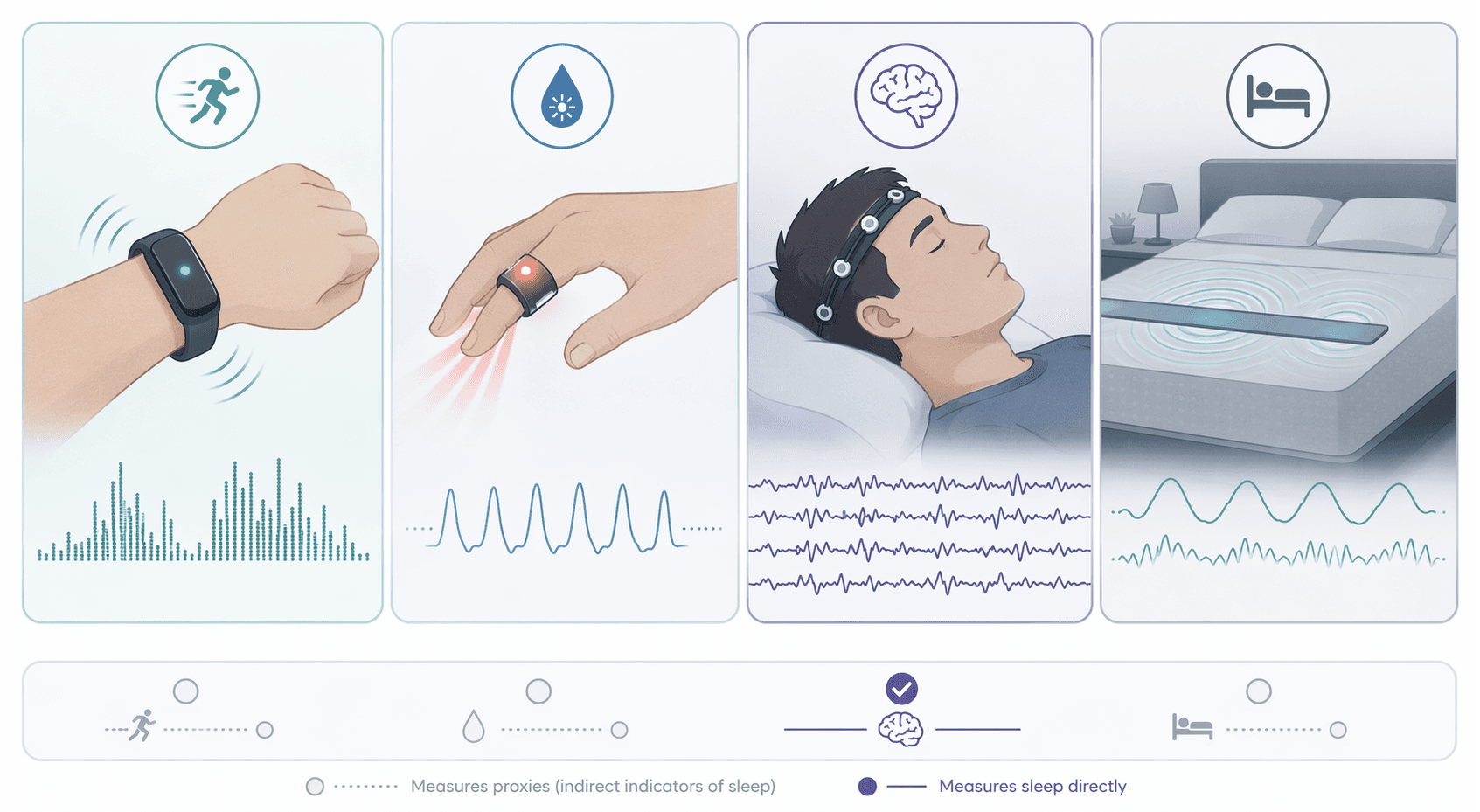
A clinical polysomnography study, usually shortened to PSG, records brain activity, eye movement, muscle tone, breathing, oxygen saturation, heart rhythm, and other signals under a defined protocol. Most consumer smart sleep devices do not have access to that full signal set. They infer sleep from proxies: a wrist stops moving, heart rate changes, heart-rate variability shifts, temperature trends drift, pressure changes across a mattress, or optical sensors detect blood-flow patterns.
Those proxies are not interchangeable. Actigraphy is useful for estimating rest-activity patterns, but it struggles when a person lies awake without moving. PPG, the optical signal used by many wearables, adds cardiovascular context but still does not directly record the brain state that defines sleep stages. Mattress sensors can observe body movement, respiration-related motion, and pressure patterns without requiring a wearable, but they do not measure cortical activity. EEG headbands get closer to the biological signal used to stage sleep, although consumer versions still depend on their own sensors, algorithms, fit quality, and validation design.
This is the sensor-science reason a sleep score can be directionally helpful and wrong in the details. If you want the mechanics behind PPG and actigraphy before comparing devices, start with how smartwatches track sleep. The important point here is simpler: once a device infers sleep from a proxy, its confidence should be lower than the app interface usually suggests.
What Accuracy Studies Actually Say
Accuracy numbers for sleep devices are easy to misuse because they often sound like grades. A device with higher agreement against PSG is not automatically the best device for every sleeper, and a lower number does not mean every metric is equally poor. Total sleep time, sleep-wake detection, sleep onset, and sleep-stage classification are different tasks.
Sleep Foundation’s 2026 tracker review summarizes one useful example: Oura Ring agreement with PSG improved from 66% in 2016 to 79% in 2021, and a 2024 independent study found Oura did not differ significantly from PSG for total sleep time, sleep onset latency, or deep sleep.[2] That is encouraging for trend interpretation. It does not mean a ring can see every sleep stage the way a lab can.
Whoop’s sleep-stage performance is reported around 64% agreement, which is a reminder that staging is a harder problem than detecting whether someone is broadly asleep or awake.[2] Earable’s EEG-headband study reported 87.8% agreement across 883 sessions, a higher figure that fits the intuition that a head-worn device measuring brain-related signals has a better starting point for sleep staging than a wrist-only proxy.[3] But even that number needs its study context: the Earable work was manufacturer-funded, and its sample was geographically and demographically narrow, with Vietnamese participants and a group mostly in their 20s and 30s.[3]
| Device type | What it mainly observes | What the evidence supports | Main caution |
|---|---|---|---|
| Wrist wearables and rings | Movement, optical heart data, temperature or related physiological trends | Useful trend data; better for sleep timing than precise staging | Still wakefulness can be misread as sleep |
| EEG headbands | Brain-related electrical activity plus device-specific sensors | Stronger basis for staging and intervention research | Evidence may come from narrow or manufacturer-funded studies |
| Bed-embedded sensors | Pressure, motion, and respiration-related movement | Convenient non-wearable tracking; reported accuracy varies broadly | Cannot directly measure brain activity |
| Clinical sleep tests | Multi-signal diagnostic measurement under a medical protocol | Appropriate for suspected sleep disorders | Different category from consumer wellness tracking |
Bed-embedded sensors occupy an appealing middle ground: no ring to charge, no watch to sleep in, and no headband to adjust. Wirecutter’s 2026 review notes that bed sensors report a broad accuracy range of roughly 60% to 90% in small studies, while also emphasizing that they cannot measure brain activity.[4] That range is too wide to treat as a single verdict. It tells us that method, sample, protocol, and metric selection can change the answer dramatically.
This is why brand-level comparisons need restraint. There are not enough independent, head-to-head PSG studies testing multiple consumer devices under the same protocol to declare a universal winner. Separate studies can still be informative, but they are not the same as a clean tournament. Readers who want device-specific validation detail can compare the evidence in which fitness tracker is most accurate for sleep or the 2024–2026 update on smart watch sleep tracker accuracy.
The Stage Score Is Usually the Shakiest Part
Most anxiety around sleep trackers seems to gather around stages: light sleep, deep sleep, REM, awake. That is also where consumer devices tend to be most overconfident. A total sleep time estimate can be useful even when individual stage labels are noisy. A consistent bedtime shift, repeated awakenings, or a rising resting heart rate trend can deserve attention without requiring the REM bar to be exact.
The problem is not merely that sleep stages are hard. It is that apps often display inferred stages with the visual authority of measured facts. A neat hypnogram can make a probabilistic model look like direct observation. If a wrist device says deep sleep fell last night, the right question is not “what is wrong with me?” It is “what signal did the device have, and how well has this specific metric been validated against PSG?”
For day-to-day use, the safer hierarchy is plain: trust long-term timing patterns more than single-night stage percentages; trust repeated changes more than isolated bad scores; treat sleep-stage labels as estimates; and do not use a consumer dashboard to rule in or rule out a disorder.
Can a Device Improve Sleep, or Only Describe It?
Tracking is one category. Intervention is another. A passive tracker observes and classifies. An active sleep device tries to change the sleep process itself, often by adjusting sound, temperature, light, or stimulation in response to measured signals. The evidence here is more interesting than the usual sleep-score debate, but it also demands more caution because efficacy claims can travel faster than replication.
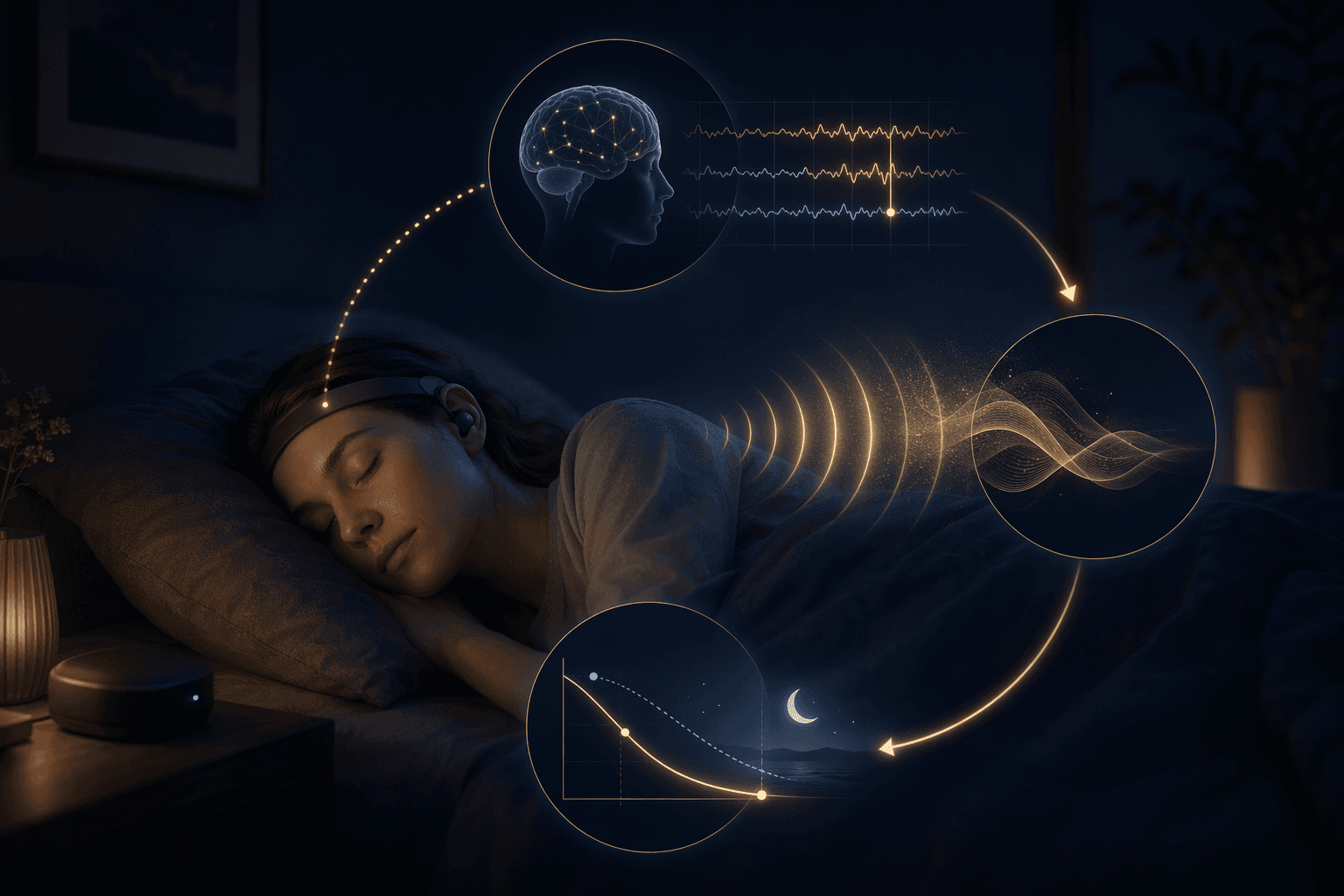
Earable’s closed-loop acoustic stimulation study is the most concrete example in the current evidence set. In a 377-subject, 883-session study published in Scientific Reports in 2023, the device reported 87.8% agreement with PSG for sleep staging and tested a stimulation system designed to reduce sleep onset latency.[3] In the PSG-validated nap protocol, sleep onset latency fell from 40.3 minutes to 16.2 minutes; in at-home full-night tests, it fell from 41.3 minutes to 22.3 minutes.[3]
Those are large changes, and they answer a real question: some smart sleep devices may do more than describe sleep. A device that detects a sleep-relevant state and responds with timed acoustic stimulation is closer to a closed-loop system than a dashboard. The mechanism matters because the intervention is tied to measurement, not simply layered on top of bedtime.
The caveats are not footnotes. The study was manufacturer-funded, the participant pool was homogeneous, and the authors noted limits to generalizability.[3] A strong result in a narrow sample does not automatically become a universal sleep solution. It becomes a promising result that deserves independent replication across older adults, people with comorbidities, different sleep complaints, and more diverse populations.
Temperature-based systems raise a similar evidence problem. Some claims around bed climate devices, including faster sleep onset and deeper sleep percentages, are manufacturer-adjacent and difficult to verify independently from the available public methodology. Without accessible sample details, protocol, and independent replication, those claims should be treated as claims, not as settled clinical findings. A clever system may still be useful, but the burden of proof rises when it promises physiological improvement rather than simple tracking.
Simple Interventions Still Count
Not every effective sleep tool has to be a wearable. Wirecutter cites a 2017 study in which white noise reduced time to stage 2 sleep by 38%.[4] That does not make white noise the answer for everyone, and it is not the same kind of evidence as a PSG-validated closed-loop device trial. It does, however, keep the discussion grounded. Sometimes the useful intervention is environmental and boring: sound consistency, a cooler room, less late-night light, fewer alerts, or a steadier schedule.
The broader relationship between technology and sleep is also mixed. A device can encourage routine, but screens, notifications, late-night checking, and anxiety about scores can disrupt the same sleep it claims to optimize. For that wider tradeoff, see how technology affects sleep. A tracker that makes a person more vigilant at 3 a.m. is not an upgrade, even if the chart looks beautiful in the morning.
Where Consumer Tracking Ends and Medical Testing Begins
The cleanest boundary is diagnostic intent. Consumer smart sleep devices are wellness tools. Home sleep apnea testing is medical testing. They may both happen in a bedroom and both involve sensors, but they answer different questions under different standards.
The growth of home sleep apnea testing makes that distinction sharper, not blurrier. Precedence Research projects the home sleep apnea testing market from $712 million in 2025 to $966 million in 2035.[5] A 2024 JMIR systematic review notes 632.6% growth in Medicare home sleep tests.[6] That expansion reflects demand for more accessible diagnostic pathways, not permission to treat a consumer sleep score as a medical result.
A tracker may notice clues that justify a medical conversation: repeated oxygen drops if the device measures oxygen saturation, frequent awakenings, unusually fragmented sleep, or a mismatch between time in bed and daytime functioning. But symptoms carry the decision. Loud snoring, witnessed pauses in breathing, gasping, persistent daytime sleepiness, morning headaches, insomnia that does not improve, or safety-critical drowsiness are reasons to seek clinical evaluation rather than keep adjusting a consumer app.
This is also where form factor matters less than category. A ring, watch, band, mattress sensor, or non-wearable monitor may be convenient for long-term observation; the best choice depends on what you will consistently use. For a taxonomy of those tradeoffs, see the form-factor comparison of sleep monitoring devices. For diagnosis, convenience is secondary to using the right test for the suspected condition.
A Calibrated Way to Use Smart Sleep Devices
The practical standard is not “ignore the device” or “believe the score.” Use the parts that match the measurement. Sleep timing, consistency, bedtime drift, wake windows, and broad changes after travel, alcohol, illness, stress, or schedule changes are often the most useful outputs. Single-night REM percentages and exact deep-sleep minutes deserve less trust, especially from devices that do not measure brain activity.
- Use trend data to test routines, not to judge one night.
- Treat sleep stages as estimates unless the device has strong PSG validation for that specific metric.
- Read manufacturer-funded studies with attention to sample size, sample diversity, protocol, and independent replication.
- Consider closed-loop intervention devices promising when the trial design is strong, but not settled without replication.
- Seek medical testing when symptoms suggest a sleep disorder, even if the consumer dashboard looks normal.
If you are comparing specific products, especially Apple Watch, Oura, Fitbit, or similar devices, a brand-level guide such as Apple Watch vs. Oura Ring vs. Fitbit can help with practical differences. Just keep the larger boundary intact: a good consumer device can make patterns visible. It cannot turn proxy signals into a diagnosis.
References
- Do Sleep Trackers Really Work?, Johns Hopkins Medicine.
- Best Sleep Trackers of 2026, Sleep Foundation.
- Earable et al., Nature Scientific Reports 2023, Scientific Reports, 2023.
- The 2 Best Sleep Trackers of 2026, Wirecutter, The New York Times.
- Sleep Tech Devices Market Size, Precedence Research.
- Detection of Sleep Apnea Using Wearable AI: Systematic Review, JMIR, 2024.
Comments
Join the discussion with an anonymous comment.