
Halle Berry Perimenopause: The Sleep-Sex Drive Connection
Halle Berry's perimenopause story puts a public face on why sleep and desire often decline together during this stage. This evidence-tiered guide explains the shared hormonal mechanisms, reviews the prevalence numbers, and separates proven treatments from anecdotes.
Halle Berry’s perimenopause story landed because it was blunt in a way many clinical visits are not. She has described being 54, having severe vaginal pain that felt like “razor blades in my vagina,” and being told she had “a pretty bad case of herpes” before perimenopause was recognized as the more relevant explanation.[1] In later coverage, she said she feared she would “never enjoy” her sex life again after menopause; she has also spoken publicly about menopause-related products and brands, which are her commercial context, not clinical evidence.[2]
That distinction matters. Berry’s story is not proof of what causes low libido or broken sleep in perimenopause. It is a public doorway into a pattern clinicians see often: night sweats, insomnia, vaginal pain, lower desire, mood changes, and “I don’t feel like myself” treated as separate problems. The mismatch is sharper when set beside one reported survey finding: 31.3% of U.S. obstetrics and gynecology residency program directors said their programs lacked a menopause curriculum.[1]
Last reviewed: August 2, 2026. Evidence tier for this article: strongest for CBT-I as a sleep intervention in menopause-related insomnia; moderate for hormone-linked mechanisms and vasomotor symptoms disrupting sleep; associative for poor sleep quality and sexual dysfunction; clinician-supervised and off-label for testosterone use in women.
The recognizable cluster: sleep breaks first, desire often follows
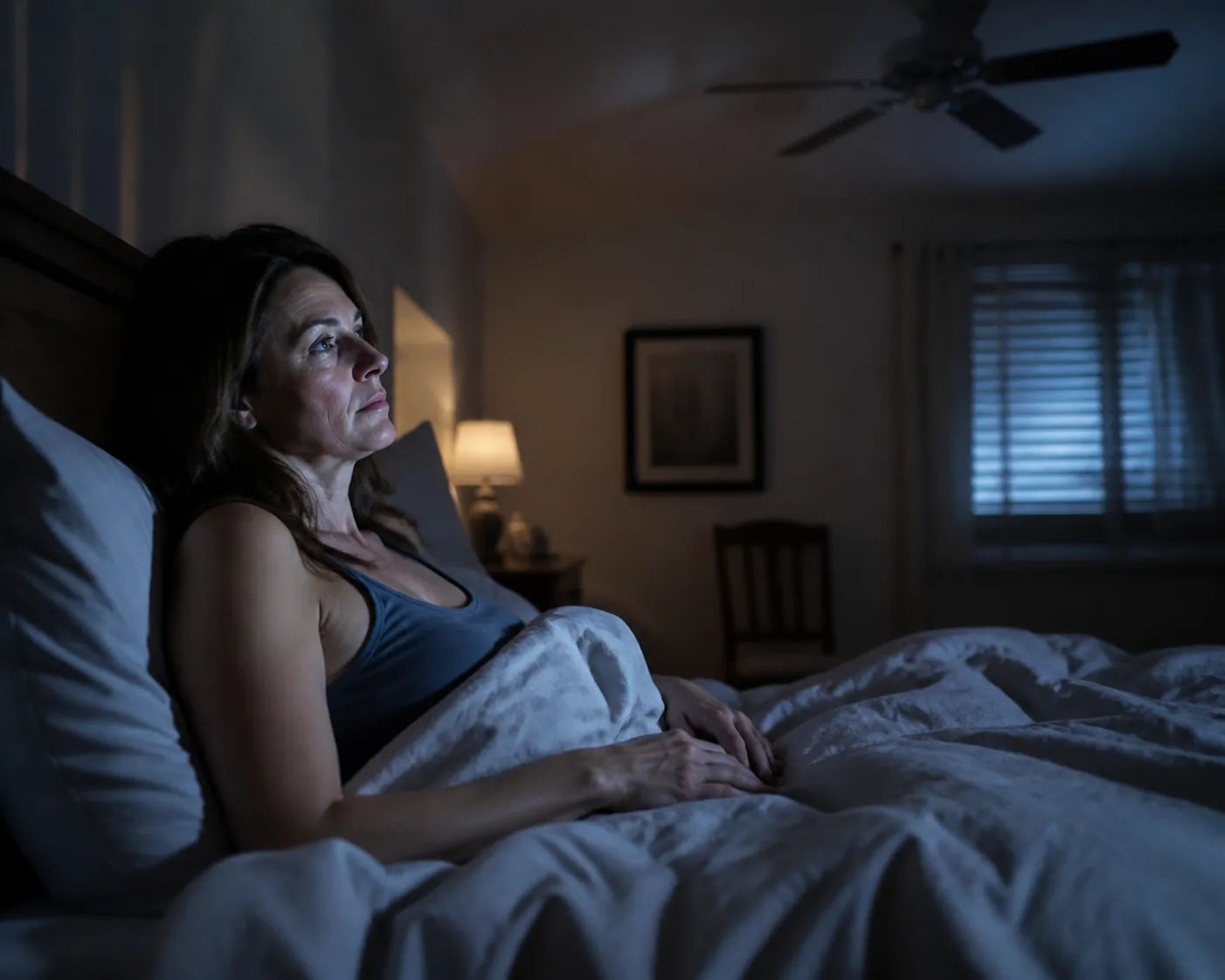
For many women, the change does not arrive as one tidy symptom. It may look like waking hot, throwing off the covers, cooling down, falling back asleep, then waking again. It may mean a 3 a.m. calculation: how many hours before work, whether to change clothes, whether the bed is damp, whether another cup of coffee will be necessary. Desire can fade in that same season, and painful sex can make the idea of sex feel less like intimacy than another body problem to brace for.
The sleep numbers are large, but they are not all measuring the same thing. Stanford Lifestyle Medicine summarizes sleep difficulties during perimenopause in the 40% to 60% range.[3] A 2023 meta-analysis estimated pooled sleep-disorder prevalence at 50.3% in perimenopausal women and 51.6% in postmenopausal women, with insomnia prevalence estimated at 37.6%.[4] A 2024 review reported insomnia symptoms in 31% to 42% of perimenopausal women per year and chronic insomnia in up to 26% of postmenopausal women.[5]
Those ranges should feel normalizing, not diagnostic. A questionnaire asking about “sleep difficulty” will not produce the same result as a formal insomnia definition, a symptom checklist, or sleep-lab measurement. Still, across methods, the direction is consistent enough to take seriously: sleep disruption is common across the menopause transition, and it is not trivial.
Why hormones can disturb both nights and sex
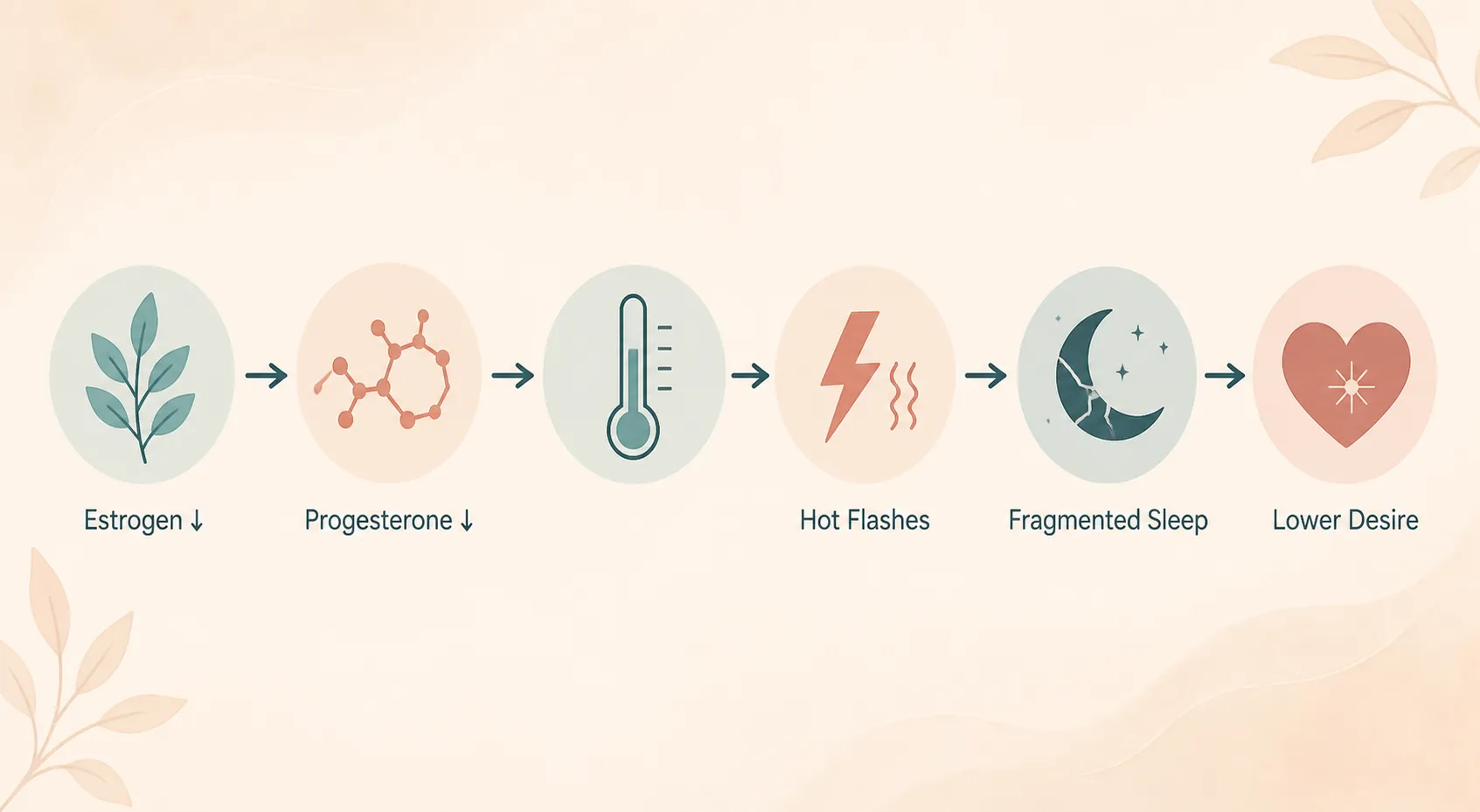
The shared biology starts with fluctuating and then declining ovarian hormones. Estrogen is involved in thermoregulation, so changing estrogen signaling can narrow the body’s comfort zone and contribute to hot flashes and night sweats. Progesterone and its metabolite allopregnanolone interact with GABA-A pathways, one reason progesterone is often discussed in relation to sedative tone. Serotonin and GABA systems also overlap with mood, arousal, and sleep regulation.[3]
That mechanism helps explain why the symptoms can feel tangled rather than sequential. A vasomotor surge wakes the brain. The awakening makes the heat more memorable. The next day is shorter on patience, energy, and sexual interest. Vaginal dryness or genitourinary discomfort can add pain or fear of pain, which is not a minor side note when the question is desire.
Heat is not only a summer inconvenience in this context. If night sweats are part of the pattern, bedroom microclimate becomes a medical-quality sleep issue, not a decorating preference. Practical next questions often belong in guides on how to sleep with perimenopause heat, including sleeping during heat waves in perimenopause, whether August worsens perimenopause sleep, and whether cooler weather improves sleep.
Caffeine sensitivity can also become more obvious when the sleep system is already fragile. A cup that once seemed harmless may become part of a longer sleep-latency problem, especially when night sweats or stress awakenings are already present. That does not make caffeine the cause of perimenopause insomnia, but it can become one modifiable load on a system with less margin. For that narrower question, see why caffeine disrupts sleep more in perimenopause.
The Mayo DREAMS finding: important, and still not causation
The most direct sleep-and-sex signal comes from the Mayo Clinic DREAMS registry study published in Menopause in 2021. It included 3,433 women with a mean age of 53. In that group, 75% had poor sleep quality and 54% met criteria for female sexual dysfunction. Poor sleep quality was associated with 1.48 times higher odds of sexual dysfunction, with a 95% confidence interval of 1.21 to 1.80.[6]
That number is useful because it ties the two complaints together without pretending they are identical. It says poor sleep quality and sexual dysfunction traveled together in this midlife sample. It does not prove that insomnia caused low desire, or that improving sleep alone will restore sexual function. The study was observational and cross-sectional, so the safest reading is association, not cause. If that distinction feels slippery, it is the same logic behind the broader association-versus-causation framing used in other sleep-health questions.
Longer-running menopause data support the idea that vasomotor symptoms and sleep problems can persist together. SWAN reports that hot flashes, night sweats, and trouble falling asleep predict persistent sleep problems after menopause.[7] A recent 2026 review also discusses high sexual dysfunction burden among postmenopausal women with insomnia, obstructive sleep apnea, or combined insomnia and sleep apnea, but that review should be read as synthesis and clinical signal, not randomized-trial proof that one treatment fixes both domains.[8]
What is most defensible to discuss with a clinician
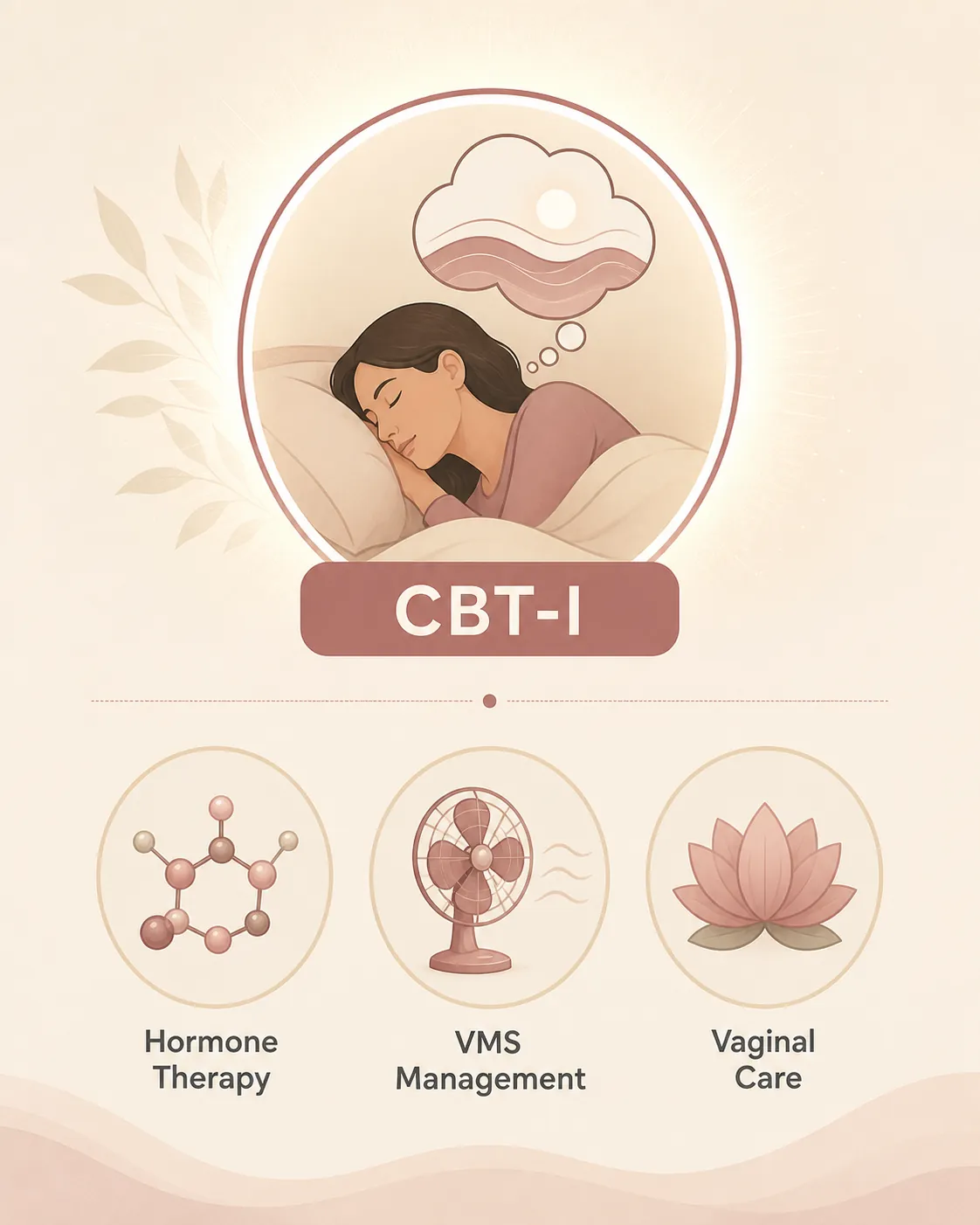
Treatment conversations get muddy when every option is presented as equal. For this particular sleep-sex cluster, the evidence is not equal. Some treatments target insomnia directly. Some target hot flashes and night sweats. Some target vaginal pain. Some target desire. A good visit names all of them, then chooses based on the symptom that is doing the most damage and the risks that need screening.
| Clinical question | Best-supported discussion point | Evidence boundary |
|---|---|---|
| “I am sleeping badly most nights.” | CBT-I is the strongest sleep-focused intervention to ask about. | Supported by randomized trial evidence in menopause-related insomnia; access and population generalizability still matter. |
| “Night sweats keep waking me.” | Treat vasomotor symptoms seriously, not as a nuisance. | Strong symptom-sleep logic and observational support; specific treatment choice depends on medical history. |
| “Would hormone therapy fix my sleep?” | Hormone therapy may improve self-reported sleep for some women. | Meta-analysis shows subjective sleep improvement, but not clean improvement in objective PSG sleep parameters.[9] |
| “My libido disappeared.” | Look at sleep, pain, mood, relationship context, medications, and hormones together. | Sleep-libido evidence is associative; a single libido fix is rarely the whole evaluation. |
| “Should I try testosterone?” | Discuss only with a clinician, including snoring or sleep-apnea risk. | Off-label in women in the U.S.; not FDA-approved for women; response is not guaranteed.[12] |
CBT-I has the strongest sleep-intervention footing
Cognitive behavioral therapy for insomnia is not “sleep hygiene with nicer branding.” CBT-I changes the learned patterns that keep insomnia going: too much time awake in bed, irregular sleep timing, conditioned alertness at bedtime, catastrophic sleep thoughts, and compensatory habits that make the next night harder. That matters in perimenopause because a hot flash may start the awakening, but insomnia can learn the route and keep traveling it.
A 2024 scoping review of menopause sleep interventions identified CBT-I as a first-line approach and summarized MsFLASH work in which CBT-I performed best among six interventions for menopause-related insomnia symptoms.[10] Telephone-delivered CBT-I also showed a larger Insomnia Severity Index reduction than menopause education control in one trial, with a −9.9 change versus −4.7.[10][11]
The limitation is not small: trial samples in this area have often been predominantly white and well educated, so access, cultural fit, work schedules, caregiving demands, and insurance coverage can affect how well the evidence translates. But as an evidence tier, CBT-I still deserves to be near the top of the conversation when the complaint is persistent insomnia.
Hormone therapy may help some sleep symptoms, but it is not a clean sleep-lab fix
Hormone therapy is often discussed because the trigger really can be hormonal. A 2022 systematic review and meta-analysis found menopausal hormone therapy improved self-reported sleep quality overall, with a standardized mean difference of −0.13; transdermal 17β-estradiol showed a larger self-reported sleep effect, with a standardized mean difference of −0.34. The same analysis did not find improvement in polysomnography parameters.[9]
That split is clinically believable. If hot flashes are waking someone repeatedly, reducing those symptoms may make nights feel better. But objective sleep architecture is a higher bar, and hormone therapy is not prescribed as a universal insomnia treatment. The decision belongs in a clinician visit that reviews migraine history, clotting and cardiovascular risk, breast and uterine history, bleeding patterns, current medications, and personal goals.
Night sweats deserve their own plan
When the main sleep disruptor is heat, the plan should not stop at “try to relax.” Track whether awakenings are linked to sweating, alcohol, late meals, room temperature, bedding, stress spikes, or menstrual-cycle timing if cycles are still present. Bring that pattern to the visit. It helps separate insomnia that is mainly conditioned and behavioral from insomnia repeatedly triggered by vasomotor symptoms.
At home, cooling strategies are not a cure for perimenopause, but they can reduce the number of avoidable awakenings. The more useful question is not whether a bedroom is “cool enough” in general; it is whether the bed, clothes, mattress, and room allow heat to dissipate quickly after a vasomotor surge. For routine-level adjustments, the perimenopause beauty sleep routine guide keeps the focus on nights rather than products.
Pain with sex is not the same problem as low desire
Pain can look like low libido from the outside. From the inside, it may be avoidance, dread, or a reasonable refusal to repeat something that hurt. Berry’s “razor blades” description is extreme language, but the clinical lesson is straightforward: painful sex should be evaluated as pain, not minimized as attitude, stress, or relationship failure.[1]
A clinician can assess for genitourinary syndrome of menopause, infections, vulvar skin conditions, pelvic floor contributors, medication effects, and other causes of pain. That assessment sits beside the sleep conversation, not behind it. If sex hurts and sleep is broken, treating only libido misses the point.
Testosterone is a supervised, off-label discussion—not a shortcut
Berry has publicly credited testosterone with helping her libido, but that is an anecdote, not evidence that testosterone is the right answer for every woman with low desire.[12] In the U.S., testosterone is not FDA-approved for women, and coverage of expert opinion has described response estimates around 50%, which means nonresponse is common even in favorable clinical use.[12]
The sleep boundary matters here. Before testosterone is considered, snoring, witnessed pauses in breathing, morning headaches, high blood pressure, and daytime sleepiness should not be brushed aside. Sleep apnea can worsen fatigue and sexual function, and hormone discussions are safer when sleep-disordered breathing risk is on the table. For that specific screening issue, see why your doctor asks about snoring before testosterone replacement.
When the menopause story is not the whole story
Perimenopause is common, but it should not become a wastebasket diagnosis. Heavy bleeding, new severe pelvic pain, sudden mood changes, medication side effects, thyroid disease, depression, relationship distress, alcohol use, restless legs, and sleep apnea can all complicate the picture. Surgical menopause can also change timing and intensity; if symptoms worsened after surgery, the better comparison may be sleep after hysterectomy rather than a gradual perimenopause timeline.
Circadian load can also make a vulnerable sleep system look worse. Late light exposure, early work start times, caregiving interruptions, and clock changes do not cause ovarian hormone decline, but they can amplify insomnia once sleep is unstable. The same is true of policy-level clock debates, which is why permanent daylight saving time and perimenopause sleep belongs in the same larger conversation.
The useful clinical move is to bring the cluster, not a single complaint: “I wake drenched three nights a week, I’m sleeping five broken hours, sex hurts, my desire is lower, and I snore,” or “I don’t have hot flashes, but I lie awake for hours and my libido changed after a medication.” Specific patterns give the clinician something to evaluate. Vague shame gives everyone too much room to miss the diagnosis.
Low desire and broken sleep in perimenopause are common and treatable, but the best-supported first move is not chasing one libido fix. It is naming the cluster, treating insomnia and vasomotor symptoms seriously, and bringing sexual pain, snoring or sleep-apnea risk, hormone questions, and libido changes into the same clinician conversation.
References
- How Halle Berry's Perimenopause Symptoms Were Misdiagnosed As Herpes — Forbes, December 15, 2024
- Halle Berry Feared She'd 'Never Enjoy' Her Sex Life After Menopause — People, June 10, 2025
- Sleep and Perimenopause — Stanford Lifestyle Medicine, October 2025
- The global prevalence of sleep disorders during menopause: a meta-analysis — Salari et al., 2023
- Sleep disturbance across the menopause transition — Frontiers in Sleep, 2024
- Association between sleep and sexual function in midlife women — Menopause, 2021
- Effects of Sleep Problems During Menopause — SWAN Study
- Sleep Disorders and Sexual Dysfunction in Postmenopausal Women — Current Sexual Health Reports, 2026
- The effect of menopausal hormone therapy on sleep quality: systematic review and meta-analysis — Pan et al., 2022
- Sleep interventions for women during the menopausal transition and postmenopause: a scoping review — Ntikoudi et al., 2024
- Brief Cognitive Behavioral Therapy Improves Sleep in Perimenopausal Women — MGH Center for Women's Mental Health
- Halle Berry Says Testosterone Helped Restore Her Libido in Menopause — Flow Space, March 2025
Safety & eligibility read
Cross-check against other interventionsExplore the mechanism
Next step
Spot an error or have clinical feedback?
Because this article covers clinical, medication, or safety information, we use a moderated correction channel instead of open public comments. Let us know if something about “Halle Berry Perimenopause: The Sleep-Sex Drive Connection” needs a closer look.
Send feedback on this article