
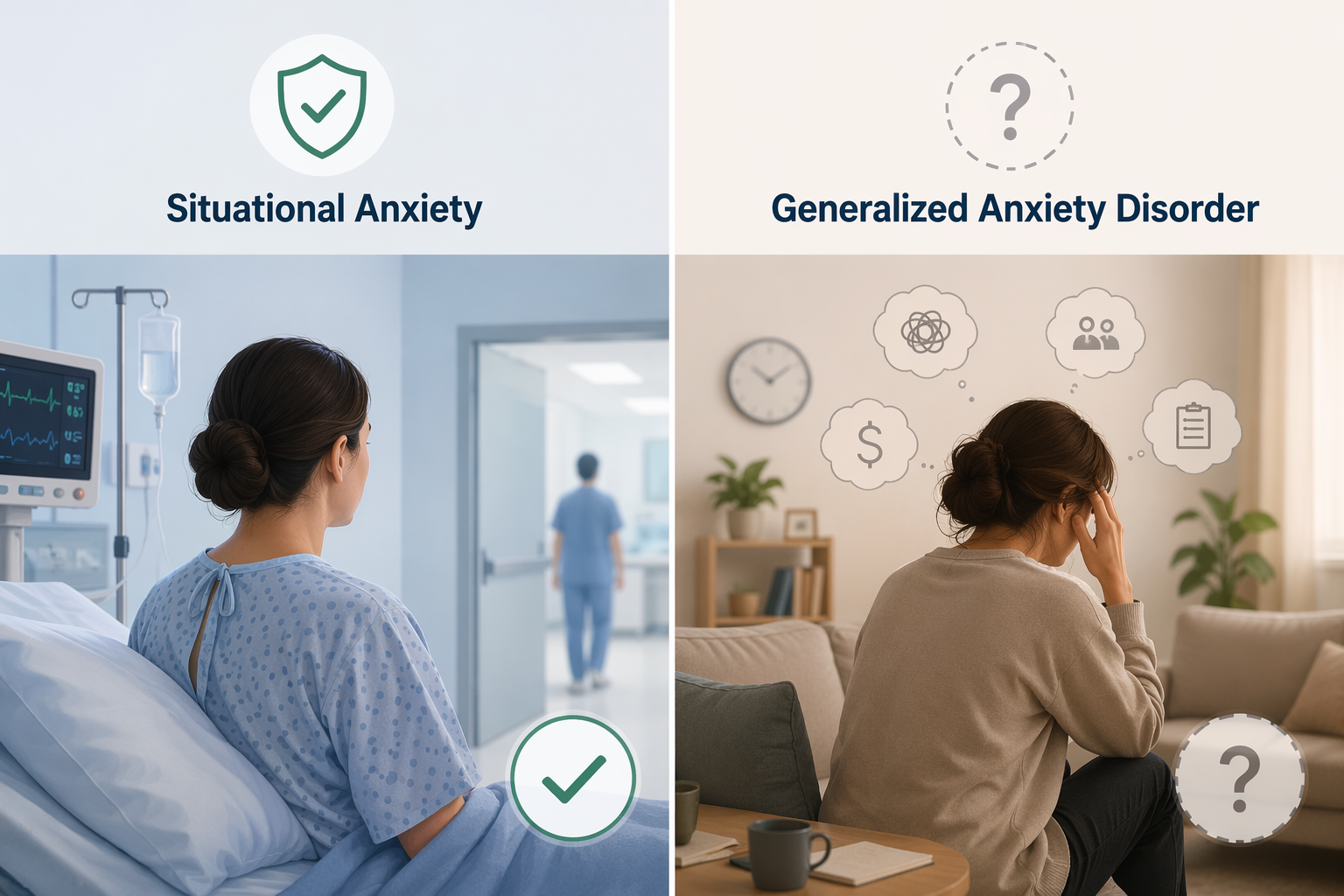
Melatonin can reduce anxiety in one fairly specific situation: short-term, procedure-related anxiety, especially before surgery. That is different from saying melatonin treats generalized anxiety disorder, panic, chronic worry, or the anxious spiral that shows up night after night when sleep is already fragile.
For people searching “melatonin for anxiety,” that distinction matters more than the label on the bottle. The best evidence is not about everyday anxiety. It is about a controlled medical setting, a short time window, and a measurable kind of anticipatory anxiety before anesthesia or surgery. For generalized anxiety disorder, the evidence is thin, and the clearest signal is closer to sleep-quality support than direct anxiety treatment.
Where melatonin has the strongest anxiety evidence
The most persuasive evidence for melatonin and anxiety comes from perioperative studies. NCCIH summarizes evidence that melatonin is better than placebo for reducing anxiety before surgery, and a Cochrane review of 18 studies with 1,264 participants found moderate-certainty evidence that melatonin reduces preoperative anxiety compared with placebo.[1][2]
That is a meaningful finding. Preoperative anxiety is not a vague wellness outcome; it is anxiety tied to an event, a deadline, and a clinical process. A person is waiting for surgery. The team needs them calm enough to proceed safely. Sedation, recovery time, breathing effects, and next-day grogginess all matter.
In that setting, melatonin has been compared with midazolam, a benzodiazepine commonly used around procedures. The Cochrane review found melatonin’s effect on preoperative anxiety was probably comparable to midazolam, while NCCIH notes that the review found no evidence of residual sedation from melatonin.[1][2]
“Comparable to midazolam” sounds stronger than it should if it is lifted out of context. It does not mean melatonin is a benzodiazepine substitute for anxiety disorders. It means that, in the studies reviewed, melatonin performed similarly for a narrow perioperative outcome. The absence of residual sedation matters there because pre-surgery medications have to calm the patient without creating avoidable recovery problems.
| Anxiety question | What the evidence supports | What it does not show |
|---|---|---|
| Preoperative or procedure-related anxiety | Moderate-certainty evidence that melatonin reduces anxiety compared with placebo; probably comparable to midazolam in that setting | That melatonin treats chronic anxiety disorders |
| Generalized anxiety disorder | Very limited evidence, mainly around sleep-quality change | A direct anxiolytic effect comparable to first-line GAD treatment |
| Nighttime anxiety with delayed sleep timing | A plausible role when circadian timing is part of the sleep problem | That melatonin will calm every anxious mind at bedtime |
Why generalized anxiety disorder is a different question
Generalized anxiety disorder is not simply “being nervous before something.” It usually involves persistent worry, physical tension, sleep disturbance, and impairment across ordinary life. The treatments with the strongest clinical role are not supplements; they include clinician-guided care such as cognitive behavioral therapy and, for many patients, medications such as SSRIs.
The available GAD-related evidence for melatonin does not carry the same weight as the perioperative evidence. It includes one small, one-month study showing modest improvement in sleep quality, but not a direct anxiolytic effect. That kind of result is worth noticing if the person’s main complaint is anxiety-linked sleep disruption. It is not enough to call melatonin a treatment for GAD.
This is where supplement marketing often gets too loose. If a person sleeps a little better after taking melatonin, their next day may feel easier. Their worry may feel less sharp because sleep loss is no longer amplifying it. But improved sleep is not the same outcome as reduced generalized anxiety symptoms, and it should not be written up as if it were.
For broader melatonin dosing and sleep-aid context, see our guide to melatonin as a sleep aid for adults. The anxiety question is narrower: whether the supplement is treating anxiety itself, or only helping one sleep-related piece of the anxiety-sleep loop.
Why it can feel calming for one person and unsettling for another
Melatonin is best understood as a timing signal. The body produces it as part of the sleep-wake rhythm, and supplemental melatonin can shift that signal. StatPearls describes melatonin’s role in circadian regulation and notes that its clinical use depends heavily on timing and indication.[3]
That timing role is one reason melatonin may help someone whose “anxiety” at night is partly a body-clock problem: they are exhausted, alert too late, and stuck in the uncomfortable gap between wanting sleep and not being biologically ready for it. In that case, melatonin may reduce the struggle by nudging sleep timing rather than by directly quieting anxious thought.
There are also plausible biological bridges between melatonin and anxiety pathways. A 2022 review in the International Journal of Molecular Sciences discusses melatonin’s interactions with GABAergic signaling, serotonin-related pathways, and hypothalamic-pituitary-adrenal axis activity, all of which are relevant to arousal and stress regulation.[4]
Plausible is not the same as predictable. The same supplement that helps one person fall asleep may make another feel oddly activated, dysphoric, or emotionally off. NCCIH lists agitation and mood swings among possible melatonin side effects.[1] Older research discussed in the 2022 review also reported that melatonin exacerbated dysphoria symptoms in depressed patients, which is a reminder that mood context matters.[4]
When melatonin worsens anxiety
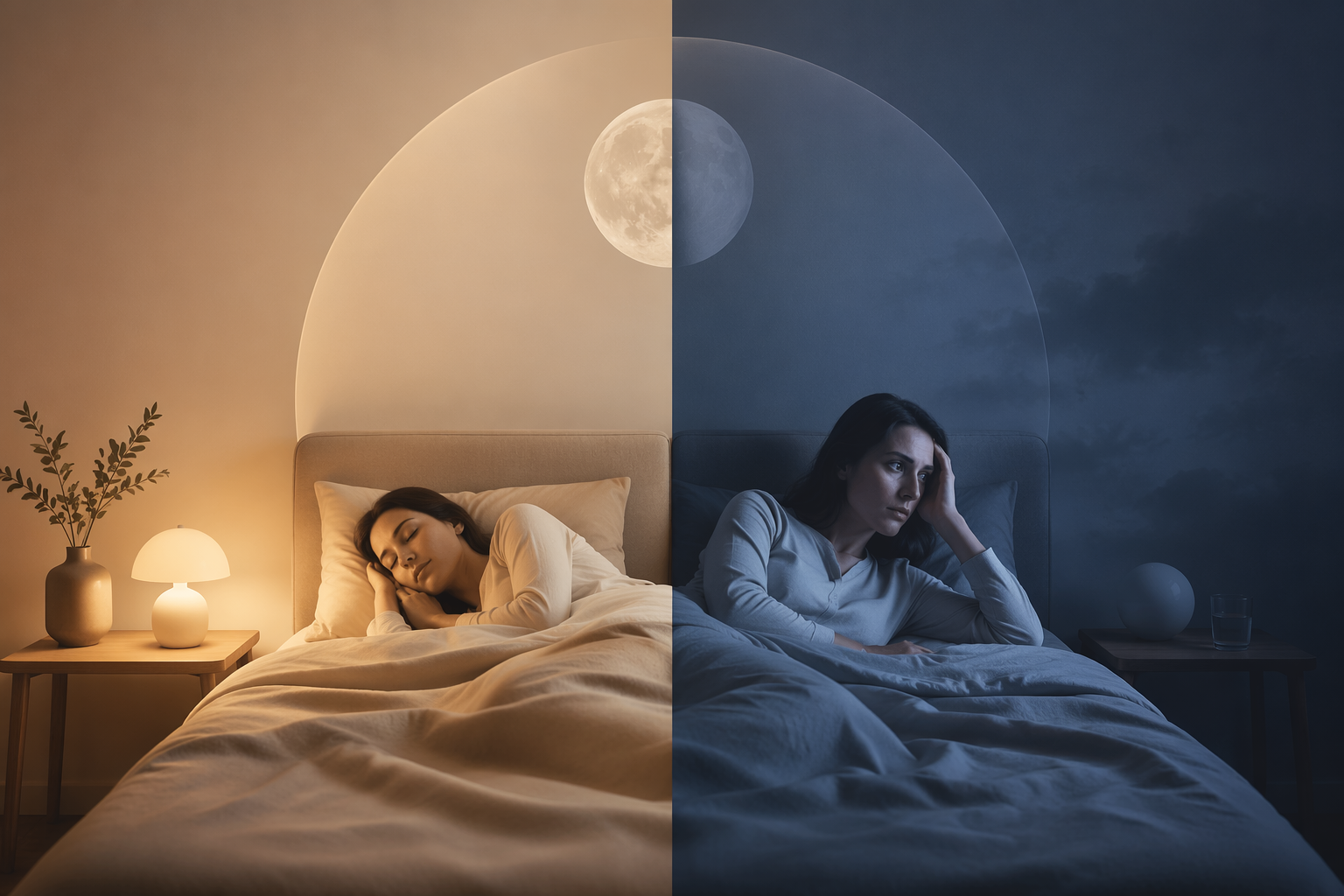
Some users report paradoxical anxiety, agitation, or restlessness after taking melatonin. Secondary clinical reports often place this worsening in the 10 to 15 percent range, but that estimate should be treated cautiously because it does not come from a single large prospective trial designed to measure anxiety worsening. It may overrepresent people who were already distressed enough to seek help or report side effects.
The practical point is simpler than the percentage: if melatonin reliably makes a person feel more anxious, that reaction should not be dismissed as impossible. More is not the answer. Switching brands is not automatically the answer. The first useful observation is that the supplement may not fit that person’s biology, dose, timing, medication mix, or current mental state.
- A calming effect is more plausible when the problem is short-term situational anxiety or delayed sleep timing.
- A worsening effect is more concerning when the person feels wired, panicky, emotionally flat, unusually irritable, or dysphoric after taking it.
- A lack of effect should not lead to escalating doses without checking timing, product quality, other medications, and the underlying sleep or anxiety diagnosis.
The bottle may not contain what the label says
Melatonin’s risk profile is often described as mild, but that assumes the dose on the label is close to the dose in the product. In the supplement aisle, that assumption can fail badly.
NCCIH cites a 2017 analysis showing that actual melatonin content in tested supplements ranged from 17 percent to 478 percent of the labeled amount, and 26 percent of products contained serotonin that was not listed on the label.[1] That is not a small rounding error. It means one bottle may underdose, another may deliver several times more than expected, and another may include an active neurochemical the buyer did not consent to taking.
Gummies raise a separate quality concern because they are common, easy to take, and easy to leave within reach. NCCIH also cites a 2023 study of melatonin gummies in which 22 of 25 products were inaccurately labeled, with actual melatonin content ranging from 74 percent to 347 percent of the labeled amount.[1]
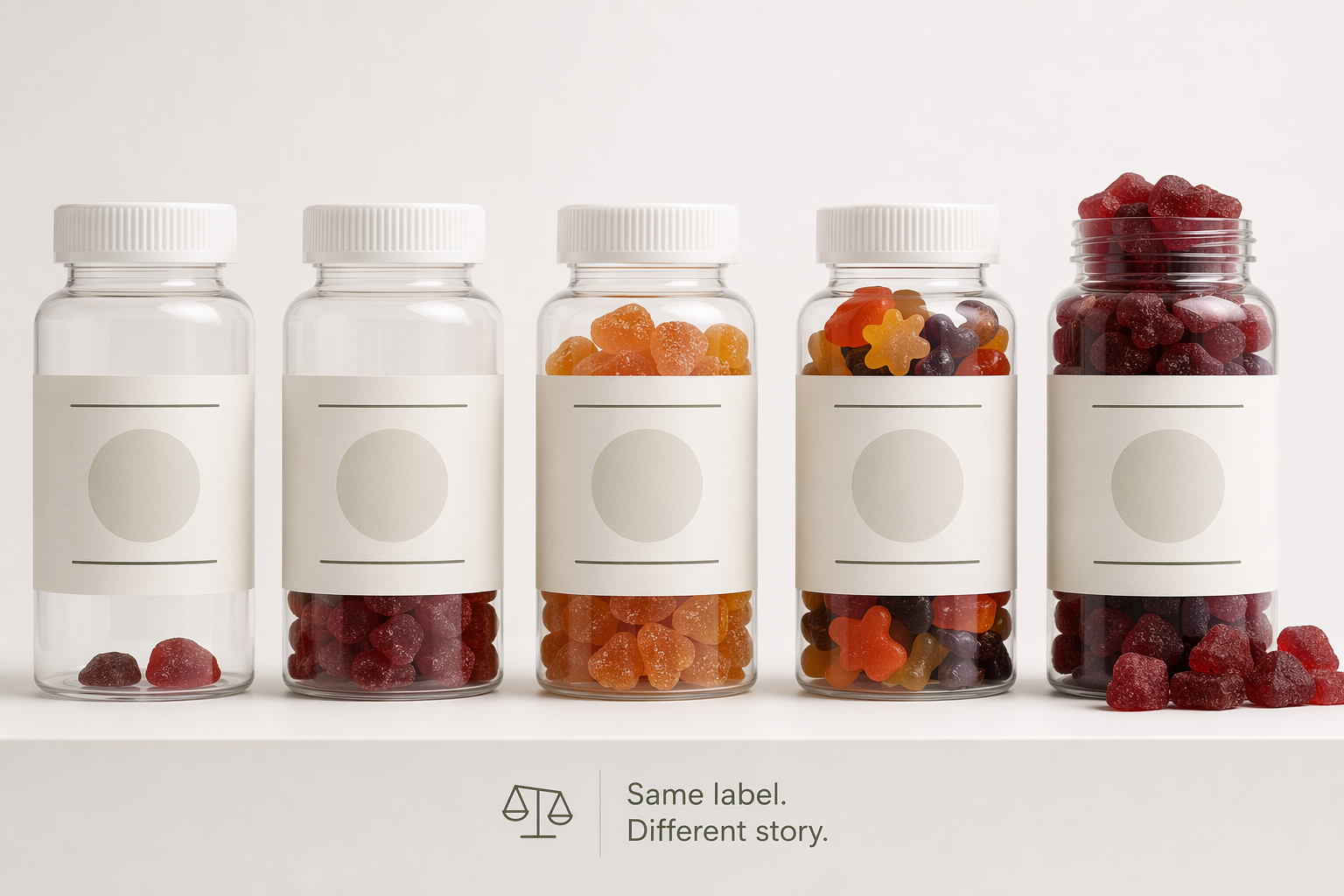
This quality-control problem is especially relevant for someone using melatonin for anxiety. If the dose is inconsistent, the effect may look mysterious: calm one night, groggy the next, agitated the next. The person may blame their mind when part of the problem is the product.
It also matters around children. Pediatric melatonin ingestion has become a recurring safety concern, particularly with flavored gummies that resemble candy. The adult buying melatonin for an anxious, sleepless night still has to store it like an active substance, not like a harmless bedtime sweet.
What to make of the 2025 heart failure signal
In 2025, an American Heart Association news release described a preliminary study of more than 130,000 adults with insomnia in which people with five-year melatonin use had a 90 percent higher hazard of heart failure than nonusers.[5]
That finding should be taken seriously without being inflated. It was observational, presented as preliminary, and not yet peer-reviewed as of July 2026. It does not prove that melatonin causes heart failure. People who use melatonin long term may differ from nonusers in sleep problems, health status, medication use, stress, or other factors that are difficult to fully separate.
Still, the signal is relevant because many people do not use melatonin as a short-term tool. They drift into nightly use for months or years because it is over the counter and feels less serious than a prescription. A preliminary association is not a reason for panic; it is a reason not to treat long-term use as automatically consequence-free.
How to decide whether melatonin fits the problem
The useful question is not only “does melatonin work for anxiety?” It is “what kind of anxiety-like problem am I trying to solve?” Those are different questions at 11 p.m., when the choices feel smaller and the hope for one gentle fix is very understandable.
- If the anxiety is acute and situation-bound, such as before a procedure, melatonin has real evidence worth discussing with the clinical team.
- If the main issue is delayed sleep timing, melatonin may be more relevant as a circadian tool than as an anxiety treatment.
- If the problem is persistent worry, panic, avoidance, or daily impairment, melatonin should not be treated as a substitute for first-line anxiety care.
- If melatonin causes agitation, mood changes, or more anxiety, that reaction is a valid safety signal, not a failure to relax correctly.
For readers trying to map nighttime anxiety more precisely, our guides to why anxiety gets worse at night and the neurobiology of sleep anxiety may be more useful than comparing supplement labels.
Melatonin’s best-supported anxiety use is narrow but real. Its weakest use is the one the supplement shelf most easily implies: a general over-the-counter answer to an anxiety disorder. The boundary is the care plan. Use the evidence to decide which question comes next: is this circadian sleep timing, acute situational anxiety, or an anxiety disorder that deserves first-line treatment?
References
- Melatonin: What You Need To Know, National Center for Complementary and Integrative Health.
- Melatonin for preoperative and postoperative anxiety in adults, PMC.
- Melatonin, StatPearls, NCBI Bookshelf.
- Melatonin and Anxiety: A Review, International Journal of Molecular Sciences, 2022.
- Long-term use of melatonin supplements to support sleep may have negative health effects, American Heart Association, 2025.


Comments
Join the discussion with an anonymous comment.