
Yes, melatonin can help with jet lag. The part that gets travelers into trouble is the word “before bed.” Before whose bed: your home bedtime, the airplane’s dimmed-cabin bedtime, or the clock on the hotel nightstand? For melatonin for jet lag, the useful plan starts with direction of travel and destination-local time.
| Trip direction | Goal | When to take melatonin | Dose and form | How long |
|---|---|---|---|---|
| Eastward travel | Advance your body clock earlier | At destination bedtime, commonly about 10 p.m. to midnight local time | 0.5–5 mg fast-release; 0.5–1 mg is often enough for circadian shifting, while 5 mg may help sleep onset | Usually 2–5 nights after arrival |
| Westward travel | Delay your body clock later | In the destination morning when a delay is needed; avoid evening dosing unless a clinician has given you a specific plan | 0.5–5 mg fast-release; avoid doses above 5 mg | Usually 2–5 days, and sometimes less if symptoms are mild |
That table is deliberately plain because the evidence is plain in one important respect: melatonin works best when it is used as a clock-shifting signal, not as a generic sedative. A Cochrane review found that 8 of 10 randomized controlled trials were positive, with a number needed to treat of 2. In the same review, weighted jet lag scores improved from 51 with placebo to 31 with melatonin after eastward flights, and from 41 to 22 after westward flights.[1] The CDC Yellow Book gives the caution that matters most at the sink-counter level: melatonin taken at the wrong circadian time can delay adaptation instead of speeding it.[2]
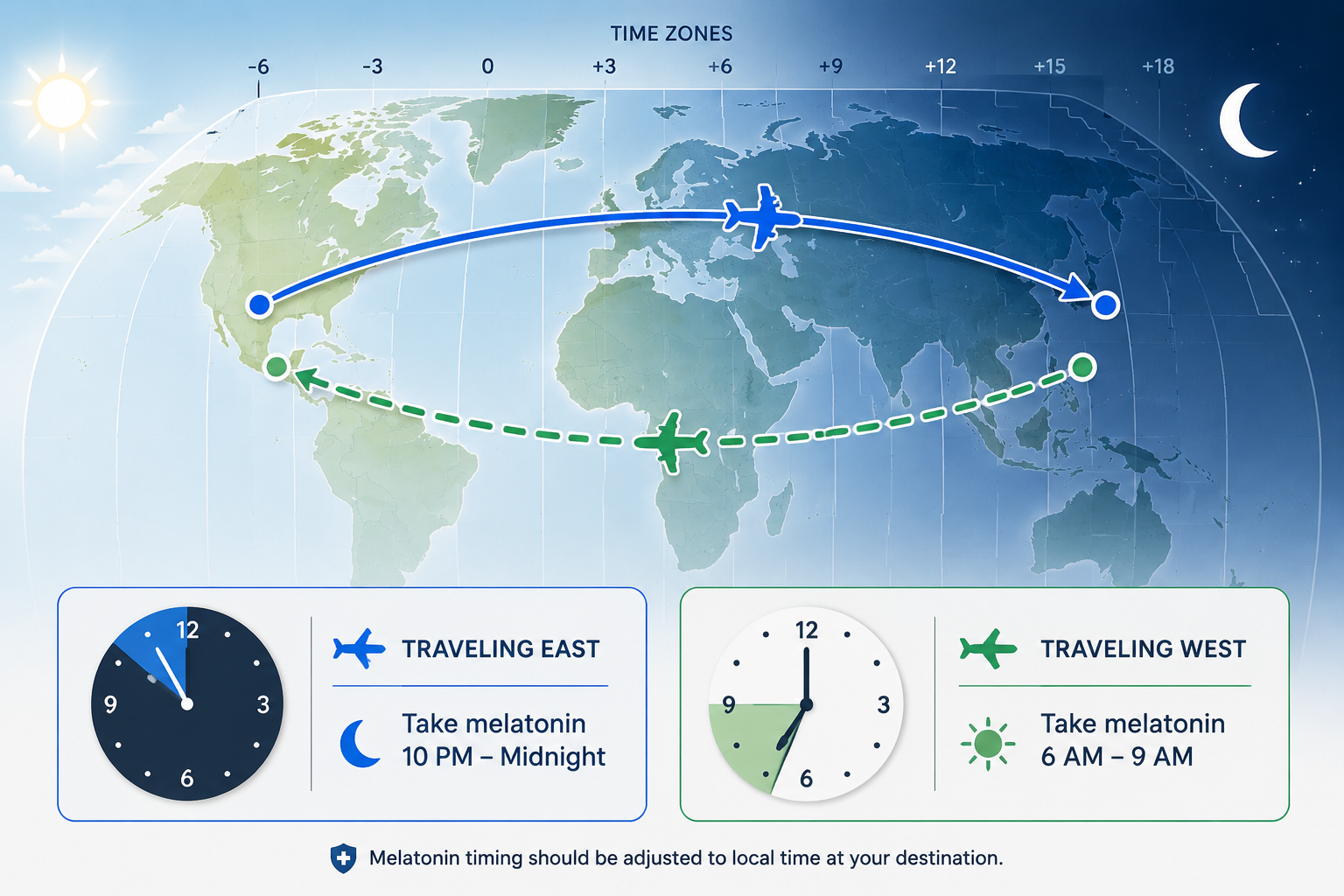
The Eastward Plan: Take It at Destination Bedtime
Eastward travel usually asks your body to sleep earlier than it wants to. Flying from the United States to Europe is the familiar example: the hotel clock says 11 p.m., but your internal clock may still be in the late afternoon or early evening. In that situation, melatonin is used to advance the circadian clock.
For most adult travelers, the practical eastward protocol is to take fast-release melatonin at destination bedtime, commonly between 10 p.m. and midnight local time, for the first few nights after arrival. The effective dose range in the Cochrane review was 0.5–5 mg, and the CDC notes that 0.5–1 mg can be sufficient for circadian shifting; doses above 5 mg are discouraged because they can leave residual daytime melatonin in the body.[1][2]
The dose is not a contest. If the goal is to tell the clock “move earlier,” 0.5–1 mg is a real dose, not a symbolic one. A 5 mg dose may produce faster sleep onset, but higher dosing does not add better jet-lag benefit in the evidence summarized by Cochrane.[1] Mayo Clinic’s patient guidance also frames melatonin as a short-term jet-lag treatment, with timing tied to the new time zone rather than to the traveler’s home schedule.[3]
Fast-release is the better default for this job. You are trying to deliver a timed signal, not to create a slow overnight drip. Slow-release products may make sense for some sleep-maintenance problems, but they are less clean for jet lag because lingering melatonin can blur the next day’s timing signal. For a broader comparison of dose by sleep problem, see the melatonin dosage guide.
The Westward Plan: Morning Use Is the Clock-Delay Tool
Westward travel usually asks your body to stay awake later. A traveler flying from New York to Los Angeles may feel sleepy early in the evening local time and then wake too early the next morning. The circadian task is different: instead of advancing the clock, the traveler often needs to delay it.
That is why westward melatonin timing is not a mirror image of the eastward plan. For westward adjustment, melatonin is used in the destination morning when a clock delay is desired, not automatically at the local bedtime. CDC guidance describes morning melatonin as a way to delay circadian timing, while also warning that incorrect timing can move the clock the wrong way.[2]
This is the point at which many bottle labels fail travelers. “Take before bedtime” may be harmless advice for an occasional sleepless night at home, but it is too vague for a westward jet-lag plan. If you take melatonin in the evening when your body needs a delay, you may send the opposite instruction.
Westward trips also tend to be somewhat easier for many people because the body clock generally delays more readily than it advances. The CDC Yellow Book cites average adaptation rates of about 1.5 hours per day westward and about 1 hour per day eastward.[2] That does not mean westward jet lag is imaginary; it means some travelers need less pre-trip maneuvering and fewer post-arrival doses.
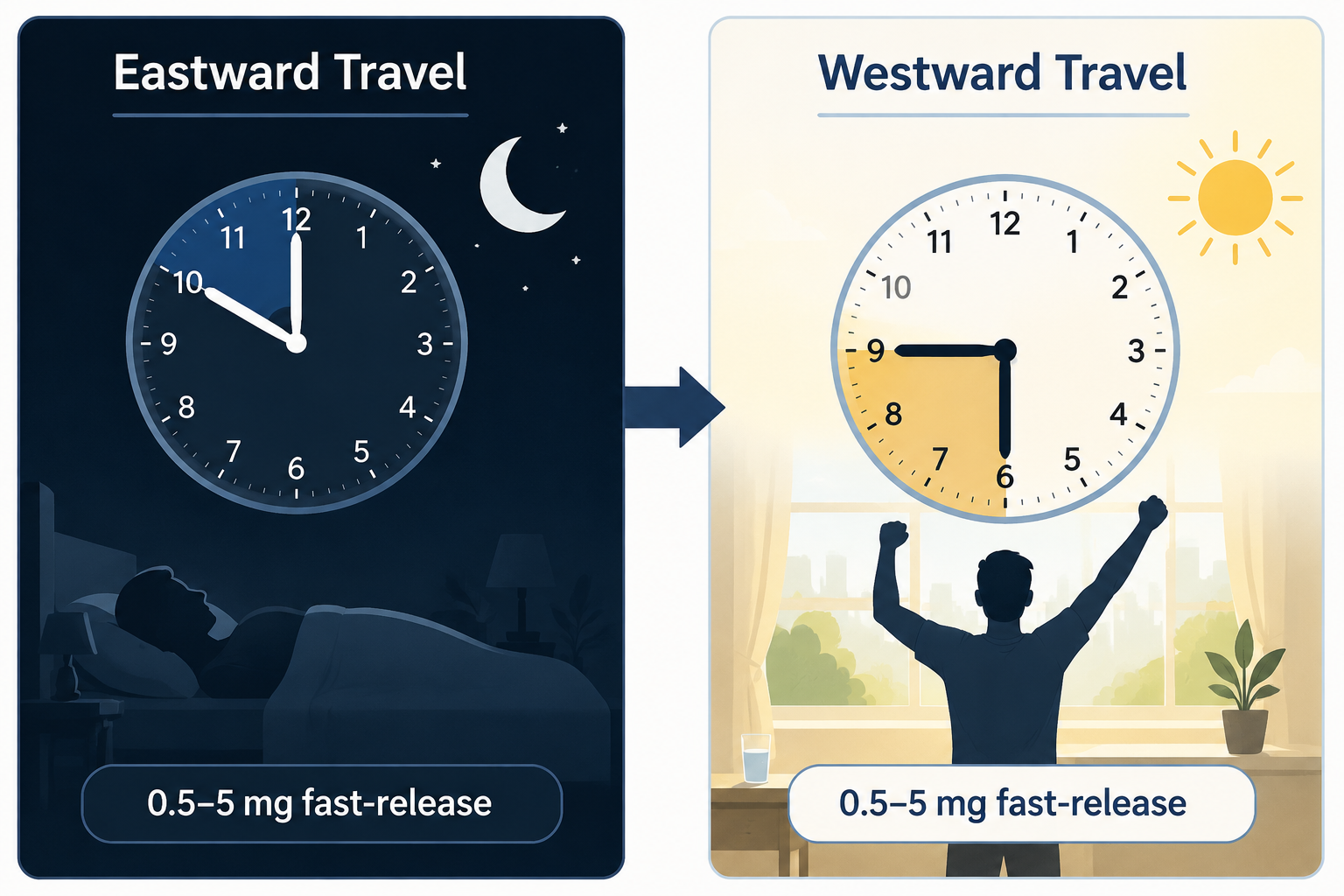
Why Wrong Timing Can Backfire
Jet lag is not just being tired after a flight. It is a mismatch between the clock inside the brain and the clock on the wall. Sleep, alertness, digestion, temperature, and hormone timing are still partly organized around home time while the itinerary demands destination time.
Melatonin can push that internal clock earlier or later depending on when it is taken. That is why the same tablet can be useful at one local time and counterproductive at another. If you want the biology behind that timing curve, the circadian rhythm mechanisms explainer is the better place for the full version; for travel planning, the immediate rule is simpler: anchor dosing to destination time and direction of travel.
The airplane complicates this because the cabin may be dark when it is not bedtime at your destination, and meals may be served at biologically unhelpful times. Do not let the cabin schedule decide the melatonin schedule. Use the destination clock.
Should You Start Before Departure?
Sometimes. Eastward travel is the situation where advance preparation is most useful, because you are asking the body to do the harder maneuver. A practical approach is to move bedtime earlier by about 30 minutes per day for the 3 days before departure, then use destination-bedtime melatonin after arrival if needed.[2]
For westward travel, pre-trip adjustment is often less necessary. Staying up a bit later before departure may help some travelers, but many do well by shifting after arrival with morning light, destination meals, and careful avoidance of premature evening sleep. Morning melatonin is a more specialized tool for delaying the clock; it should not become an automatic add-on for every westward flight.
More detailed schedules exist. The Frontiers in Physiology paper by Roach and Sargent lays out day-by-day light and melatonin plans for 3-, 6-, 9-, and 12-hour shifts, and Timeshifter’s guidance from Steven W. Lockley, Ph.D., gives practical timing rules for travelers.[4][5] Those are useful scheduling aids, but they are not the same kind of evidence as the Cochrane randomized-trial review. Treat them as structured circadian planning support, especially when light exposure is also being controlled.
How Long to Keep Taking It
For most long-haul travelers, melatonin is a short adaptation tool: 2–5 nights after arrival is the usual window, not an open-ended nightly habit.[2] If you are mostly adjusted after two nights, stop. If symptoms persist after several days, the remaining problem may be light timing, sleep deprivation, alcohol, caffeine, illness, schedule demands, or an underlying sleep issue rather than a melatonin shortage.
The same boundary matters on the return trip. Recalculate from scratch based on the direction you are flying home. A westward outbound trip may become an eastward return, and the melatonin timing changes with it.
If You Wake Before 4 A.M. Local Time
Early-morning waking is common after eastward travel. If you wake before 4 a.m. local time and cannot return to sleep, a small rescue dose may be reasonable: 0.5–1 mg, ideally fast-release. The point is not to knock yourself out until noon. The point is to avoid reinforcing a 3 a.m. wake pattern while still protecting the next day’s light exposure and schedule.
Do not take a large dose close to the time you need to be alert. The CDC’s caution about residual daytime melatonin above 5 mg is especially relevant here.[2] If the next morning includes driving, meetings, operating equipment, or supervising children in an unfamiliar place, leave yourself a safety margin.
Product Choice Matters More Than the Label Suggests
A precise protocol depends on a product that contains roughly what the label says it contains. In the United States, melatonin is sold as a dietary supplement, not as a prescription medicine, so product quality is not uniform. This is why a low-dose fast-release tablet from a reputable manufacturer is a better travel tool than a candy-like product with a vague “sleep support” label.
- Choose fast-release rather than slow-release unless a clinician has told you otherwise.
- Look for a product that allows 0.5 mg or 1 mg dosing without guesswork.
- Prefer reputable, third-party-tested products when available.
- Be cautious with gummies if the dose needs to be exact.
- Do not assume that “extra strength” is better for jet lag.
This is not supplement snobbery. If the plan calls for 0.5–1 mg and the product delivers an unpredictable amount, the traveler is no longer following the plan. They are guessing with a nicer label.
Who Should Be More Careful
Healthy adults using melatonin briefly for jet lag generally tolerate it well, and consumer-facing clinical guidance commonly discusses it as a short-term option.[3][6] Still, “available without a prescription” is not the same as “irrelevant to your medical history.”
- Ask a clinician first if you are pregnant, trying to become pregnant, breastfeeding, or managing a seizure disorder, autoimmune condition, serious liver disease, or complex psychiatric condition.
- Check medication interactions if you use anticoagulants, diabetes medicines, blood pressure medicines, sedatives, seizure medicines, or immune-modifying drugs.
- Use extra caution in older adults, especially if fall risk, confusion, nighttime bathroom trips, or next-day grogginess would create a safety problem.
- Do not give melatonin to children for jet lag without pediatric guidance; the jet-lag-specific evidence base is limited.
- Avoid combining melatonin with alcohol or other sedating sleep aids during travel unless specifically advised.
Also be honest about the next morning. A dose that seems harmless in a hotel room can matter if you will be driving on the opposite side of the road, navigating stairs with luggage, or making decisions while sleep-deprived.
What Melatonin Cannot Fix by Itself
Melatonin works best when the rest of the schedule is not fighting it. Timed light is the other major clock signal. Morning light can advance or delay the clock depending on the traveler’s circadian timing, which is why detailed plans sometimes pair melatonin with light exposure and light avoidance.[4][5] If you want the broader mechanism-matching approach, see how to choose a sleep supplement based on your specific sleep problem.
Caffeine, alcohol, heavy late meals, and strategic naps can either help or sabotage the adjustment. None of those erases the melatonin evidence; they explain why a traveler can take the right tablet at the right time and still feel awful after a badly managed first day.
There is also a regulatory footnote worth knowing if you travel internationally: melatonin is treated differently across countries. For example, the NHS does not recommend melatonin for jet lag on the NHS, even though US travel-medicine sources discuss it as an option. That does not overturn the Cochrane findings, but it should make travelers check local rules before packing or buying it abroad.
A Simple Way to Build Your Travel Plan
- Count the direction first: eastward usually needs an advance; westward usually needs a delay.
- Use destination-local time, not home time and not the airplane’s mood lighting.
- Start low: 0.5–1 mg fast-release is often enough for clock shifting.
- Consider up to 5 mg only if sleep onset is the main problem and next-day grogginess would not be dangerous.
- Stop after the short adaptation window, usually 2–5 nights or days after arrival.
Melatonin is one of the better-supported supplement uses in sleep health; for a wider evidence comparison, see natural sleep remedies graded by scientific evidence. But for jet lag, it is not a general sleeping pill for flights. It is a timing tool. The right way to use it is defined by travel direction, destination-local timing, low-dose fast-release use, and stopping once the clock has had time to catch up.
References
- Melatonin for the prevention and treatment of jet lag, Cochrane Review, PMC, 2022, https://pmc.ncbi.nlm.nih.gov/articles/PMC8958662/
- Jet Lag Disorder, CDC Yellow Book 2026, https://www.cdc.gov/yellow-book/hcp/travel-air-sea/jet-lag-disorder.html
- Jet lag disorder — Diagnosis and treatment, Mayo Clinic, https://www.mayoclinic.org/diseases-conditions/jet-lag/diagnosis-treatment/drc-20374031
- Jet Lag Treatment: Light Exposure and Melatonin, Frontiers in Physiology, 2019, https://www.frontiersin.org/journals/physiology/articles/10.3389/fphys.2019.00927/full
- Melatonin for Jet Lag: Type, Dose & Timing, Timeshifter, https://www.timeshifter.com/jet-lag/melatonin-for-jet-lag-type-dose-timing
- Melatonin for jet lag, Harvard Health, https://www.health.harvard.edu/sleep/melatonin-for-jet-lag


Comments
Join the discussion with an anonymous comment.