
Natural sleep remedies are easy to buy and hard to compare. A bottle of melatonin, a magnesium capsule, valerian root, chamomile tea, CBD gummies, lavender spray, and warm milk can all be sold into the same tired moment, even though they do not address the same sleep problem and do not carry the same evidence.
That distinction matters because sleep-aid use is not rare. In 2024, 12.9% of U.S. adults reported using a sleep aid most days or every day, 5.7% reported using over-the-counter medications or supplements, and 15.4% said they had trouble falling asleep most days or every day. Adults 65 and older had the highest frequent sleep-aid use, at 15.8%, which is also the group where adverse effects, drug interactions, and falls deserve more attention. [1]
The commercial confidence is even larger than the clinical certainty. Allied Market Research estimated the global sleep aid supplement market at about $6.8 billion in 2023, with projected growth of about 5.1% annually. [2] Sales volume does not tell you which ingredient helps, which sleep problem it fits, or whether the capsule contains what the label says.
Two corrections should come before any ranking. Natural does not mean effective. Natural also does not mean accurately labeled or automatically safe. In one Journal of Clinical Sleep Medicine analysis of 31 melatonin supplements purchased from Canadian retailers, more than 71% were not within 10% of the labeled dose; actual melatonin content ranged from 83% less than labeled to 478% more than labeled. [3] That study was small and market-specific, so it should not be stretched into a precise estimate for every supplement shelf. It is still a useful warning: the label is not the evidence.
In the U.S., dietary supplements are not verified by the FDA for safety, effectiveness, or label accuracy before they reach consumers. [4] Third-party verification from groups such as USP, NSF, or ConsumerLab cannot prove that a sleep remedy works, but it can reduce one basic uncertainty: whether the product is more likely to contain what it claims.
The Evidence Map
| Evidence tier | Remedies | Best-supported use | Main caution |
|---|---|---|---|
| Tier 1: strongest, but specific | Melatonin; valerian | Melatonin for circadian timing problems; valerian for modest sleep-quality improvement | Melatonin is not a general chronic-insomnia treatment; valerian evidence quality is low to moderate |
| Tier 2: moderate or emerging | Magnesium; L-theanine; glycine | Selected poor sleepers, older adults, anxious sleepers, or people with sleep fragmentation | Evidence is narrower than marketing claims |
| Tier 3: limited or mixed | Passionflower; chamomile supplements; tart cherry; kava; CBD | Possible symptom-specific or preliminary use | Insufficient large, consistent trials; kava carries liver-safety concerns |
| Tier 4: minimal trial support | Warm milk; chamomile tea; lavender | Low-risk bedtime ritual for some adults | Comfort should not be mistaken for insomnia treatment |
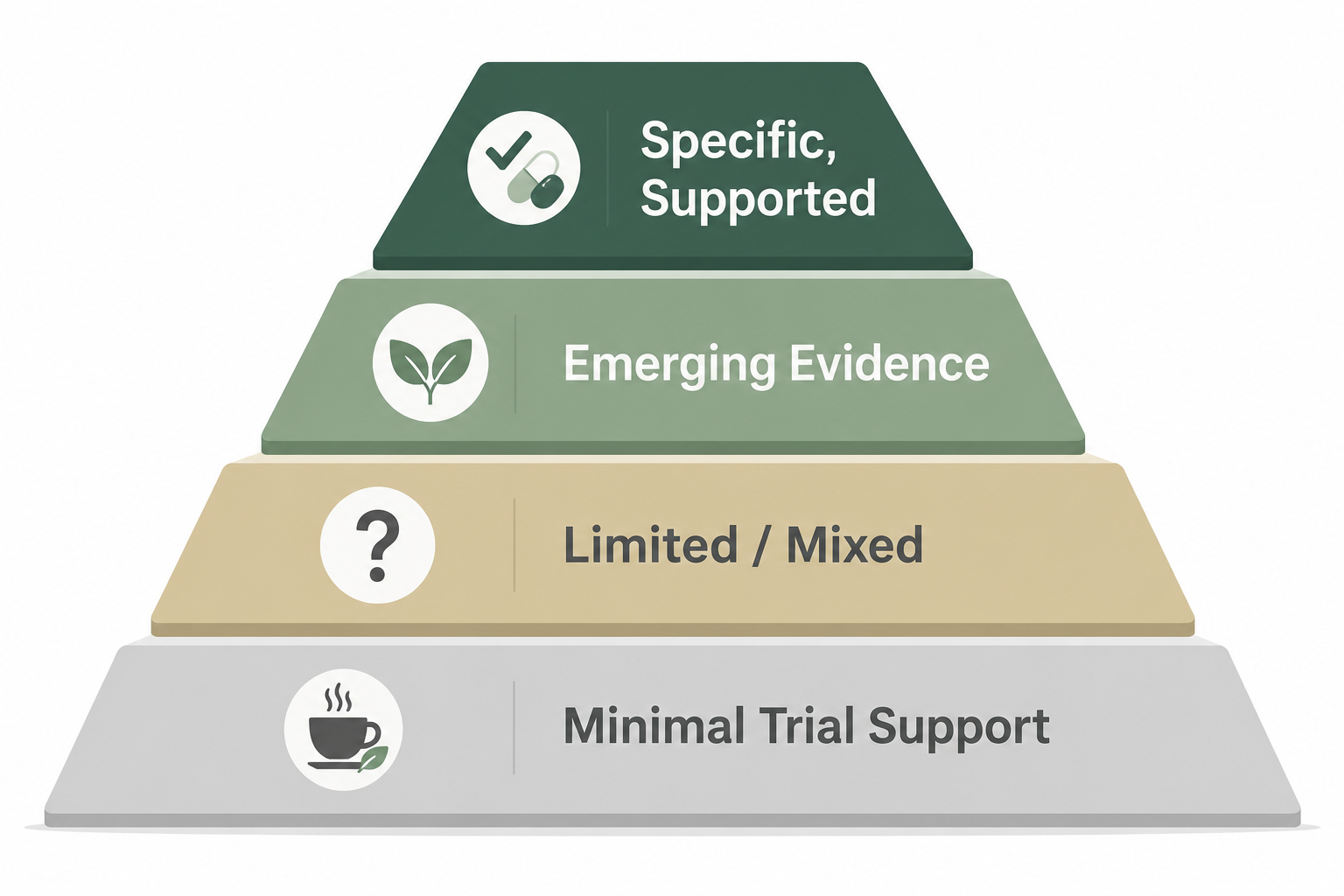
This table is not a moral ranking of “natural” versus “medical.” It is a usefulness ranking. The practical question is: which sleep problem are you trying to solve, in which person, with what evidence, and with what safety caveats?
Tier 1: The Best Evidence Is Not the Broadest Evidence
Melatonin: useful for body-clock timing, weak for chronic insomnia
Melatonin is the remedy most likely to be both overused and misunderstood. It is a hormone signal involved in circadian timing, not a universal sedative. The American Academy of Sleep Medicine recommends strategically timed melatonin for several circadian rhythm sleep-wake disorders, including some jet lag, delayed sleep-wake phase, and shift-work situations. [5]
That support does not transfer cleanly to chronic insomnia. Harvard sleep specialist Dr. Suzanne Bertisch has summarized the insomnia evidence bluntly: “Several randomized clinical trials have shown that melatonin is not effective for insomnia.” [6] AASM guidance similarly recommends that clinicians not use melatonin for sleep-onset or sleep-maintenance insomnia in adults. [7]
This is where many buying decisions go wrong. If someone is sleepy at the wrong time because their internal clock is shifted, melatonin may be a timing tool. If someone is awake because of conditioned insomnia, pain, alcohol rebound, medication effects, untreated sleep apnea, hot flashes, panic, or a bedroom routine that trains alertness, adding more melatonin may simply miss the cause.
Use is widespread despite those boundaries. AASM-linked consumer reporting has noted that nearly two-thirds of American adults have tried melatonin. [8] That number describes adoption, not effectiveness. It also makes label quality more than a technical detail. If a product may contain far less or far more melatonin than stated, the person taking it may be adjusting a dose that was never real in the first place.
- Melatonin is most defensible when the main problem is timing: jet lag, delayed sleep phase, or shift-work-related circadian mismatch.
- It is less defensible as a nightly default for chronic insomnia without first identifying why sleep is failing.
- For supplement purchases, third-party testing matters more with melatonin than many shoppers realize because label accuracy has been a documented problem.
- Older adults, pregnant or nursing people, people taking interacting medications, and people with complex medical conditions should treat “natural hormone” claims cautiously.
Valerian: modest sleep-quality signal, not a knockout remedy
Valerian earns a higher grade than most herbal sleep remedies, but not the breathless one it often gets in marketing copy. A 2020 meta-analysis of 18 randomized controlled trials found statistically significant improvement in sleep quality, with a standardized mean difference of -0.46, and reduced sleep latency, with a standardized mean difference of -0.71. [9] In ordinary language, that points toward a possible modest benefit, not a reliable cure.
The same review rated the underlying study quality as low to moderate. [9] That matters because valerian trials vary in preparation, dose, population, and outcome measures. A person with mild sleep-quality complaints may reasonably view valerian as a trial option. A person with months of severe insomnia should not read the meta-analysis as proof that an herb can replace insomnia treatment.
Valerian may also appear in conversations about menopausal sleep disruption. If night sweats, mood changes, or perimenopausal symptoms are part of the pattern, the better first step is to name that pattern rather than treating it as generic sleeplessness. The guide to perimenopause and sleep disruption is the more useful comparator for that situation.
Tier 2: Plausible Options With Narrower Evidence
Magnesium: most interesting in older adults and stress-linked sleep
Magnesium has a more specific evidence base than many broad supplement claims suggest. In an 8-week randomized trial in older adults with primary insomnia, 500 mg of magnesium improved sleep time and sleep efficiency, reduced Insomnia Severity Index scores, and lowered serum cortisol compared with placebo. [10]
That trial supports a narrower thought: magnesium may be reasonable to discuss for older adults or people whose sleep problem overlaps with arousal and stress physiology. It does not prove that every poor sleeper is magnesium-deficient, and it does not make magnesium a stand-alone answer for chronic insomnia.
Magnesium form and tolerance also matter. Some forms can cause gastrointestinal side effects, and people with kidney disease or medication interactions should not casually add high-dose minerals. The safer version of this choice is not “take magnesium because it is natural”; it is “ask whether magnesium fits this person’s medical context and sleep pattern.”
L-theanine: calming without the promise of sedation
L-theanine is usually discussed as a calming amino acid rather than a classic hypnotic. Sleep Foundation’s evidence summary, citing NIH information, notes that doses up to 200 mg per day appear safe and may improve sleep quality by reducing nighttime awakenings without causing next-day sleepiness. [11]
That makes L-theanine most plausible for a sleeper whose problem is light, fragmented, anxious sleep rather than a shifted body clock or severe insomnia. If worry is the main driver, ingredient matching should be more careful than grabbing the strongest-looking bottle. The anxiety-focused guide to OTC sleep aids for anxiety walks through that symptom-first decision more directly.
Glycine: promising for subjective sleep quality
Glycine has a small but interesting evidence niche. Sleep Foundation summarizes crossover studies in poor sleepers where 3 g of glycine before bed improved subjective sleep quality and reduced next-day fatigue. [12] The outcome is important: subjective sleep quality and next-day fatigue are meaningful, but they are not the same as curing insomnia or correcting circadian timing.
For a person who falls asleep but wakes feeling unrefreshed, glycine may be more relevant than another sedating herb. For a person who cannot sleep because of a persistent insomnia cycle, it remains a limited-evidence supplement rather than first-line care.
Tier 3: Limited, Mixed, or Safety-Limited Remedies
Several popular natural sleep remedies sit in the uncomfortable middle: not ridiculous, not proven enough for confident recommendations, and often sold with more certainty than the trials justify. A systematic review of herbal medicine for insomnia concluded that evidence was insufficient to support firm conclusions. [13]
| Remedy | What the evidence allows you to say | Practical caution |
|---|---|---|
| Passionflower | Possible calming or sleep-related benefit, but evidence remains limited. | Do not treat it as a proven insomnia therapy. |
| Chamomile supplements | Traditional use and some limited study interest, but not enough for strong insomnia claims. | Separate concentrated supplements from casual chamomile tea. |
| Tart cherry | Preliminary interest, often connected to melatonin content and sleep measures. | Sugar content, product type, and small-study limitations matter. |
| Kava | May have anxiolytic effects, which could matter for some sleep complaints. | Liver toxicity concerns change the risk calculation; “natural” is not reassuring here. |
| CBD | Preliminary sleep interest, but few large randomized trials for insomnia. | Product variability, drug interactions, and next-day effects need caution. |
Kava deserves special restraint because safety can outweigh plausibility. A remedy that may calm anxiety but carries hepatotoxicity concerns is not in the same category as a cup of tea. CBD also needs a cleaner conversation than it usually gets: early interest is not the same as large, consistent insomnia-trial evidence, and product variability can make dose comparisons messy.
Tier 4: Rituals Are Allowed, but They Are Not Treatments
Warm milk, chamomile tea, and lavender belong in a different mental folder. Johns Hopkins Medicine describes these kinds of natural sleep aids as having “not much scientific proof but no harm trying.” [14] That is a fair, modest claim. A warm drink can mark the end of the day. A familiar scent can become part of a wind-down cue. A ritual can reduce friction around bedtime.
The problem begins when comfort is packaged as treatment. If a nightly tea helps someone keep a consistent routine and stop scrolling, it may be useful. If it delays evaluation of severe insomnia, untreated sleep apnea, medication side effects, depression, alcohol-related sleep disruption, or restless legs symptoms, it has become a distraction.
For readers mainly looking for behavioral and traditional home approaches rather than supplement decisions, the companion home remedies for insomnia evidence guide is the better next stop.
When Supplements Are the Wrong Comparator
For chronic insomnia, the relevant comparison is not melatonin versus valerian versus magnesium. It is supplements versus cognitive behavioral therapy for insomnia. CBT-I is recommended as first-line treatment by major clinical organizations, including the AASM, the European Sleep Research Society, and the American College of Physicians; 6- to 8-session protocols are associated with response rates of about 70% to 80%. [15]
That does not mean every poor night needs formal therapy. It means that persistent insomnia should not be treated as a supplement shopping problem. If sleep trouble has lasted for months, causes daytime impairment, or has become a cycle of dread, effort, and clock-watching, the article on what actually cures insomnia with CBT-I is a better clinical starting point than another bottle.
The same logic applies to routine. Supplements often get blamed or praised for changes that actually come from bedtime consistency, light exposure, alcohol timing, caffeine timing, temperature, and how much wakefulness happens in bed. The guide to sleep hygiene fundamentals and an evidence-based bedtime routine covers that foundation.
A Practical Way to Choose
- If the sleep problem is circadian timing, melatonin has the clearest role, but timing, dose reliability, and product quality matter.
- If the problem is mild sleep-quality difficulty, valerian may offer modest benefit, with expectations kept modest.
- If the pattern is older-adult insomnia, stress-linked arousal, or fragmented sleep, magnesium, L-theanine, or glycine may be reasonable to consider within their narrower evidence limits.
- If the remedy is warm milk, chamomile tea, or lavender, treat it as a ritual unless better evidence or a clearer diagnosis says otherwise.
- If insomnia is chronic, impairing, or escalating, use CBT-I and medical evaluation as the benchmark, not the supplement aisle.
The useful conclusion is narrower than most marketing and less dismissive than blanket skepticism. Some natural sleep remedies can help some sleep problems. Melatonin makes the most sense for circadian timing problems. Valerian may modestly improve sleep quality for some people. Magnesium and calming amino acids may fit selected situations. Most traditional remedies are better understood as low-evidence bedtime rituals. None of them should let the word “natural” replace diagnosis, evidence grade, label quality, safety, or first-line care.
References
- Use of Sleep Aids Among Adults Age 18 and Older: United States, 2024 — CDC National Center for Health Statistics, 2024.
- Sleep Aids Supplement Market — Allied Market Research.
- Melatonin Natural Health Products and Supplements: Presence of Serotonin and Significant Variability of Melatonin Content — Journal of Clinical Sleep Medicine, 2017.
- Questions and Answers on Dietary Supplements — U.S. Food and Drug Administration.
- Clinical Practice Guideline for the Treatment of Intrinsic Circadian Rhythm Sleep-Wake Disorders — American Academy of Sleep Medicine, Journal of Clinical Sleep Medicine, 2015.
- Can supplements really help you sleep? — Harvard Health Publishing, 2022.
- Clinical Practice Guideline for the Pharmacologic Treatment of Chronic Insomnia in Adults — American Academy of Sleep Medicine, Journal of Clinical Sleep Medicine, 2017.
- Melatonin and Sleep — Sleep Foundation.
- Valerian for Sleep: A Systematic Review and Meta-Analysis — Journal of Evidence-Based Integrative Medicine, 2020.
- The effect of magnesium supplementation on primary insomnia in elderly: A double-blind placebo-controlled clinical trial — Journal of Research in Medical Sciences, 2012.
- L-Theanine for Sleep — Sleep Foundation.
- Glycine for Sleep — Sleep Foundation.
- Herbal medicine for insomnia: A systematic review and meta-analysis — Sleep Medicine Reviews, 2015.
- Natural Sleep Aids: Home Remedies to Help You Sleep — Johns Hopkins Medicine.
- Behavioral and psychological treatments for chronic insomnia disorder in adults: an American Academy of Sleep Medicine clinical practice guideline — American Academy of Sleep Medicine, Journal of Clinical Sleep Medicine, 2021.


Comments
Join the discussion with an anonymous comment.