

The problem with searching for the best sleep supplements is that “can’t sleep” is doing too much work. One person cannot fall asleep until 2 a.m. after flying east. Another gets into bed exhausted and then feels mentally electric. Someone else is physically restless, tight, or cramp-prone. Another falls asleep easily and wakes at 3 a.m. with no obvious trigger.
Those are not the same sleep problem. They should not automatically lead to the same capsule.
A sleep supplement is most defensible when its active ingredient has a clean job to do: shift timing, reduce stress-driven arousal, support relaxation where a deficiency or tension pattern may matter, or modestly improve next-day fatigue after imperfect sleep. That is a narrower promise than most labels make, but it is also more useful.

Start by naming the bottleneck
Before choosing a supplement, identify which part of sleep is failing. The answer does not have to be perfect, but it should be specific enough that you can tell whether the ingredient is doing what it is supposed to do.
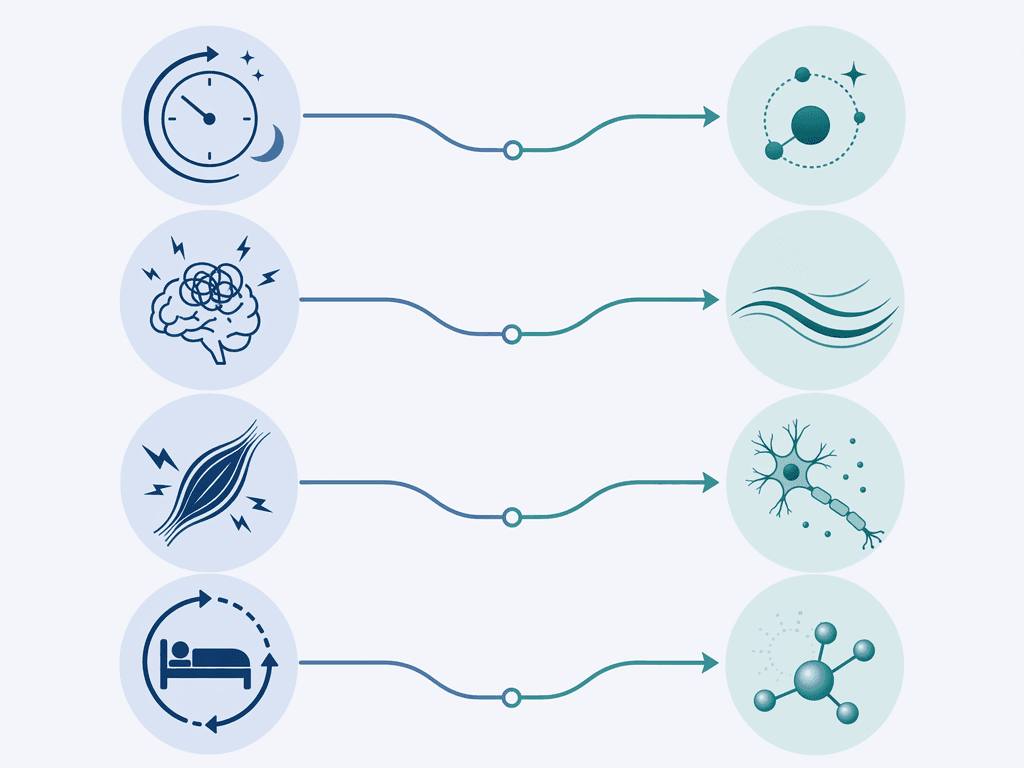
| If the problem sounds like this | Likely bottleneck | Most plausible supplement match | What you would expect to change |
|---|---|---|---|
| You are sleepy at the wrong time, alert at bedtime, jet-lagged, shift-worked, or naturally delayed. | Circadian misalignment | Melatonin | Sleep timing shifts earlier or stabilizes. |
| You are tired but wired, mentally rehearsing, stress-reactive, or physically calm but internally activated. | Stress-driven hyperarousal | L-theanine | Arousal feels lower; falling asleep may become easier if stress is the barrier. |
| You feel tense, restless, twitchy, or prone to muscle tightness; diet or baseline status may be relevant. | Muscle tension or restlessness | Magnesium | Sleep onset may improve, especially if magnesium status is low. |
| You sleep, but sleep feels light or non-restorative; next-day fatigue is the main complaint. | Sleep-quality or maintenance fragmentation | Glycine, cautiously | Subjective sleep quality or next-day fatigue may improve modestly. |
This table is not a diagnosis. It is a buying filter. If your pattern is chronic, severe, worsening, linked with breathing pauses, major mood symptoms, medication changes, pain, alcohol use, or daytime safety risks, the right next step is not to keep rotating supplements.
Melatonin: useful when the clock is wrong, overused when sleep is simply hard
Melatonin is easiest to misuse because it has become shorthand for “natural sleeping pill.” Its better role is as a circadian timing signal. Your body releases melatonin in relation to darkness; supplemental melatonin is most coherent when the problem is that your internal clock is out of sync with the sleep schedule you need.
That makes it a more logical fit for jet lag, delayed sleep phase, certain shift-work schedules, or a pattern where sleepiness reliably arrives too late. It is less persuasive as a nightly answer for chronic insomnia when the main problem is lying awake despite being on the right schedule. A review of sleep supplement evidence notes that the American Academy of Sleep Medicine guideline found evidence weakly against melatonin for chronic insomnia involving sleep onset or sleep maintenance, even though melatonin remains relevant for circadian rhythm problems. The same review found that 5 of 7 randomized controlled trials reported statistically significant sleep-quality improvements, but the trials used different doses, including 3 mg and 10 mg, and intervention periods ranging from 30 days to 6 months, which makes a single “best dose” hard to defend [1].
Johns Hopkins Medicine makes the same practical distinction: melatonin is described as a hormone that helps regulate the sleep-wake cycle, rather than as a general sedative [2]. If you want a deeper dose-and-timing discussion by problem type, use a dedicated melatonin dosage guide instead of guessing from the front of a bottle.
The key question is not “Will melatonin knock me out?” It is “Am I trying to move a clock?” If the answer is yes, timing usually matters as much as the milligram amount. If the answer is no, melatonin may still make you feel as if you did something, but it may not be aimed at the part of sleep that is actually failing.
A product-quality problem you should not ignore
Melatonin also has one of the clearest supplement-quality warnings. The American Academy of Sleep Medicine summarized a 2017 Journal of Clinical Sleep Medicine study in which 71% of tested melatonin supplements were outside a 10% margin of their labeled content. Actual melatonin content ranged from 83% below the label claim to 478% above it, and 26% of products contained unlabeled serotonin [3].
That does not mean every melatonin product is bad. It means a melatonin plan is not just an ingredient decision; it is also a quality-control decision. If you are trying to fine-tune a circadian signal, a product that may contain far more or less than the label says is not a small detail.
Magnesium: more plausible for tension and restlessness than for every case of insomnia
Magnesium is often sold as a sleep supplement because it is involved in neuromuscular function and pathways related to relaxation. That mechanism makes it most interesting when the sleep complaint has a physical component: tension, restlessness, cramp-prone muscles, or a sense that the body will not settle even when the schedule is reasonable.
The evidence is conditional, not empty. A 2021 systematic review discussed in the 2024 evidence overview found that magnesium reduced sleep onset latency by about 17 minutes in older adults. That is a meaningful number if you are the person lying awake every night waiting for your body to power down. But the same evidence picture includes a 7-week randomized controlled trial using 320 mg of magnesium citrate that found no difference versus placebo. The likely dividing line is baseline magnesium status: benefit appears more plausible in people starting low, rather than in everyone who happens to sleep poorly [1].
This is where supplement marketing tends to blur the most important distinction. “Magnesium helps sleep” is too broad. “Magnesium may help sleep onset in some people, particularly where low status or physical restlessness is part of the pattern” is less glamorous and more accurate.
Form matters for tolerability, and dose matters for side effects. Magnesium citrate, glycinate, oxide, and other forms are not interchangeable in how people experience them. If magnesium is the match you are considering, a form-specific guide such as magnesium glycinate for sleep is a better next stop than choosing the largest bottle on sale.
L-theanine: a reasonable match for “wired but tired,” with a narrower sleep claim
L-theanine earns attention because “wired but tired” is a real state, not a wellness cliché. Many people are sleepy in the abstract and still too activated to fall asleep. Their bottleneck is not the clock. It is arousal: stress physiology, mental rehearsal, anticipatory worry, or a body that keeps acting as if the day is not over.
The evidence fits that narrower use better than it fits a broad promise of longer sleep. In a 2021 randomized controlled trial summarized in the 2024 review, 200 mg per day of L-theanine increased alpha brainwave activity and reduced salivary cortisol after acute stress. Those are calming-physiology signals. But a later 28-day trial had mixed objective sleep findings and did not show a clear improvement in total sleep time [1].
That split matters. Feeling calmer before bed is valuable if stress is what blocks sleep. It is not the same as proving that L-theanine reliably extends total sleep duration or repairs sleep architecture. For someone who wakes repeatedly because of untreated sleep apnea, alcohol rebound, pain, hot flashes, or medication effects, a calming amino acid is unlikely to be the central solution.
If your nights are dominated by anxious activation, it may help to understand the broader physiology behind that pattern. The article on why anxiety gets worse at night goes deeper into the cortisol-melatonin conflict without turning every anxious night into a supplement problem.
Glycine: modest, interesting, and easy to oversell
Glycine is the quietest of the four. It does not have melatonin’s clock-shifting identity, magnesium’s familiar relaxation reputation, or L-theanine’s stress-calming appeal. Its sleep case is more modest: studies have often used 3 g before bed and looked at subjective sleep quality, fatigue, and next-day performance under imperfect sleep conditions.
The encouraging part is that glycine has been associated with improved subjective fatigue and reaction time in partial sleep restriction studies. The limiting part is that the evidence base is small, and much of it is more than a decade old. A 2024 review still treats glycine as promising but limited, not as a broadly proven fix for sleep maintenance insomnia [1].
That makes glycine a possible fit for someone whose main complaint is non-restorative sleep or next-day tiredness after short sleep, especially when the goal is gentle support rather than sedation. It is not the first ingredient I would reach for if the problem is a shifted circadian rhythm, acute stress arousal, or obvious physical restlessness.
How strong is the match?
Evidence strength is not just about whether a study somewhere found a positive result. It is about whether the mechanism, study population, outcome, dose, and your actual sleep complaint line up. A supplement can be evidence-supported for one job and poorly matched for another.
| Ingredient | Best-fit bottleneck | Evidence signal | Main caveat |
|---|---|---|---|
| Melatonin | Circadian misalignment | Most coherent when used as a timing signal for clock-related sleep problems. | Not well supported as a general chronic-insomnia sedative; dose and product content vary. |
| Magnesium | Tension, restlessness, possible low magnesium status | Systematic review signal includes about 17 minutes shorter sleep-onset latency in older adults. | A magnesium citrate RCT found no benefit versus placebo; baseline status may determine who benefits. |
| L-theanine | Stress-driven hyperarousal | 200 mg/day showed stress-physiology effects in an RCT, including alpha-wave and cortisol changes. | Objective sleep-duration results are mixed; calm is not the same as longer sleep. |
| Glycine | Sleep quality or next-day fatigue support | 3 g before bed has shown subjective fatigue and reaction-time benefits in partial sleep restriction studies. | Small, older evidence base; not a proven broad sleep-maintenance treatment. |
The supplement label is part of the evidence problem
Even a well-matched ingredient can become a poor choice if the product is unreliable. Sleep Foundation’s overview of natural sleep aids emphasizes that supplement evidence varies by ingredient and that natural products are not automatically risk-free [4]. Its guide to evaluating sleep supplements also explains the regulatory gap: under the Dietary Supplement Health and Education Act of 1994, supplements are regulated differently from drugs, and manufacturers do not have to prove effectiveness to the FDA before selling them [5].
That is why “OTC” can be confusing. A supplement sold over the counter is not evaluated the same way as an FDA-monographed over-the-counter drug. If that distinction is new, the practical differences are covered in what over the counter actually means for sleep aids.
For sleep supplements, quality markers are not decorative. They are part of risk management. Look for clear single-ingredient labeling when you are testing a mechanism, avoid proprietary blends that make dose impossible to interpret, and prefer products with credible third-party testing. If you combine several sedating or calming ingredients at once, you lose the ability to know what helped, what caused side effects, or what should be stopped.
A practical sequence before you buy three bottles
The most boring sequence is usually the safest one: stabilize the basics first, then test one targeted supplement only if the bottleneck is clear. Sleep hygiene does not solve every sleep disorder, but if light exposure, caffeine timing, alcohol, irregular wake times, or late-night screen habits are actively pushing against the supplement, the supplement has to fight your routine every night.
- Start with the fundamentals: consistent wake time, appropriate light exposure, caffeine cutoff, alcohol awareness, and a wind-down period. For a fuller version, use sleep hygiene fundamentals rather than trying to rebuild your routine from memory.
- Name the bottleneck in one sentence: “My clock is late,” “My mind is activated,” “My body is restless,” or “My sleep feels fragmented and non-restorative.”
- Choose one ingredient whose mechanism fits that sentence. Do not start melatonin, magnesium, L-theanine, and glycine together.
- Track the expected mechanism, not just whether the night felt good. For melatonin, did timing shift? For L-theanine, did arousal drop? For magnesium, did tension or sleep-onset restlessness change? For glycine, did subjective sleep quality or next-day fatigue improve?
- Stop if there is no meaningful change, side effects appear, or the pattern points to something a supplement is not designed to address.
Harvard Health frames sleep supplements as something to approach carefully, especially when insomnia may have an underlying medical, medication-related, or behavioral cause [6]. That caution is not anti-supplement. It is pro-not-wasting-time.
When the supplement aisle is the wrong place to keep looking
If insomnia is chronic, the standard first-line treatment is not a supplement; it is cognitive behavioral therapy for insomnia, often called CBT-I. Supplements may be adjuncts for narrow problems, but they should not replace evaluation when the pattern is persistent or clinically suggestive [1].
Escalate sooner if you have loud snoring or witnessed breathing pauses, restless legs symptoms, panic-like awakenings, depression or severe anxiety, dangerous daytime sleepiness, new insomnia after starting a medication, or sleep disruption tied to pain, hot flashes, alcohol, or other medical changes. In those situations, the most important question is not which supplement is best. It is what condition is being missed.
If you are comparing supplements with OTC or prescription options, use a broader sleep aid selection guide so the choice is not artificially limited to the supplement shelf.
The decision rule
Choose melatonin when the sleep-wake clock is the problem. Consider L-theanine when stress arousal is the barrier. Consider magnesium when physical tension, restlessness, or possible low status makes the mechanism plausible. Treat glycine as a modest sleep-quality or next-day-fatigue support with limited evidence.
The better question is not “What is the best sleep supplement?” It is “Which mechanism matches the thing that is actually keeping me from sleeping?” Choose the mechanism, not the trend.
References
- PMC11082867 (2024 systematic review) — PMC — 2024
- Melatonin for Sleep: Does It Work? — Johns Hopkins Medicine
- Study Finds That Melatonin Content of Supplements Varies Widely — American Academy of Sleep Medicine
- Natural Sleep Aids — Sleep Foundation
- How to Evaluate Sleep Supplements — Sleep Foundation
- Supplementing Your Sleep — Harvard Health

Comments
Join the discussion with an anonymous comment.