
The most reasonable worry about Nature Made melatonin gummies is not whether the bottle looks reputable. It is whether the gummy actually contains the dose on the label, and whether that dose is a sensible one to take.
That first question matters because melatonin gummies have a real labeling problem. In a 2023 JAMA analysis of 25 melatonin gummy products sold in the U.S., 22 products — 88% — were inaccurately labeled. Actual melatonin content ranged from 74% to 347% of the amount declared on the label, and only 3 products were within 10% of the labeled dose.[1]
That study should not be turned into a direct accusation against Nature Made. The published brand code table did not identify Nature Made as one of the tested brands. What the study does show is the condition of the aisle Nature Made is competing in: a gummy market where a clean-looking label cannot be assumed to mean a measured dose.
Nature Made’s better argument is separate: many of its products carry USP verification. USP verification checks that a dietary supplement contains the ingredients listed on the label in the declared potency, does not contain harmful levels of specified contaminants, breaks down properly, and is made under FDA current good manufacturing practices. Nature Made says it was the first national vitamin brand to earn USP Dietary Supplement Verification and that it holds the USP Verified Mark on more products than any other national brand.[2]
That makes Nature Made a comparatively strong label-accuracy choice in a messy category. It does not settle the second question: whether 2.5 mg, 5 mg, or 10 mg is the amount most adults should want from a melatonin gummy.
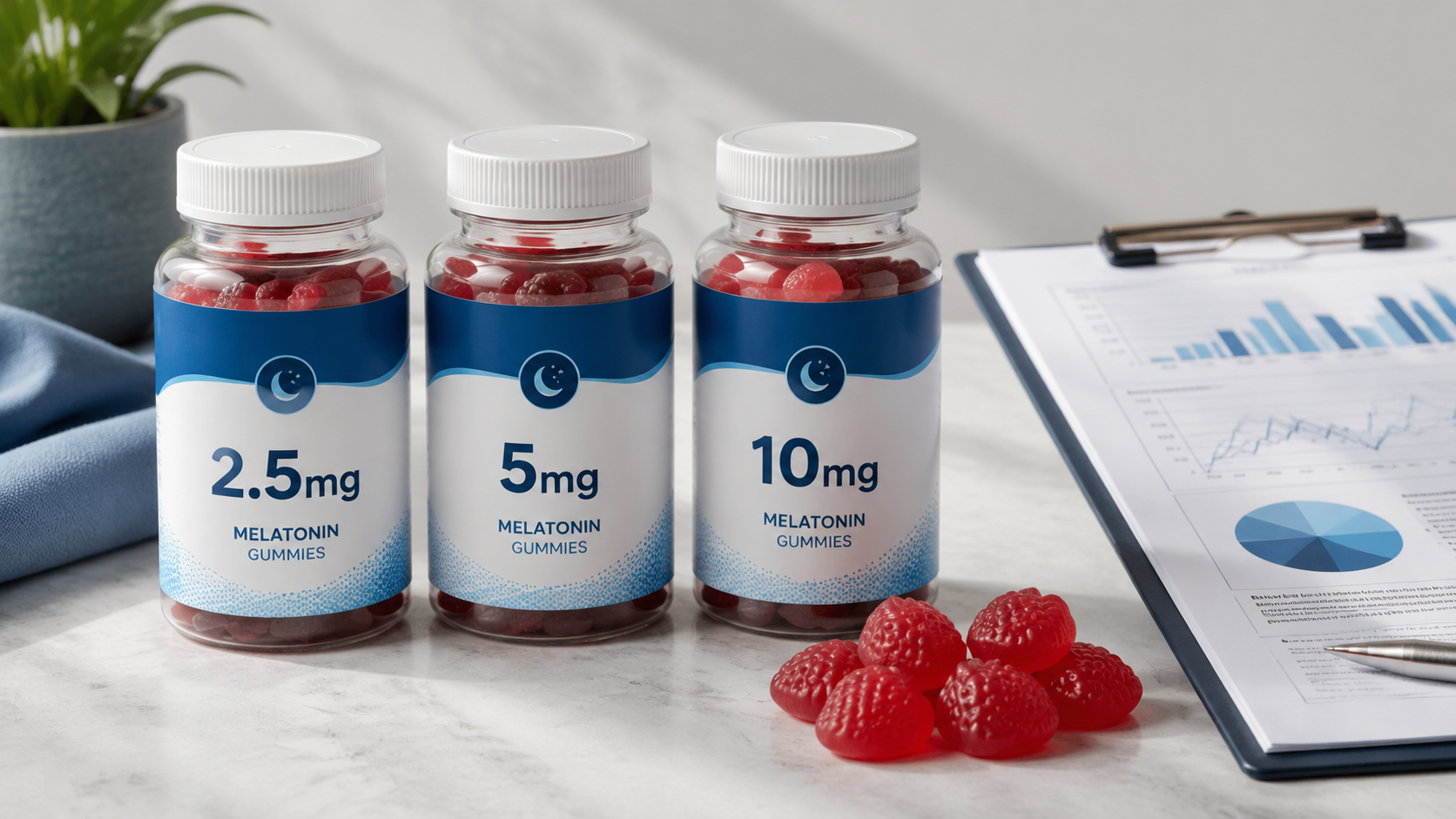
What USP Verification Can Tell You — And What It Cannot
For melatonin gummies, USP verification is not a decorative trust badge. It speaks to the exact weakness exposed by the JAMA gummy study: whether the active ingredient is present in the amount the label claims. If a shopper is choosing between an unverified gummy and a USP-verified Nature Made gummy, verification is a meaningful advantage.
It is still a quality standard, not a clinical endorsement. USP verification does not mean melatonin is the right sleep aid for a particular person, that a higher dose works better, or that a gummy is the best format. It means the product has met a set of manufacturing and label-quality checks.[2]
That distinction is easy to lose in the pharmacy aisle. A verified 10 mg serving is reassuring if the fear is hidden underdosing or overdosing. It is less reassuring if the real problem is that 10 mg is simply more melatonin than most adult sleep situations require.
For a broader look at why third-party verification matters more than brand polish in this category, see our guide to choosing the best melatonin for adults based on label accuracy.
The Dose Problem Starts Below the Retail Shelf
The body does not normally produce melatonin in retail-gummy quantities. GoodRx summarizes research indicating that the body naturally produces about 0.1 mg to 0.9 mg of melatonin per night, and that supplemental doses around 0.1 mg to 0.3 mg can raise blood melatonin into the normal nighttime range.[3] UC Davis Health similarly describes low-dose melatonin as often sufficient and notes that more is not necessarily better.[4]
This is where the usual “maximum strength” logic becomes unhelpful. Melatonin is a timing signal, not a sedative that becomes neatly stronger as the milligrams climb. A larger serving may create higher blood levels, but that is not the same as a better sleep result.
The 0.3 mg to 0.5 mg benchmark is best treated as a research-derived physiological reference point, not as an FDA-approved insomnia dose or a formal recommendation from the American Academy of Sleep Medicine. The American Academy of Sleep Medicine does not recommend melatonin as a treatment for chronic insomnia. That caveat matters, but it should not be flattened into “melatonin never helps.” It means the dose discussion should stay modest and specific.
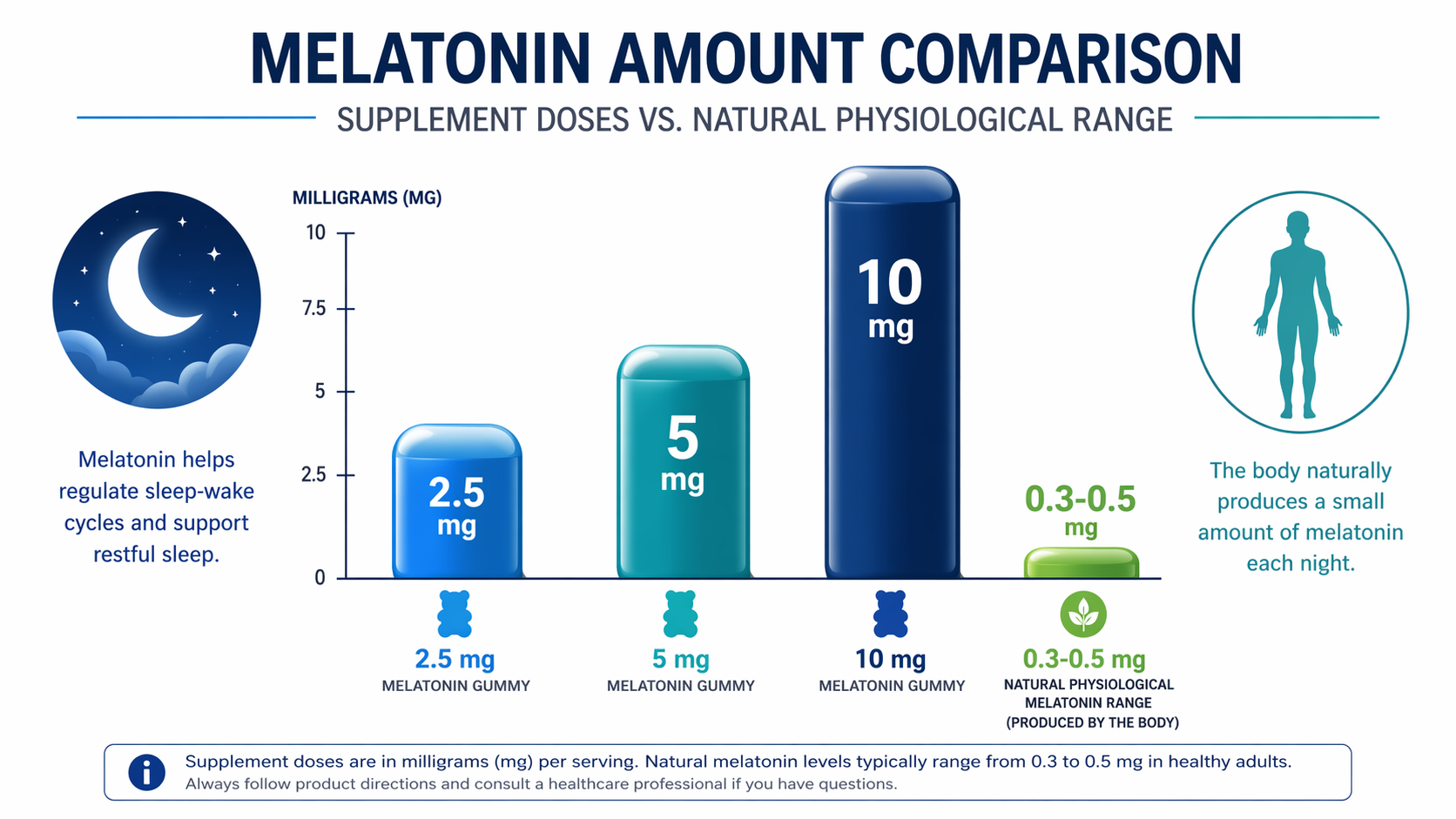
How the Nature Made Doses Compare
Nature Made’s adult gummy lineup is easiest to understand if the serving size is kept visible. The 2.5 mg and 5 mg products are framed as one gummy per serving. The 10 mg “Maximum Strength” serving is two 5 mg gummies, not one 10 mg gummy.[5][6]
| Nature Made option | Serving-size detail | How it compares with the 0.3–0.5 mg physiological benchmark |
|---|---|---|
| 2.5 mg | 1 gummy per serving | Still above the benchmark, but closest of the three options |
| 5 mg | 1 gummy per serving | Far above the benchmark for raising melatonin into normal nighttime range |
| 10 mg | 2 gummies per serving, 5 mg per gummy | Highest labeled serving; strongest mismatch with the lower-dose evidence |
2.5 mg: The Most Defensible Starting Point in This Lineup
The 2.5 mg Nature Made gummy is not a “low dose” in the physiological sense. It is several times higher than the 0.3 mg to 0.5 mg range often discussed in relation to normal nighttime melatonin levels. But among Nature Made’s gummy options, it is the closest available match to the lower-dose research.
That makes it the most defensible place for most adults to start if they have already decided to try this brand’s gummies. The advantage is not that 2.5 mg perfectly mirrors the body’s own output. It does not. The advantage is that it avoids jumping straight to 5 mg or 10 mg simply because those numbers look more decisive on a package.
There is also a practical problem with gummies: they are not always easy to split accurately. If a product is manufactured and labeled as a 2.5 mg gummy, the cleaner comparison is between labeled servings, not between improvised fractions of a sticky candy-format supplement.
5 mg: Common, Verified, And Higher Than the Physiology Suggests
A 5 mg gummy may feel like the middle option, but it is not middle-of-the-road when compared with normal nighttime melatonin production. It is well above the amount described in plasma-level research as sufficient to raise melatonin into a normal nocturnal range.[3]
This is where Nature Made’s strength can blur into a shopper’s mistake. A USP-verified 5 mg label is useful because it gives more confidence that the product contains what it says. It does not make 5 mg the better default. For many adults comparing the Nature Made lineup, 5 mg is better understood as a step up from the most conservative gummy choice, not as the natural starting point.
10 mg: Two 5 mg Gummies, Not a Better Evidence Story
Nature Made’s 10 mg product is labeled as a two-gummy serving, with 5 mg per gummy.[6] That detail matters. Someone taking one gummy from that bottle is taking 5 mg, not 10 mg. Someone following the full serving is taking the highest dose in this comparison.
The “Maximum Strength” phrase may be legal label language, but it is not a scientific reason to prefer the product. If the main goal is to choose a dose that stays closer to the body’s normal melatonin signaling range, 10 mg is the least persuasive option here.
Dose can also depend on the sleep problem being targeted. Sleep onset trouble, jet lag, delayed sleep-wake phase patterns, and shift-work timing are not identical use cases. For that narrower matching exercise, see our melatonin dosage guide by sleep problem.
A Note on Availability
At the time this article was prepared, the official Nature Made pages for these gummy products showed discontinued status, even though the products remained available through major retailers. The 2.5 mg and 10 mg official product pages also provide the serving and label context used here.[5][6]
That could mean old inventory, a packaging change, reformulation, or a distribution decision. It does not prove a safety problem or an efficacy problem. It does mean buyers should check the current bottle, serving size, USP mark, expiration date, and supplement facts panel rather than relying on an old product listing.
Gummy-Specific Safety Concerns
Melatonin gummies are convenient partly because they look and taste less like medicine. That is also their safety weakness. Mayo Clinic describes melatonin gummies as a supplement option that may help some people with sleep timing, while also warning about side effects and the need to keep them away from children.[7]
The child-safety issue deserves more than a casual “store safely” reminder. Gummies can look like candy, and a bottle left on a nightstand or bathroom counter is easier for a child to misunderstand than a blister pack of tablets. This risk is not unique to Nature Made, but it is especially relevant to gummy-format melatonin.
- Treat the bottle like medication for storage purposes, even though melatonin is sold as a dietary supplement.
- Keep gummies in a child-resistant location, not beside the bed for convenience.
- Check the serving size every time, especially with the 10 mg product because a full serving is two gummies.
- Account for added sugar if nightly use is becoming routine; Nature Made gummy labels list sugar in the approximate range of 1 g to 3 g per gummy depending on the product.[5][6]
Adults should also remember the regulatory category. Melatonin is sold as a dietary supplement in the U.S., not as an FDA-approved sleep drug. That does not make it useless. It does mean the evidence standard, labeling pathway, and medical role are different from approved prescription or OTC sleep medications.
So, Are Nature Made Melatonin Gummies Accurate?
Among melatonin gummies, Nature Made is one of the more trustworthy choices for label accuracy because USP verification directly addresses the problem that has made this category hard to trust. The 2023 JAMA gummy study showed widespread mislabeling in the market, but it did not identify Nature Made as a tested brand, so the fair conclusion is not “Nature Made failed.” It is that a verified product is more reassuring than an unverified one when the category has documented accuracy problems.
The dose judgment is less flattering. Within this lineup, 2.5 mg is the most evidence-aligned adult starting point because it is closest to the lower physiological range described in melatonin research. The 5 mg and 10 mg servings may be accurately labeled, but reliable labeling does not turn a higher dose into the more physiologically sensible choice.
For occasional adult use, the strongest case for Nature Made is label confidence. For chronic insomnia, melatonin should not be treated as first-line therapy, and a higher-strength gummy is not a substitute for figuring out why sleep is repeatedly failing.
References
- Quantity of Melatonin and CBD in Melatonin Gummies Sold in the US, JAMA, 2023.
- What is United States Pharmacopeia?, Nature Made.
- How Much Melatonin Is Too Much?, GoodRx.
- Melatonin and your sleep: Is it safe, what are the side effects and how does it work?, UC Davis Health, 2025.
- Nature Made Melatonin 2.5 mg Gummies, Nature Made.
- Nature Made Melatonin 10 mg Gummies, Nature Made.
- Mayo Clinic Minute: What are the benefits, risks of sleeping with melatonin gummies?, Mayo Clinic News Network.


Comments
Join the discussion with an anonymous comment.