
Medical review date: July 10, 2026.
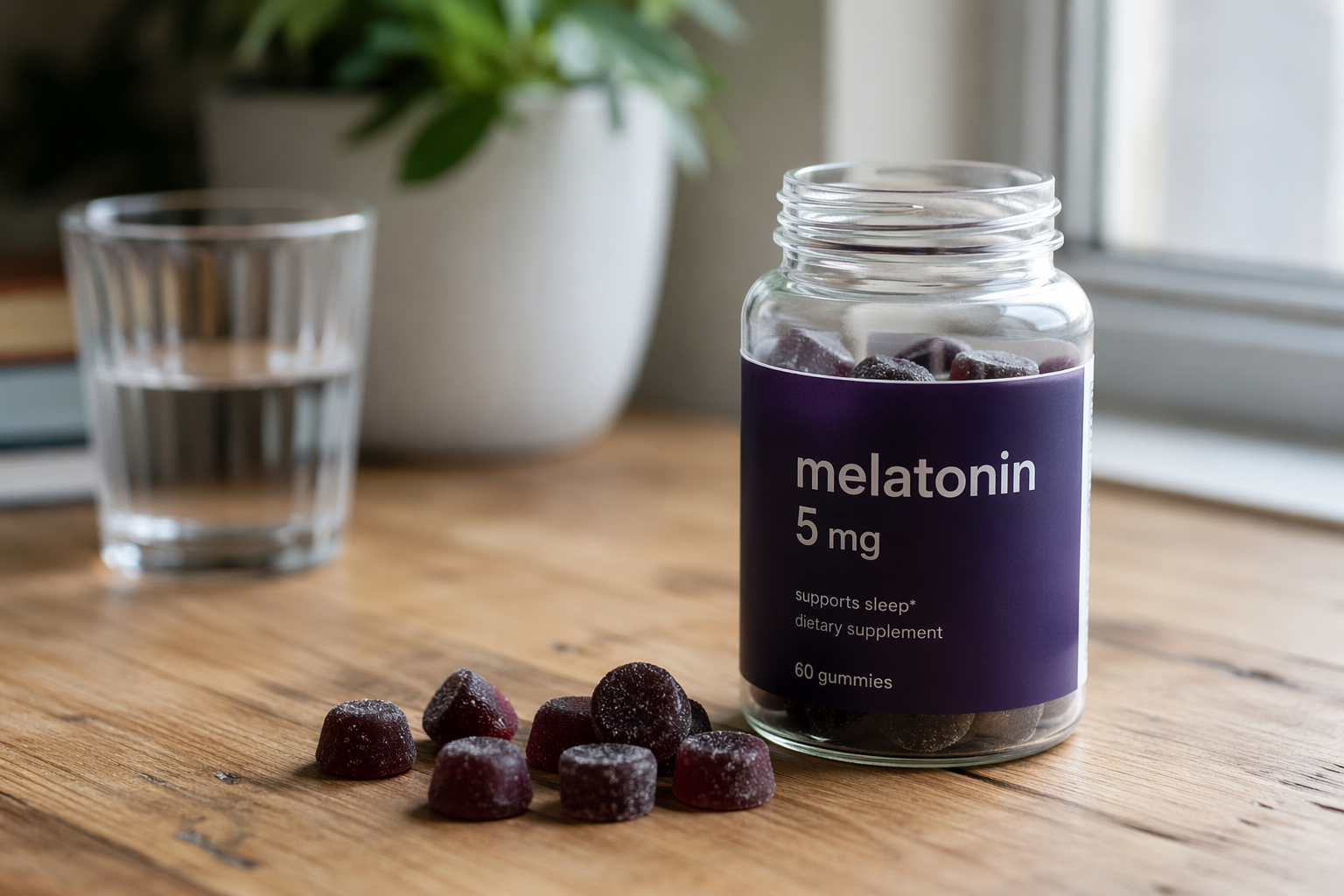
The first thing to know about sleep melatonin gummies is uncomfortably simple: the number on the front of the bottle may not be the amount in the gummy. That matters more than it would with many supplements because adults often buy these products at the end of a long day, take them as casually as candy, and assume that “5 mg” or “10 mg” means something precise.
In the U.S., melatonin products are regulated as dietary supplements, not as FDA-approved sleep drugs. They are not FDA-approved for any sleep indication, and they do not go through the same premarket review for safety, effectiveness, and label accuracy that prescription or over-the-counter drugs do. That regulatory fact is easy to wave away until the lab testing starts looking at gummies.
A 2023 JAMA analysis tested 25 melatonin gummy products sold in the U.S. and found that 22 of them, or 88%, were inaccurately labeled. The actual melatonin content ranged from 74% to 347% of the labeled amount, and one product contained no detectable melatonin while containing cannabidiol, or CBD, instead. [1]
That is not a small rounding problem. If a bottle says 5 mg, the consumer is not simply deciding whether 5 mg is the right amount. They may be taking much less, much more, or in rare cases something meaningfully different from what they thought they bought.
The gummy study is the sharpest example because gummies are the format many families leave on counters and nightstands, but the broader supplement problem is not new. A Canadian study of melatonin supplements found that measured melatonin content varied from 83% below to 478% above the label claim. The researchers also detected serotonin in several products, a finding that makes the “it’s just natural” sales pitch feel especially thin. [2]
More Milligrams Does Not Mean More Sleep
Melatonin is often shelved and advertised as if it were a gentle sedative. Biologically, its cleaner role is different: it is a timing signal. Your brain naturally releases melatonin as darkness approaches, helping coordinate the body’s circadian rhythm. A supplement can sometimes help when the problem is timing, such as jet lag, delayed sleep phase, or certain shift-work schedules.
That distinction changes the dose conversation. If the job is to nudge a clock, a bigger hammer is not automatically better. Many adults would be better served by thinking in the 0.5 mg to 3 mg range, not by reaching first for 5 mg or 10 mg gummies because those are common on store shelves. European food-safety opinions have treated 1 mg and 2 mg claims as the relevant range for sleep-related melatonin effects, while U.S. consumer guidance commonly advises starting low and avoiding escalation when it does not help.
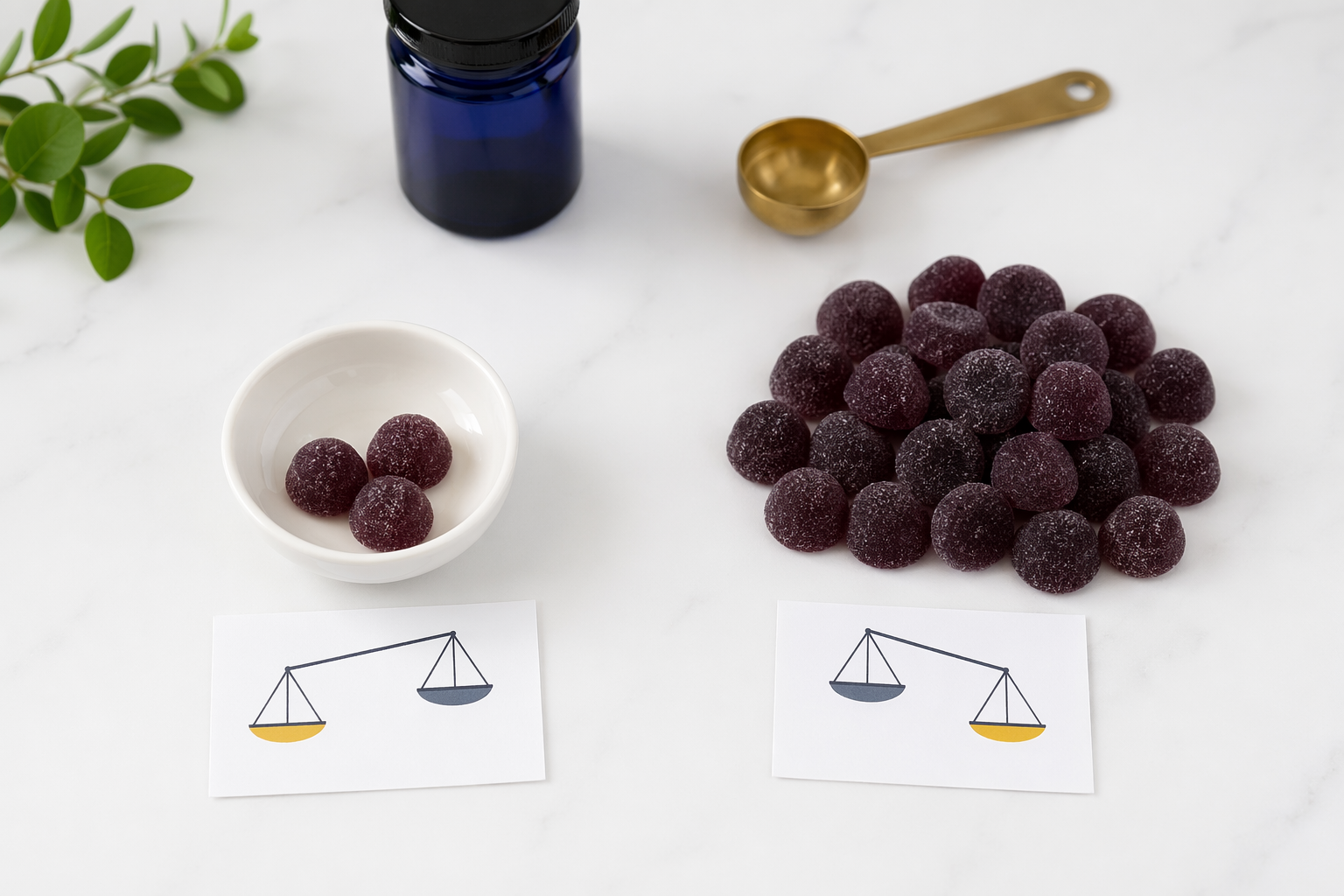
The practical reason to start low is not purity. It is odds management. Higher doses may increase next-day grogginess, vivid dreams, headache, dizziness, or a heavy “off” feeling without reliably producing a better night. With gummies, the label-accuracy problem adds another layer: a person who thinks they are taking 5 mg may already be taking substantially more.
If you are using melatonin for a timing problem, the question is not only “how much?” but “when?” For jet lag, delayed sleep phase, or shift work, timing relative to the desired sleep schedule can matter as much as dose. A poorly timed dose can send the wrong signal. For a fuller timing-based guide, see The Best Melatonin Sleep Aid for Adults Depends on Your Sleep Problem.
What Melatonin Can and Cannot Do for Insomnia
For chronic insomnia, melatonin is a weaker tool than its shelf presence suggests. Research summaries commonly find that melatonin shortens the time it takes to fall asleep by roughly 7 to 12 minutes in insomnia. That is not nothing. If someone lies awake for 25 minutes and starts falling asleep in 15, they may feel the difference. But it is not the same as treating the reasons a person is awake every night.
This is where the nightly gummy habit can quietly become a detour. A person starts with a plausible idea: “I need help falling asleep.” The first bottle helps a little or seems to. Then a bad week arrives, the dose goes up, and the product becomes a standing appointment instead of a targeted tool. The original problem may be stress arousal, conditioned wakefulness, pain, alcohol timing, restless legs, medication effects, or an untreated sleep disorder. Melatonin does not sort those out.
For persistent insomnia, cognitive behavioral therapy for insomnia, or CBT-I, remains the more appropriate first-line route. That does not mean every adult who has taken a gummy has made a foolish choice. It means that repeated dose escalation is a poor diagnostic process. If melatonin only helps a little, or only helps when life is already calm, that is useful information: the problem may not be a melatonin shortage.
A simple way to separate the use cases is to ask what you are trying to fix:
| Sleep problem | Melatonin’s fit | Better next step if it keeps happening |
|---|---|---|
| Jet lag or a temporary schedule shift | Often more logical, if timed carefully | Use a low dose for a short window |
| Delayed sleep phase, such as not getting sleepy until very late | Potentially useful as a circadian timing tool | Work on timing, morning light, and consistency; consider clinician guidance |
| Shift-work sleep timing | May help some people with schedule alignment | Plan around light exposure, work schedule, and safety-sensitive tasks |
| Chronic insomnia without a circadian diagnosis | Not a strong first-line treatment | Consider CBT-I and evaluate underlying causes |
| Waking repeatedly during the night | Often a poor match | Look for pain, breathing, alcohol, medication, bladder, mood, or sleep-disorder contributors |
A Lower-Dose Decision Framework
If an adult still wants to use melatonin gummies, the most reasonable approach is narrow: use them selectively, use the lowest practical dose, and treat the label as a claim that deserves verification.
- Start with the use case. Melatonin makes more sense for a circadian timing problem than for open-ended nightly insomnia.
- Start low. Consider 0.5 mg to 3 mg rather than assuming 5 mg or 10 mg is the adult dose.
- Avoid stacking. Do not combine multiple gummies, sleep blends, alcohol, or sedating products because one dose “didn’t work.”
- Look for third-party verification. USP, NSF, or ConsumerLab seals do not make a product medically necessary, but they are more meaningful than front-label reassurance.
- Make it time-limited. If the pattern requires nightly use for weeks or months, the sleep problem deserves a better workup.
Third-party testing is not a perfect shield. It can reduce the chance that the bottle is wildly different from the label, but it does not prove that melatonin is the right intervention for the person taking it. The cleanest product can still be the wrong answer to the wrong sleep problem.
Brand-specific label checks can be useful when they focus on measured content rather than marketing language. For examples of how this question plays out product by product, see Do Natrol Melatonin Gummies Meet Their Label Claims?, How Accurate Are Nature Made Melatonin Gummies?, and Olly Sleep Gummies May Not Contain the Dose You Expect.
The Safety Questions Are Not All Theoretical
For many healthy adults, short-term low-dose melatonin is usually discussed as low risk. The problem is that “usually low risk” has been stretched in the marketplace into “take a sweet 10 mg gummy whenever sleep is annoying.” Those are not the same claim.
Some people should be more cautious from the start. Older adults can have higher exposure at the same dose; one review reported that peak serum concentrations may be up to 240% higher in older adults than in younger adults. That does not prove every older adult will have side effects, but it does make high-dose casual use harder to justify. [3]
Medication interactions are another practical flag. Melatonin may be a poor fit, or may need clinician review, for people taking drugs such as fluvoxamine, warfarin, nifedipine, or those using significant caffeine close to the dosing window. The point is not that every combination is dangerous. The point is that a supplement can still behave like a biologically active substance once it is inside the body.
The household safety issue is sharper with gummies than with tablets. Pediatric melatonin exposures rose steeply in the U.S. over the last decade, with poison-control calls increasing 530% from 2012 to 2021 and about 28,000 emergency department visits reported in the same broader safety literature. Gummies are a specific concern because a child does not have to misunderstand a supplement aisle to mistake a sweet, fruit-shaped product for candy.
If gummies are in the house, they should be stored like medication: out of sight, out of reach, and not in a bedside drawer, purse, backpack, or kitchen spot where ordinary candy might live. This warning is not mainly about adults deciding whether a low dose helps with jet lag. It is about what happens when the format lowers everyone’s guard.
What To Make of the 2025 Heart Failure Signal
The most recent safety concern deserves attention and restraint at the same time. In 2025, an American Heart Association newsroom release described preliminary research involving more than 130,000 adults. Long-term melatonin users had a higher rate of heart failure diagnosis over five years than non-users: 4.6% versus 2.7%, described as about a 90% higher rate. [4]
That finding does not prove melatonin causes heart failure. It was preliminary, conference-level evidence, not a peer-reviewed full manuscript, and the association could be influenced by differences between people who use melatonin long term and those who do not. People who need chronic sleep support may already have more health problems, more medication use, more stress, or worse sleep, any of which could matter.
Still, it changes the tone of the decision. A preliminary association is not a reason to panic over occasional use. It is a reason to stop treating indefinite nightly melatonin as a harmless default, especially at higher doses and especially when the product may not contain what the label says.
So Should You Take Melatonin Gummies?
For an adult using sleep melatonin gummies occasionally for a timing problem, a cautious yes is possible: choose a third-party-tested product when available, start around 0.5 mg to 3 mg, take it at a deliberate time, and keep the use short-term.
For an adult taking 5 mg or 10 mg gummies every night because sleep has become unreliable, the better answer is no, not as a long-term plan. The evidence does not support escalating the dose as a reliable insomnia strategy, and the product category gives consumers too little assurance that the printed dose is the swallowed dose.
The most useful next move may be to step back from the bottle and name the sleep problem more precisely. Is the body clock late? Is the schedule changing? Is anxiety keeping the brain alert? Is sleep breaking apart after midnight? A gummy treats all of those as if they were the same complaint. They are not. If you need help sorting that out, How to Choose the Right Sleep Aid for Your Sleep Problem is a better starting point than buying a stronger bottle.
If you are pregnant, managing a seizure disorder, taking blood thinners or complex psychiatric medications, caring for a child who has taken melatonin, or using melatonin nightly as an older adult, this is clinician territory rather than label-reading territory. For older readers specifically, see Is Melatonin Safe for Older Adults?.
The narrow answer is the honest one: melatonin gummies can be useful when the sleep problem is timing, the dose is low, the product is verified as well as possible, and the use is occasional. They are not a dependable long-term fix for insomnia, and the candy-like format should not be allowed to make an uncertain dose feel safer than it is.
References
- Quantity of Melatonin and CBD in Melatonin Gummies Sold in the US. JAMA. April 25, 2023.
- Melatonin natural health products and supplements: presence of serotonin and significant variability of melatonin content. Journal of Clinical Sleep Medicine.
- Current Insights into the Risks of Using Melatonin as a Treatment for Sleep Disorders in Older Adults. PMC.
- Long-term use of melatonin supplements to support sleep may have negative health effects. American Heart Association Newsroom.


Comments
Join the discussion with an anonymous comment.