
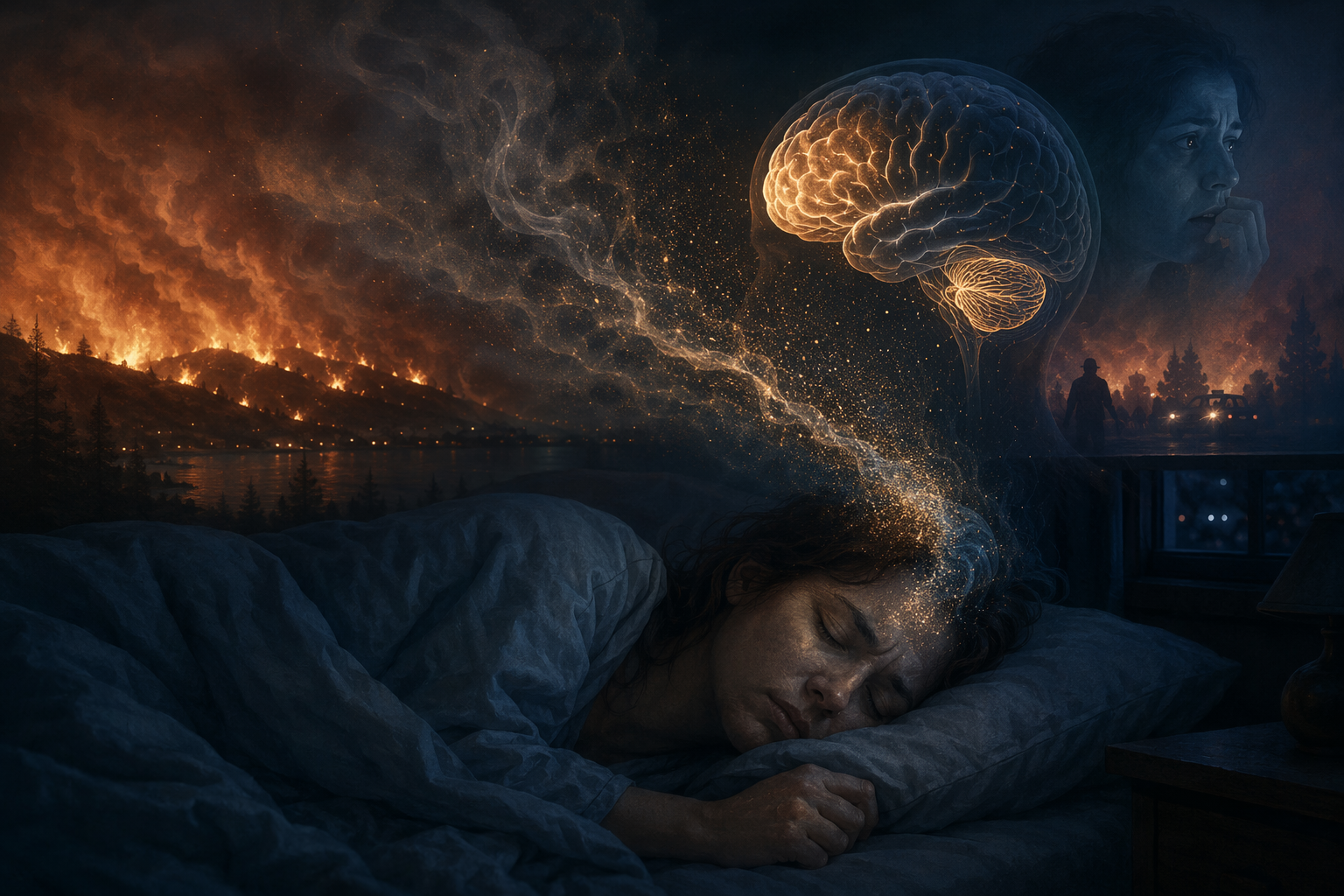
The first problem with wildfire smoke and sleep is that the body can keep reacting after the flames are out of view. A sealed bedroom helps, but it does not erase what smoke has already done to breathing, arousal, and the sense that the night is not safe. That is why the answer to how wildfire smoke affects sleep is not one mechanism. It is two that keep feeding each other.
The physical route
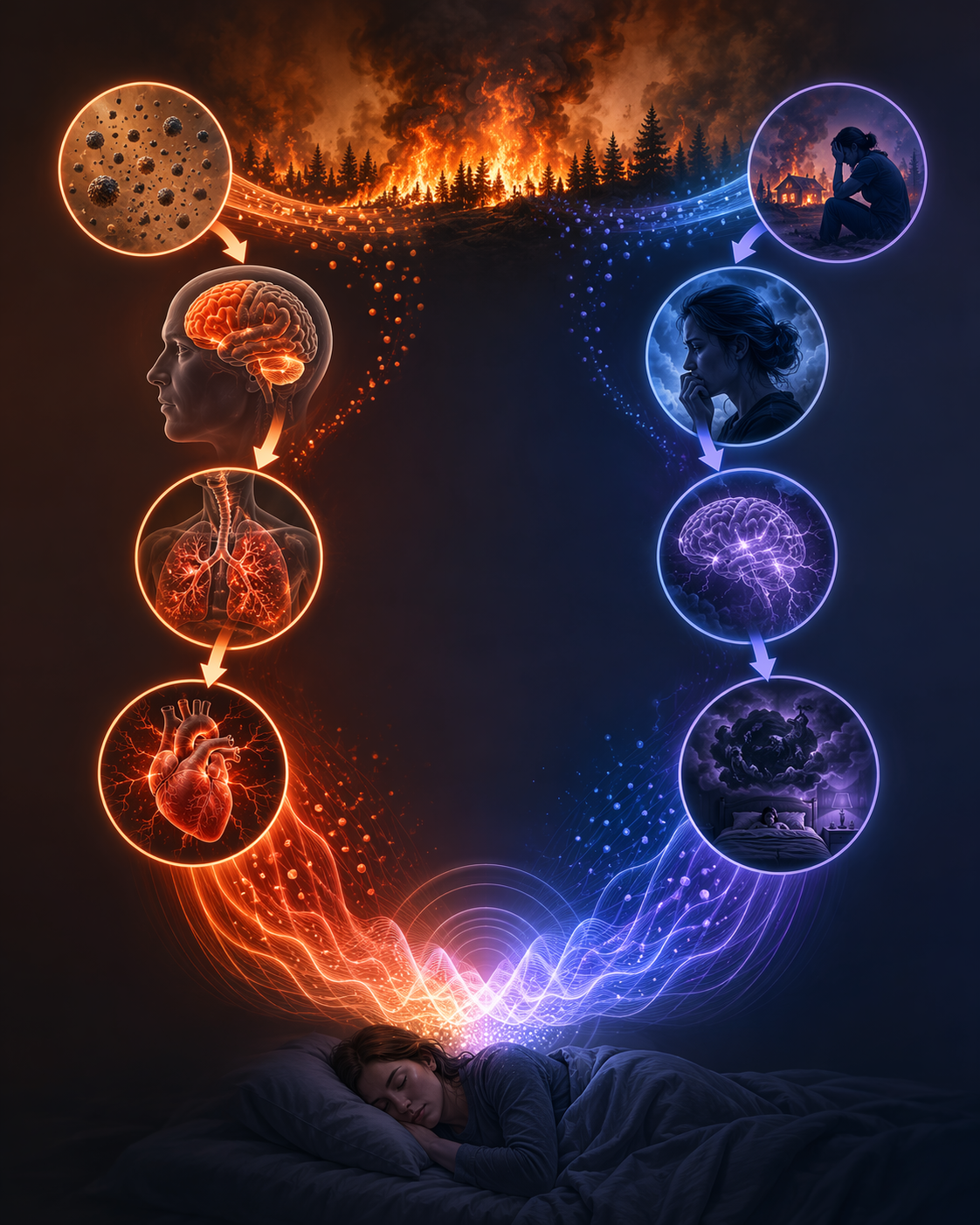
Wildfire smoke is not just a smell event. Stanford reported in January 2025 that wildfire smoke is about 10 times more toxic than fossil-fuel air pollution [1]. On the sleep side, the most useful way to think about the physical route is simple: PM2.5 particles and the inflammatory response they trigger keep the body in a more vigilant state, and some research suggests the particles may even reach sleep-regulating brain regions. In a 2023 Frontiers in Environmental Health rat study, sleep disruption plus smoke inhalation raised heart rate, blood pressure, and cardiac sympathetic tone more than either exposure alone, and it also triggered adrenergic receptor gene-expression changes that did not appear with either factor alone [4]. The limitation matters: that work used eucalyptus wood smoke in rats, so it is support for mechanism, not a direct human sleep study. But the direction of the effect is hard to miss.
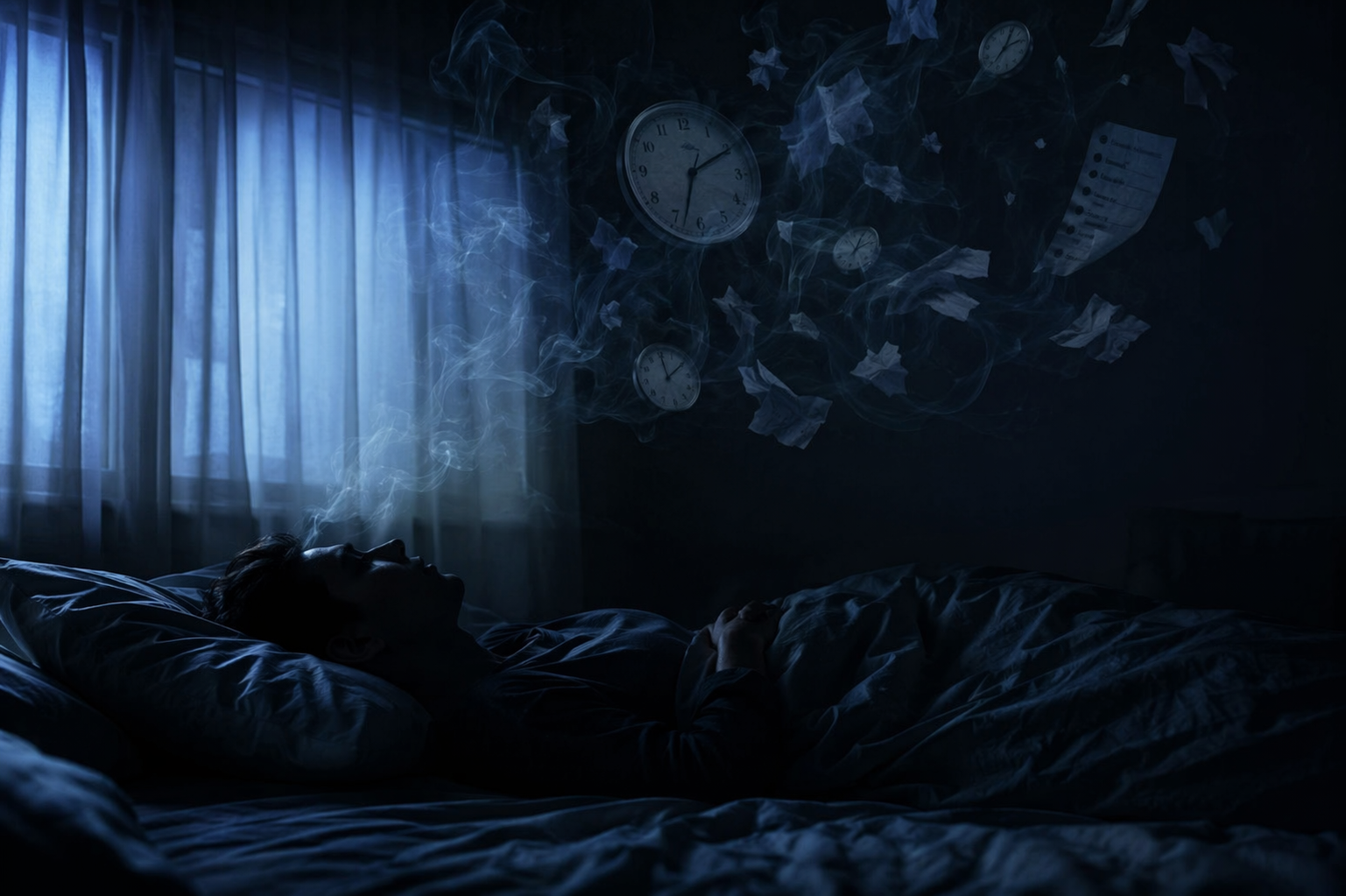
That helps explain why some people feel tired but wired on smoky nights. The airway irritation is one part; the nervous system leaning toward alertness is the other. Even when the fire is distant, the body may behave as if the environment still needs monitoring.
The psychological route
This is where the strongest human data on sleep symptoms shows up. In a 2021 systematic review of wildfire survivors, 63-72.5% reported insomnia symptoms and 33.3-46.5% reported nightmares [2]. The review was limited to five studies, and those studies mostly captured people with direct exposure, evacuation, or loss, so those numbers should not be read as the rate for every smoky household. Still, they show that sleep disruption is common after wildfire events, not rare.
A 2023 study in Sleep Epidemiology sharpened the point by separating smoke from the rest of the event: smoke was an independent predictor of insomnia, with beta = 0.17 and p < .05, and insomnia then predicted both PTSD and nightmare severity [3]. That does not mean smoke alone explains every bad night. It does mean the night-time picture can keep going long after the visible fire is gone, especially when the experience included evacuation, loss, or the feeling that the house was not fully safe.
Why the two pathways compound
The important part is that these are not separate lanes. A body already irritated by smoke is easier to wake, and a mind already keyed to threat has less room to settle. The EPA study points in that direction too: when sleep disruption and smoke inhalation were combined, the cardiovascular stress response was stronger than either one alone [4]. That is a rat model, not a human insomnia trial, but it matches the lived pattern readers describe: the smoke changes breathing and arousal, and the fear of the event keeps the system from downshifting.
So the better answer is not smoke caused insomnia in the singular. For many people, the nightly breakdown is part physiology, part trauma, and part the interaction between them. If the smoke came with direct danger, the psychological pathway often dominates. If the exposure was mostly distant haze, the physiological pathway may be more prominent. Either way, the problem is real, and it is not adequately explained by stress alone.
References
- Assessing wildfire health risks, Stanford Report, Jan. 2025, https://news.stanford.edu/stories/2025/01/assessing-wildfire-health-risks
- Wildfire smoke exposure and sleep disturbance: a systematic review, International Journal of Environmental Research and Public Health, 2021, https://pmc.ncbi.nlm.nih.gov/articles/PMC8508521/
- Smoke as an independent predictor of insomnia and its links with PTSD and nightmare severity, Sleep Epidemiology, 2023, https://www.sciencedirect.com/science/article/pii/S2667343622000336
- Sleep disruption and smoke inhalation compound cardiovascular risk in rats, Frontiers in Environmental Health, 2023, https://www.frontiersin.org/journals/environmental-health/articles/10.3389/fenvh.2023.1166918/full

Comments
Join the discussion with an anonymous comment.