
You can do the normal things right during wildfire season and still be awake at 2 a.m. You can stop caffeine early, dim the lights, put your phone down, and keep a steady bedtime. Then the room smells faintly smoky, the air-quality number is ugly, an evacuation alert is possible, and your body does not accept the argument that this is just another Tuesday night.
That failure is not a character flaw. Wildfire nights push sleep from two directions at once. One pathway is threat-detection: worry, vigilance, memories of past fires, checking behavior, and the uneasy knowledge that conditions can change while you are asleep. The other is physical exposure: fine particles in smoke can irritate airways and affect the body in ways that make rest feel less available. If you calm only the anxiety while the bedroom air is still bad, sleep may stay broken. If you clean the air but keep waking yourself to check alerts, sleep may stay broken for a different reason.
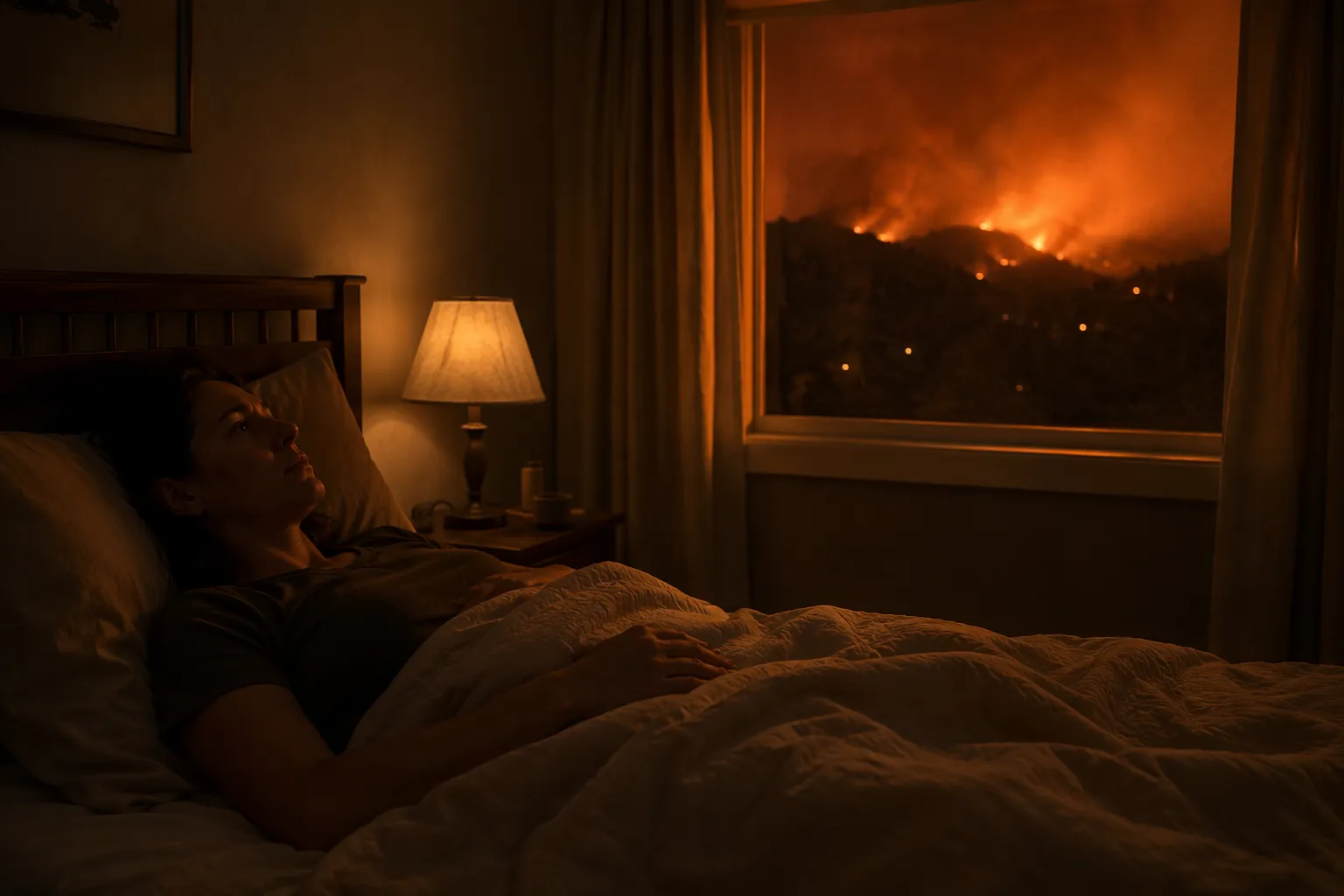
The wildfire-specific sleep evidence base is not enormous, but it is serious enough to stop treating this as ordinary insomnia with dramatic lighting. A 2021 systematic review found insomnia rates of 63% to 72.5% among wildfire survivors assessed 1 to 10 months after a fire, and nightmares affected 33.3% to 46.5% of survivors. The review included only five studies, so it should not be stretched into a universal forecast for every smoke season. Still, the scale of distress in those studies is a useful correction to the idea that people are simply failing to relax.[1]
Smoke adds another reason the usual advice can feel insulting. PM2.5 means particles smaller than 2.5 micrometers; Yale Medicine describes them as about 30 times smaller than the width of a human hair, small enough to enter the bloodstream and reach the brain.[2] That does not mean every restless smoky night has one neat biological cause. It does mean that a scratchy throat, chest tightness, headache, inflamed sinuses, or wired feeling during smoke exposure should not be dismissed as “just stress.”
The two tracks can also reinforce each other. A 2025 JAMA Network Open study from Harvard researchers looked at 86,588 mental-health emergency department visits in California during the 2020 wildfire season and found that each 10 microgram per cubic meter increase in wildfire-specific PM2.5 was associated with increased visits for depression, anxiety, and mood disorders for up to seven days after exposure.[3] That study comes from one record-setting season, so it should not be treated as a precise prediction for every year. But it fits what many people recognize from lived experience: smoky air makes coping harder, and worse coping makes sleep more fragile.
The Bedtime Question Changes During Fire Season
On an ordinary bad-sleep night, the useful question might be, “What is keeping me activated?” During wildfire season, make it more specific: “Which pathway is still active tonight?”
| If this is active | What it feels like | What helps tonight |
|---|---|---|
| Threat-detection | Repeated alert checking, racing thoughts, dread, startle responses, mental rehearsal of escape plans | A planned check-in system, scheduled worry time, relaxation that lowers arousal, and a rule for leaving bed when wakefulness becomes conditioned |
| Smoke irritation | Scratchy throat, coughing, headache, chest discomfort, stuffy nose, smell of smoke indoors, concern about AQI | AQI monitoring, a cleaner sleeping room, filtration, sealing leaks, HVAC settings when appropriate, and escalation if indoor air is unsafe |
This is why coping with wildfire stress for better sleep is not just a nicer bedtime routine. It is a paired routine. You are trying to lower both the alarm level in the nervous system and the particle burden in the room enough for sleep to become possible.
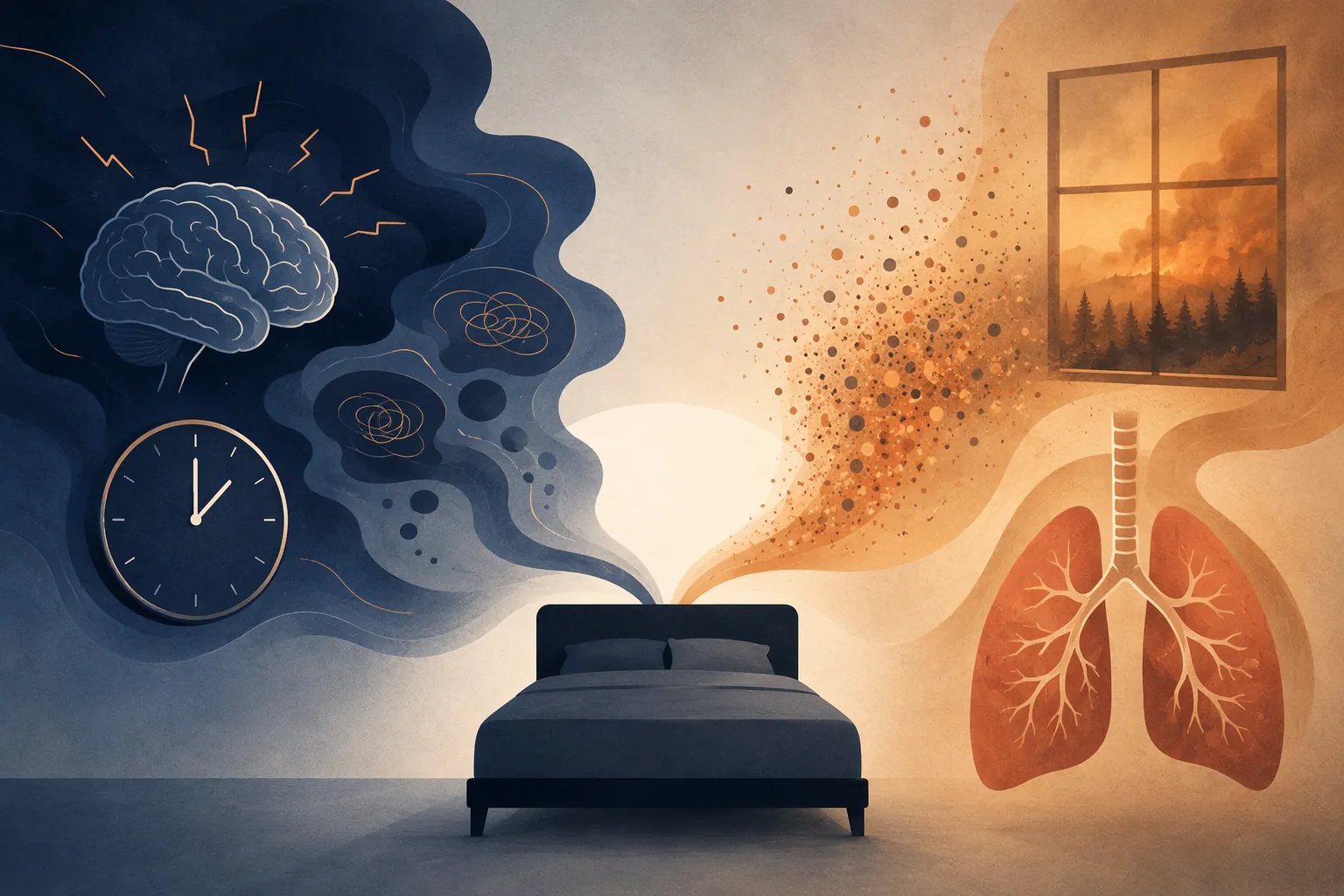
Track 1: Lower the Threat Signal Without Pretending Nothing Is Wrong
The goal is not to convince yourself that fire risk is imaginary. That would be useless, and on some nights unsafe. The goal is to move necessary vigilance out of bed and into a plan, so the bed is not where your brain conducts emergency management.
Start earlier than bedtime if you can. The Sleep Health Foundation recommends structured worry time during emergencies: set aside a limited period earlier in the evening to write down concerns and possible actions, rather than letting the same concerns cycle once the lights are out.[4] For wildfire nights, that can be very plain: evacuation status, go-bag location, pet plan, medication, air purifier setting, who you would call, and what alert source you trust.
Then decide how alerts will reach you. Repeated self-waking is one of the quiet ways a responsible person trains the brain to treat sleep as dangerous. Use official alerts where available, keep the phone audible for emergency notifications if that is part of your local system, and choose a scheduled check-in window instead of opening the app every time you surface from light sleep. The Sleep Health Foundation specifically points people toward scheduled check-ins or alarms rather than relying on anxious self-waking.[4]
After that, use a downshift practice that has a job. Slow breathing, progressive muscle relaxation, or a brief body scan is not there to make you cheerful about fire season. It is there to reduce physiological arousal enough that sleep pressure can do its work. If one method makes you more aware of smoke symptoms or panic, switch to another. For some people, tensing and releasing muscles is more grounding than breath focus on a smoky night.
- Before bed: write the practical worries and the action attached to each one.
- At bed: set the alert plan once, then stop renegotiating it in the dark.
- In bed: use one calming technique long enough to let arousal fall.
- If awake too long: leave bed briefly and return when sleepy, so the bed does not become the place where wildfire monitoring happens.
That last point comes from the same practical family as CBT-I stimulus control. If you are lying there awake, checking, bargaining, and bracing, bed starts to acquire the meaning of “watch station.” A common CBT-I approach is to get out of bed after sustained wakefulness, do something quiet and low-light, and return when sleepy. For a deeper walk-through of anxiety-specific insomnia skills, use What to Do When Anxiety Keeps You Up at Night.
Track 2: Treat the Bedroom Like an Air-Quality Decision
The smoke track starts with one unglamorous habit: look at air quality before you decide what kind of night you are having. If the AQI is high, the plan is not simply “try to sleep anyway.” It is to reduce what gets into the room where you are spending the next several hours.
A cleaner sleeping room is usually more useful than trying to perfect the entire home at once. Sleep Foundation guidance on sleeping when air quality is poor emphasizes monitoring AQI, using HEPA filtration, keeping windows and doors closed, sealing obvious gaps, and running HVAC systems in fan mode when appropriate so air continues to circulate through filtration.[5] The details depend on your home: a tight newer apartment, an older house with leaky windows, and a room with a window AC unit do not behave the same way.
The basic sequence is simple enough to do tired:
- Check AQI from a source you trust, preferably before the bedtime spiral begins.
- Choose the room with the best chance of staying clean: fewer exterior doors, fewer leaky windows, and enough space for the people who need to sleep there.
- Close windows and doors, and seal obvious smoke leaks if you can do so safely.
- Run a HEPA purifier sized for the room, or use the best available filtration your HVAC system can safely support.
- Avoid adding indoor particles from candles, smoking, frying, incense, or unnecessary vacuuming.
The CDC advises creating a clean room during wildfire smoke events: a room set up to keep particle levels lower, with windows and doors closed and a portable air cleaner when available.[6] California public-health guidance also recognizes escalation during severe smoke events, including using N95 respirators in some indoor situations when people must reduce smoke exposure and cleaner air is not otherwise available.[7] A mask is not a sleep comfort item for most people, and it is not a substitute for evacuation guidance or medical care. But in extreme conditions, public-health advice may move beyond the usual “close the windows and run a purifier” script.
If the air inside is still smoky, if the room is too hot to sleep safely with windows closed, or if someone has asthma, COPD, heart disease, pregnancy, an infant, or other vulnerability, the cleaner-air decision may need to be bigger than the bedroom. That can mean using a community cleaner-air space, staying with someone outside the smoke zone, or following local emergency guidance. The point is not to be heroic in a sealed room that is not actually safe.
For a more detailed air-quality setup, including purifier placement and hazardous-air decisions, see How to Sleep When Air Quality Is Hazardous. For the deeper mechanism of how smoke can affect sleep through respiratory, neurological, and psychological routes, see How wildfire smoke disrupts your sleep through three pathways.
Put the Two Tracks on the Same Timeline
The mistake is doing these tracks one after the other, as if anxiety is the first problem and air is the second, or the other way around. On a real smoke night, they overlap. A practical routine might look like this:
| Time | Threat-detection task | Smoke-exposure task |
|---|---|---|
| Early evening | Check official alerts, write down concrete concerns, decide what would trigger action | Check AQI, close up the home if needed, start filtration before bedtime |
| One hour before bed | Set the alert plan and scheduled check-in; stop open-ended scanning | Confirm the sleeping room is closed, filtered, and not adding indoor pollutants |
| At lights out | Use breathing, progressive muscle relaxation, or another downshift practice | Keep the room closed and filtration running if safe and appropriate |
| If awake in the night | Use the planned check-in only if scheduled or alerted; leave bed if wakefulness becomes sustained | Notice symptoms: coughing, chest tightness, heavy smoke smell, heat, or unsafe conditions may require escalation |
This does not need to be elaborate. In fact, elaborate plans often collapse at 10 p.m. when the house is hot and everyone is irritated. The useful version is short, repeatable, and written down somewhere you do not have to search for it.
A pathways paper by Eisenman and Galway describes possible routes by which wildfire smoke may affect mental health and well-being, but the authors characterize those pathways as preliminary and hypothetical.[8] That caveat matters. We do not need to pretend every link is proven in order to act on what is already clear enough for tonight: smoke exposure can be harmful, distress can disrupt sleep, and a bedtime plan that ignores either one is incomplete.
When the Evidence Is Messy, Keep the Claim Narrow
Some wildfire sleep data comes from surveys and disaster contexts where clean measurement is hard. During the 2019–2020 Australian bushfires, 37% of surveyed Australian Capital Territory residents reported disrupted or poor sleep attributed to smoke, but the response rate was 6.4%, which raises the risk that people most affected were more likely to answer.[9] That does not make the finding useless. It means it should be read as evidence that smoke-related poor sleep occurred and mattered to respondents, not as a clean estimate of how often it happens in every exposed community.
The strongest practical claims here are therefore modest: wildfire season can disrupt sleep through both psychological and physical pathways; survivor studies show clinically important sleep disturbance after fires; smoke exposure has plausible and observed links with mental-health strain; and public-health agencies already recommend reducing smoke exposure indoors. That is enough to justify a two-track bedtime routine without overselling it as a cure.
When Tonight’s Plan Is Not Enough
Some nights need more than a better routine. Seek medical or public-health guidance urgently if you have trouble breathing, chest pain, worsening asthma or heart symptoms, confusion, severe smoke exposure, or local instructions to evacuate or relocate to cleaner air. Sleep advice does not outrank emergency guidance.
Also get help if the sleep problem stops being situational. Persistent insomnia, recurring nightmares, panic at bedtime, trauma symptoms, or daytime impairment after the immediate fire threat has passed deserve clinical attention. If you are unsure whether you are still in a normal stress response or have crossed into something that needs care, Can’t Sleep? A Self-Triage Guide can help sort the next step.
For the ordinary-but-not-ordinary wildfire night, keep the routine adapted to the actual problem. Do the alert plan before bed. Make the sleeping room as clean as you reasonably can. Use a downshift practice that lowers arousal rather than arguing with fear. Leave bed if it becomes a monitoring station. Wildfire-season sleep improves when the night is treated as both a nervous-system problem and an air-quality problem.
References
- The Impact of Wildfires on Sleep Disturbances: A Systematic Review, 2021.
- How Wildfire Smoke Affects Your Body, Yale Medicine.
- Wildfire Smoke Exposure and Emergency Department Visits for Mental Health Conditions, JAMA Network Open, 2025.
- Sleeping Well in Emergencies, Sleep Health Foundation.
- How to Sleep When Air Quality Is Poor, Sleep Foundation.
- Create a Clean Room to Protect Indoor Air Quality During a Wildfire, CDC.
- Wildfire Smoke and Your Patients' Health, California Department of Public Health.
- The mental health and well-being effects of wildfire smoke: a scoping review, 2022.
- Physical and Mental Health Effects of Bushfire and Smoke in the Australian Capital Territory 2019–20, Frontiers in Public Health, 2021.
Comments
Join the discussion with an anonymous comment.