
“I can not sleep” can mean several different things. It can mean one wired, miserable night after bad news. It can mean two weeks of lying awake after a schedule change. It can also mean months of repeated sleep disruption that is now affecting work, driving, mood, or health. Those are not the same problem, and they do not call for the same next step.
Start with four questions before you buy anything, diagnose yourself, or decide to ignore it:
- How long has this been happening: days, weeks, or at least 3 months?
- How often does it happen: once in a while, several nights a week, or at least 3 nights per week?
- What happens the next day: mild annoyance, real fatigue, impaired concentration, mood changes, mistakes, or safety concerns?
- Is there an obvious trigger: stress, illness, travel, shift changes, medication changes, pain, alcohol, caffeine, caregiving, anxiety, or depression symptoms?

Trouble sleeping is common enough that it should not make you feel unusually broken. In the 2024 National Health Interview Survey, 30.5% of U.S. adults reported sleeping less than 7 hours, and 15.4% reported trouble falling asleep most days or every day in the previous 30 days. Women reported trouble falling asleep more often than men, 18.5% versus 12.2%.[1]
Common, though, is not the same as harmless. The useful question is whether your sleep problem is recent and tied to a trigger, whether it is stretching into weeks, or whether it has crossed the chronic-insomnia threshold: at least 3 months, at least 3 nights per week, with daytime impairment.[2][3]
The Sorting Point: Duration, Frequency, Daytime Impact
Insomnia is easier to misread when you judge it only by how bad tonight feels. A single night can feel extreme and still be temporary. A milder pattern can be more concerning if it is frequent, persistent, and changing how you function.
| Pattern | What it usually looks like | What to do next |
|---|---|---|
| Transient sleeplessness | Days of difficulty sleeping, often tied to an identifiable trigger such as stress, jet lag, illness, or a disrupted schedule | Stabilize the next few nights, reduce obvious triggers, and watch whether sleep returns as the trigger passes |
| Acute insomnia | Weeks of difficulty falling asleep, staying asleep, or waking too early, often during a period of adjustment or ongoing stress | Make targeted behavioral changes and consider help if it persists, worsens, or causes significant daytime impairment |
| Chronic insomnia | At least 3 months, at least 3 nights per week, with daytime impairment | Seek professional evaluation; treatment usually starts with CBT-I rather than sleep aids alone |
This framework is not meant to make you prove your suffering. It is meant to protect you from two common errors: treating three bad nights as a lifelong disorder, or treating three impaired months as something you should simply tolerate.
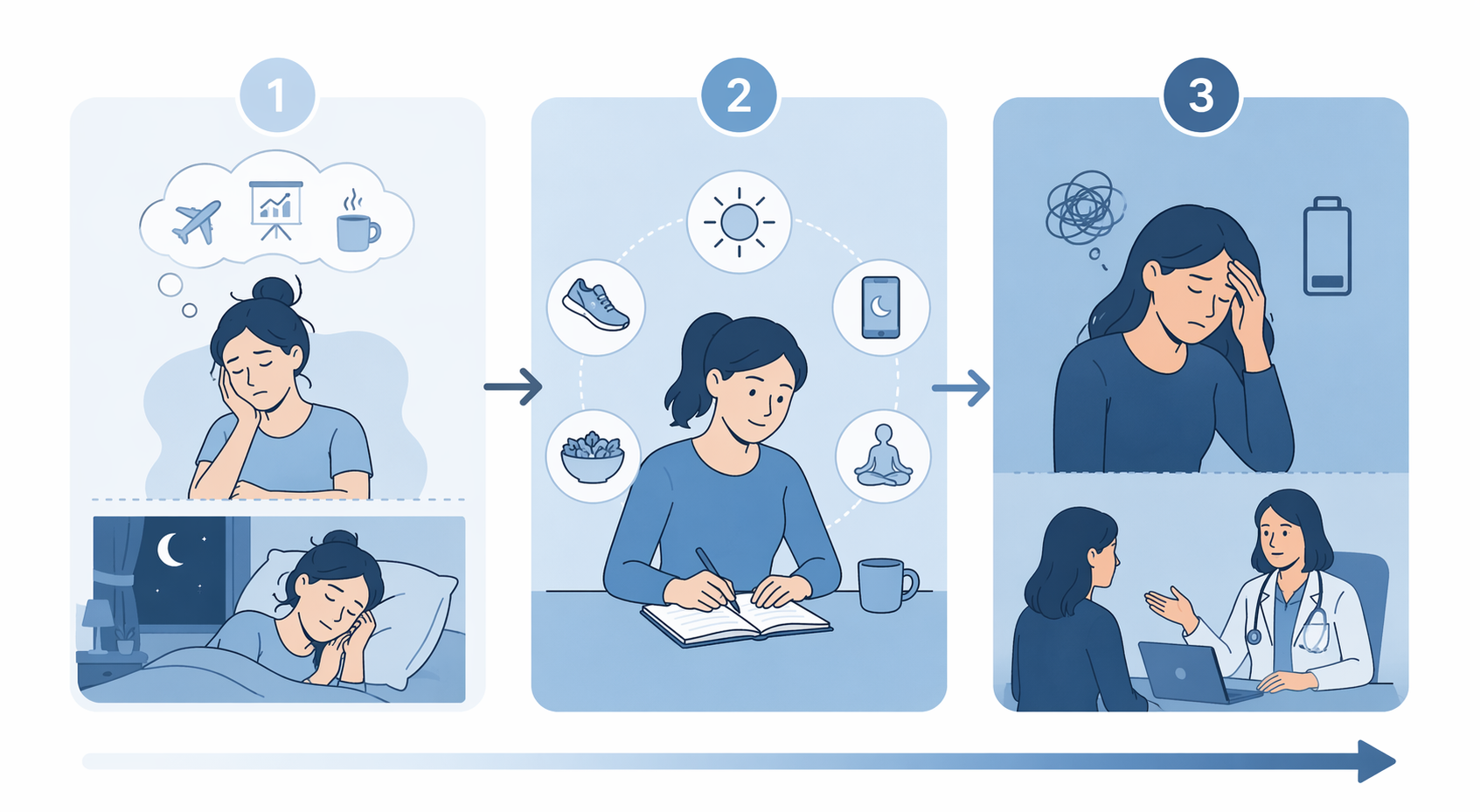
If It Has Been Days: Look for the Trigger First
Sleeplessness lasting days is often transient, especially when it follows a clear event: travel across time zones, a respiratory illness, a painful flare, an argument, a deadline, a new baby, or a sudden schedule shift. Transient insomnia is commonly described as lasting days and resolving when the trigger resolves.[4][2]
The goal at this stage is not to perfect your sleep. It is to avoid turning a temporary disruption into a nightly negotiation. Keep your wake time reasonably steady, get daylight early in the day if you can, avoid long late naps, and be careful with alcohol as a sleep strategy. Alcohol may make you feel sedated, but it can fragment sleep later in the night.
If you are awake in bed and getting more agitated, it is reasonable to leave the bed for a quiet, low-light activity until sleepiness returns. That is not a cure for insomnia; it is a way to stop the bed from becoming the place where you practice being awake and frustrated.
A few poor nights after a clear trigger usually call for monitoring and stabilization. If the trigger is resolving and your days are manageable, you do not need to escalate immediately.
If It Has Been Weeks: Treat It as Acute, Not Random
When sleep trouble continues for weeks, it deserves more attention even if it began with something obvious. Acute insomnia often overlaps with an adjustment-related sleep problem: the original stressor may still be present, or the sleep worry may have become part of the problem.
This is where a simple sleep log can be more useful than guessing. For one to two weeks, write down bedtime, estimated time to fall asleep, awakenings, wake time, naps, caffeine timing, alcohol, exercise timing, major stressors, and how you functioned the next day. The point is not to measure perfectly. The point is to see whether your sleep problem has a pattern.
Examples are often ordinary: caffeine that drifted later because work got busier; naps that started as recovery and began delaying sleep; bedtime moving earlier because you are desperate to “catch up,” even though you are not sleepy yet; work messages keeping your nervous system active until lights-out. None of these means the problem is your fault. They are adjustable levers.
For more detailed triage language, the related guide Sleeping Problem at Night vs. Insomnia: A Triage Framework walks through how clinicians separate a general sleep complaint from insomnia. If you want practical non-drug options for this early stage, Home Remedies for Sleep: What the Evidence Actually Says is the better next read than a sleep-aid comparison.
A week-long reset that is reasonable to try
- Choose a steady wake time for the week, including weekends if possible.
- Move caffeine earlier and stop testing whether late caffeine “really affects you.”
- Keep naps short or skip them temporarily if they are pushing sleep later.
- Do not go to bed early just to compensate if you are not sleepy.
- Put a buffer between problem-solving and bed, even if the buffer is brief.
- If you are awake and escalating, get out of bed for something quiet, then return when sleepy.
These steps are basic stabilization, not a full insomnia treatment plan. If they help, you have learned something useful. If they do not, that also matters.
If It Has Been 3 Months or More: This Is Professional-Care Territory
Chronic insomnia is not defined by how desperate one night feels. It is defined by a pattern: sleep difficulty at least 3 nights per week for at least 3 months, with daytime impairment.[2][3]
Daytime impairment is doing important work in that definition. It means the night problem is carrying into life: fatigue, reduced attention, irritability, low mood, mistakes, slowed performance, reliance on substances to get through the day or night, or worry about driving or work safety. If your sleep is short but you function well and feel rested, that is a different conversation. If your sleep is repeatedly poor and your days are paying for it, the situation has changed.
At this stage, the next step is evaluation, not a stronger bedtime hack. A clinician can check whether the sleep complaint is primary insomnia, insomnia linked with anxiety or depression, a medication effect, pain, a circadian rhythm problem, sleep apnea, restless legs syndrome, or a combination. It is common for sleep problems to overlap rather than arrive neatly labeled.
The 2026 American Academy of Sleep Medicine guideline describes cognitive behavioral therapy for insomnia, or CBT-I, as the most efficacious first-line treatment for chronic insomnia. The recommendation is conditional and based on low-certainty evidence, so it should not be oversold as a guaranteed fix. Still, it is the main treatment direction to understand before making sleep aids the center of the plan. The guideline reserves combination therapy, CBT-I plus medication, for cases where CBT-I alone is insufficient.[5]
CBT-I is not generic “sleep hygiene.” It typically includes stimulus control, sleep restriction, cognitive restructuring, sleep hygiene education, and relaxation training.[2] If you are ready to go deeper, start with CBT-I for Insomnia FAQ. If you want the full implementation details, use CBT-I: A Complete Protocol Guide.
Signals That Should Move You Toward a Provider Sooner
Some sleep complaints should not be buried under a longer sleep hygiene checklist. Contact a health care provider sooner if any of the following are part of the picture:
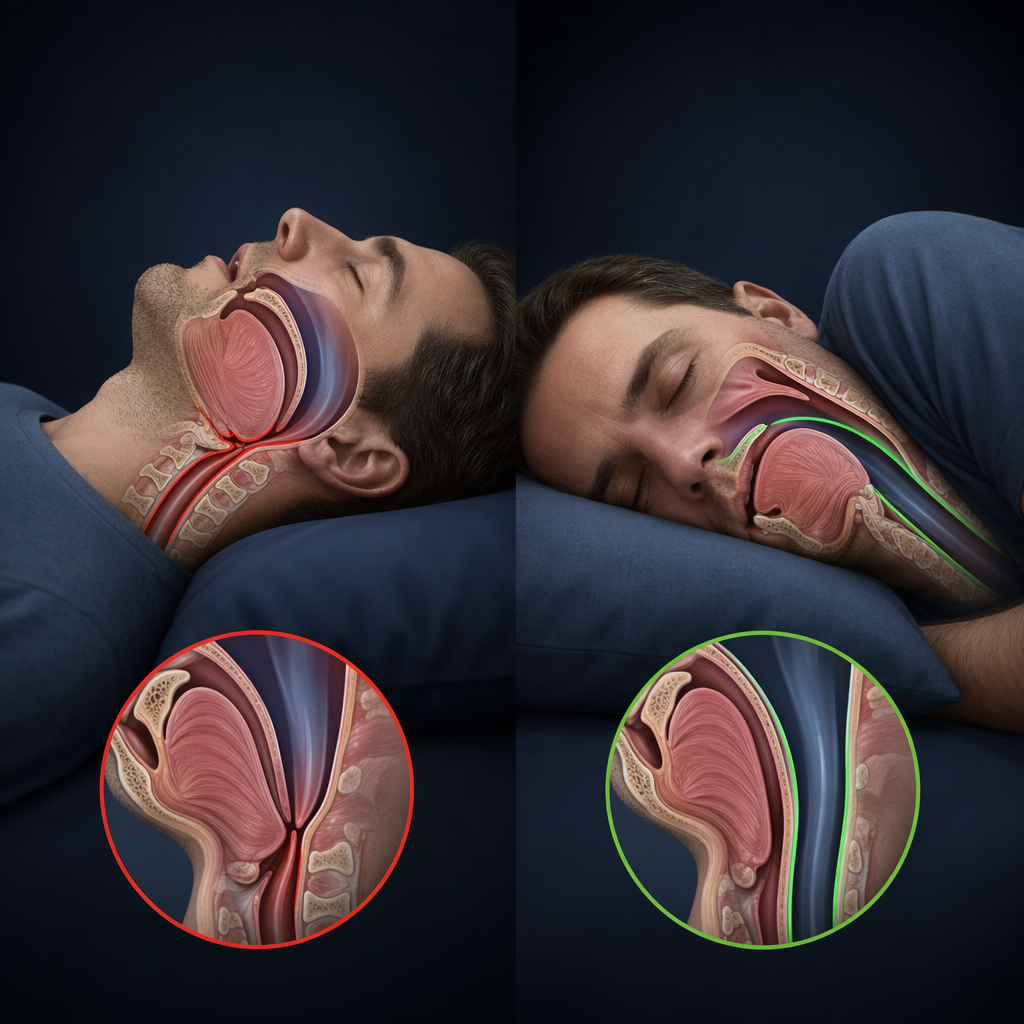
- Loud snoring, choking, gasping, or witnessed pauses in breathing during sleep, which can point toward sleep apnea.[4][3]
- Uncomfortable leg sensations or an urge to move the legs at night, especially if movement brings relief.[4][3]
- Persistent anxiety, depression, panic, or mood changes along with insomnia.
- Insomnia that continues beyond 4 weeks despite basic sleep-hygiene changes.[4][3]
- Daytime sleepiness that creates safety concerns, especially with driving, caregiving, machinery, or clinical work.
The mental-health overlap deserves particular care. Half of chronic insomnia cases involve an underlying mental health condition, most commonly anxiety, stress, or depression.[6][3] That does not mean the sleep problem is “just in your head.” It means the sleep system and mood system often keep each other activated. The related article Sleep Anxiety and Insomnia: The Bidirectional Link may be useful if worry about sleep has become part of the nightly cycle.
If snoring and gasping are present, do not assume the problem is only insomnia. Some people have both insomnia symptoms and another sleep disorder. For that specific distinction, see How to Tell the Difference Between Snoring and Sleep Apnea.
Where Sleep Aids Fit
Sleep aids are not the first sorting tool. They may have a place for some adults, but they do not tell you whether the problem is transient, acute, chronic, apnea-related, medication-related, mood-related, or schedule-driven. That distinction matters more than choosing a product at 2 a.m.
If you are considering an over-the-counter or prescription option, make the triage decision first: how long, how often, what daytime effect, and what red flags. Then read How to Choose the Right Sleep Aid for Your Sleep Problem with that context in mind. A short-term tool and a chronic treatment plan are not interchangeable.
Your Next Decision
If your sleep problem is only a few days old and tied to a clear trigger, stabilize the next few nights and watch the pattern. If it has lasted weeks, look for modifiable drivers and track sleep well enough to see what is actually happening. If it has lasted at least 3 months, happens at least 3 nights per week, and affects your days, it is time for professional evaluation.
Most sleeplessness is temporary or acute. Duration plus frequency plus daytime impairment is what changes the meaning of “I can not sleep.”
References
- Short Sleep Duration and Sleep Difficulties Among Adults: United States, 2024, CDC National Center for Health Statistics, April 2026.
- Chronic Insomnia, StatPearls.
- Insomnia: What It Is, Causes, Symptoms & Treatment, Cleveland Clinic.
- Insomnia: Symptoms and causes, Mayo Clinic.
- Combination treatment for chronic insomnia guideline, American Academy of Sleep Medicine, April 2026.
- Insomnia: A Complete Guide to Falling and Staying Asleep, HelpGuide.



Comments
Join the discussion with an anonymous comment.