

The first problem with sleeping during an excessive heat warning is not discomfort. It is that the body is trying to start sleep by cooling itself, and the room is refusing to cooperate.
In ordinary conditions, sleep onset is helped by a circadian-driven decline in core body temperature. Blood flow moves toward the skin, heat leaves the body, and the internal temperature drop makes it easier to fall asleep and stay asleep. Heat exposure during sleep can suppress that normal decline, and research summarized by the European Insomnia Network links hot sleep conditions with reductions in deep Stage 3 sleep and REM sleep duration.[1]
That mechanism matters more than another generic reminder to “keep the bedroom cool.” During an excessive heat warning, the bedroom may still be in the upper 70s or 80s after midnight, the window may be letting in hotter air, and the fan may be the only appliance running. At that point, sleep advice has to answer a narrower question: which actions actually help the body lose heat, and which ones only feel briefly cooling?
The problem is measurable, not just anecdotal. A USC/Keck study of 14,232 U.S. adults found that a 10°C increase in nighttime temperature was associated with 2.63 fewer minutes of sleep per night. The same work projected that by 2099, U.S. adults could lose 8.5 to 24 hours of sleep per year because of rising temperatures; that second figure is a model-based estimate, not an observed sleep tally.[2]
Why Heat Breaks Sleep Architecture
The body does not enter the night at one steady setting. In the evening, core temperature begins to fall as part of the circadian rhythm. Skin blood vessels widen, especially in the hands and feet, so warm blood can move closer to the surface and release heat. This is one reason warm feet can sometimes be sleep-friendly: they can be a sign that heat is leaving the core.
A hot room interferes with that exchange. If the air around the body is already warm, the gradient between skin and room shrinks. If humidity is high, sweat evaporates less efficiently. The sleeper can be lying still, doing everything “right,” and still have a body that cannot shed heat fast enough to support the usual temperature drop.
This is why nighttime heat can feel so different from a warm bedroom in winter. In winter, a blanket can be adjusted and the surrounding air may still carry heat away. During an excessive heat warning, the walls, mattress, and indoor air may all be holding heat. The body is trying to dump warmth into an environment that has little room left to accept it.
Deep sleep is especially vulnerable because stable sleep depends on thermoregulation staying within a workable range. Research cited by the European Insomnia Network describes heat exposure as reducing slow-wave sleep and REM sleep, not only delaying sleep onset.[1] That helps explain the specific misery of a hot night: you may technically sleep, but wake repeatedly, dream oddly, or feel as if the night never became restorative.
Temperature targets are still useful as a calibration point. Sleep guidance commonly clusters around the mid-60s Fahrenheit: the European Insomnia Network points to about 66°F, and the Sleep Health Foundation gives a similar 63–66°F range.[1][3] Those numbers are not a moral assignment. They are a reminder of how far a bedroom at 78°F, 82°F, or higher may be from the conditions under which sleep physiology works most easily.
Use Cooling Strategies by Mechanism, Not by Vibe
Hot-weather sleep tips become safer when they are sorted by what they ask the body or the room to do. Some widen skin blood vessels. Some increase evaporation. Some prevent the apartment from storing heat in the first place. They are not interchangeable.
| Cooling route | What it is trying to do | Examples |
|---|---|---|
| Vasodilation and timing | Move heat from the body core toward the skin before bed | Warm shower 1–2 hours before sleep; warming hands or feet briefly |
| Evaporative cooling | Use water plus air movement so heat leaves the skin as moisture evaporates | Damp cloth, light misting, damp top sheet, fan below the indoor safety threshold |
| Passive home cooling | Reduce the heat load the bedroom carries into the night | Shade, closed windows during hotter hours, night ventilation only when outdoor air is cooler |
| Risk reduction | Treat dangerous indoor heat as a health issue, not a sleep inconvenience | Cooling center, cooler part of the home, backup plan during power outage risk |
The Warm Shower Works Because It Is Not Trying to Freeze You
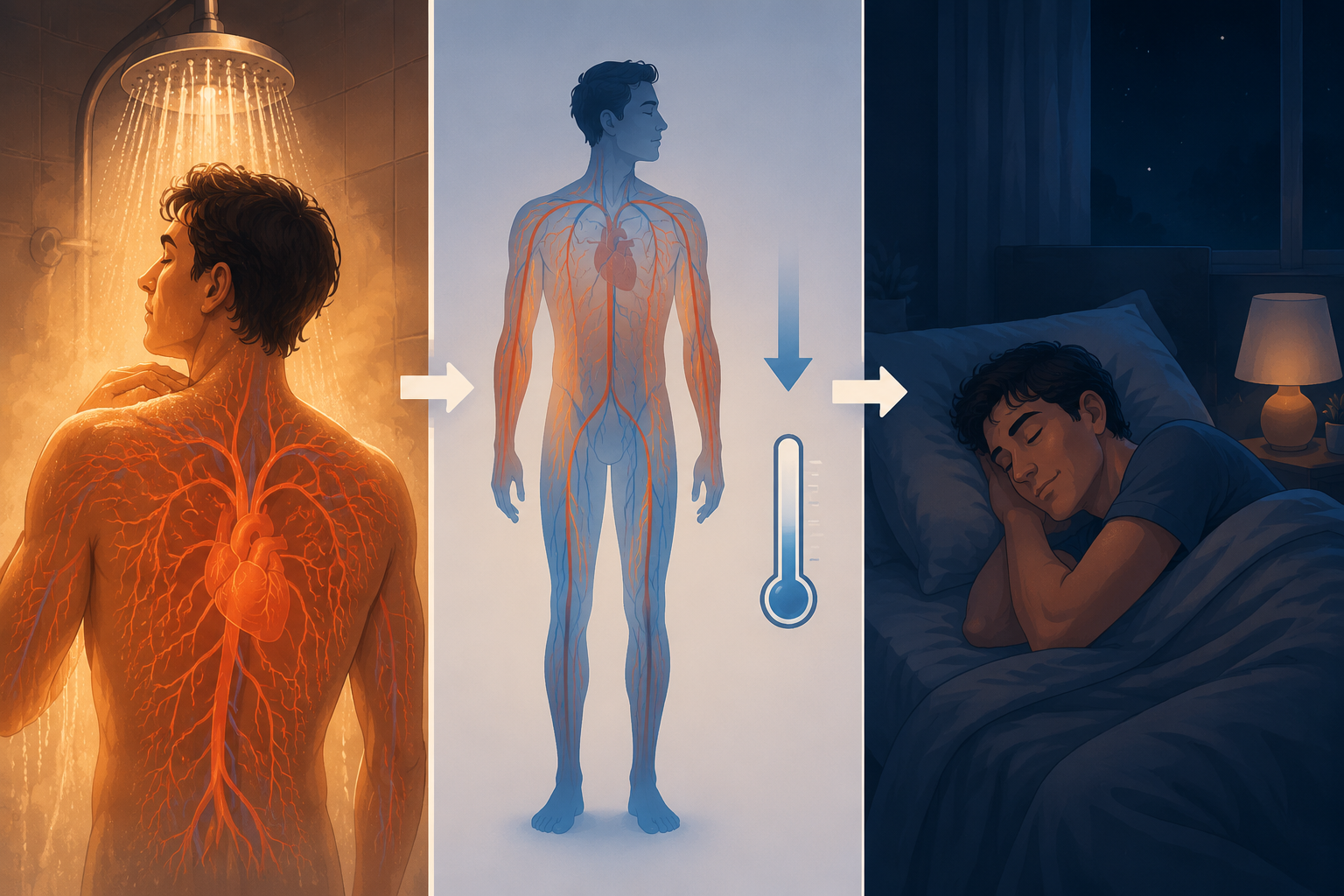
A warm shower before bed sounds wrong during a heat warning until the timing is clear. The goal is not to climb into bed hotter. The goal is to warm the skin, widen surface blood vessels, and then allow heat to leave the core more efficiently as the body cools afterward.
The useful window is roughly 1–2 hours before bed, not immediately before lying down. The European Insomnia Network includes this kind of thermal timing in its practical recommendations for hot nights, and hot-weather sleep guidance from sleep researchers describes the same basic pathway: warm water encourages skin blood flow, which can support the later fall in core temperature that sleep needs.[1][4]
A cold shower can feel better for a few minutes, but it can work against the same pathway. Cold exposure can constrict blood vessels near the skin, reducing heat loss from the core. If the bedroom is still hot afterward, the body may be left with a brief surface chill and less efficient internal cooling. During a dangerous heat night, that distinction is more useful than the usual debate over whether showers are “relaxing.”
- Use warm, not scalding, water.
- Finish about 1–2 hours before trying to sleep.
- Let skin dry naturally or dress lightly afterward so heat can continue to leave.
- Skip the strategy if showering makes the bathroom dangerously hot or humid.
Evaporation Helps Only When the Air Can Accept Moisture
A cool damp cloth on the neck, wrists, or chest can help because water carries heat away as it evaporates. A lightly damp top sheet can work the same way for some sleepers. These are small interventions, but at 2 a.m. small matters: they can reduce the need to get fully out of bed, turn on more lights, or start a long wakeful routine.
Humidity sets the limit. When the room is humid, sweat and water on the skin evaporate more slowly. Adding more moisture can then become clammy rather than cooling. In that situation, the better move may be to use a small amount of water on pulse points, pair it with safe airflow, and avoid soaking bedding that will trap heat against the body.
Light sleepwear and breathable bedding belong here, but they do not need to carry the whole plan. They reduce insulation; they do not create a cool room. If you want a broader room-by-room setup beyond heat warnings, use a general sleep environment optimization guide as background, not as a substitute for heat-specific safety decisions.
The Fan Rule Deserves Its Own Line
A fan can be helpful when it moves cooler air across damp skin and improves evaporation. It can also be cheap to run: the CDC notes that electric fans use up to 50 times less electricity than air conditioning.[5] But this is not a blanket permission slip.
The CDC’s heat guidance says fans are effective only when indoor temperature is below 90°F; above that, a fan can increase body temperature.[5] That warning conflicts with a lot of casual hot-weather advice, which treats fans as harmless. The difference is physics, not preference. At very high indoor temperatures, airflow may push hot air across the body faster than evaporation can compensate, especially if the person is dehydrated, older, ill, or in a humid room.
| Indoor condition | How to think about the fan |
|---|---|
| Below 90°F indoors | Use airflow strategically, especially with light moisture on skin or a damp cloth. |
| At or above 90°F indoors | Do not rely on the fan as a cooling strategy; prioritize a cooler location or active cooling. |
| Humid room | Expect weaker evaporative cooling; avoid soaking bedding and monitor how your body feels. |
| Older adult, chronic illness, pregnancy, limited mobility, or heat illness symptoms | Treat the fan threshold conservatively and seek a cooler environment sooner. |
If a storm, grid strain, or rolling outage is part of the heat warning, the sleep problem becomes a preparedness problem. A no-AC plan should include where the coolest room is, how to keep phones charged, and when to leave for a safer place. For that scenario, a dedicated power-outage sleep guide is the more useful route.
Cool the Apartment Before You Cool the Bed
Passive cooling is less satisfying than a cold pillow, but it often does more. The bedroom you meet at midnight was built during the afternoon: sun on windows, hot air entering at the wrong time, appliances adding heat, and walls releasing stored warmth after sunset.
The practical rule is to treat windows as temperature gates. If outdoor air is hotter than indoor air, opening windows usually imports heat. If outdoor air finally drops below indoor air, cross-ventilation can help release stored heat. In many heat warnings, that cooler window may arrive late, briefly, or not at all.
- Close blinds or curtains before direct sun hits the room.
- Keep windows closed during hotter outdoor hours unless ventilation is needed for safety.
- Ventilate at night only when outdoor air is cooler than indoor air.
- Move sleep to the lowest or least sun-exposed room if that space is cooler.
- Reduce indoor heat sources in the evening: oven use, unnecessary lights, and heat-producing electronics near the bed.
Some common instincts are understandable but counterproductive: opening windows because the room feels stale even when outside air is hotter, sleeping directly on a heat-retaining surface, or assuming fewer clothes always means cooler sleep. For a deeper pass through those traps, use the guide to cooling mistakes that worsen hot-weather sleep.
When Sleep Advice Has to Yield to Heat Safety
A bad hot night is not automatically an emergency. But during an excessive heat warning, indoor heat can become a health risk before it becomes a sleep problem. The CDC emphasizes that heat-related illness can occur when the body cannot cool itself properly, and risk is higher for older adults, young children, people with chronic medical conditions, and people without reliable cooling.[5]
The American Red Cross advises people to stay in air-conditioned places when possible during extreme heat and to check on those at higher risk.[6] That advice can sound unrealistic to someone in a rented apartment with no car and no quiet place to go. Still, it sets the correct hierarchy: if the indoor temperature remains dangerously high, the solution is not a better bedtime routine. It is a cooler environment.
- Move to a cooler room, hallway, lower floor, or shaded side of the home if available.
- Use air-conditioned public spaces or cooling centers when home cooling is inadequate.
- Check indoor temperature before relying on a fan overnight.
- Do not ignore dizziness, confusion, faintness, nausea, or a racing pulse as merely “bad sleep.”
- Check on older adults, neighbors, and anyone who may be trying to endure the heat alone.
Broad sleep hygiene still matters at the edges. Caffeine timing, alcohol, bright light, and irregular schedules can all make a hot night worse. But they are background variables here. If you need that wider routine context, use an evidence-based sleep hygiene fundamentals guide; during an active heat warning, put thermal safety first.
A Night Plan for an Excessive Heat Warning
The most useful plan starts before the bedroom feels unbearable. It does not promise perfect sleep. It gives the body a better chance to lower core temperature, protect some deep sleep, and avoid unsafe indoor heat.
| Time | Action | Reason |
|---|---|---|
| Late afternoon | Block sun, reduce oven use, close windows if outdoor air is hotter | Prevents the room from storing extra heat |
| Evening | Compare indoor and outdoor temperature before opening windows | Ventilation helps only if it brings in cooler air |
| 1–2 hours before bed | Take a warm shower if the bathroom can stay tolerable | Supports skin blood flow and later core cooling |
| Bedtime | Use light bedding, a damp cloth, and safe airflow if indoor temperature is below 90°F | Pairs evaporation with the body’s sleep-onset cooling |
| Overnight | Reassess if the room stays dangerously hot or symptoms appear | Heat illness risk outranks sleep continuity |
Targeted cooling can partially protect sleep quality during an excessive heat warning, especially when it supports vasodilation, evaporation, and a lower indoor heat load. It cannot make a dangerously hot room safe by willpower. If the room is too hot for the body to cool itself, that is not failed sleep hygiene; it is a heat exposure problem.
References
- How to deal with sleep problems during heatwaves: practical recommendations from the European Insomnia Network, Journal of Sleep Research, 2023.
- Study links rising temperatures to reduced sleep in U.S. adults, Keck School of Medicine of USC.
- Hot nights: how to help sleep, Sleep Health Foundation Australia.
- Eight ways to sleep well in hot weather, The Conversation.
- About Heat and Your Health, CDC.
- Extreme Heat Safety, American Red Cross.
Comments
Join the discussion with an anonymous comment.