
A sleep remedy can fail for a perfectly ordinary reason: it was aimed at the wrong sleep problem. Melatonin is the usual example. It has some of the clearest support among natural sleep aids when the issue is circadian timing, such as jet lag, shift work, or a delayed sleep schedule, with commonly cited timing around 0.5–3 mg taken 30–60 minutes before the desired bedtime and review-level evidence showing a modest 7–12 minute reduction in sleep-onset time.[1][2] That is different from being a universal sedative for every person who cannot sleep.
So the better first question is not “Which natural remedies to help sleep are strongest?” It is “What kind of sleep problem am I trying to solve?”
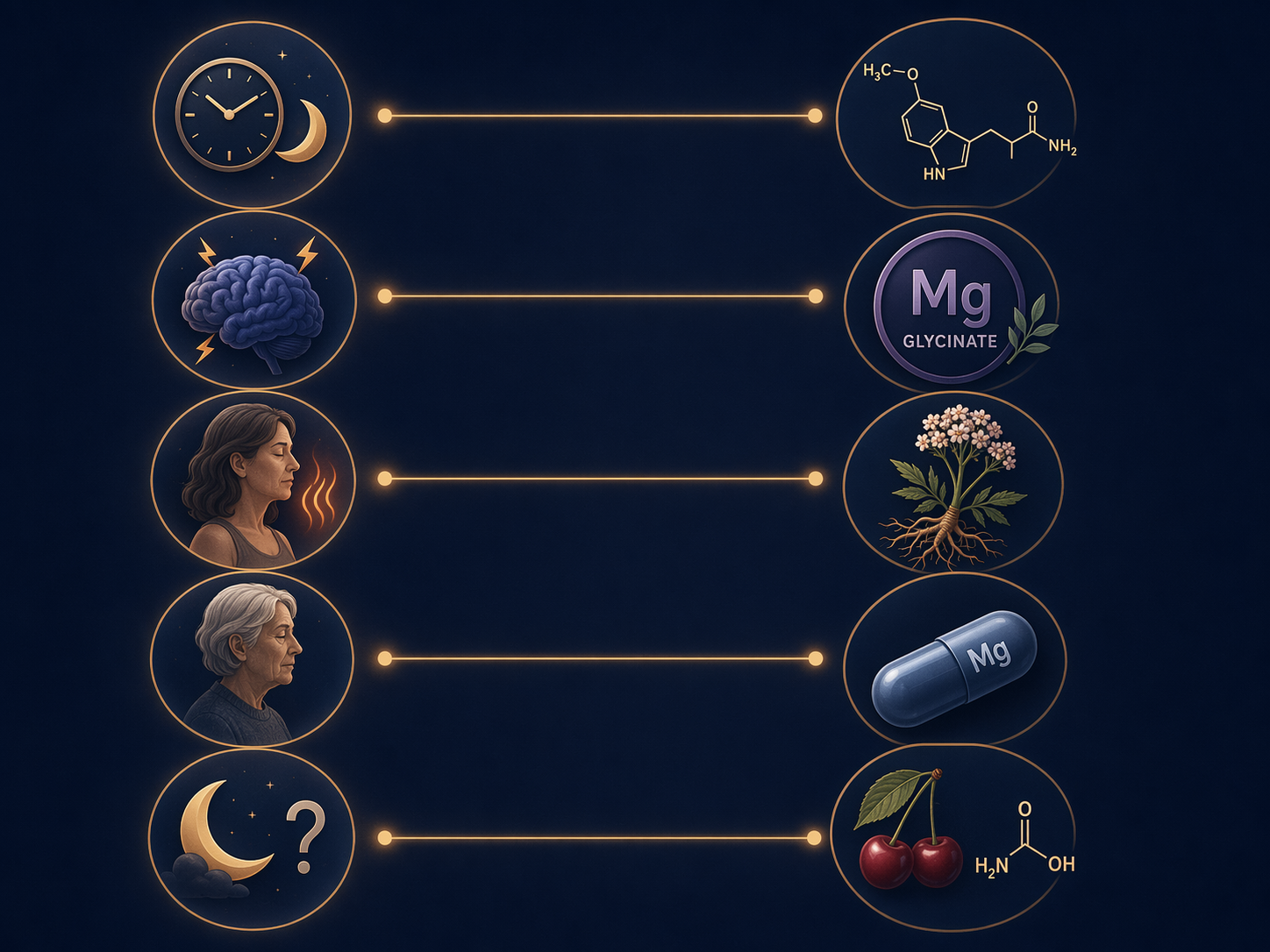
Match the remedy to the sleep pattern
| Sleep pattern | Best-fit natural remedy | Typical dose or timing from available guidance | Reasonable signal | Not ideal for |
|---|---|---|---|---|
| Jet lag, shift work, delayed sleep phase, or feeling sleepy at the wrong clock time | Melatonin | 0.5–3 mg, 30–60 minutes before the desired bedtime[1][2] | Sleepiness shifts earlier; falling asleep becomes a little easier at the intended time | Repeated night waking, chronic primary insomnia, or “I need something stronger to knock me out” |
| Stress-driven trouble falling asleep; body is tired but mind stays alert | L-theanine or magnesium glycinate | L-theanine 100–200 mg; magnesium glycinate 200–400 mg are commonly discussed ranges in sleep-aid guidance[2][3] | Lower pre-sleep arousal; fewer nights where tension keeps delaying sleep | Circadian problems where bedtime is biologically too early, or insomnia that has become chronic |
| Menopausal sleep disruption, especially when hot flashes are part of the pattern | Valerian root | 300–900 mg standardized extract in commonly cited supplement ranges[1] | Sleep quality improves alongside fewer or less disruptive hot flashes | General insomnia without menopausal symptoms; anyone expecting consistently strong trial results |
| Older-adult sleep changes, shorter sleep, more awakenings, stress physiology in the background | Magnesium, preferably bioavailable forms such as glycinate or citrate | A trial in older adults used 500 mg daily for 8 weeks[1] | Longer sleep time, lower insomnia severity, or fewer awakenings | People using magnesium oxide and assuming all forms behave the same way |
| General poor sleep quality without a clear circadian, anxiety, menopausal, or age-related pattern | Glycine or tart cherry juice | Glycine 3 g before bed; tart cherry juice has preliminary evidence as a natural melatonin source[1][5] | Subjective sleep feels a bit deeper or more restorative | Severe insomnia, long-running sleep loss, or symptoms suggesting a sleep disorder |
This table is not a ranking. A weaker-looking remedy can be a better first trial if it fits the pattern, and a better-studied remedy can disappoint if it is pointed at the wrong mechanism.
When the clock is the problem, melatonin makes the most sense
Melatonin is often sold as if it were a gentle sleeping pill. It is more useful to think of it as a timing signal. Your brain naturally uses melatonin as part of the dark-night message; supplemental melatonin is most coherent when the problem is that your sleep window is happening at the wrong time.
That distinction matters for jet lag, shift work, and delayed sleep phase. If your body is ready to sleep at 2 a.m. but your life requires 11 p.m., the target is not simply “more sedation.” The target is a shifted bedtime signal. For a deeper explanation of why timing cues matter, see circadian rhythm mechanisms.
The expected effect should be calibrated. A review summarized more than 400 melatonin studies and reported a 7–12 minute reduction in sleep-onset time.[1] For the right person, that can be meaningful, especially when it helps anchor a new schedule. For the wrong person, it can feel insulting: you took a pill and still woke up at 3 a.m., or still lay awake because your mind would not stop rehearsing tomorrow.
A reasonable melatonin trial has a narrow job description: take the dose before the desired bedtime, keep the timing consistent, and watch whether sleepiness begins arriving closer to the intended window. If the main complaint is waking repeatedly, waking too early, or lying awake with anxious arousal despite being on the right schedule, poor results do not mean your body is unusually resistant. They may mean the bottle was answering a different question.
For stress-driven sleep onset, look at arousal rather than sedation
Stress-related insomnia has a different texture. The person is in bed at a normal time. The room may be dark enough. The schedule may even be consistent. The problem is that the nervous system has not stood down.
L-theanine is usually discussed in this lane because it appears to influence relaxation-related pathways without acting like a classic sedative. Harvard Health describes interest in L-theanine for sleep, especially where stress is part of the complaint, while still treating the evidence cautiously rather than as a guaranteed insomnia treatment.[3]
Magnesium is also more useful when the form and the complaint are specified. “Magnesium for sleep” is too broad. Magnesium glycinate and citrate are generally treated as more bioavailable options, while magnesium oxide is poorly absorbed and is less convincing as a sleep-focused choice. That distinction explains why someone can “try magnesium” and still not really have tested the version most often recommended for sleep.
The signal to look for is not dramatic unconsciousness. It is a lower-friction transition into sleep: fewer evenings where a tense body keeps postponing sleep, fewer awakenings linked to agitation, or a modest improvement in sleep efficiency. If the pattern is actually circadian — for example, you reliably become sleepy hours after your target bedtime — magnesium may feel pleasant and still miss the main mechanism.
Magnesium has a stronger case in older-adult sleep than generic “relaxation” claims suggest
The cleanest magnesium example is not a wellness slogan. It is a small randomized trial in older adults. In the Rondanelli 2011 trial summarized in a 2024 literature review, 46 older adults took 500 mg of magnesium daily for 8 weeks; the magnesium group had increased sleep time, lower insomnia severity, and reduced serum cortisol.[1]
That does not prove magnesium is the answer to every older adult’s insomnia. The trial was small, and older-adult sleep can be affected by pain, medications, sleep apnea, restless legs, nocturia, depression, and changing circadian rhythms. What makes the trial useful is the fit between mechanism and outcome: sleep changed alongside a stress-hormone measure, not just a vague report of feeling calmer.
For an older adult considering magnesium, the practical question is whether the complaint resembles that pattern enough to justify a limited trial. If sleep is shorter, more fragmented, and paired with signs of physiological stress, magnesium glycinate or citrate is a more defensible experiment than grabbing magnesium oxide because it was the cheapest bottle on the shelf.
Valerian is most interesting when menopause is part of the sleep problem
Valerian is easy to overstate because it sounds like a traditional answer to insomnia. The more useful version is narrower: it may be worth considering when sleep disruption is tied to menopause, especially if hot flashes are part of the night’s pattern.
A 2023 study included in the 2024 review found valerian improved sleep quality and reduced hot flash frequency in menopausal women.[1] That pairing matters. If hot flashes are repeatedly breaking sleep, a remedy that appears to affect both sleep quality and hot flash frequency is more targeted than a general promise that valerian “supports rest.”
The caveat is real. The same review notes mixed valerian evidence overall: a meta-analysis of 16 randomized controlled trials found improved sleep quality, while several higher-quality individual trials found no benefit over placebo.[1] That makes valerian a possible trial for a specific menopausal pattern, not a first-choice answer for every form of insomnia. For a fuller look at the hormonal side of this pattern, see perimenopause and sleep disruption.
For vague poor sleep, keep the experiment modest
Some people do not have a clean pattern. They are not jet-lagged, not clearly anxious at bedtime, not navigating hot flashes, and not dealing with a distinct older-adult sleep shift. Sleep just feels light, unrefreshing, or inconsistent.
This is where lower-stakes options such as glycine or tart cherry juice may fit. Glycine at 3 g before bed has shown modest but consistent improvements in subjective sleep quality in the reviewed literature.[1] Tart cherry juice has preliminary evidence and is often discussed because tart cherries are a natural source of melatonin, though that does not make juice equivalent to a precisely timed melatonin supplement.[5]
The word “subjective” should not be brushed aside. Feeling more restored matters. But it also changes the standard for the trial. If the goal is general sleep quality, the expected result is a modest improvement in how sleep feels, not a rescue from entrenched insomnia.
What to do with chamomile, CBD, and ashwagandha
Chamomile tea, CBD, and ashwagandha often enter the conversation because they feel approachable, familiar, or calming. That emotional appeal is not meaningless. A warm drink can become part of a predictable bedtime routine, and perceived safety is one reason people try natural remedies before medications.
The evidence boundary is the issue. The direct sleep-specific support for chamomile, CBD, and ashwagandha is weaker than their marketing often suggests. If one of them reliably helps you wind down and does not create side effects or interact with medication, the experience does not need to be argued away. It simply should not be treated as the best evidence-matched next step for someone with a clear circadian, menopausal, anxiety-driven, or older-adult sleep pattern.
Run a limited trial, not an endless supplement rotation
A useful trial starts with the pattern, not the product. Name the main problem first: wrong clock time, pre-sleep arousal, hot flashes, older-adult fragmentation, or general poor sleep quality. Then choose one matching aid, use the same timing consistently, and decide in advance what would count as a signal.
- If the target is circadian timing, track whether sleepiness moves toward the desired bedtime.
- If the target is stress arousal, track how long it takes the body and mind to settle.
- If the target is menopausal disruption, track both sleep quality and hot flash disruption.
- If the target is older-adult fragmentation, track total sleep time, awakenings, and next-day functioning.
- If the target is general sleep quality, track whether sleep feels more restorative, not just whether a wearable score changes.
This is also where the placebo effect deserves a careful place. National Geographic’s coverage notes that placebo responses in sleep studies can be substantial, with up to 30–40% of participants responding to placebo.[4] That does not mean people are imagining benefits. Sleep is sensitive to expectation, safety, routine, and the relief of doing something concrete. It does mean a personal improvement from a weak-evidence remedy should be interpreted as “this may be helping me,” not “this is the strongest remedy for everyone like me.”
The behavioral foundation still matters. Supplements work best as a small part of a routine that gives the body consistent cues. If the basics have become scattered, sleep hygiene fundamentals are worth rebuilding before adding more bottles.
Safety is part of matching, too
Natural does not mean standardized. In the United States, supplements are not reviewed by the FDA for safety and effectiveness before they are sold, and Mayo Clinic cautions that over-the-counter sleep aids and supplements can still cause side effects or interact with other medications.[6]
Melatonin is a good example of why product quality matters. Johns Hopkins notes that melatonin content in supplements has been found to vary widely from what labels claim, from 83% less to 478% more than listed.[7] A person who thinks they are testing a low dose may not actually be doing that.
Practical filters help: choose established brands, look for third-party certification such as USP, NSF, or ConsumerLab when available, avoid stacking several sedating products at once, and check with a clinician if you are pregnant, have liver or kidney disease, take psychiatric or blood-thinning medication, use other sedatives, or are treating a child. With magnesium, confirm the form before judging the experiment; magnesium oxide is not the same trial as magnesium glycinate.
The boundary: four weeks changes the assignment
If insomnia has lasted more than four weeks, repeated supplement trials should stop being the main plan. At that point, the question is no longer which capsule might be next. It is whether insomnia has become a conditioned pattern, whether another sleep disorder or medical condition is involved, and whether treatment needs to move beyond self-selection.
CBT-I belongs at that boundary. In National Geographic’s coverage, University of Arizona sleep expert Michael Grandner describes CBT-I as “shockingly effective,” and it is the more appropriate route for chronic insomnia than cycling through natural remedies indefinitely.[4] For what that treatment actually involves, see CBT-I explained.
A failed remedy is information. Melatonin that did nothing for chronic night waking, magnesium oxide that never touched stress arousal, or valerian that did not fit your symptom pattern does not mean your sleep is uniquely broken. It may only mean the remedy was asked to solve the wrong problem.
References
- Herbal and Natural Supplements for Improving Sleep: A Literature Review, PMC, 2024
- Natural Sleep Aids: Which Are the Most Effective?, Sleep Foundation
- Supplementing your sleep, Harvard Health
- Do natural sleep aids like melatonin and magnesium work?, National Geographic
- Best Natural Remedies for Sleep: Science-Backed Tips, NCOA
- Sleep aids: Understand options sold without a prescription, Mayo Clinic
- Natural Sleep Aids: Home Remedies to Help You Sleep, Johns Hopkins Medicine
Comments
Join the discussion with an anonymous comment.