
A lot of sleepless adults are already treating themselves before anyone in a clinic has explained what kind of sleeplessness they have. CDC data published in 2024 found that 5.7% of U.S. adults used over-the-counter supplements for sleep every night, and 12.9% used some form of sleep aid most days.[1] That is too many people standing in the aisle, comparing melatonin gummies with magnesium capsules and CBD drops, for “natural remedies for sleeplessness” to remain a loose wellness phrase.
The useful question is not whether a remedy is natural. It is whether the remedy matches the sleep problem, has replicated clinical support, has dosing that is not guesswork, and carries safety caveats that are visible before the purchase.
| Evidence tier | Remedies | Best fit | Main caution |
|---|---|---|---|
| Tier 1: Strongest support | CBT-I; melatonin for circadian misalignment | Chronic insomnia for CBT-I; delayed or shifted sleep timing for melatonin | Melatonin is often used as a general insomnia pill, which overstates the evidence |
| Tier 2: Moderate support | Valerian; magnesium | Short-term experimentation when safety is reasonable and expectations are modest | Trials are often short, formulations vary, and optimal dosing is unsettled |
| Tier 3: Limited but plausible | L-theanine; tart cherry juice; glycine | People looking for low-intensity adjuncts, not primary insomnia treatment | Promising mechanisms or small studies do not equal established clinical benefit |
| Tier 4: Unsupported or problematic | Chamomile; kava; CBD | Generally not first choices for evidence-based insomnia care | Evidence is weak, contradictory, unpublished, or complicated by safety concerns |
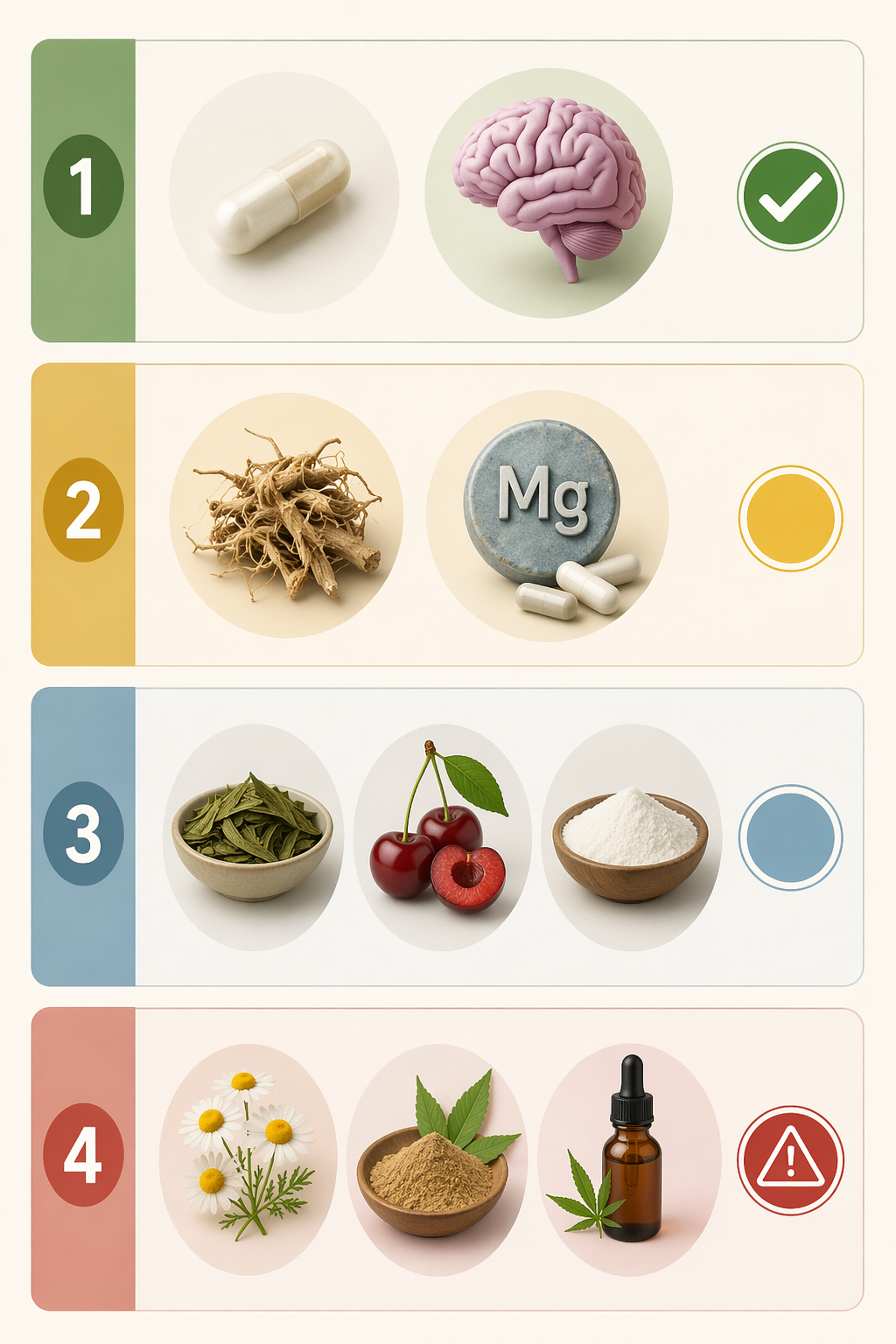
Tier 1: CBT-I and melatonin, but not for the same problem
The strongest tier has two very different entries. One is not a supplement at all: cognitive behavioral therapy for insomnia, or CBT-I. The other is melatonin, but mainly when the problem is sleep timing rather than insomnia in a normally timed circadian system.
CBT-I belongs in a natural-remedy conversation because it changes sleep through behavior, timing, stimulus control, and thought patterns rather than through a sedating drug. A Nature article described CBT-I as “shockingly effective,” and that phrasing matters because chronic insomnia is often treated as if it should yield to a calmer tea, a heavier blanket, or a stronger capsule.[2] The person who has been awake for months usually needs a structured treatment plan, not another ingredient to rotate through.
In practical terms, CBT-I is the best-supported “natural” option for chronic insomnia because it targets the loop that keeps insomnia going: spending too much wakeful time in bed, sleeping in irregular windows, trying harder to sleep, and gradually teaching the bed to feel like a place of monitoring rather than rest. For readers who want the mechanics rather than the slogan, our guide to CBT-I for sleep anxiety explains how that treatment is usually built.
Melatonin earns its place for a narrower reason. A literature review summarizing a 19-randomized-controlled-trial meta-analysis reported that melatonin reduced sleep latency, but the clinically important distinction is that the support is strongest for circadian misalignment, not for chronic insomnia when circadian timing is normal.[3] That means melatonin makes the most sense when the body clock is late, shifted, or confused: jet lag, delayed sleep timing, some shift-work patterns, or a schedule that has drifted later than the person’s obligations allow.
This is where many labels and many social-media recommendations become too broad. “Helps you fall asleep” sounds like one problem. It is not. A person who gets sleepy at 2 a.m. and must wake at 7 a.m. has a timing problem. A person who feels exhausted at 10 p.m., falls asleep, then wakes at 3 a.m. with dread has a different problem. A person who spends nine hours in bed chasing six broken hours of sleep has another one. Melatonin may be rational in the first pattern and much less convincing in the others.
The same review also flags a problem that follows most sleep supplements: optimal dosages, formulations, and treatment durations remain unestablished for many products.[3] That caveat is not a small footnote. Melatonin products vary by dose, release type, timing, and label accuracy; readers comparing products can use our separate guide to melatonin for adults for ingredient-specific details.
Tier 2: Valerian and magnesium have real signals, not settled answers
A 2025 scoping review in Sleep Medicine examined 51 randomized controlled trials of over-the-counter products for insomnia in adults and found valerian and melatonin among the most studied and most effective options.[4] That does not make valerian equal to melatonin, and it certainly does not make it equal to CBT-I. It means valerian has enough clinical signal to discuss seriously instead of filing it under folklore.
The most concrete valerian number here is an 18-RCT meta-analysis reporting a standardized mean difference of -0.71 for sleep latency.[3] In plain language, that points toward a shorter time to fall asleep in the studied groups. The reason valerian stays in Tier 2 is that supplement evidence often comes with uneven preparations, varying doses, short study windows, and outcomes that do not always tell a patient what will happen after a month or a year.
That middle ground is easy to mishandle. Valerian is not “proven to cure insomnia,” and it is not “useless because it is herbal.” It is a candidate for cautious, short-term experimentation in adults who are not pregnant, not giving it to a child, not mixing it casually with sedatives or alcohol, and not trying to medicate a worsening mental-health pattern. Readers who want a narrower ingredient review can compare the evidence in our valerian root sleep evidence guide.
Magnesium has a different appeal. It is familiar, inexpensive, and often framed as a nervous-system mineral rather than a sleep drug. The strongest specific finding comes from an older-adult trial using 500 mg over 8 weeks, which improved Insomnia Severity Index scores and sleep efficiency.[3] That is a meaningful signal, especially because older adults commonly struggle with fragmented sleep.
But magnesium should not be promoted as a universal insomnia fix from that finding alone. The population matters. The dose matters. The baseline magnesium status may matter, although the available evidence here is not enough to turn deficiency into a broad explanation. Older adults also have the highest likelihood of kidney disease, multiple prescriptions, and medication interactions, which is exactly the group that should not treat “natural” as a synonym for “automatically safe.”
This is the point in the evidence ladder where many people overgeneralize. Valerian and magnesium are not in the same position as chamomile, where the clinical support is thin. They are also not in the same position as CBT-I, where the treatment targets chronic insomnia directly. Tier 2 means: plausible, studied, sometimes helpful, still limited.
Tier 3: L-theanine, tart cherry juice, and glycine are plausible adjuncts
Tier 3 is where the language has to stay restrained. L-theanine, tart cherry juice, and glycine have plausible mechanisms and enough interest to be worth watching, but the current evidence does not support treating them as established insomnia treatments. They may be reasonable adjuncts for some adults, especially when used as part of a consistent evening routine, but they should not displace CBT-I for chronic insomnia or melatonin for a clearly shifted body clock.
A useful way to think about this tier is to ask what job the product is supposed to do. If the claim is gentle relaxation before bed, that is a softer claim. If the claim is reliable insomnia relief, that demands stronger trials. If the claim is “clinically proven” but the evidence rests on small, short, or product-specific studies, the marketing has outrun the answer.
For a broader comparison of ingredient-level claims, see our evidence guide to natural sleep aids and clinical evidence. The important distinction here is that Tier 3 remedies are not being dismissed. They are being kept in the correct lane.
Tier 4: Chamomile, kava, and CBD should not be sold as proven insomnia remedies
Chamomile tea may be a pleasant bedtime cue. That is not the same as having sufficient quality evidence as an insomnia treatment. If the warm mug helps mark the end of the day, lowers stimulation, and replaces alcohol or late caffeine, the routine may help sleep even if the chamomile itself is not doing much measurable pharmacologic work.
Kava is more complicated because the issue is not only weak evidence. The sleep-supplement review notes hepatotoxicity concerns despite some efficacy signals.[3] A remedy can look interesting in symptom studies and still be a poor casual choice if the safety tradeoff is too serious for unsupervised bedtime use.
CBD deserves the firmest skepticism because the marketplace has moved faster than the clinical record. The Nature article cited multiple company-sponsored trials that reportedly went unpublished because of null results.[2] That does not prove CBD will never have a sleep role, and cannabis research is still evolving. It does mean CBD should not be treated as a proven natural insomnia remedy on the basis of branding, anecdotes, or the general idea that calm equals sleep.
The ritual can work even when the ingredient is uncertain
There is one reason people can honestly report benefit from low-evidence remedies: bedtime rituals are active ingredients in their own right. A National Geographic piece quoted sleep researcher Michael Grandner saying, “supplements don’t treat medical conditions,” a useful correction when insomnia is being treated as a shopping problem rather than a health problem.[5] But a nightly ritual can still reduce arousal, create predictability, and give the brain a repeated cue that the day is ending.
That distinction protects two truths at once. The perceived benefit may be real. The explanation may not be the capsule’s advertised mechanism. If someone drinks a noncaffeinated tea, dims the lights, stops scrolling, and sits quietly for 20 minutes, sleep may improve for reasons that have little to do with the herb named on the box.
This is also why supplement trials are hard to interpret. Taking something at bedtime is not a neutral act. It changes expectation, routine, and attention. Good research tries to separate those effects from the ingredient itself, but many over-the-counter sleep products still lack the kind of long-term, standardized evidence that would make strong claims comfortable.
How to match the remedy to the sleep problem
Before choosing a natural remedy, name the pattern. A person whose bedtime has drifted late should think differently from a person who wakes with panic, who snores heavily, who has restless legs, who is pregnant, who is giving a product to a child, or who takes several medications. The same bottle cannot answer all of those situations.
- If sleeplessness has become chronic, prioritize CBT-I and clinical evaluation rather than cycling indefinitely through supplements.
- If the main issue is a delayed, shifted, or disrupted body clock, melatonin is the best-supported supplement category, used with attention to timing and dose.
- If trying valerian or magnesium, treat the experiment as modest and time-limited, especially if you are older, pregnant, taking sedating medications, or managing kidney, liver, anxiety, or depression concerns.
- If considering L-theanine, tart cherry juice, or glycine, think of them as adjuncts with limited evidence, not replacements for insomnia treatment.
- If a product promises broad insomnia relief without strong human data, read that as marketing pressure, not medical certainty.
For readers trying to sort the symptom first, our guide to matching a sleep problem to a natural remedy gives a more practical decision path.
References
- CDC HESTAT 116, CDC, 2024.
- Nature article on CBT-I and sleep treatments, Nature.
- PMC literature review on sleep supplements, PMC.
- Over-the-counter products for insomnia in adults, Sleep Medicine, 2025.
- National Geographic piece on sleep supplements, National Geographic.
Comments
Join the discussion with an anonymous comment.