
Valerian root as a sleep aid sits in an awkward place: it is common enough to appear on ordinary supplement shelves, yet the evidence is too uneven for a clean “yes, it works” label. The most useful answer is narrower. Valerian may help some adults fall asleep faster or feel that their sleep quality is better, especially after consistent use for at least two weeks, but it is not a recommended treatment for chronic insomnia.
The reason the answer keeps wobbling is not only placebo response or weak trials, though both matter. It is also that “valerian” is not one thing. Studies have tested dried root, rhizome, teas, capsules, tinctures, standardized extracts, different extraction methods, different doses, and different sleep outcomes. A 2020 systematic review and meta-analysis of 60 studies with 6,894 participants found a striking split: whole root or rhizome preparations showed a combined effect size of 0.83 for sleep quality improvement, while standardized extracts showed 0.10.[1]
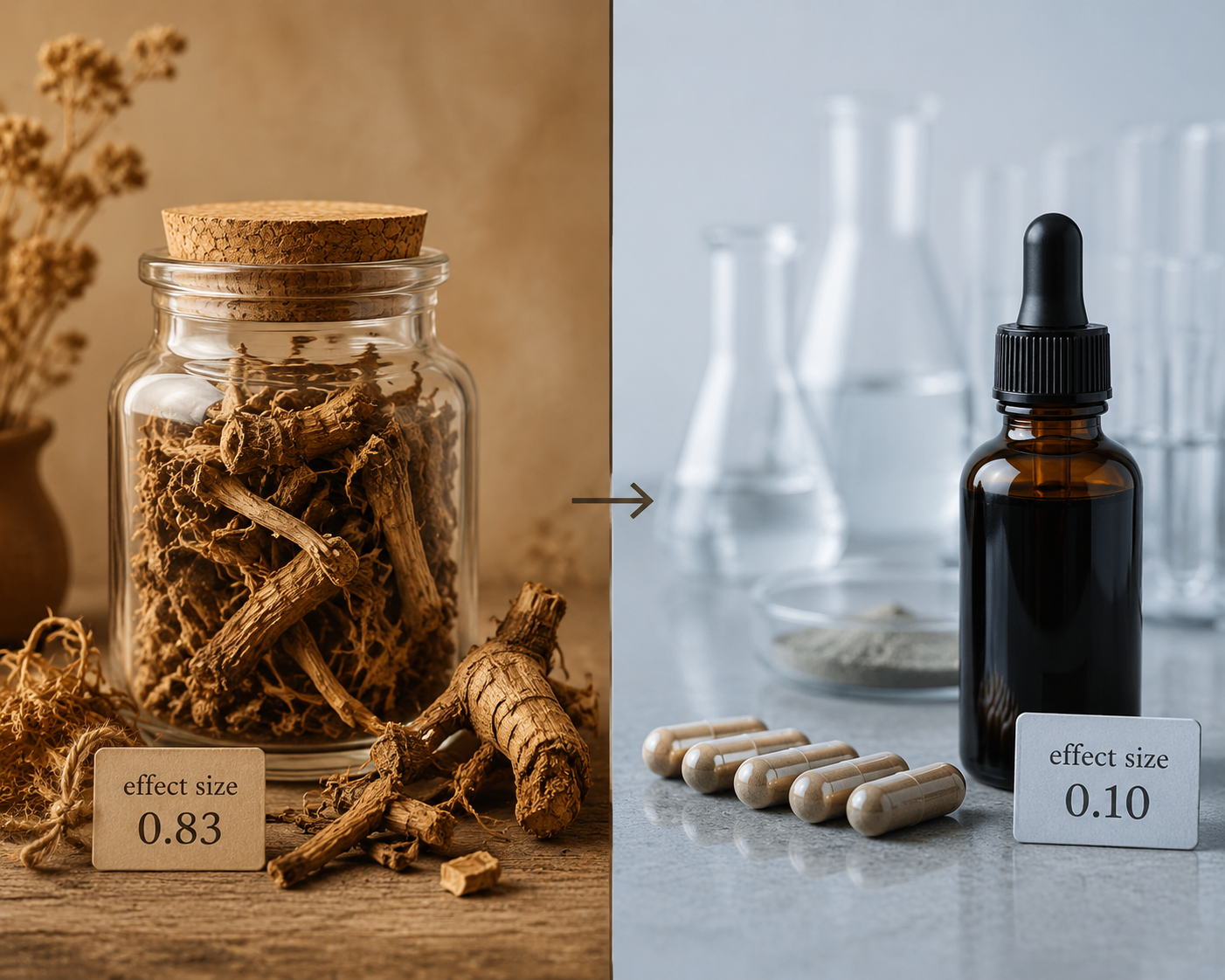
That split does more explanatory work than another generic verdict that the evidence is “mixed.” It suggests that a person using a whole-root preparation and a person using a standardized extract capsule may not be running the same experiment at all.
The Evidence Looks Different Once You Separate the Preparations
The Shinjyo review is useful because it refuses to flatten valerian into a single product category. It included studies across sleep problems, anxiety, and associated conditions, then examined formulation differences rather than treating every capsule, tea, and extract as interchangeable.[1]
| What was tested | What the 2020 review found | How to read it |
|---|---|---|
| Whole root or rhizome preparations | Combined effect size of 0.83 for sleep quality improvement | The more favorable signal; closest to dried-root tea or minimally processed root/rhizome products |
| Standardized extracts | Combined effect size of 0.10 | A much weaker signal; product standardization did not translate into a clearly stronger sleep effect |
| Valerian studies as a broad group | Highly variable results across preparations and outcomes | A single all-purpose conclusion is likely to mislead |
The whole-root advantage should not be inflated into certainty. An effect size from a meta-analysis is not a guarantee that a person will sleep better after buying a jar of dried root. The trials varied in design, product chemistry, participant type, and outcome measurement. Still, this is the part of the evidence that makes the most sense of the contradiction: valerian can look mildly promising in one set of studies and nearly inert in another because the tested material is not consistent.
That distinction also matters because supplement labels often imply precision. “Standardized extract” sounds more scientific than dried root, and sometimes it is more controlled. But with valerian, the available synthesis does not show standardized extracts clearly outperforming whole root or rhizome preparations for sleep. In the 2020 review, the opposite pattern appeared.[1]
This does not mean every dried-root product is potent or every extract is useless. It means product form belongs near the top of the evidence conversation, not in the fine print.
Why Authoritative Sources Still Sound Cautious
The NIH Office of Dietary Supplements states that clinical evidence for valerian’s efficacy in insomnia is inconclusive.[2] The American Academy of Sleep Medicine guideline advises clinicians not to use valerian for chronic insomnia treatment because the evidence is insufficient.[3] Those positions are not contradicted by the whole-root signal; they draw a boundary around it.
An adult with occasional sleeplessness asking whether a cautious trial is reasonable is asking a different question from a clinician treating chronic insomnia. Subjective sleep quality matters, especially when the complaint is lived sleep rather than a lab endpoint. But subjective improvement in some trials is not the same thing as a validated treatment recommendation for chronic insomnia.
The older Bent systematic review reached a similar kind of cautious middle ground: valerian showed a small but statistically significant benefit for sleep quality in some studies, but trial results were inconsistent.[4] Mayo Clinic’s patient-facing discussion also frames valerian with a question mark rather than a promise, describing it as a possible sleep aid while emphasizing uncertainty and safety cautions.[5]
So the practical reading is not “valerian has been debunked.” It is also not “valerian is proven.” It is that the best case is modest, preparation-dependent, and more relevant to occasional sleep difficulty than to persistent insomnia that deserves structured care.
What a Reasonable Trial Would Actually Look Like
If an otherwise healthy adult wants to try valerian for sleep, the most honest trial is boring: choose one product type, take it consistently, avoid mixing it with other sedating substances, and judge it over a realistic window rather than one bad night.
Clinical trial protocols commonly use 300–600 mg of standardized extract, or 2–3 g of dried root steeped as tea, taken 30 minutes to 2 hours before bed. These are not FDA-established dosing recommendations; valerian is sold as a dietary supplement, and there is no FDA-approved insomnia dose.[2]
- If choosing based on the most favorable evidence pattern, a whole root or rhizome preparation is the more defensible starting point than a random standardized extract.
- Use the same preparation and timing for at least two weeks before deciding whether it helps.
- Track one or two outcomes that matter: time to fall asleep, number of awakenings, next-day grogginess, or perceived sleep quality.
- Do not combine it casually with alcohol, benzodiazepines, opioids, sedating antihistamines, sleep medications, or other central nervous system depressants.
- Stop if side effects appear or if sleep worsens.
A two-week window is not a magic threshold. It is simply more faithful to the way valerian has often been studied than a single desperate dose at midnight. One-night use can still feel helpful or useless, but it is a poor basis for deciding whether the herb has any meaningful pattern for you.
For people whose sleep problem is frequent, long-running, or impairing daytime function, the better next step is not deeper supplement shopping. It is an insomnia evaluation and evidence-based treatment planning. Our guide to the insomnia self-care evidence spectrum explains where home strategies and supplements sit relative to CBT-I and clinical care.
What Valerian Might Be Doing in the Brain
Mechanism is where valerian often gets oversold. The biology is interesting; it is not a receipt for clinical effectiveness.
Valerian compounds have been reported to interact with GABA signaling, including binding at the beta subunit of GABA-A receptors. That matters because benzodiazepines bind at a different site, the gamma subunit, so valerian should not be described as simply a weak herbal benzodiazepine. Valerian has also been described as increasing synaptic GABA availability and acting as a partial agonist at 5-HT5A serotonin receptors in sleep-relevant brain regions, including the suprachiasmatic nucleus and amygdala.[6]
Adenosine pathways may also be involved, which is plausible because adenosine signaling is tied to sleep pressure.[6] Plausible, however, is doing a lot of work here. Much of this mechanistic evidence comes from animal and in vitro research. It helps explain why valerian is worth studying; it does not prove that a capsule on a shelf will produce reliable sleep improvement in humans.
For readers interested in how valerian fits among other supplements that make GABA-related claims, see our guide to GABA-targeting OTC sleep aids. The short version is that receptor activity and sleep outcomes are different levels of evidence.
Safety Is Usually Mild, but Not Irrelevant
Valerian is generally associated with mild side effects such as headache, dizziness, and gastrointestinal upset.[2] In one 102-subject study of the valerian preparation LI 156 at 600 mg, next-day cognitive impairment appeared lower than with stronger prescription sleep aids, but that finding should not be stretched into a blanket safety guarantee for all valerian products.[1]
Some people should avoid valerian or ask a clinician first: people who are pregnant or breastfeeding, people with liver conditions, and anyone taking central nervous system depressants or medications with relevant cytochrome P450 metabolism concerns.[2]
Product quality is the quieter safety issue. Valerian products can differ by plant part, extraction solvent, standardization target, storage conditions, and age. Valepotriates and related constituents can degrade over shelf life, and consumers usually cannot verify whether a product’s chemistry still resembles the material used in a trial. This is one more reason not to treat “valerian” as a single, stable intervention.
The Decision Boundary
Valerian root is reasonable to consider as a short, cautious experiment for some adults with occasional sleeplessness, especially if the choice is a whole root or rhizome preparation and the person is not taking sedatives or managing a condition that raises safety concerns. It is less reasonable as a substitute for insomnia treatment, a quick fix after one bad night, or a product bought mainly because a label hints at “GABA support.”
If you want a broader comparison of where valerian sits among nonprescription options, our natural sleep remedies evidence guide covers the wider landscape. Our companion article on valerian root for sleep may also help if you want a simpler product-focused overview.
The cleanest conclusion is also the least marketable one: valerian has a plausible mechanism and a more favorable evidence pattern for whole root or rhizome preparations, but the evidence remains inconsistent and does not clear the bar for chronic insomnia treatment.
References
- Valerian Root in Treating Sleep Problems and Associated Disorders-A Systematic Review and Meta-Analysis, Journal of Evidence-Based Integrative Medicine, 2020.
- Valerian: Fact Sheet for Health Professionals, NIH Office of Dietary Supplements.
- Clinical Practice Guideline for the Pharmacologic Treatment of Chronic Insomnia in Adults, American Academy of Sleep Medicine, 2017.
- Valerian for Sleep: A Systematic Review and Meta-Analysis, The American Journal of Medicine, 2006.
- Valerian: A safe and effective herbal sleep aid?, Mayo Clinic.
- Valerian (Valeriana officinalis) for Treating Insomnia and Sleep Disorders, EBM Consult.


Comments
Join the discussion with an anonymous comment.