
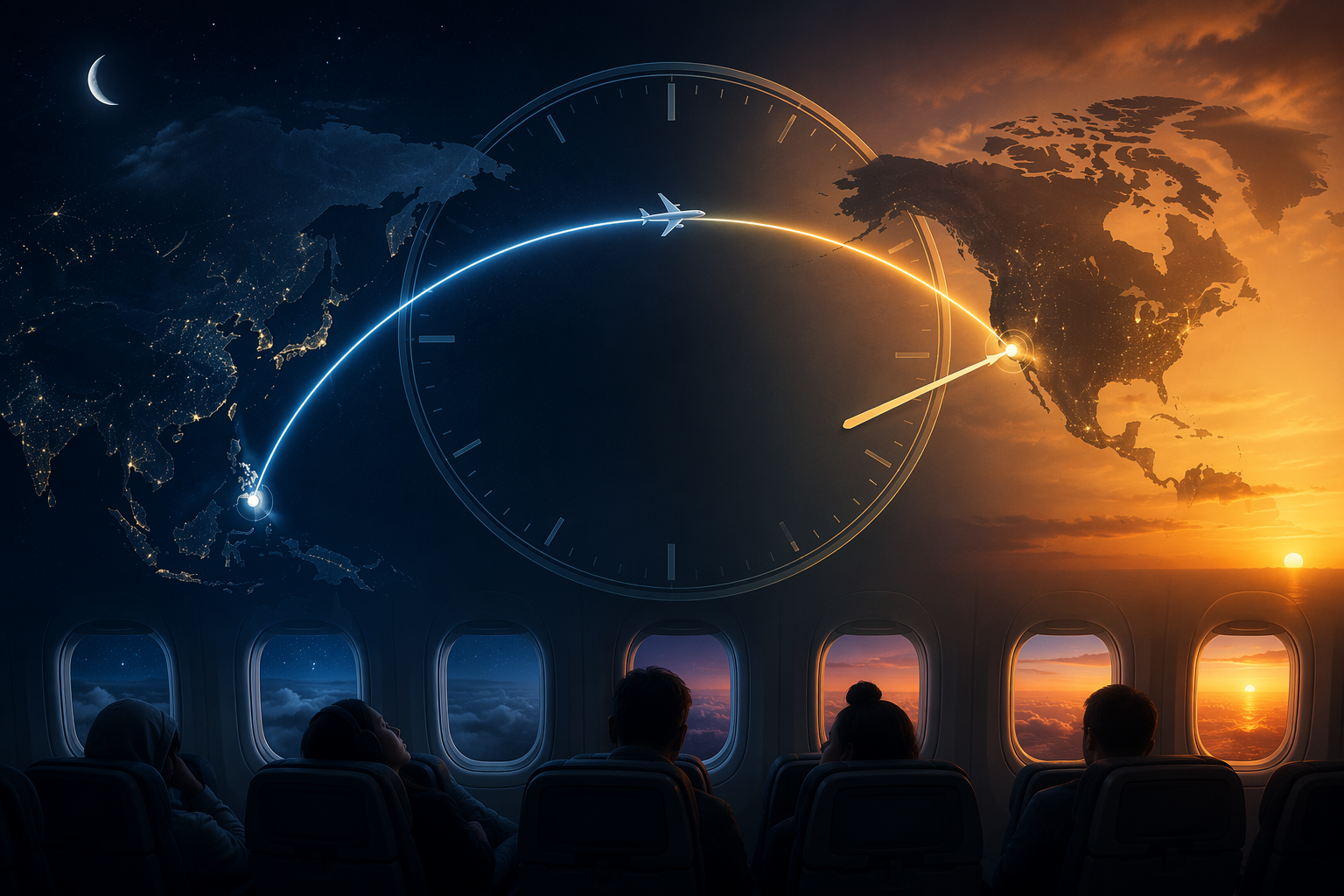
The Manila-to-Los Angeles overnight flight is better timed than it looks. PR102 is typically scheduled out of Manila around 10:15–10:30 PM and into Los Angeles around 8:40 PM, with a 13–15 hour flight time depending on winds and operations.[1] In July 2026, Manila is 15 hours ahead of Los Angeles because California is on Pacific Daylight Time; the offset becomes 16 hours during Pacific Standard Time.[1] That timing gives you one useful opening: sleep soon after departure, wake into the last part of the flight on LA time, then use the evening arrival to finish the day instead of starting a new one.
| When | What to do | Why it matters |
|---|---|---|
| Before boarding in Manila | Treat the flight as a late bedtime. Eat enough before the airport or keep the onboard meal small. | A heavy late meal can steal the first usable sleep window. |
| Takeoff to first 5–7 hours | Make this the main sleep block. Mask, earplugs or noise canceling, neck support, minimal screen time. | This is closest to your Manila bedtime and still early enough to protect the LA evening. |
| Middle of flight | If awake, stay boring: dim screen, quiet audio, water, bathroom, back to sleep or rest. | The goal is not perfect sleep; it is avoiding a fully alert movie-and-snack loop. |
| Last 2–3 hours | Shift attention to Los Angeles. Open the shade only if cabin timing and daylight make sense; avoid trying to force another long sleep. | You are preparing to land around LA evening, not extending Manila night. |
| After arrival at LAX | Get through immigration, eat lightly if needed, keep evening light dim, and go to bed at a normal LA bedtime. | This keeps the westward delay working for you instead of turning arrival night into a nap trap. |
| First LA morning | Do not blast yourself with very early bright light if you wake too early. Use stronger light later in the day. | For westward travel, late-afternoon and early-evening light helps delay the body clock. |
Why This Route Gives You a Real Opening
The main advantage is directional. Westbound travel usually asks the body to delay its clock — to stay up later — rather than advance it. Circadian researchers commonly describe that as easier for most people because the internal body clock tends to run slightly longer than 24 hours; Timeshifter, citing sleep researcher Steven Lockley, puts the share of people with a longer-than-24-hour intrinsic period at about 75%.[2] Sleep Foundation makes the same practical distinction: westward jet lag is often easier to tolerate than eastward jet lag, though individual responses vary.[3]
That does not mean the 15-hour shift disappears. A rough, unmanaged rule of thumb is about one day of recovery per time zone crossed westward, and longer when traveling eastward.[2][3] Timed light and behavior can move the body clock faster — often discussed as roughly 2–3 time zones per day rather than one — but that is a protocol, not magic.[2][4] The Manila departure happens to support the protocol because boarding lines, takeoff, and the first meal service all occur near the time many passengers would already be preparing to sleep.
The mistake is treating the flight like a 13–15 hour entertainment block with a nap somewhere inside it. On this route, the first half of the flight is the most valuable sleep real estate. If you spend it eating slowly, watching two movies, and waiting until you feel exhausted, you may still sleep — but you will probably wake closer to Los Angeles with your body still behaving like it is Manila morning.
Before Departure: Do Less, Earlier
If you have several days before departure, the cleanest preparation is to drift a little later: meals, sleep, and bright light slightly later than usual. Do not turn this into a heroic pre-trip sleep experiment. The flight itself already departs at a useful time, so the bigger win is arriving at NAIA not over-caffeinated, overfed, or determined to finish work until boarding.
- Eat a real dinner before the airport if that is practical, then treat the onboard meal as optional or small.
- Cut caffeine early enough that it is not still doing the work during the first sleep block.
- Pack the few items that protect the sleep window: eye mask, earplugs or noise-canceling headphones, a supportive neck pillow, water, and any prescribed medication you normally use.
- Set your watch or phone to Los Angeles time after takeoff, but use Manila bedtime as the cue to start sleeping.
Seat choice matters, but not in the way seat-map folklore usually frames it. The commonly listed PR102 operating context is a Philippine Airlines Boeing 777-300 with 370 seats and a 3-3-3 economy cabin, though aircraft substitution is always possible.[5] In that layout, the window seat has one obvious sleep advantage: it gives you a solid side surface. An aisle gives freedom, but it also gives shoulders, carts, and neighbors more chances to interrupt you.

The First Half of the Flight Is the Main Sleep Window
Once the aircraft is climbing out of Manila, make the boring choice quickly. Finish any meal you actually need, use the bathroom before the aisle fills, put on your eye mask, and reduce sound. The meal service is the fork in the road: if you turn it into a full restaurant experience, the cabin may be dark by the time your body has already been pushed through a second wind.
This is where economy sleep improves through friction removal, not comfort fantasy. Cruising cabin noise has been reported around 85 dBA — often compared with a vacuum cleaner — though actual levels vary by aircraft, seat location, and flight phase.[4][6] That is loud enough to make earplugs or noise canceling more than a nice extra on an overnight sector. You are not only blocking crying babies or announcements; you are lowering a constant arousal signal.
The recline question is less simple than “more recline equals more sleep.” A 2021 ergonomics study reported less head and neck strain in a vertical seat position than at a 110-degree recline, but the test condition did not include head-support pillows.[7] That caveat matters. Unsupported recline can let the head fall into worse positions; a proper pillow may change the comfort equation. The practical answer is to support the head first, then use recline only if it improves that supported position.
Pillow choice is not a miracle category either, but neck support is one of the few product decisions that directly affects whether you can stay asleep upright. A 2021 meta-analysis found latex and memory foam pillows provided better neck support than polyester fiberfill in seated positions.[8] For this route, the best pillow is the one that stops the chin-drop and side-collapse you personally get in a 3-3-3 seat. If it only looks plush in the terminal and fails when your muscles relax, it is luggage.
Avoid using the tray table as a headrest. Travel ergonomics advice has warned that leaning forward onto the tray can create nerve compression risk, and it also leaves you vulnerable to turbulence, service interruptions, and a locked neck when you wake.[7] If you need to change position, change it briefly: feet planted or slightly supported, lower back settled, head supported, shoulders relaxed, then return to stillness.
What to Do If You Cannot Sleep
Do not escalate. The useful substitute for sleep is low-stimulation rest. Keep the cabin dark around you, keep audio dull, and skip the bright-screen negotiation where one episode becomes three. Even if you only sleep in fragments, you are still protecting the timing of the route. The failure mode is not waking up; it is waking up and deciding the night is over while the rest of the aircraft is still in your best sleep window.
Compression stockings belong in the health-and-comfort layer, not the sleep-hack layer. A Cochrane review found high-certainty evidence that compression stockings reduce symptomless deep vein thrombosis and reduce leg swelling on flights longer than four hours.[9] They may make the flight feel better, especially if you swell on long sectors, but they do not time your circadian clock or make you sleepy. Wear them for circulation, then still follow the light and sleep schedule.
Melatonin: Time Cue, Not Knockout Pill
Melatonin is easy to misuse on this flight because Manila bedtime and Los Angeles bedtime are not the same biological instruction. Medical sleep guidance commonly discusses low doses around 0.5–3 mg, taken about 30 minutes before the desired destination bedtime, as a circadian timing signal rather than a sedative.[6][10] Taking it at the wrong biological time can shift the clock in the wrong direction.[6]
For a traveler landing around 8:40 PM in Los Angeles, that usually makes melatonin more relevant after arrival, near the LA bedtime you intend to keep, than as a casual mid-flight sleeping pill. If you already use melatonin under medical guidance, follow that guidance. If you are new to it, do not make a long-haul aircraft cabin the first place you test dose, timing, and side effects.
The Last 2–3 Hours: Stop Protecting Manila Night
As the flight moves into its final hours, the job changes. You are no longer trying to maximize total sleep at any cost. You are trying to arrive in Los Angeles tired enough to sleep at a normal local bedtime, but awake enough to complete landing, immigration, baggage, transport, and a short evening without collapsing into an accidental early nap.
Light is the main lever because it tells the circadian system which way to move. For westward travel, late-afternoon and early-evening light at the destination helps delay the body clock; bright light at the wrong time, especially very early after waking, can work against that delay.[2][3] That is why the final part of the flight should feel like a controlled transition, not a second bedtime.
Cabin reality may limit how precise you can be. Crew instructions, shade rules, seat location, and actual daylight outside all matter. If the cabin is dark and you are still several hours from landing, do not flood yourself with bright screen light just to “wake up.” If breakfast or a pre-arrival meal appears, take it as a destination-time cue rather than a Manila-time meal. A 2017 study has been cited for the finding that eating according to the destination time zone while still in flight can help speed adjustment.[11]
After Landing at LAX: Do Not Waste the Evening Arrival
An 8:40 PM arrival is not early enough for a full LA day, and that is good. The task is narrow: get out of the airport, take in enough normal evening cues to tell your body where it is, avoid a giant late meal, and go to bed at a reasonable local time. If your hotel room is bright, make it dim. If you are hungry, eat lightly. If you are wired, use a quiet wind-down rather than trying to solve jet lag with another screen.
The next morning is where many travelers undo the westbound advantage. If you wake at 3:00 or 4:00 AM LA time, that does not mean the adjustment failed. It means part of your body is still ahead. Keep light low in those first hours rather than turning on every lamp, opening the laptop, and giving your clock a premature morning signal. Save stronger outdoor light and movement for later, especially late afternoon or early evening, when it better supports the westward delay.[2][3]
- Arrival night: dim light, light food if needed, normal LA bedtime.
- First early wake-up: stay boring, keep light low, do not start the day at Manila timing.
- First afternoon in LA: get outside if possible; a walk in late-day light is useful.
- Second and third nights: keep bedtime and meals on LA time, even if sleep is still uneven.
The realistic target is not to feel untouched by the flight. Economy on a 13–15 hour trans-Pacific sector is still economy, and a 15-hour offset is still a large biological move. The better target is to prevent the avoidable damage: losing the first-half sleep window, using melatonin at the wrong time, treating cabin noise as background, waking yourself with bright light too early in LA, and eating as if your body never left Manila.
Handled well, this particular itinerary gives you more help than it first appears to. The late Manila departure lines up with a natural sleep attempt, the westbound direction favors a delay, and the Los Angeles evening arrival lets you finish the destination day instead of inventing one. That is enough to turn a punishing recovery into a controlled two- or three-day adjustment for many travelers, if the timing is protected.
References
- Philippine Airlines Flight PR102 Schedule, Philippine Airlines.
- Is jet lag worse going east or west?, Timeshifter.
- Jet Lag: Navigating the Symptoms, Causes, & Prevention, Sleep Foundation.
- How to beat jet lag, National Geographic.
- Philippine Airlines PR102 Seat Map, flightseatmap.com.
- Good sleep hygiene key in sleeping on plane, UCLA Health.
- How to Sleep on a Plane, According to Experts, Verywell Health.
- The Effect of Pillow Designs on Promoting Sleep Quality, Spinal Alignment, and Pillow Comfort in Adults: A Systematic Review, Clinical Biomechanics, 2021.
- Compression stockings for preventing deep vein thrombosis in airline passengers, Cochrane Database of Systematic Reviews.
- How to Actually Sleep On A Plane, Henry Ford Health.
- How to Eat Your Way Out of Jet Lag, Condé Nast Traveler.



Comments
Join the discussion with an anonymous comment.