
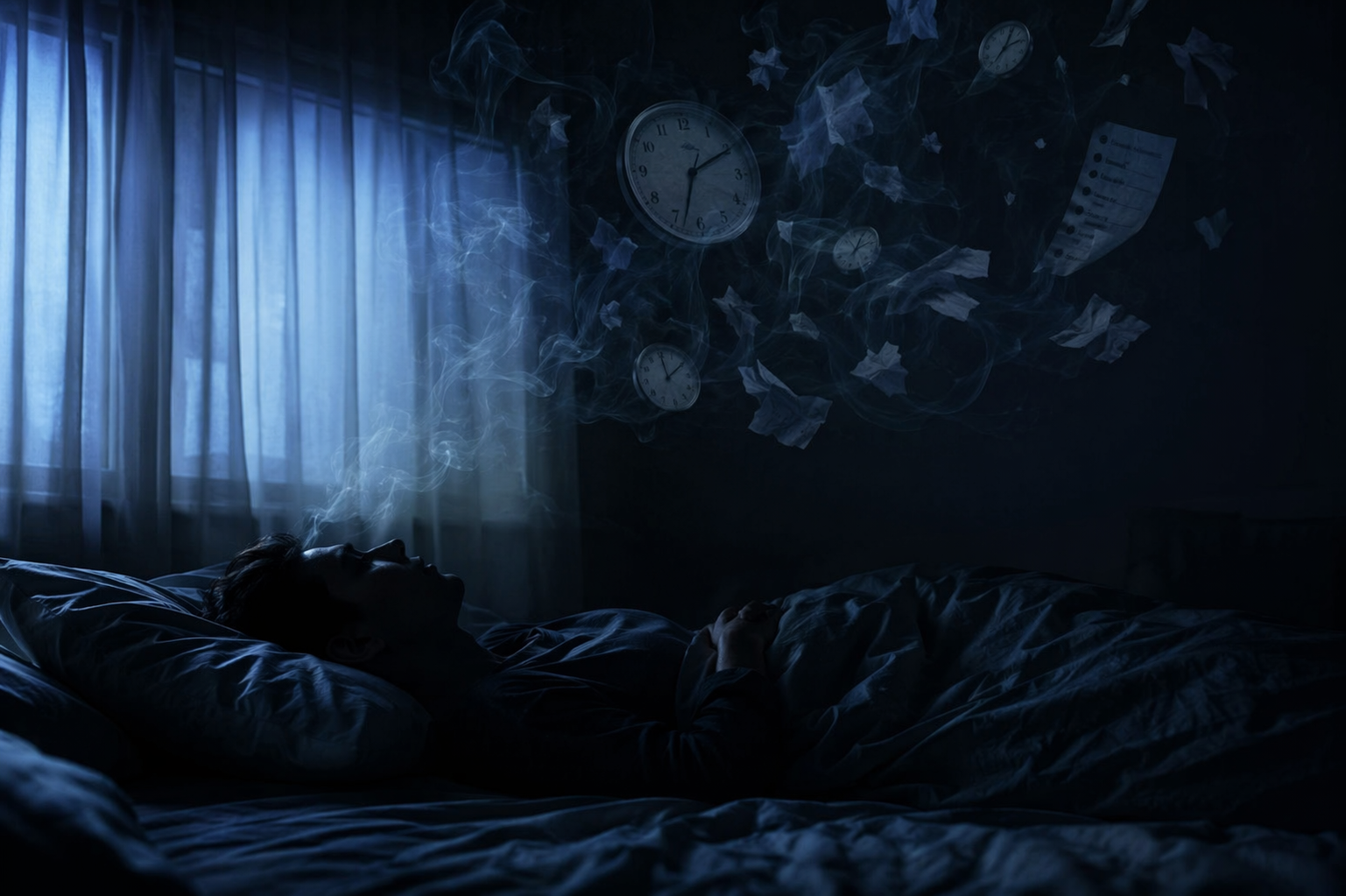
The loop often starts before the lights are fully out. A person is exhausted, gets into bed, and then the mind reopens a file it has already reviewed: the stove, the email, the contamination fear, the moral doubt, the body sensation, the sentence that might have meant something terrible. Sleep feels close, but not permitted. One more check, one more mental replay, one more attempt to feel certain.
That is the practical problem behind OCD and sleep problems: OCD can delay sleep through obsessions, bedtime compulsions, mental review, reassurance seeking, washing, checking, counting, confessing, or avoidance of the bed itself. Then the shortened, fragmented night makes the next day harder. Intrusive thoughts may feel louder, threat may feel more urgent, and resisting compulsions may take more effort because the systems needed for inhibition and emotional regulation are running on less sleep.
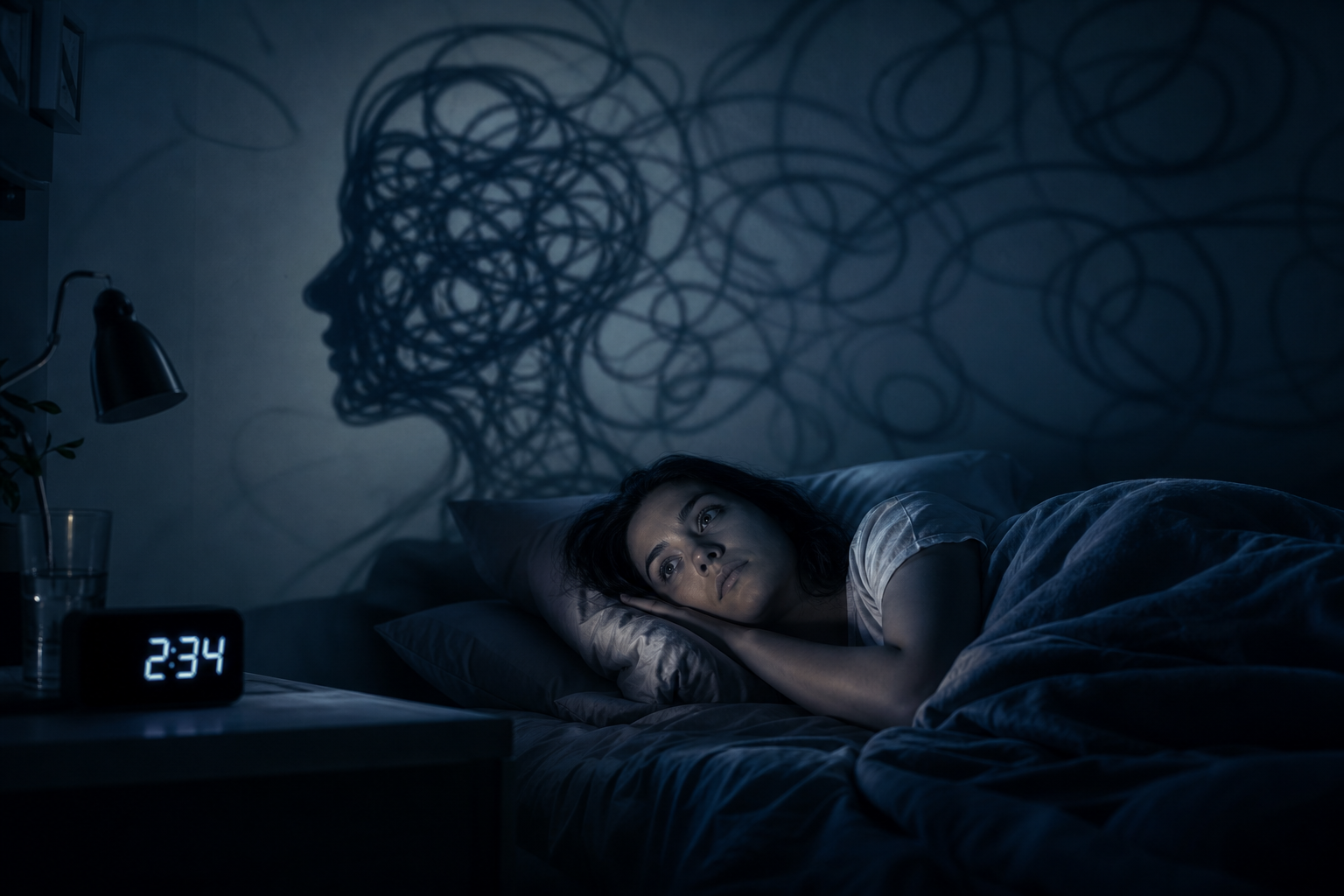
The connection is not rare. In a Swedish population cohort and a later systematic review, insomnia affected more than 42% of people with OCD, with insomnia risk roughly seven times higher than in the general population.[1][2] Those figures do not mean every person with OCD has insomnia, and some clinical samples may overstate rates for people with milder symptoms. But they do make one thing hard to dismiss: when OCD and sleep deteriorate together, the person noticing the pattern is not inventing it.
Why Bed Becomes a Bad Place to Think
OCD does not need a special “night version” to interfere with sleep. The ordinary machinery of OCD is enough. Obsessions arrive as intrusive doubts, images, sensations, or urges. Compulsions promise relief or certainty. At night, there are fewer distractions, fewer competing tasks, and a strong pressure to finish the mental work before sleep. That pressure can make compulsions feel less optional.
Some sleep disruption is direct. Checking a lock, washing again, rereading a message, or repeating a prayer or phrase keeps the person physically awake. Some of it is quieter. Mental review can look like lying still, but the brain is performing threat analysis: reconstructing a memory, testing whether a thought felt “wrong,” scanning for guilt, or trying to prove that a feared outcome will not happen. The body may be in bed; the person is still working.
Sleep initiation is the obvious casualty, but maintenance can suffer too. A person may wake during the night and immediately re-enter the same checking or neutralizing sequence. Others wake with a spike of uncertainty and then avoid returning to sleep until a ritual feels complete. Over time, the bed can become associated with vigilance rather than letting go, which is exactly the kind of conditioned wakefulness insomnia treatments are designed to address.
For a more granular breakdown of the OCD-to-sleep direction, the companion article on three OCD sleep pathways separates nighttime obsessions, compulsive rituals, and delayed sleep timing. The important point here is that these are not merely “bad habits.” They are attempts to reduce feared uncertainty, and they can become tightly attached to bedtime.
The Reverse Direction: Poor Sleep Makes OCD Harder to Resist
The next morning is where self-blame often sneaks in. After a short night, the same intrusive thought may feel more believable. The urge to check may arrive faster. A small uncertainty may feel intolerable. That does not mean the person has become weak or careless overnight. Sleep loss can impair the cognitive and emotional capacities that OCD treatment asks people to use: inhibition, flexible attention, distress tolerance, and the ability to let a thought remain unresolved.
This matters because resisting a compulsion is not passive. It requires noticing an intrusive thought without treating it as an emergency, allowing anxiety to rise without immediately neutralizing it, and tolerating the absence of complete certainty. Those are demanding skills even on a good day. After poor sleep, the brain may have less room for them.
A 2023 study of 639 participants found that repetitive negative thinking partially mediated the relationship between sleep disturbance and obsessive-compulsive symptoms: sleep disturbance was linked with more repetitive negative thinking, which in turn was linked with stronger obsessive-compulsive symptoms.[3] Because the study was cross-sectional, it should not be read as proof that poor sleep directly causes OCD symptoms in every person. Its value is narrower and still useful: it identifies a plausible bridge between a bad night and a more sticky, repetitive next day.
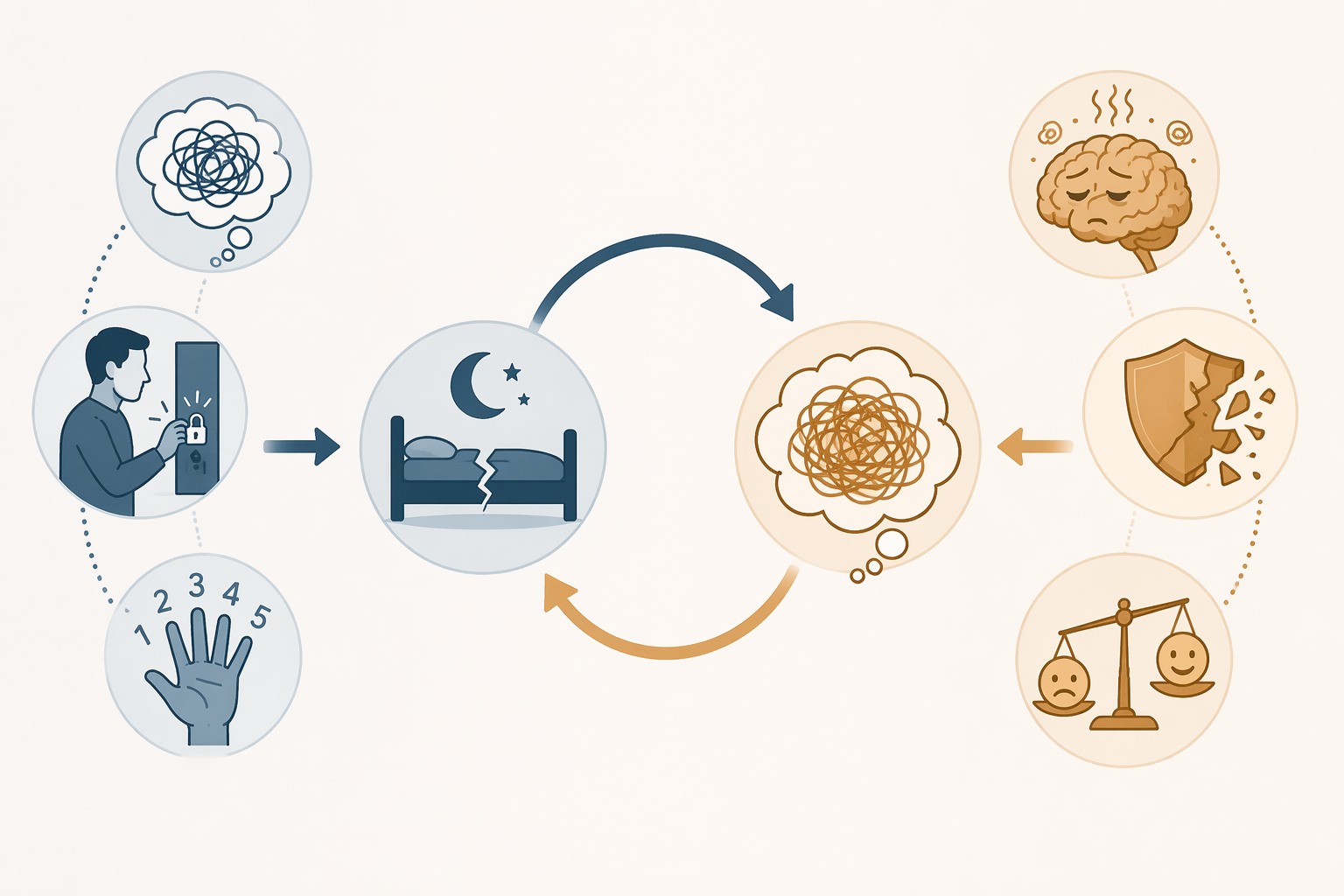
The mechanism fits what many people describe clinically. Poor sleep does not have to create a new obsession. It can make existing intrusive thoughts more available, more emotionally charged, and harder to disengage from. The thought returns; the person reviews it; the review makes the thought feel important; the next night begins with unfinished business.
OCD Severity Is Not the Only Lever
It is tempting to draw a clean line: worse OCD causes worse sleep. Sometimes that may be partly true. But the research is messier in a way that should change how the problem is treated.
In a study of 61 people with OCD and 100 controls, trait anxiety and depressive symptoms mediated the effect of OCD severity on sleep quality; after accounting for those symptoms, OCD symptom severity alone no longer predicted poor sleep.[4] That does not make OCD irrelevant. It means the sleep problem may be traveling through anxiety, depression, emotional dysregulation, or other overlapping burdens rather than through obsessive-compulsive symptom count alone.
Medication can complicate interpretation too. Many clinical OCD samples include people taking psychotropic medications, including SSRIs or benzodiazepines, and these can affect sleep architecture.[2] That is not a reason to stop or change medication without medical guidance. It is a reason to bring sleep changes into the prescribing conversation instead of assuming every night problem is purely psychological.
For readers without a formal OCD diagnosis, the same caution applies in the other direction. Bedtime checking, reassurance seeking, intrusive thoughts, or mental rituals may be worth discussing with a clinician even if they do not meet full diagnostic criteria. This article is not a diagnostic test. It is a way to name a pattern that can deserve care before it becomes more entrenched.
Delayed Sleep Timing Is More Than Staying Up Late
One part of the OCD-sleep picture is easy to misread as preference or procrastination: delayed sleep timing. In OCD samples, delayed sleep phase disorder has been reported in 17.6% to 42% of patients, compared with 0.2% to 10% in the general population.[4] Those ranges are wide, and sample differences matter, but the signal is clinically important.
The evidence is not only self-report. A systematic review notes objective circadian findings in OCD, including actigraphy and dim light melatonin onset measures, which support delayed circadian rhythms rather than only a subjective sense of being a “night person.”[2] This distinction matters because circadian delay changes the treatment question. A person may not be failing to comply with an early bedtime; their internal timing may be shifted later.
Delayed timing may also affect OCD treatment response. In a Behavior Therapy study, delayed sleep timing in OCD was associated with diminished response to exposure and response prevention therapy.[5] That does not prove that moving sleep earlier will treat OCD, and it does not make circadian work a substitute for ERP. It suggests that sleep timing can affect readiness, consistency, and capacity during treatment, especially when exposures require tolerating uncertainty without ritualizing.
A useful clinical question, then, is not simply “What time do you go to bed?” It is whether the person’s sleep window, alertness, treatment appointments, medication timing, light exposure, and compulsive rituals are all pulling in different directions. The circadian dimension deserves attention when sleep is persistently late, hard to advance, and impairing daytime functioning.
Why Combined Treatment Makes Sense
Once both engines of the cycle are visible, the treatment logic becomes less mysterious. Exposure and response prevention, or ERP, targets the OCD side: feared thoughts, avoided triggers, reassurance loops, and compulsions that temporarily reduce distress but keep the obsession-compulsion cycle alive. Cognitive behavioral therapy for insomnia, or CBT-I, targets the insomnia side: conditioned wakefulness, irregular sleep opportunity, time in bed spent awake, and behaviors that maintain sleep initiation or maintenance problems.
A 2025 systematic review concluded that combining ERP and CBT-I can produce better outcomes than treating either side alone, because ERP can reduce nighttime compulsions while CBT-I improves sleep initiation and maintenance.[2] The point is not to add more homework for an already exhausted person. It is to stop leaving one half of the loop untreated.
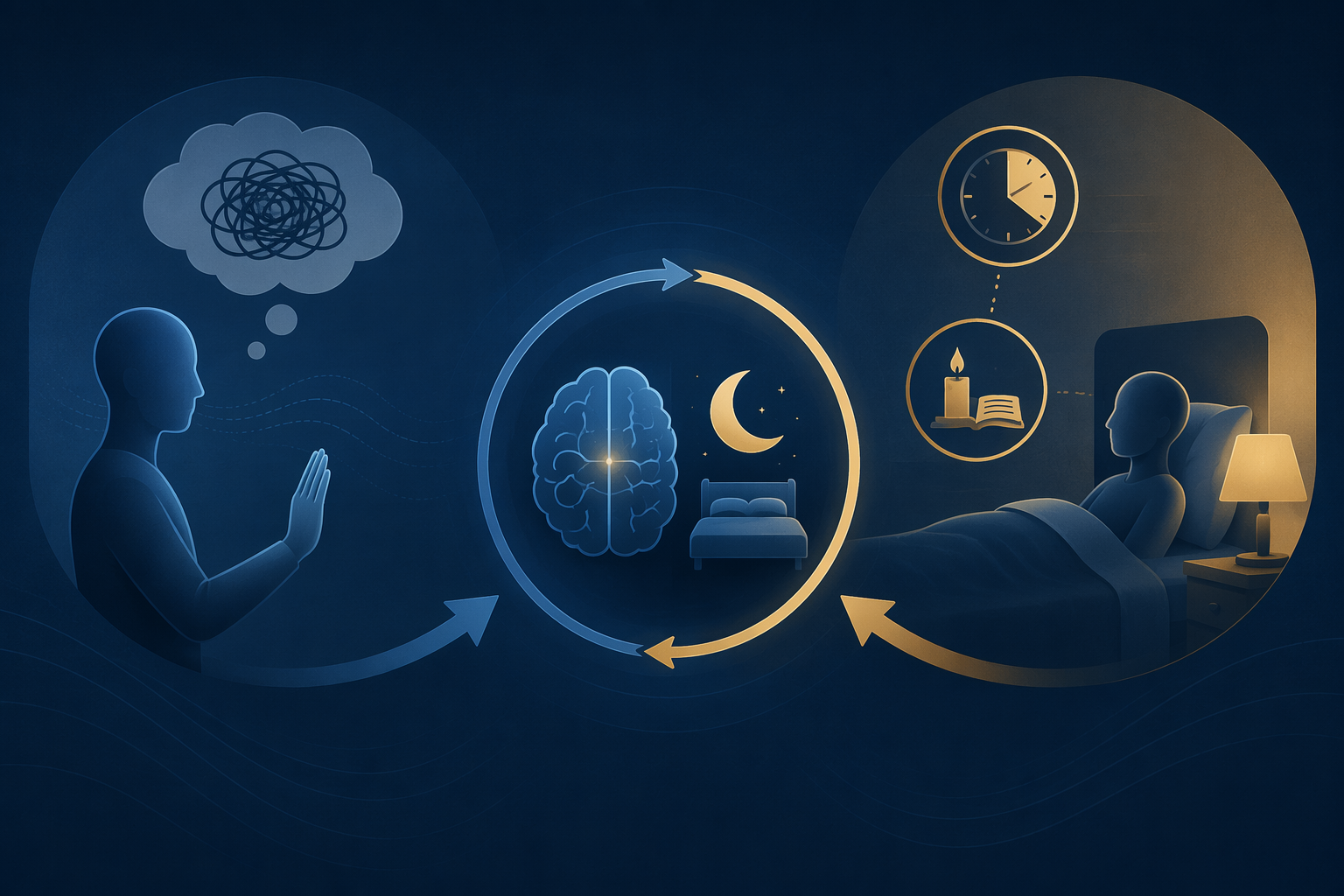
In practice, that may mean ERP work around bedtime fears: touching a feared object and not washing before bed, leaving a message unread, allowing an intrusive thought to remain unresolved, or going to sleep without completing a checking sequence. The exposure is not meant to prove that nothing bad will ever happen. It is meant to help the person practice living without the ritual that OCD says is required before sleep is allowed.
CBT-I has a different job. It may reduce the amount of time spent awake in bed, rebuild the bed-sleep association, adjust sleep scheduling, and address insomnia-maintaining behaviors. For someone with OCD, this has to be done carefully. A sleep rule can become a ritual if it is treated as a certainty-producing command. Good CBT-I is structured, but it should not become another compulsive system for monitoring the night.
When delayed sleep phase is present, the plan may also need circadian work: consistent wake time, appropriately timed light, evening light reduction, and careful scheduling. The goal is not moral discipline around bedtime. The goal is to align treatment demands with the person’s biological timing and daily obligations. Readers who want more detail can use the site’s CBT-I FAQ, the more detailed CBT-I protocol guide, and the article on sleep timing and mental health as next stops.
What to Bring Into Care
A clinician does not need a perfect sleep diary to start seeing the pattern. The useful information is concrete: what happens in the hour before bed, which rituals delay sleep, whether awakenings trigger compulsions, how late sleep naturally shifts when obligations disappear, and whether poor nights reliably make intrusive thoughts harder to resist the next day.
- Name the bedtime compulsions directly, including mental rituals that are invisible from the outside.
- Track whether sleep loss changes urge intensity, reassurance seeking, checking, washing, confessing, or rumination the next day.
- Ask whether ERP targets should include bedtime and nighttime situations, not only daytime triggers.
- Ask whether CBT-I is appropriate if the bed has become a place for prolonged wakefulness, monitoring, or dread.
- Raise delayed sleep timing if sleep is consistently shifted late and difficult to advance, especially if it interferes with treatment participation.
- Discuss medication timing and sleep effects with the prescriber rather than changing medication independently.
Anxiety and depression deserve the same directness. They can be part of the route by which OCD severity and sleep quality become linked, and they can also maintain insomnia in their own right.[4] For more on that overlapping loop, the article on sleep anxiety and insomnia is a useful companion, especially when worry, panic, or anticipatory fear of not sleeping is prominent.
If OCD and sleep problems are reinforcing each other, the credible plan is not more generic sleep advice and not OCD treatment that ignores the night. It is an integrated approach: ERP for compulsions and avoidance, CBT-I for insomnia mechanisms, circadian attention when sleep timing is delayed, and careful attention to anxiety, depression, and medication effects when they are part of the picture.
References
- Sleep and obsessive-compulsive disorder: a Swedish population-based cohort study. PubMed. 2020.
- Sleep disturbances and circadian rhythm in obsessive-compulsive disorder: a systematic review. Journal of Sleep Research. 2025.
- The mediating role of repetitive negative thinking in the relationship between sleep disturbance and obsessive-compulsive symptoms. Frontiers in Psychology. 2023.
- Delayed sleep phase disorder and emotional dysregulation in obsessive-compulsive disorder. PMC. 2021.
- Delayed sleep timing is associated with diminished response to exposure and response prevention in obsessive-compulsive disorder. Behavior Therapy. 2021.




Comments
Join the discussion with an anonymous comment.