
“Not being able to sleep” sounds like one problem until you try to fix it. The person who cannot drop off at 11 p.m. is not having the same night as the person awake at 3 a.m. with heartburn, or the person who opens their eyes at 5 a.m. and cannot return to sleep. Treating all three with the same bedtime checklist is how people end up feeling as if they failed at sleep hygiene, when the problem was never that simple.
A more useful first question is: which part of sleep is breaking? Most insomnia complaints fall into one or more of three patterns: trouble falling asleep, trouble staying asleep, or waking too early. That pattern does not diagnose the cause by itself, but it does point you toward a better first response.
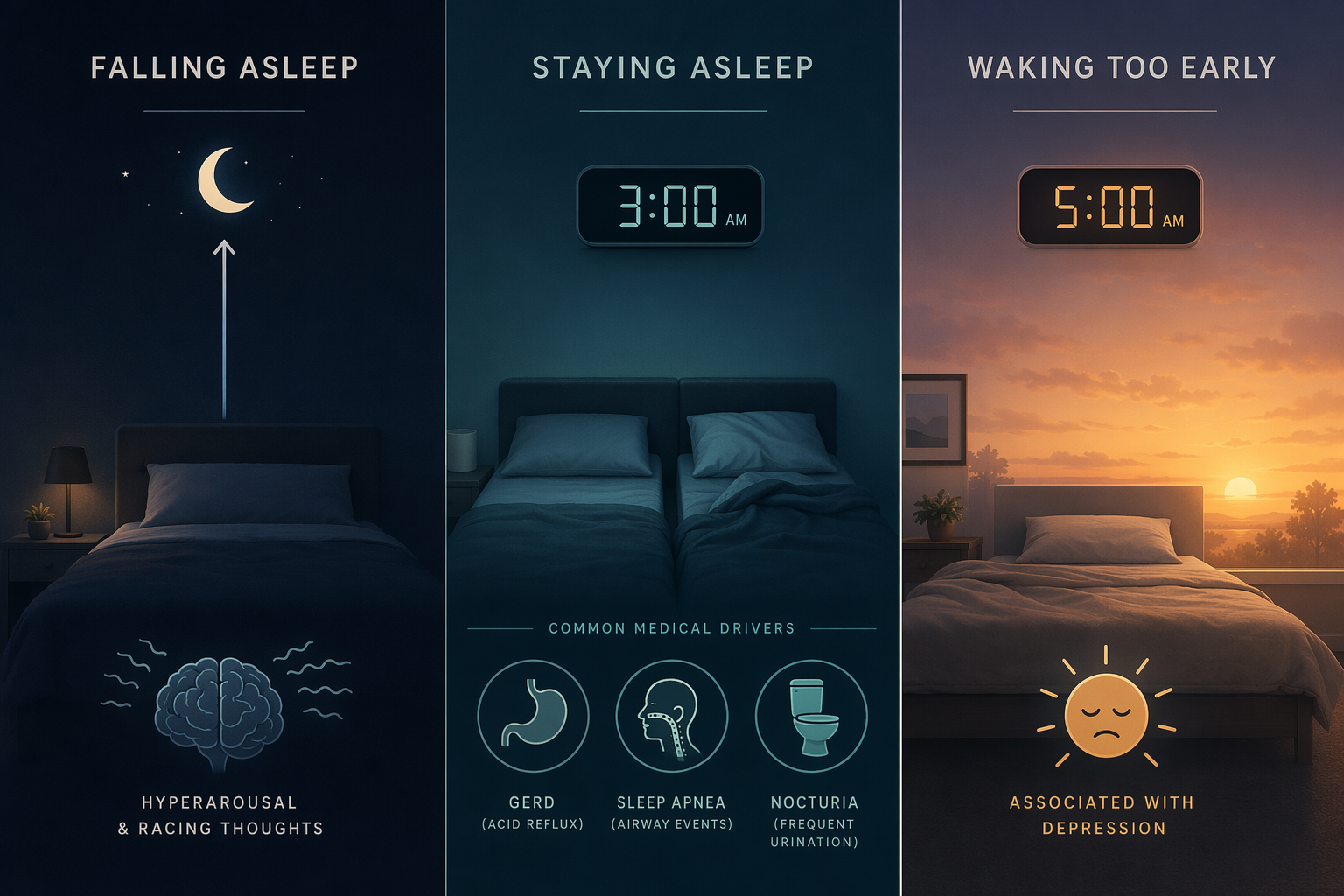
| If your main problem is... | The pattern is usually called... | Common drivers to consider | First response that fits the pattern |
|---|---|---|---|
| You get into bed but stay awake for a long time | Sleep onset insomnia | Hyperarousal, anxiety, racing thoughts, late caffeine, circadian timing, conditioned alertness in bed | Stimulus control, scheduled worry time, caffeine timing review, CBT-I |
| You fall asleep, then wake during the night and struggle to return to sleep | Sleep maintenance insomnia | Sleep apnea, reflux, pain, nocturia, alcohol-related sleep disruption, medications, age-related changes | Medical review, treating the driver, sleep restriction therapy within CBT-I |
| You wake earlier than intended and cannot get back to sleep | Early morning awakening | Depression, age-related circadian advancement, conditioned arousal, possible stress-system disruption | Depression care if mood symptoms are present, CBT-I strategies for early waking |
These are not niche distinctions. In 2024, 15.4% of U.S. adults reported trouble falling asleep most days or every day, while 18.1% reported trouble staying asleep most days or every day, according to CDC National Center for Health Statistics data.[1] That slight tilt toward staying asleep matters because many people assume insomnia means staring at the ceiling at bedtime. For a large share of adults, sleep starts but does not hold.
The patterns can overlap. You may spend an hour trying to fall asleep, wake twice overnight, and then be fully awake before your alarm. Still, naming the most disruptive part of the night keeps the first step from becoming a grab bag.
When the Problem Is Falling Asleep
Sleep onset insomnia is the pattern people usually picture first: you are tired, you go to bed, and your brain does not come down with the lights. The problem may feel mental because it often is experienced as mental noise: replaying a conversation, planning tomorrow, checking the clock, calculating how little sleep remains.
That does not mean the person is choosing to worry. Insomnia is closely tied to hyperarousal, a state in which the body and mind remain too activated for sleep. Anxiety can feed that state, and sleep loss can make anxiety more likely the next night. Anxiety disorders affect about 20% of American adults, and sleep-anxiety loops are common enough that treating the nighttime pattern often requires more than telling someone to relax.[2]
Caffeine timing is another practical suspect, especially when the evening feels wired rather than sleepy. Caffeine has a half-life of about 4 to 6 hours, which means a late-afternoon coffee can still be active when someone is trying to fall asleep.[3] The useful question is not just “Do I drink coffee?” but “How close to bedtime is my last meaningful dose of caffeine?” Tea, energy drinks, pre-workout products, cola, and some medications can belong in that inventory.
For this pattern, the bed itself can become part of the problem. If you spend night after night awake, frustrated, and monitoring yourself in bed, your brain can start treating bed as a place for effort rather than sleep. That is where stimulus control becomes more relevant than another soothing ritual.
- If you are not asleep after roughly 15 to 20 minutes, get out of bed and do something quiet and low-stimulation until sleepy, then return to bed.[4]
- Use the bed for sleep and sex, not for clock-watching, scrolling, worrying, or trying harder to sleep.
- Set a brief “worry time” earlier in the evening to write down concerns and next actions, so problem-solving has a place that is not the pillow.
- Review caffeine timing before adding new products or supplements.
If anxiety is clearly driving the night, a more specific plan can help. Readers who recognize the racing-thought version of this pattern may want the practical steps in what to do when anxiety keeps you up at night. If the issue feels less like worry and more like being naturally alert too late, it may be worth sorting out whether the problem is your mind or your body clock in this guide to sleep onset timing.
When You Fall Asleep, Then Wake Up Again
Sleep maintenance insomnia is the pattern that gets mislabeled as poor discipline. The person did fall asleep. Then something pulled them out of sleep, and returning to sleep became the hard part.
This is the point where generic advice can be especially unhelpful. A cooler bedroom will not treat untreated sleep apnea. Chamomile will not fix reflux that repeatedly wakes someone. A phone-free room will not solve nocturia, chronic pain, or a medication side effect. Mayo Clinic lists medical conditions, medications, sleep apnea, pain, and frequent urination among factors that can contribute to insomnia symptoms.[5]
Alcohol deserves separate mention because it can fool people. It may make falling asleep feel easier, but it can disrupt sleep later in the night, including deeper stages of sleep.[5] For someone whose pattern is “I fall asleep fine, then wake at 2 or 3 a.m.,” the evening drink is worth treating as a variable, not as proof that sleep came easily.
The first pass for this pattern is a driver check. That does not require diagnosing yourself; it means noticing what consistently appears near the awakenings.
| Night pattern | Possible driver to discuss or track | Why it changes the next step |
|---|---|---|
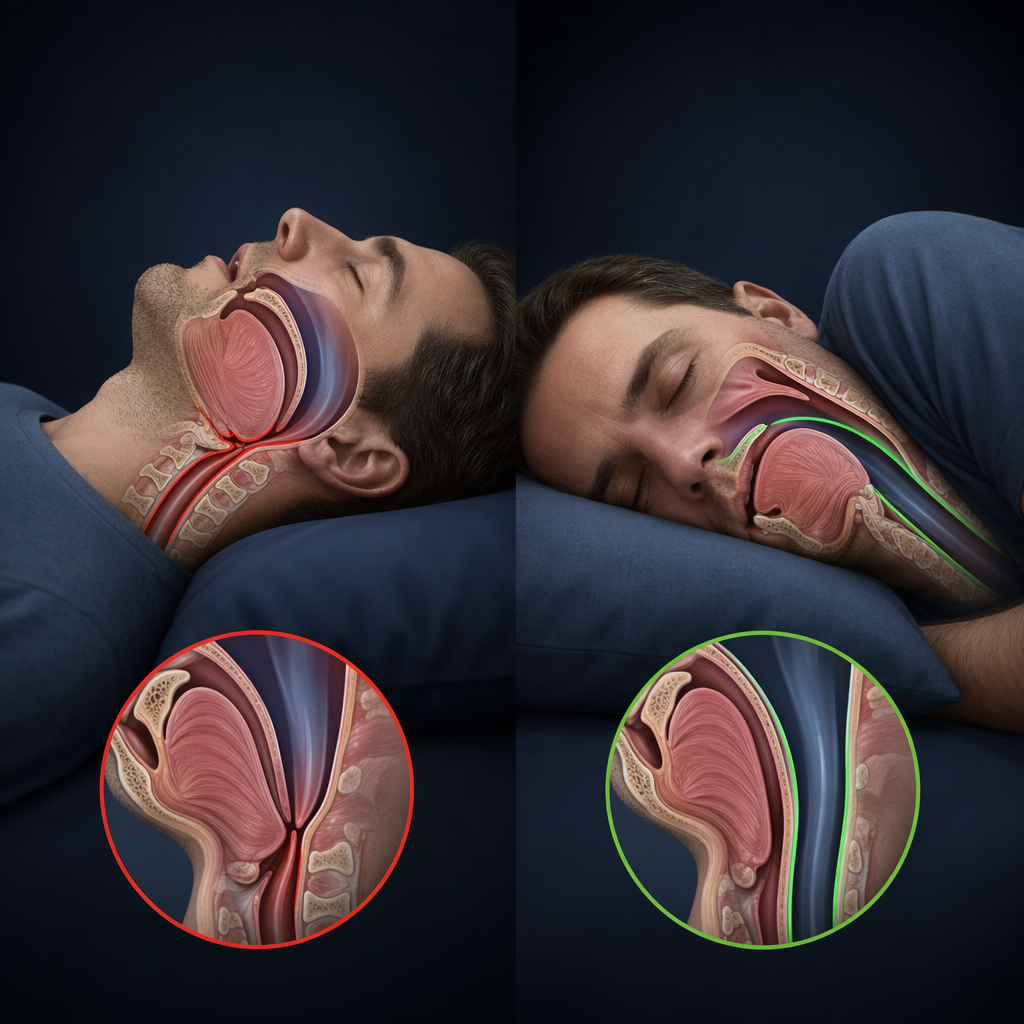
| Waking with choking, gasping, loud snoring, or morning headaches | Possible sleep-disordered breathing | The priority becomes medical evaluation, not more bedtime relaxation |
| Waking with burning, sour taste, coughing, or chest/throat discomfort | Possible GERD or reflux-related awakening | Meal timing, reflux care, and clinician guidance may matter more than sleep hygiene |
| Waking because of pain or stiffness | Pain condition or inadequate overnight pain control | The sleep plan has to include pain management |
| Waking repeatedly to urinate | Nocturia, fluid timing, medications, urinary or metabolic concerns | The cause may sit outside the sleep routine |
| Waking after alcohol use | Alcohol-related sleep fragmentation | Reducing or avoiding evening alcohol becomes a testable change |
| Waking after a new prescription or dose change | Medication effect or timing issue | A medication review is safer than stopping treatment on your own |
Age can also shift the picture. Sleep often becomes lighter and more fragmented with age, and older adults are more likely to be managing medical conditions or medications that affect sleep. That does not make repeated awakenings irrelevant. It means the plan should be less moralizing and more investigative. For a fuller discussion of why the usual checklist often misses this, see why sleep hygiene advice often fails older adults.
Within insomnia treatment, sleep restriction therapy can be especially relevant for people who spend long stretches in bed awake. It is a CBT-I technique that temporarily limits time in bed to strengthen sleep drive and consolidate sleep, then gradually expands the sleep window. It should be used carefully, especially for people with certain medical or safety risks, but it is one reason a structured insomnia treatment plan differs from a list of calming habits. For a deeper look at this pattern, see sleep maintenance insomnia and sleep drive.
When You Wake Too Early
Early morning awakening is not just “being a morning person.” The defining feature is that you wake earlier than intended and cannot return to sleep, even though you need more rest. It can appear alone or as part of a mixed insomnia pattern.
Mood symptoms matter here. Insomnia is a symptom associated with depression, and early morning awakening is often described clinically in that context.[5][6] That does not mean waking at 5 a.m. automatically means depression. It means that if early waking travels with low mood, loss of interest, hopelessness, appetite changes, low energy, or thoughts of self-harm, the sleep complaint should not be handled as a standalone habit problem.
There are other plausible pathways. Circadian rhythm can shift earlier with age, making the body ready for sleep and waking earlier than it used to.[3] Stress-system activation may also contribute for some people, though in day-to-day triage it is usually more useful to track the pattern and associated symptoms than to try to prove a hormone story at home.
A practical first response depends on what comes with the early waking. If mood symptoms are present, depression care belongs near the front of the plan. If the main issue is lying awake every morning in a state of dread, CBT-I tools such as stimulus control, consistent wake time, and reducing awake time in bed may help retrain the bed-sleep connection. If the pattern appears after a schedule change, travel, retirement, or a shift in light exposure, circadian timing may need attention.
Why Sleep Hygiene Alone Is Usually Too Thin
A dark, cool, quiet room is fine. A consistent wind-down routine may help. But sleep hygiene alone has weak evidence as a standalone treatment for chronic insomnia, and the American Academy of Family Physicians identifies cognitive behavior therapy for insomnia, or CBT-I, as first-line treatment for chronic insomnia in adults.[7] The American Academy of Sleep Medicine also advises against using hypnotic medication as the primary treatment for chronic insomnia in adults, instead recommending CBT-I when possible.[8]
That treatment hierarchy is important because it protects people from being handed the same soft advice indefinitely. CBT-I is not just “better habits.” It can include stimulus control, sleep restriction, cognitive work around sleep anxiety, relaxation strategies, and circadian scheduling. The mix depends on the pattern. A person with conditioned wakefulness at bedtime may need a different emphasis than a person waking repeatedly with reflux symptoms.
If you want the treatment framework rather than another list of tips, start with what actually cures insomnia: CBT-I explained. If you are comparing onset and maintenance patterns specifically, trouble falling asleep vs. staying asleep can help sharpen the distinction.
This is also where supplement curiosity should be kept in proportion. Some people want to know whether melatonin, magnesium, herbal products, or other home approaches have evidence. That is a separate question from identifying the insomnia pattern, and it is better handled with evidence tiers than with a promise. For that, see which home remedies for insomnia actually have scientific backing.
When to Stop Treating It as a Bad Night
Chronic insomnia is not defined by one rough week. The American Academy of Sleep Medicine describes chronic insomnia as sleep difficulty occurring at least three nights per week for at least three months, with daytime impairment or distress.[9] A 2024 AASM survey of 2,006 adults found that 12% of Americans reported having been diagnosed with chronic insomnia.[9] Cleveland Clinic gives a wider context: about 1 in 3 adults worldwide have insomnia symptoms, while about 10% meet criteria for chronic insomnia.[10]
Professional evaluation is especially important when sleep difficulty is frequent, persistent, or paired with symptoms that suggest the cause may not be behavioral. That includes loud snoring, gasping, breathing pauses, chest discomfort, reflux, significant pain, repeated urination, new or changed medications, worsening mood, panic, trauma symptoms, or thoughts of self-harm. In those situations, the sleep pattern is useful information to bring to care, not a reason to manage everything alone.
Pattern-matching will not tell you the whole diagnosis. It will keep you from aiming the same advice at three different problems. If the night fails at the beginning, look for hyperarousal, timing, and conditioned wakefulness. If it breaks in the middle, look for medical drivers and fragmented sleep. If it ends too early, pay attention to mood, circadian timing, and the habits that keep early waking rehearsed. Mixed patterns are common, and the right next step is often the one that matches the part of sleep that is failing most often.
References
- Short Sleep Duration and Sleep Difficulties Among Adults: United States, 2024. CDC National Center for Health Statistics. 2025.
- Anxiety and Sleep. Sleep Foundation.
- 8 reasons why you're not sleeping. Harvard Health Publishing.
- Fall asleep faster with mental tricks that calm your racing mind. Harvard Health Publishing.
- Insomnia. Mayo Clinic.
- Medical Causes of Sleep Problems. HelpGuide.
- Treatment of Chronic Insomnia in Adults. American Academy of Family Physicians. February 2024.
- Choosing Wisely: Avoid use of hypnotics as primary therapy for chronic insomnia in adults; instead offer cognitive behavior therapy. American Academy of Sleep Medicine.
- Survey shows 12% of Americans have been diagnosed with chronic insomnia. American Academy of Sleep Medicine.
- Insomnia: What It Is, Causes, Symptoms & Treatment. Cleveland Clinic.

Comments
Join the discussion with an anonymous comment.