
The annoying part is that both memories can be true. You can remember the cold edge of the sleeping pad, the branch that sounded too close, the zipper you checked twice, and the small awakenings that made the night feel thin. Then morning arrives, and instead of feeling wrecked, you feel oddly clear. Not euphoric, not magically healed — just more awake than the night seems to justify.
That is the real question behind camping overnight sleep deprivation impact. A rough camping night can look like poor sleep if you count awakenings. It can look restorative if you measure timing, morning alertness, and how quickly the body returns to a stronger light-dark rhythm. Those are not the same measurement.
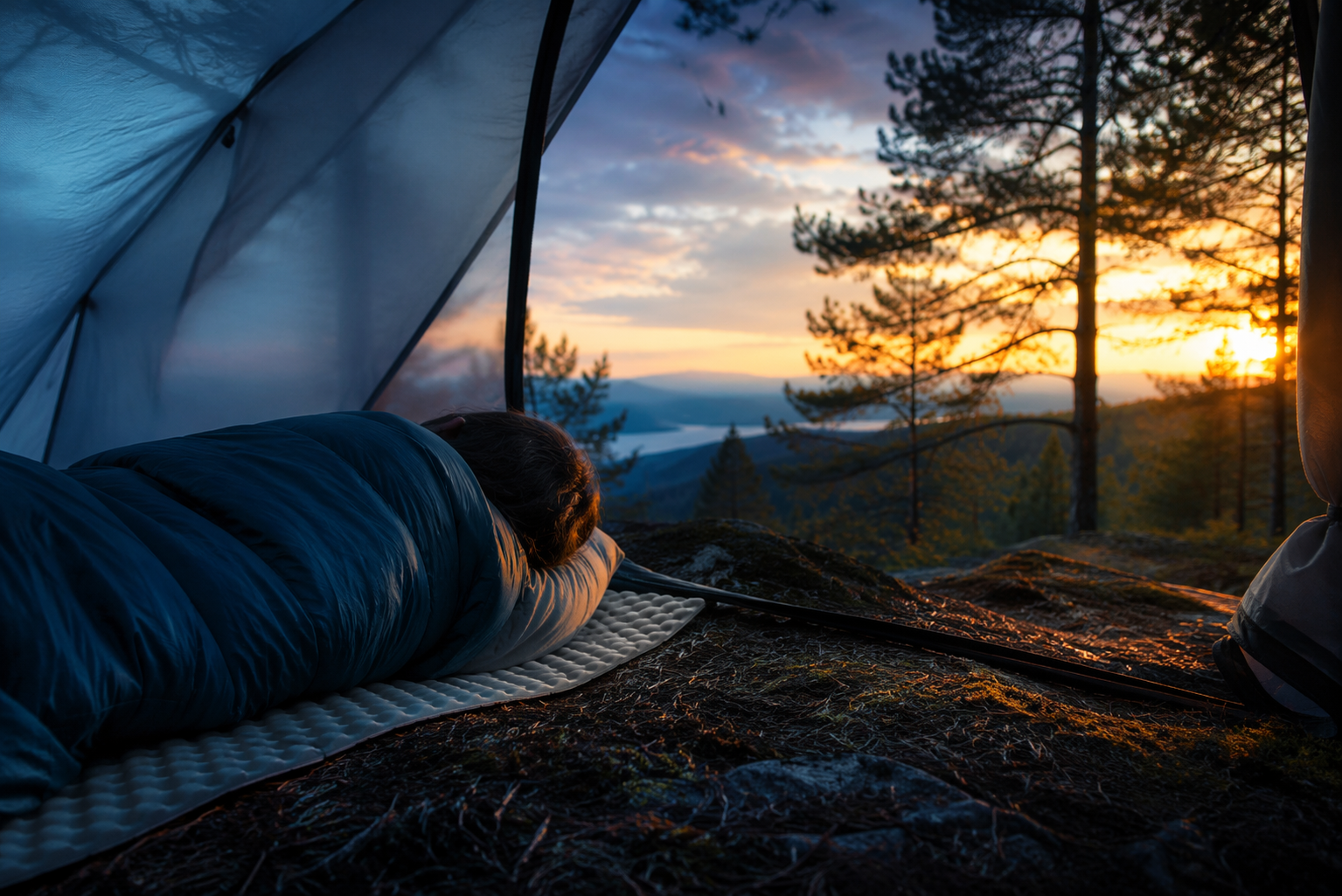
The cleanest example comes from a winter camping study by Kenneth Wright and colleagues. Participants had more fragmented sleep outdoors: awakenings averaged 2.3 minutes while camping, compared with 1.5 minutes in the modern indoor environment. Yet their total sleep time increased from 7.6 hours indoors to 9.9 hours outdoors — a gain of 2.3 hours — while their biological night shifted and lengthened under natural light-dark exposure.[1]
That is not a neat “camping improves sleep” result. It is better than that. It shows the split most people feel but cannot name: the night may be more interrupted, while the body’s timing system may be less confused.
The Problem Camping May Fix Is Not Always Sleep Loss
Sleep deprivation usually means too little sleep. Circadian misalignment means sleep is happening at the wrong biological time. Modern indoor life often gives people both, but they are separate problems. A person can spend enough hours in bed and still feel poorly timed; another can have a broken night outdoors and still wake closer to the body’s expected morning.
This distinction matters because the consequences of true insufficient sleep are not subtle. When sleep is repeatedly shortened, attention, working memory, mood regulation, and decision-making suffer; the details are covered more fully in how sleep deprivation impairs the brain. But a single camping night with awakenings is not automatically the same biological event as chronic sleep restriction. If total sleep expands and timing improves, the “bad night” label starts to wobble.
Outdoor sleep changes the inputs that set the circadian clock. Daylight is stronger and arrives earlier than most indoor lighting. Evening light drops sharply when phones, lamps, and ceiling lights stop dominating the visual field. Darkness becomes actual darkness rather than a negotiated dimness. In Wright’s camping work, this natural light-dark exposure shifted melatonin timing earlier and expanded the biological night; in winter, the biological night reached 14.4 hours, compared with 10.0 hours in summer.[1]
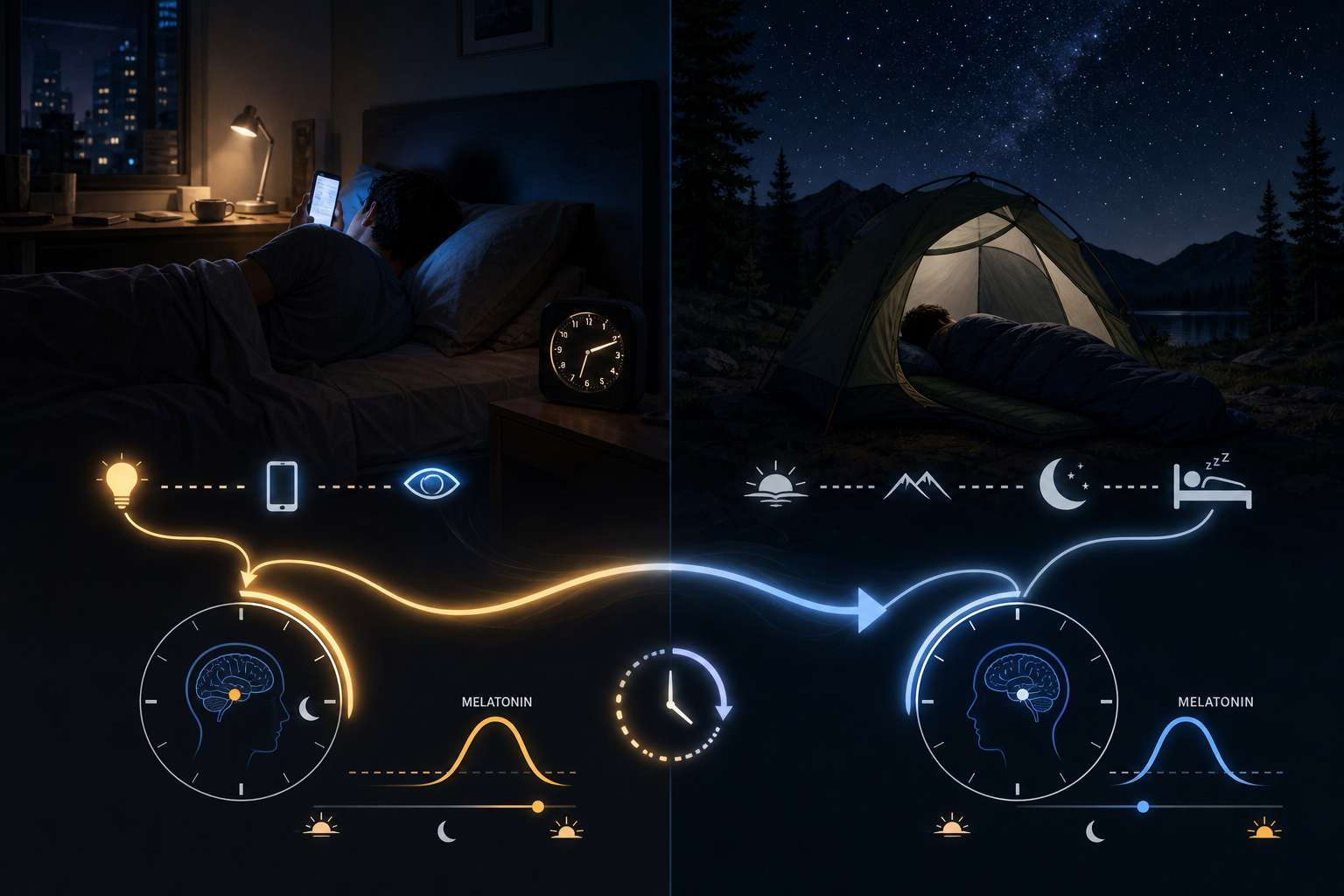
This is why the morning after camping can feel disproportionate to the night itself. The pad was hard. The sleep was not smooth. But the body may have received a clearer dusk, a darker night, and a stronger dawn than it had received for weeks.
Fragmented Sleep and Better Timing Can Coexist
A camping night asks the nervous system to solve several new problems at once. The ground is less forgiving. Temperature changes are harder to ignore. Sounds have no familiar household explanation. A tent wall is not a bedroom wall, and the brain knows it.
On the first night in a new sleep environment, people commonly sleep more lightly. Sleep researchers often call this the first-night effect: part of the brain remains more alert in unfamiliar surroundings. In a tent, that effect is easy to recognize. The sleeper is not being melodramatic by noticing every twig snap. The brain is doing a version of threat monitoring.
That alertness can increase awakenings without erasing the circadian benefit. The mistake is to compress everything into one phrase — “sleep quality” — and then argue about whether it was good or bad. A more useful split looks like this:
| Sleep dimension | What camping may do | What the camper may feel |
|---|---|---|
| Sleep fragmentation | Increase brief awakenings because the environment is unfamiliar, colder, noisier, or less comfortable | “I kept waking up.” |
| Total sleep opportunity | Lengthen time asleep when nights are long and evening artificial light is reduced | “Somehow I slept more than I thought.” |
| Circadian timing | Shift the biological night earlier and strengthen the light-dark signal | “Morning felt clearer.” |
| Subjective restoration | Remain positive if nature, emotion, and environmental conditions offset some disruption | “It was rough, but I feel better.” |
The winter data make this table more than a tidy theory. Longer awakenings and longer total sleep appeared together in the same outdoor condition.[1] For someone trying to interpret one night in a tent, that combination is the point: fragmentation is a real cost, but it is not the only variable the body is counting.
Why Natural Light Can Outweigh a Bumpy Surface
The circadian system is not impressed by intentions. It responds to light, darkness, timing, and repetition. A person can decide to “wind down” indoors while still sitting under bright evening light and checking a glowing screen. Outside, the schedule is less negotiable. Sunset removes light. Night removes options. Morning light arrives without asking whether the sleeper feels ready.
That stronger signal matters especially for people whose usual sleep is delayed by artificial evening light. The issue may look like insomnia — lying awake too late, dragging in the morning — when part of the problem is timing. Camping does not necessarily make someone sleep beautifully. It may instead pull sleep into a better phase.
Chronotype complicates this, because not everyone’s clock prefers the same schedule. A natural light-dark cycle does not turn every evening person into a cheerful dawn person. It can, however, remove some of the artificial delay layered on top of a person’s underlying tendency. That distinction is worth keeping if you are comparing your own pattern with a chronotype guide.
The same logic explains why one night is not the whole story. Sleep timing becomes more powerful when it repeats. Camping often compresses the usual decision clutter around bedtime: fewer lights, fewer screens, fewer late errands, fewer reasons to push sleep later. Even if the first night is choppy, the timing signal may be more regular than a normal week at home. That is one reason sleep regularity can matter as much as the raw number of hours.
There is also a civic version of this problem. Debates about clock time, including standard time versus permanent daylight saving time, are really debates about whether social schedules cooperate with morning light and biological timing. Camping is a small, temporary version of the same principle: more morning light, less artificial evening light, cleaner timing.
Feeling Restored Is Not the Same as Sleeping Perfectly
Subjective refreshment is sometimes dismissed as a story people tell themselves after doing something wholesome. That is too easy. People can misread their sleep, but they can also report a real dimension that a fragmentation count does not capture.
A 2024 study of camping sleep experience found that campers could report positive emotions even when sleep quality was poor. The authors interpreted nature connection as a buffer in the subjective experience of poor sleep.[2] The finding names something familiar. A person may dislike the cold wakeups and still feel emotionally restored by the place.
That emotional buffering does not cancel sleep physiology. It sits beside it. If someone slept two miserable hours, no amount of pine-scented gratitude makes that a well-recovered night. But when the disruption is moderate, the nervous system may be receiving enough positive context — spaciousness, reduced social demand, natural light, a sense of being away — for the morning to feel better than the sleep log looks.
The Outdoor Microenvironment Helps, But It Is Not Magic
After timing, the smaller environmental mechanisms deserve a place. Air is one. Outdoor carbon dioxide levels are often around 400 ppm, while a stuffy bedroom can reach about 1200 ppm; lower indoor CO2 exposure has been associated with more restful sleep and better next-day cognitive performance in a cited 2016 sleep study.[3] That does not mean every tent is automatically ideal — a sealed tent with poor ventilation is still an enclosed space — but it helps explain why fresh outdoor air can feel different from a closed bedroom.
Sound is another. Natural sounds such as water and wind through trees can act more like pink noise than random disturbance, and Phyllis Zee of Northwestern University has described their ability to enhance slow-wave sleep compared with silence or white noise.[3] This is not the same as saying all camping noise helps. A stream is one thing. A nearby road, loud campsite, or animal noise that triggers vigilance is another.
The useful version of the claim is modest: some outdoor environments reduce certain indoor burdens and provide sound patterns the sleeping brain may tolerate well. They support restoration. They do not override cold, fear, pain, altitude, or a bad setup by force.
When the Camping Night Really Is Too Disrupted
The positive findings should not be stretched past their samples. Wright’s camping studies were small, with 5 to 14 healthy, physically active adults in Colorado.[1] They are valuable because the physiology is carefully observed, not because they represent every age group, anxiety level, latitude, season, or camping style.
The Weibo-based camping sleep framework has a different limit. It helps explain subjective restoration and emotional tone, but a social media-derived Chinese data source cannot tell us how all campers interpret poor sleep, especially across cultures and trip types.[2]
There are also conditions where the restorative explanation simply loses. Severe cold, sustained noise, high anxiety, pain, unsafe surroundings, or extreme light exposure can dominate the night. Research from extreme environments such as Antarctic summer conditions belongs in that category of caution, not in the ordinary recreational camping bucket. A tent under sub-zero temperatures or continuous light is not the same biological problem as a weekend campsite.
The boundary is simple: circadian repair can survive moderate disruption, but it cannot compensate when discomfort collapses total sleep. If the night is so cold, frightening, noisy, or painful that sleep barely happens, the restorative mechanisms have probably been outmatched.
The Better Answer to the Paradox
Camping is not automatically better sleep. It is also not automatically harmful sleep deprivation because you woke up more often than usual. The body can register a rough surface and a cleaner clock signal at the same time.
The most defensible answer is narrower and more useful: camping can temporarily worsen sleep fragmentation while improving circadian alignment. Nature connection, lower CO2 exposure, and tolerable natural sound may help preserve subjective restoration, but they are secondary to the light-dark reset. The benefits are most likely when discomfort stays below the point where it becomes the main event.
References
- Entrainment of the Human Circadian Clock to the Natural Light-Dark Cycle, Current Biology / Cell Press, February 20, 2017.
- Camping sleep experience framework study, Journal of Outdoor Recreation and Tourism / ScienceDirect, 2024.
- Why Science Says Camp Sleep Is Good for You, Outside Online.
Comments
Join the discussion with an anonymous comment.