
“Alternative medicine for insomnia” sounds like one shelf. It is not. Acupuncture, melatonin, valerian, magnesium, kava, meditation, chamomile tea, and diet changes do not carry the same kind of evidence, the same safety burden, or the same practical meaning for a tired adult deciding what to try next.
The first comparison point should be clear: for chronic insomnia, cognitive behavioral therapy for insomnia, or CBT-I, remains the established first-line treatment. The American Academy of Family Physicians’ 2024 clinical review describes CBT-I as first-line care and places medications and supplements behind behavioral treatment rather than beside it as equal substitutes.[1] If sleep anxiety is part of the pattern, the same hierarchy still matters; a practical starting point is CBT-I for sleep anxiety, not an escalating stack of capsules.
That does not make every non-drug option useless. It means the useful question changes. The question is not which natural remedy is best. It is which approach has been tested for which sleep problem, whether the measured benefit is large enough to matter, and what risk or uncertainty comes with it.

Start With the Evidence Ladder
| Option | Best-supported use | Evidence confidence | Main caveat |
|---|---|---|---|
| CBT-I | Chronic insomnia | Highest; first-line treatment | Requires behavior change and usually structured guidance |
| Acupuncture | Insomnia symptoms, especially subjective sleep quality and severity | Strongest among alternative modalities | Objective sleep outcomes rest on smaller samples; usually requires a treatment course |
| Melatonin | Sleep-timing problems and modest sleep-latency support in selected adults | Moderate, but effect size is small | Product labels can be unreliable; long-term safety data are limited |
| Mindfulness meditation | Sleep quality support, especially when stress or rumination is involved | Modest and reasonably consistent | Not a stand-alone cure for chronic insomnia |
| Magnesium | Possibly older adults with low intake or related sleep complaints | Low to moderate; one small older-adult RCT is encouraging | Not enough evidence for broad insomnia claims |
| Valerian | Marketed for sleep quality | Mixed to weak | Some meta-analytic signals are clinically modest; umbrella-review conclusions are negative |
| Kava | Anxiety-related sleep difficulty | Narrow and safety-limited | Liver toxicity warnings change the risk-benefit calculation |
| Chamomile, passionflower, ashwagandha, L-theanine | Popular self-treatment choices | Insufficient large, well-controlled insomnia evidence | Thin evidence should not be dressed up as proof |
The table is not a shopping list. It is a sorting tool. A person with chronic insomnia needs a different decision path than someone whose main problem is delayed sleep timing, stress-related rumination, or new sleep trouble in later life. For a more granular matching exercise, see how to match your sleep problem to the right natural remedy.
Acupuncture Has the Strongest Alternative Evidence, With a Real Boundary
Acupuncture is the alternative treatment in this group that deserves the most careful attention. A 2025 systematic review and meta-analysis in Frontiers in Neurology pooled 10 randomized controlled trials with 757 patients and found that acupuncture improved subjective sleep quality compared with sham treatment. On the Pittsburgh Sleep Quality Index, the mean difference was −2.60 points, with a 95% confidence interval from −3.24 to −1.97. On the Insomnia Severity Index, the mean difference was −2.04 points, with a 95% confidence interval from −3.18 to −0.90.[2]
Those are not vague wellness outcomes. PSQI and ISI are standard insomnia measures, and the comparison was against sham acupuncture, not merely a waitlist or usual-care control. The review also found benefit for both manual acupuncture and electroacupuncture, which matters because acupuncture is often discussed as if every technique were interchangeable.[2]

The boundary is just as important as the positive result. The same review found that total sleep time and other objective sleep outcome comparisons relied on only 3 randomized controlled trials with 205 patients, and the trial sequential analysis judged the sample size insufficient for stable conclusions on those outcomes.[2] In plain terms: acupuncture looks meaningfully promising for how people rate their sleep and insomnia severity, but the evidence is thinner when the question becomes exactly how much objective sleep time changes.
It is also not a one-visit intervention. The AAFP review notes that at least 12 treatments are typically needed when acupuncture is used for chronic insomnia.[1] That makes the practical burden part of the evidence discussion. A capsule can be bought impulsively; acupuncture asks for time, access, money, and a practitioner. For some people, that structure is a benefit. For others, it is the reason a promising trial result may not translate into real use.
The fairest reading is neither “acupuncture cures insomnia” nor “it is just placebo.” It is the best-supported alternative modality in the current evidence set, especially for subjective sleep quality and insomnia severity, while still sitting below CBT-I for chronic insomnia because the treatment standard is broader, better established, and more directly aimed at the behaviors and conditioning that maintain insomnia.
Melatonin: Modest Benefit, Messy Bottle
Melatonin is often treated as the gentle default. The evidence is more specific than that. A review of natural products for sleep summarized a meta-analysis of 19 randomized controlled trials showing that melatonin reduced sleep latency, but the average reduction was about 7 minutes.[3] Seven minutes may be worth something to a person who lies awake every night, but it is not the same thing as fixing chronic insomnia.
Melatonin makes the most biological sense when timing is the problem: circadian rhythm disruption, delayed sleep timing, jet lag-type misalignment, or older-adult sleep patterns in which endogenous melatonin rhythms may be relevant. For adults deciding whether it fits their situation, a safer next read is Melatonin for Adults: How to Use It Safely as a Sleep Aid.
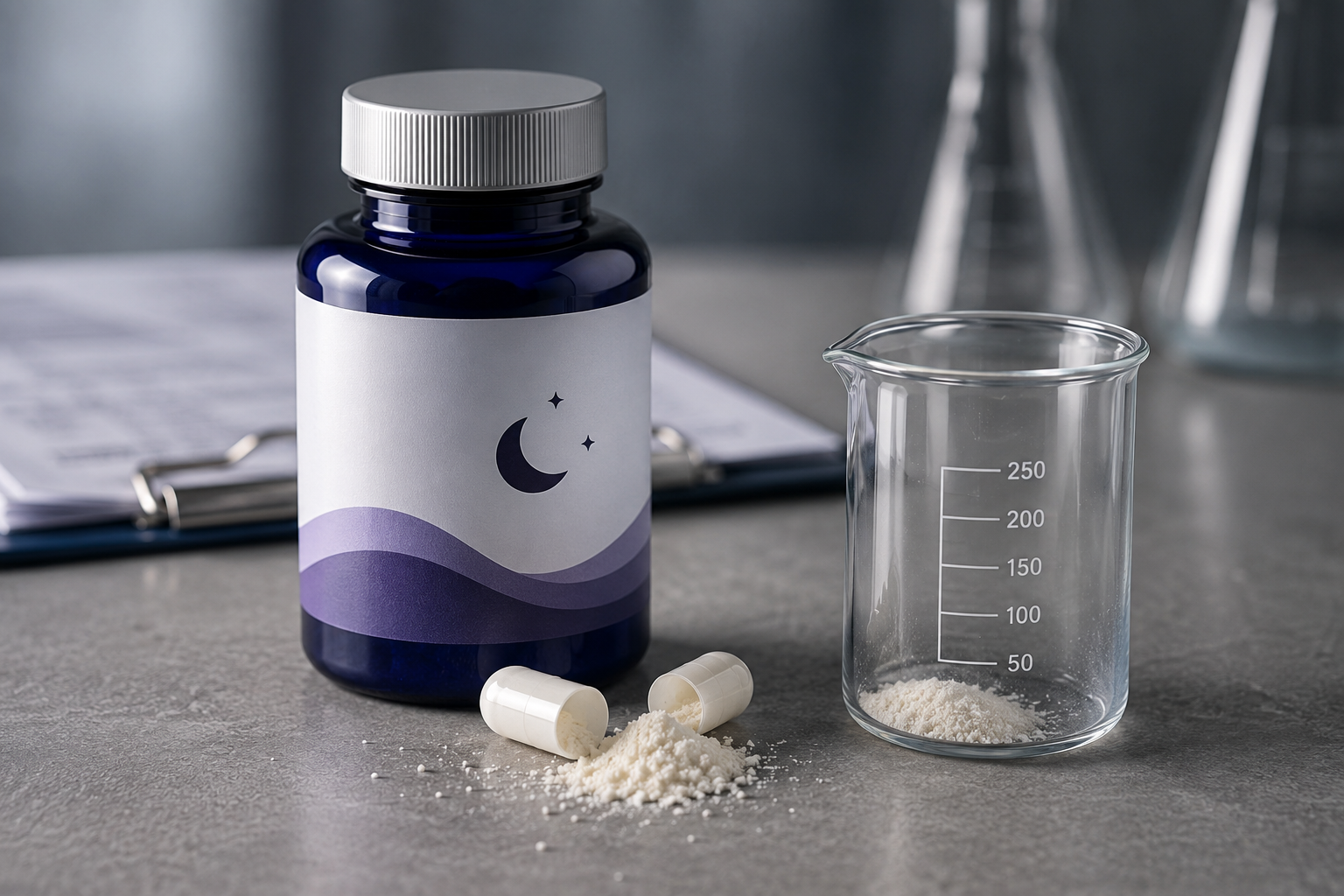
The product-quality problem is not a footnote. The AAFP review notes that over-the-counter melatonin products are not regulated by the FDA in the same way as prescription or OTC drugs, and product purity can vary.[1] A 2017 study cited in the sleep-supplement literature found that 71% of melatonin supplements did not match their label claims, with actual content ranging from 83% below the label amount to 478% above it.[3]

That finding changes the practical meaning of “try a low dose.” If the label is wrong, the person trying to be cautious may not actually know the dose they are taking. The issue is not that melatonin is never useful. It is that a modest average benefit plus label inaccuracy makes product selection part of the clinical question. For that reason, the best melatonin for adults depends on label accuracy, not just milligrams or gummies versus tablets.
Long-term safety is another narrow point. Most melatonin trials are short, often lasting days to weeks, so the evidence base does not justify casual indefinite use.[3] A short trial for a timing-related problem is different from nightly open-ended use for chronic insomnia.
Valerian Is the Cautionary Tale
Valerian has the profile that misleads readers most easily: long tradition, familiar sleep-aid branding, and enough scattered positive findings to sound persuasive in a product description. But the evidence does not hold together cleanly.
The 2024 supplement review summarized two meta-analyses that found statistically significant improvements in sleep quality, with standardized mean differences from −0.46 to −0.70. Those numbers suggest a possible signal, but the same review also noted that a 2024 umbrella review concluded there was “no evidence of efficacy” for treating insomnia, with concerns about low-to-moderate trial quality.[3]
This is where “statistically significant” should not be allowed to do all the work. A supplement can produce a favorable pooled estimate and still leave clinicians and readers unsure whether the effect is dependable, clinically meaningful, or driven by weaker studies. Anyone considering it should read a remedy-specific evidence review, such as Does Valerian Root Actually Help You Sleep?, before treating it as a proven sleep aid.
Safety also deserves more than the usual “natural does not mean risk-free” sentence. The Sleep Health Foundation warns that valerian may carry liver-related concerns, particularly in combination products or when used with other substances that affect the liver.[4] That does not mean every valerian user will be harmed. It means the evidence is not strong enough to make liver-risk uncertainty feel like an acceptable afterthought.
Magnesium Has a Narrower, Older-Adult Signal
Magnesium is usually sold as if the mechanism alone settles the question: muscles relax, nerves calm down, sleep improves. The clinical evidence is narrower. The supplement review describes a randomized controlled trial in 46 older adults using 500 mg per day for 8 weeks. Participants had increased sleep time, improved sleep efficiency, reduced Insomnia Severity Index scores, and reduced serum cortisol.[3]
That is enough to make magnesium interesting for some older adults, especially when dietary intake or deficiency is a plausible issue. It is not enough to turn magnesium into a broad insomnia treatment for every adult who wakes at 3 a.m. For older readers comparing supplement risks, sleep supplements safe for older adults is the better framing than “which mineral is calming?”
Kava Belongs in the Anxiety Conversation, Not the Casual Sleep-Aid Basket
Kava is different from valerian or melatonin because its sleep relevance often runs through anxiety. The supplement review describes meta-analysis support for anxiety-related insomnia, which gives kava a plausible, narrower role when worry and physiological arousal are central to the sleep problem.[3]
The safety constraint is serious. Reports of hepatitis and liver failure led to market withdrawals, and the Sleep Health Foundation warns about kava-related liver risks.[3][4] Some discussions distinguish aqueous extracts used at recommended doses as lower risk, but “lower risk” is not the same as “low-risk sleep supplement.” People with liver disease, heavy alcohol use, interacting medications, pregnancy, or unclear product quality have a different risk equation than a healthy trial participant.
Kava may be relevant for anxiety-linked insomnia, but it is not a casual first experiment. If anxiety is driving the night, behavioral treatment, medical review, and safer supportive practices deserve priority before a liver-risk supplement enters the picture.
Mindfulness Is Reasonable Support, Especially When Rumination Keeps the Bed Awake
Mindfulness meditation should not be inflated into a universal insomnia cure, but it has a more respectable role than many supplement ads. Harvard Health summarized JAMA-published randomized trial evidence in which mindfulness meditation reduced insomnia, fatigue, and depression at study endpoints.[5]
The appeal is not that mindfulness forces sleep. Trying to force sleep is usually part of the problem. Its value is more indirect: changing the relationship to arousal, rumination, and frustration so bedtime becomes less of a nightly performance review. That makes it a reasonable companion to CBT-I principles and sleep-hygiene work, particularly for people whose insomnia is tangled with stress.
It also has a practical advantage over many supplements: no label-accuracy problem, no hidden dose, and little downside when taught responsibly. The limitation is that modest sleep-quality improvement is still modest. If someone has months of conditioned wakefulness in bed, mindfulness may help them tolerate the work of recovery, but it should not be asked to replace the work.
Popular Herbs and Dietary Approaches Need Less Confidence, Not Better Copywriting
Chamomile, passionflower, ashwagandha, and L-theanine are common in sleep teas, powders, and “calm” capsules. The problem is not that they have been disproven. The problem is that convincing large, well-controlled insomnia trials are not there for confident claims.[3] A small study, a traditional-use argument, or a plausible calming mechanism can justify curiosity. It cannot justify ranking them beside CBT-I, acupuncture, or even melatonin.
Dietary advice sits in a similar lower-confidence zone unless the claim is modest. Eating in a way that avoids reflux, late heavy meals, excess alcohol, or caffeine too close to bedtime is sensible sleep support. But that is different from claiming a specific food or nutrient reliably treats insomnia. For a broader supplement-by-supplement comparison, use Natural Sleep Aids Ranked by Clinical Evidence or Home Remedies for Sleep: What the Evidence Actually Says.
How to Prioritize Without Turning This Into a Supplement Stack
The safest decision path starts with the sleep pattern, not the product. Chronic insomnia means persistent trouble falling asleep, staying asleep, or waking too early with daytime impairment. For that pattern, CBT-I stays first. If access is the barrier, a structured digital option may be more evidence-aligned than experimenting with several supplements at once; see how to choose a CBT-I app for chronic insomnia.
- If the main issue is chronic insomnia, prioritize CBT-I and consider acupuncture as the best-supported alternative add-on if cost and access are realistic.
- If the main issue is sleep timing, melatonin may be worth considering, but product quality and dose uncertainty matter.
- If the main issue is stress, rumination, or bedtime arousal, mindfulness is a reasonable low-risk support and may pair well with CBT-I.
- If the reader is an older adult, magnesium has limited but specific trial support; medication interactions, kidney issues, and total supplement burden still matter.
- If anxiety is prominent, kava should not be the casual first choice because liver-risk constraints change the calculation.
- If pregnant, trying to conceive, managing liver or kidney disease, or taking multiple medications, treat supplement decisions as medical decisions; start with population-specific safety guidance such as which sleep aids are safe during pregnancy.
The biggest mistake is combining several “natural” products and then judging the mixture by how the next few nights feel. That approach hides side effects, makes interactions harder to recognize, and gives no clean answer about what helped. If a non-drug option is worth trying, it is worth trying one at a time, with a defined reason, a short evaluation window, and attention to next-day functioning.
A calibrated answer is less exciting than a miracle list, but it is more useful. CBT-I remains the first-line treatment for chronic insomnia. Acupuncture has the strongest alternative evidence, especially for subjective sleep quality and insomnia severity, but it requires a treatment course and still has thinner objective-sleep data. Melatonin may help selected adults modestly, especially when timing is involved, but label accuracy is a real problem. Mindfulness is a reasonable low-risk support. Valerian, magnesium, kava, and the long tail of herbs require narrower claims, more caution, and less faith in the word “natural.”
References
- Chronic Insomnia in Adults: Evaluation and Management. American Academy of Family Physicians, February 2024.
- Acupuncture for insomnia: a systematic review and meta-analysis with trial sequential analysis. Frontiers in Neurology, 2025.
- Herbal and natural supplements for sleep: a literature review. PMC, 2024.
- Herbal remedies and sleep. Sleep Health Foundation.
- Mindfulness meditation helps fight insomnia, improves sleep. Harvard Health Publishing.


Comments
Join the discussion with an anonymous comment.