
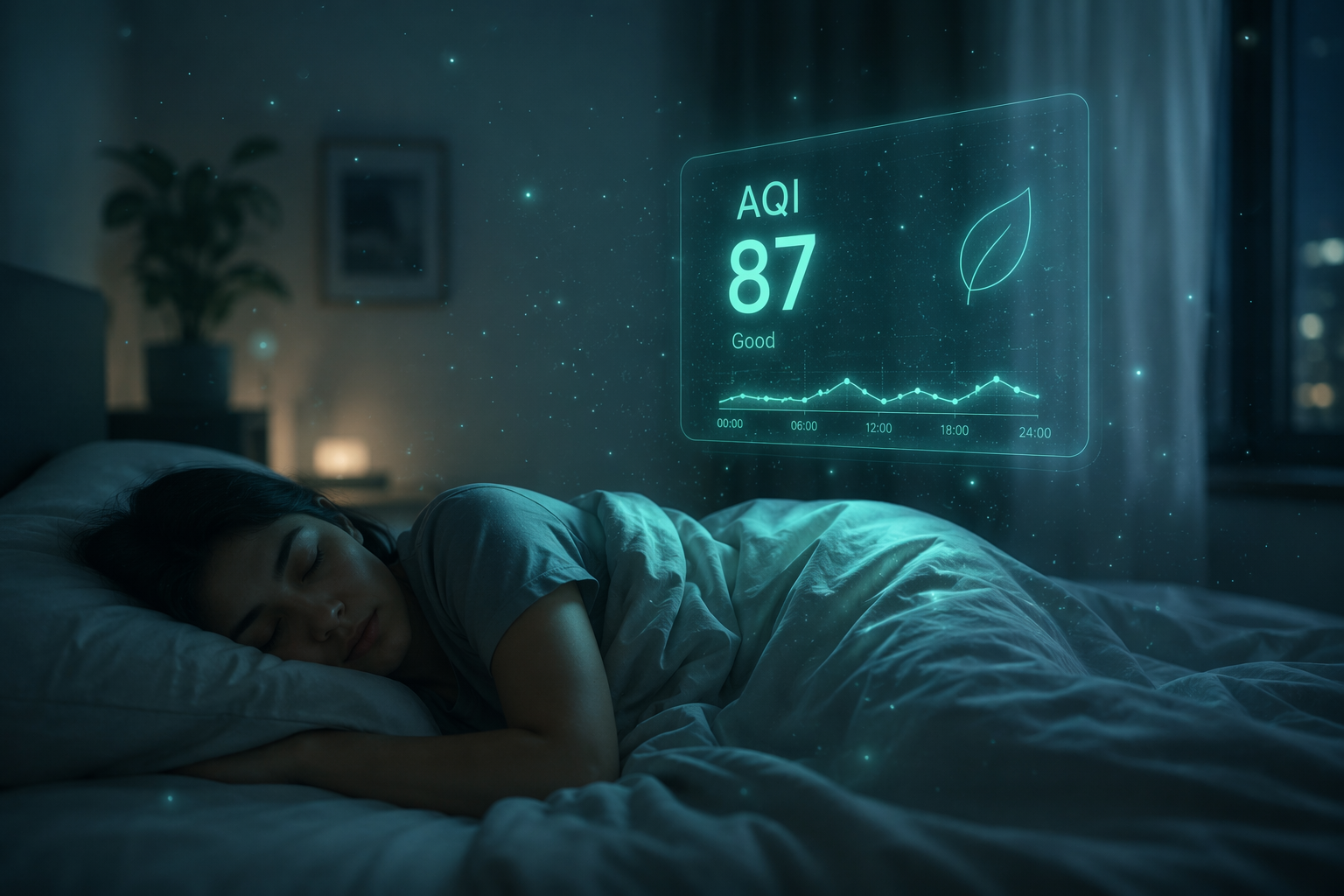
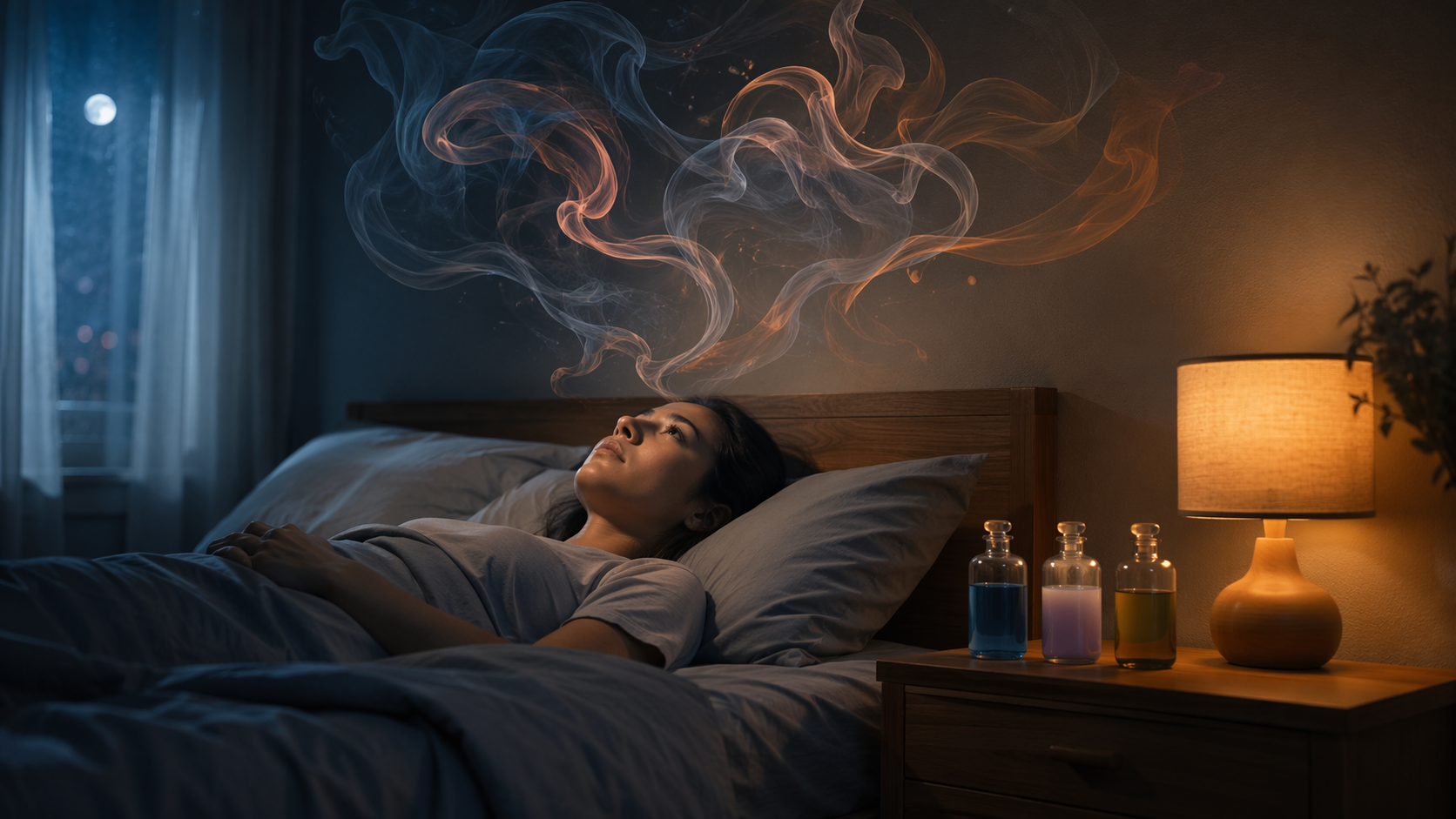
The awkward thing about checking the Air Quality Index at bedtime is that the number looks official, but the sleep decision is not spelled out. AQI 42 feels easy. AQI 87 is less obvious. AQI 142, especially when the bedroom is warm and the window is the usual cooling strategy, is where “good sleep hygiene” starts to conflict with “don’t pull dirty outdoor air into the room.”
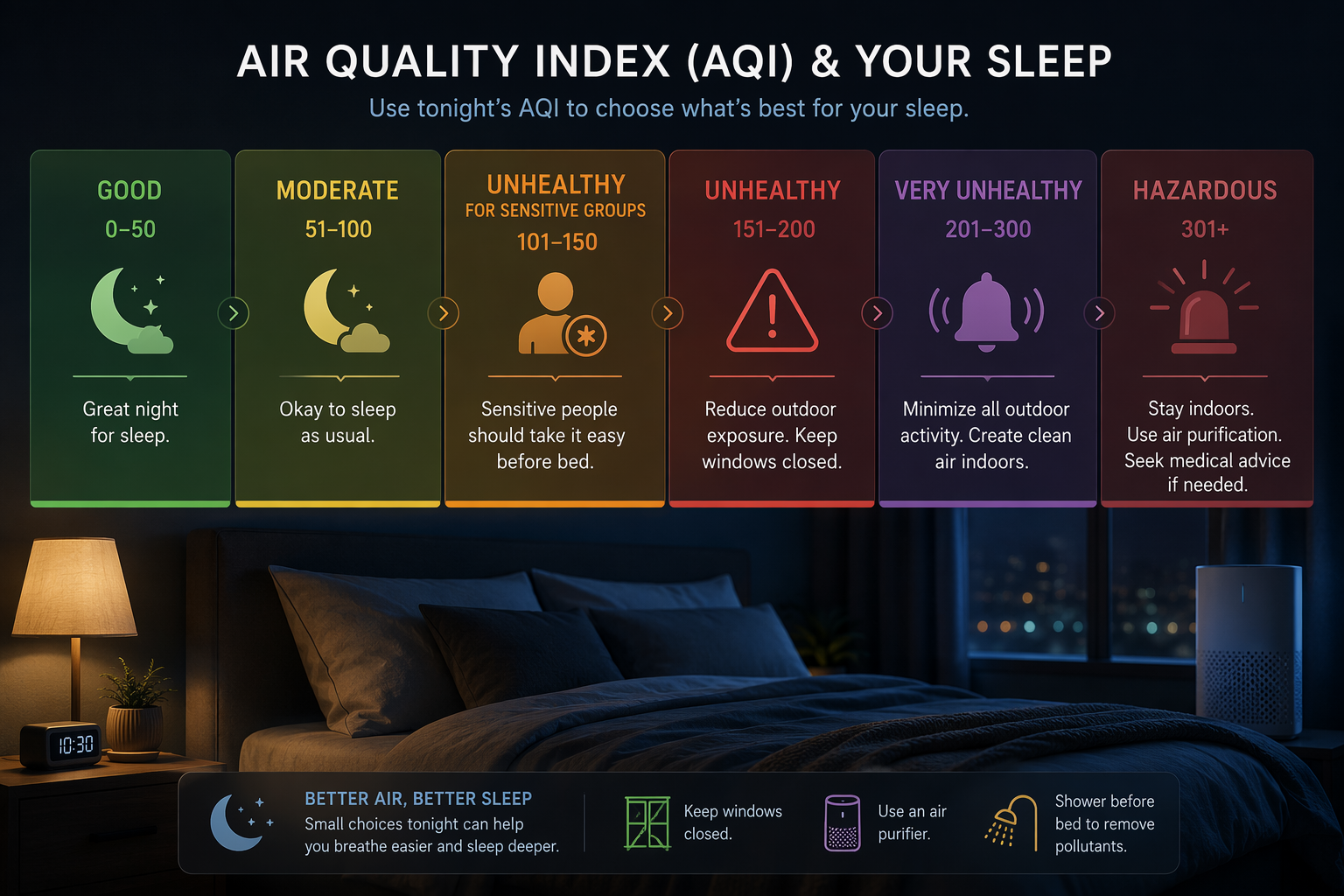
The EPA’s AQI categories were built as public health categories, not sleep-stage categories. Still, they are the most useful place to start because they tell you how polluted the outdoor air is right now: Good is 0–50, Moderate is 51–100, Unhealthy for Sensitive Groups is 101–150, Unhealthy is 151–200, Very Unhealthy is 201–300, and Hazardous is 301 and higher.[1] For sleep, that category should become one input into a practical question: should you use outdoor air tonight, limit it, or actively keep it out?
A bedtime reading of the AQI categories
This is a sleep-focused interpretation of the official categories, not a separate EPA sleep standard. The point is not to diagnose tonight’s sleep from one number. It is to decide how much outdoor air you want entering the room before and during the hours you are trying to recover.
| Tonight's AQI | Official category | Sleep relevance | Bedtime decision |
|---|---|---|---|
| 0-50 | Good | Air pollution is unlikely to be the main sleep variable for most people. | Use your normal ventilation routine if temperature, noise, and allergies allow. |
| 51-100 | Moderate | Not an emergency category, but no longer a clean-air night. Sensitive sleepers or people with asthma, allergies, heart or lung disease, pregnancy, or older age may have more reason to limit exposure. | Ventilate earlier if needed, then close windows before sleep if the room can stay comfortable. |
| 101-150 | Unhealthy for Sensitive Groups | The sleep tradeoff becomes real: open-window cooling may bring in pollution that can matter overnight. | Avoid sleeping with windows open if possible; use filtration or recirculating HVAC if available. |
| 151-200 | Unhealthy | Outdoor air is a poor default bedroom-air source, even for people who do not think of themselves as sensitive. | Keep windows closed, reduce indoor particle sources, and treat ventilation as controlled rather than casual. |
| 201-300 | Very Unhealthy | This is no longer a routine sleep-hygiene adjustment. | Use a smoke or high-pollution playbook, including cleaner-room strategies if available. |
| 301+ | Hazardous | Sleep planning becomes part of a broader exposure-reduction problem. | Follow local health guidance and prioritize keeping polluted air out of the sleeping space. |
The most common mistake is treating Moderate air as either “basically fine” or “dangerous.” It is neither. At 51–100, the AQI is telling you that the air is acceptable for many people, while some pollutants may be a concern for a smaller group.[1] In sleep terms, that usually means you do not need an emergency response, but you should stop treating the window as automatically helpful.
The next category changes the judgment. At 101–150, the official label is Unhealthy for Sensitive Groups.[1] For a bedtime decision, that is the point where “I need fresh air” deserves a second look. If you can cool the room before bed, then close the window while you sleep, that is usually a more defensible compromise than leaving outdoor air flowing all night.
At 151 and higher, the question becomes less subtle. The EPA category is Unhealthy at 151–200, Very Unhealthy at 201–300, and Hazardous at 301 or above.[1] If the high number is from wildfire smoke or another acute particle event, this article is no longer the whole playbook; use a dedicated guide to sleeping when wildfire smoke is in the air rather than improvising around a cracked window.
Why the number deserves attention before sleep
The clearest AQI-to-sleep number comes from a cohort study of 31,582 university freshmen in Beijing followed across five years. In that study, each standard deviation increase in AQI, about 77 points, was associated with 0.68 hours less sleep per night — roughly 41 minutes.[2]
That is a useful number because it puts AQI into the scale people actually feel: not a vague wellness penalty, but a measurable difference in sleep duration. It is also not a universal conversion table. The study population was young college students in Beijing, with a specific exposure pattern, climate, academic calendar, and pollution mix. A 77-point AQI increase in another city, in another age group, should not be assumed to remove exactly 41 minutes from sleep.
The broader literature supports taking the association seriously while keeping the causal language restrained. A life-course systematic review found evidence linking air pollution with adverse sleep health, but also noted that “plausible toxicological mechanisms remain inconclusive.”[3] In plain terms: the signal is strong enough to act on, but not clean enough to blame every restless night on the AQI.
Pollutant-specific findings help explain why the AQI can matter even when you are not coughing. Reported findings have linked high nitrogen dioxide exposure with about 60% higher odds of low sleep efficiency, and high PM2.5 exposure with about 50% higher odds of low sleep efficiency.[4] Sleep efficiency is the share of time in bed actually spent asleep, so this is closer to the experience of lying there awake than a generic warning about lungs.
Outdoor AQI is not the same as bedroom air
The AQI on your weather app is an outdoor ambient measurement. Your sleeping exposure depends on how that outdoor air gets into the room, how much it is diluted or filtered, and what the room itself is adding. A leaky old apartment with a window cracked beside a busy road is not the same exposure as a tighter building with filtered mechanical ventilation.
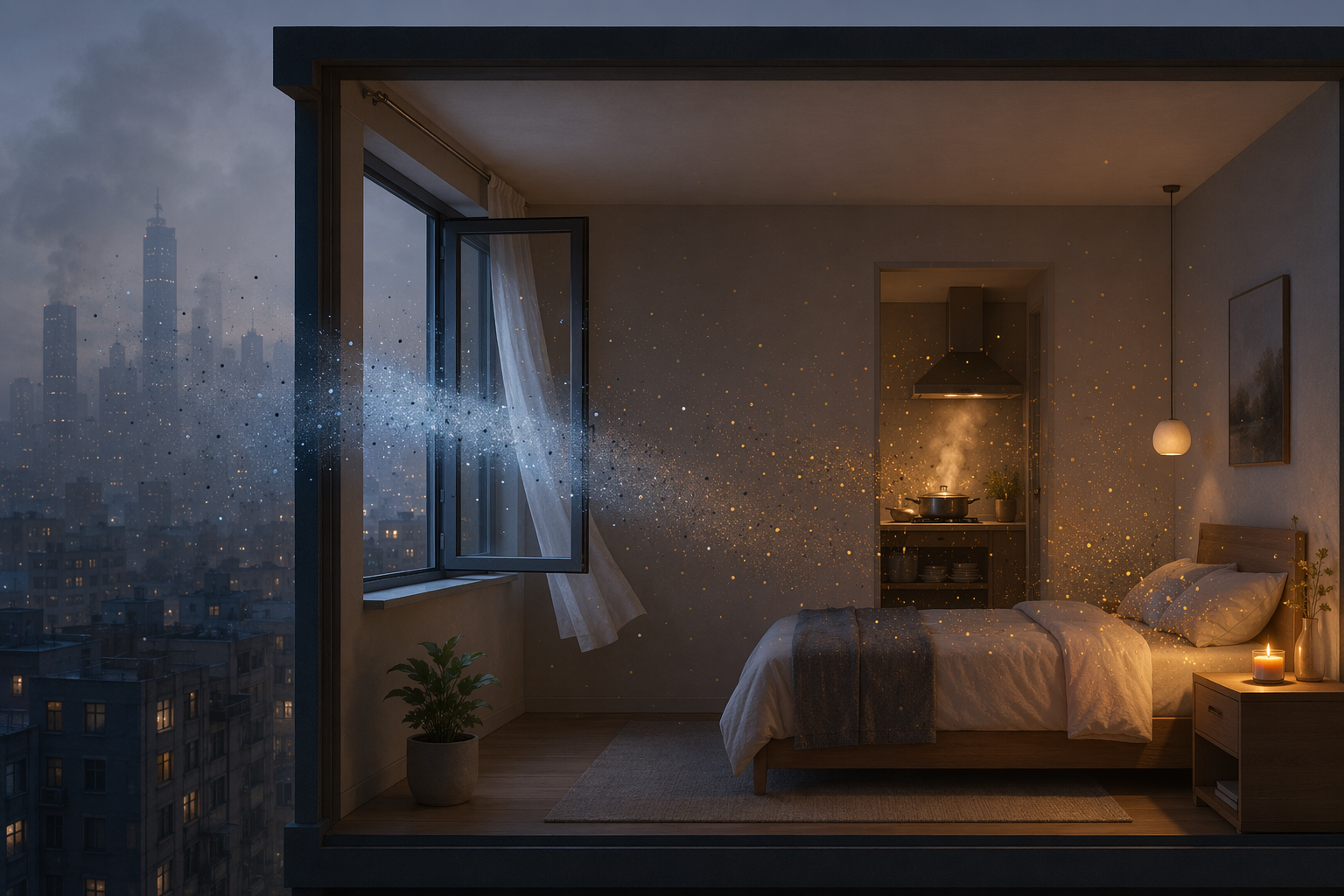
This is where bedtime routines can either help or quietly undercut you. Opening windows can lower heat and indoor carbon dioxide, both of which can matter for comfort and sleep quality. But when outdoor particle pollution is elevated, the same window can move PM2.5 into the room. Bedroom research on PM2.5, carbon dioxide, temperature, humidity, and noise emphasizes that indoor sleep conditions are shaped by both outdoor-to-indoor transport and indoor sources.[5]
Indoor sources are the part people tend to forget because they are not on the weather app. Cooking close to bedtime, burning candles, incense, smoking, and some fireplaces can raise indoor particle levels even when the outdoor AQI looks acceptable. On a Moderate or worse AQI night, adding particles indoors and then closing the bedroom can leave you with the worst version of both choices: less ventilation and more indoor pollution.
The practical sequence is simple enough to use when you are tired. First, check the AQI category, not just the color. Second, decide whether outdoor air is helping more with temperature than it is hurting with pollution. Third, reduce avoidable indoor particle sources before bed. Fourth, if you have filtration, use it in the room where you will actually sleep, not only in the living room earlier in the evening.
If your main concern is stale air, carbon dioxide, humidity, or how closed-door sleeping changes the room overnight, that is a slightly different problem from interpreting the outdoor AQI. A deeper indoor-focused guide to how bedroom air quality affects sleep quality is the better next branch.
What to do tonight at AQI 87, 142, or 180
If the AQI is 51-100
This is the “pay attention, don’t panic” range. If the bedroom is hot, a short ventilation period earlier in the evening may be reasonable. If you are sensitive to air pollution, live near traffic, or notice symptoms on poor-air days, close the window before sleep and avoid adding indoor particles. The sleep decision is mostly about reducing unnecessary exposure, not creating a sealed-room emergency.
If the AQI is 101-150
This is the range where the usual advice to keep the bedroom cool needs a qualifier. Cool air is useful; polluted outdoor air is not neutral. If you need to cool the room, do it earlier, then close windows for the main sleep period. If you have a portable air cleaner, place it in the bedroom and run it before and during sleep according to the device instructions. Skip candles and other particle sources, even if they are part of a wind-down routine.
If the AQI is 151 or higher
Treat outdoor air as something to limit, not as a sleep aid. Close windows and exterior doors as much as conditions allow. Use filtered recirculation if your HVAC setup supports it. Move sleep to the room where you can best reduce incoming air and run filtration. If heat makes closed-window sleeping unsafe or unrealistic, the problem is no longer only sleep hygiene; cooling and exposure reduction both matter.
One caution matters in every category: AQI is one variable among several. Temperature, noise, light, stress, alcohol, illness, medications, and irregular schedules can all disturb sleep. If you slept badly on an AQI 110 night, the air may have contributed; it does not automatically explain the whole night. The number is most useful when it changes a decision you can make before bed.
The useful bottom line
For sleep, AQI is not a diagnosis. It is a bedtime exposure cue. At 0–50, manage the bedroom the way you normally would. At 51–100, be more selective about open windows and indoor particle sources. At 101–150, especially if you are sensitive, stop treating outdoor air as the default fix for a stuffy room. At 151 and higher, protect the sleeping space from outdoor air as much as practical.
References
- AQI Basics. AirNow.gov.
- The Association between Air Pollution and Sleep Duration: A Cohort Study of Freshmen at a University in Beijing, China. PubMed Central.
- Air Pollution and Adverse Sleep Health across the Life Course: A Systematic Review. PubMed Central.
- Air pollution and sleep: How air quality impacts sleep quality. Clarity Movement.
- Associations of Bedroom PM2.5, CO2, Temperature, Humidity, and Noise with Sleep. PubMed Central.

Comments
Join the discussion with an anonymous comment.