
Mechanism explainer
Protein Restriction Won't Improve Perimenopause Sleep Quality
Cutting protein to manage weight or hot flashes may seem logical during perimenopause, but the evidence shows it does not improve sleep. This explainer examines why protein needs rise as estrogen declines, how low-protein diets are linked to worse sleep quality, and what intake level, sources, and timing actually support better midlife rest.
If dinner protein has become the thing you are afraid to eat
The promise usually sounds tidy: eat lighter, lower calories, cut back on protein, and maybe the night sweats, weight gain, or 3 a.m. wake-ups will calm down. For a perimenopausal woman already sleeping in fragments, that advice can be seductive because it gives her one more thing to control.
But when the question is whether protein restriction improves sleep quality in perimenopause, the evidence points in the opposite direction. Cutting protein is not supported as a sleep-quality intervention. The better-supported move is to meet midlife protein needs, pay attention to source, and use evening timing more intelligently instead of making dinner smaller until sleep becomes another test of discipline.

Evidence note: this Restful Ground sleep-science guide was last reviewed on August 2, 2026. The protein-and-sleep evidence here is observational for the key sleep associations, not a perimenopause-specific randomized trial. This is informational only and is not a substitute for care from a clinician who knows your symptoms, medications, cardiovascular risk, eating history, and menopause stage.
Perimenopause is not just general adult nutrition with fewer calories
Sleep disruption is not a minor side complaint in the menopause transition. A menopause and perimenopause nutrition review reported a meta-analytic sleep-disorder prevalence of about 51.6% during menopause, while self-reported sleep disturbance ranged from 40% to 56% across the transition years.[1]
That matters because the person being told to “eat light” may already be waking with heat, sweat, anxiety, or a racing mind. The restriction advice lands on a body whose hormones, body composition, and sleep regulation are changing at the same time.
The same review describes the midlife context that makes protein restriction a poor default: weight gain becomes more common, fat distribution shifts, and preserving skeletal muscle becomes more important as estrogen declines.[1] Protein is not only a calorie source here. It is part of the maintenance work the body is being asked to do while sleep is already less stable.
The practical intake anchor from the review, drawing on North American Menopause Society guidance, is about 1–1.2 grams of protein per kilogram of body weight per day during weight loss or regular exercise, with about half from plant sources.[1] For example, a 70 kg woman would be looking at roughly 70–84 grams per day, not because that number is magic for sleep, but because it keeps the sleep question from being solved by underfeeding the very tissue she is trying to protect.
This is also why the “longevity diet” version of low-protein advice can be too blunt for midlife sleep. A strategy discussed for one outcome, in one population, can become a bad fit when it is applied to a woman losing estrogen, trying to preserve muscle, and waking drenched at 3 a.m.
The sleep evidence does not reward low-protein restriction
The most relevant age-adjacent sleep study in this evidence set is not a perimenopause trial, so it should not be stretched into one. It studied middle-aged and older adults in Singapore and found that low protein intake, defined as less than 16% of total energy, was associated with poor sleep quality.[2]
That finding does not prove low protein causes poor sleep, and it does not prove that raising protein will fix insomnia. It does, however, undercut the idea that protein restriction has a clear sleep payoff. If the available association runs toward worse sleep quality at low protein intake, “cut protein for sleep” needs a much higher burden of proof than it usually gets.
The same study also points to a more useful mechanism than restriction: the dietary tryptophan-to-large neutral amino acid ratio, often shortened to Trp:LNAA, was positively associated with sleep duration, especially when the ratio came from plant protein sources.[2] Tryptophan is a precursor for serotonin and melatonin, but it competes with other large neutral amino acids for transport across the blood-brain barrier; the ratio matters because it affects how much tryptophan is available relative to its competitors.[2]
There is a small but important timing clue here. Carbohydrate can raise plasma Trp:LNAA by about 20% to 50%, which is one reason an evening meal or snack that pairs protein with carbohydrate is more physiologically interesting than a sparse, protein-avoidant dinner.[2]
For readers who want the broader evidence-tier explanation of the less-than-16%-of-energy threshold, the U-shaped pattern discussed in general adult data, and the Trp:LNAA mechanism, Restful Ground’s does eating less protein affect sleep guide covers that foundation. The perimenopause decision is narrower: there is no good reason, on current evidence, to make protein restriction your sleep strategy.
Source matters more than a blanket “more protein” message
A large 2024 analysis from three prospective cohort studies helps prevent the advice from turning into a high-protein sales pitch. In that analysis, total protein intake was not clearly associated with better sleep quality overall. Vegetable protein, however, was associated with better sleep quality in the Nurses’ Health Study comparison of the highest versus lowest quartile, with an odds ratio of 1.12 and a 95% confidence interval of 1.04–1.20.[3]
The same paper reported less favorable sleep associations for some animal-source categories, including processed red meat and poultry.[3] That does not mean one chicken dinner ruins sleep, and it does not turn tofu into a sedative. It does make the practical advice sharper: do not restrict protein, but let more of it come from plant-forward meals when you can.
This is also where soy can be used sensibly without becoming a supplement detour. The menopause nutrition review notes a recommendation around 20 mg per day of soy isoflavones, roughly the amount in about 400 mL of soy drink or about 80 g of soy product.[1] That is a food-source example, not a promise that soy will stop hot flashes or that low protein causes them. The evidence here does not support that claim.
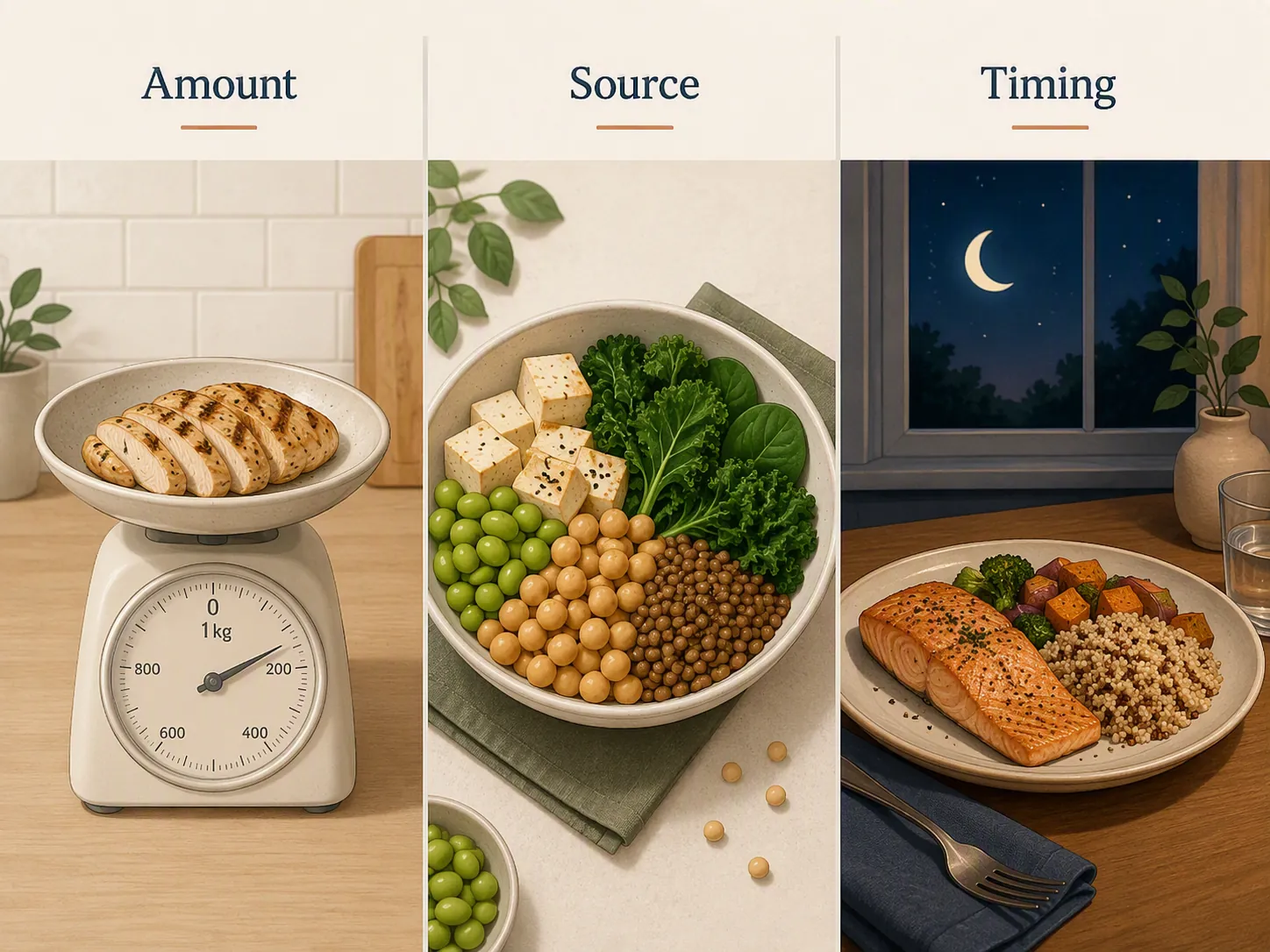
A usable protein plan for perimenopause sleep
The evidence translates best into three decisions: amount, source, and timing. They are not equal in certainty. Amount is anchored by menopause nutrition guidance; source and timing are supported by observational sleep signals and plausible physiology.
| Decision | Evidence-aligned move | What to avoid |
|---|---|---|
| Amount | Aim for roughly 1–1.2 g/kg/day during weight loss or regular exercise, using body size and clinical context rather than a generic “light eating” rule. | Do not cut protein as a sleep experiment, especially if you are also restricting calories. |
| Source | Make protein plant-forward when practical: soy foods, tofu, beans, lentils, chickpeas, nuts, seeds, and mixed meals that also provide fiber-rich carbohydrates. | Do not turn this into a processed-meat or protein-powder escalation. |
| Timing | Keep some protein at dinner or in an evening snack if you tolerate it, and pair it with carbohydrate rather than eating protein in isolation or skipping it. | Do not go to bed hungry because a “clean” dinner was too small to carry you through the night. |
Amount: meet the midlife floor before experimenting
If you are exercising, dieting for weight change, or noticing strength loss, the first question is not whether protein is too high for sleep. It is whether the day contains enough protein to support muscle while the menopause transition is making body composition harder to maintain.
A practical day might spread protein across breakfast, lunch, dinner, and possibly a small evening snack. That distribution is often easier on appetite and digestion than trying to repair a low-protein day at 9 p.m. It also prevents dinner from becoming the place where restriction has to prove itself.
Source: plant-forward does not mean protein-light
Plant-forward protein can still be substantial. A bowl with tofu, chickpeas, lentils, edamame, or beans is not a “light” meal in the punitive sense; it is a way to meet protein needs while also supplying carbohydrate, fiber, and micronutrients that fit the observational sleep signals better than a narrow focus on grams alone.
Animal proteins do not have to disappear if they work for your body and your medical context. The more defensible adjustment is to reduce reliance on processed red meat and make room for legumes, soy foods, nuts, seeds, and mixed plant proteins more often.
Timing: the evening meal should not be a punishment
The Trp:LNAA finding makes evening timing worth considering, but it does not require a complicated protocol. If you wake hungry, or if a very light dinner tends to precede early-morning waking, a reasonable experiment is a normal dinner that includes plant-forward protein plus a carbohydrate you tolerate: tofu with rice, lentils with whole-grain toast, chickpeas with potatoes, soy yogurt with fruit, or beans with a tortilla.
If hot flashes make large meals uncomfortable, the adjustment can be size and timing rather than protein elimination. Keep dinner moderate, then consider a smaller evening snack that contains both protein and carbohydrate. The point is not to eat more at night for its own sake; it is to stop confusing underfed with sleep-friendly.
The upper bound still matters
Rejecting protein restriction does not mean pushing protein as high as possible. The menopause nutrition review notes that protein intakes around 1.5–2 g/kg/day have been associated with increased fracture risk in the cited North American Menopause Society context.[1]
That caution is useful. The evidence does not justify swinging from a protein-light dinner to aggressive high-protein supplementation. For most readers asking about sleep, the better question is whether daily intake is adequate, plant-forward enough, and timed in a way that does not create hunger or discomfort overnight.
When the wake-up is not a dinner-protein problem
Night sweats can be part of perimenopause, but not every hot, sweaty, racing-heart wake-up belongs in a nutrition experiment. Chest pressure, faintness, new shortness of breath, severe palpitations, neurologic symptoms, unexplained weight loss, fever, or a sudden change in the pattern of night sweats should be treated as a medical fork, not as a reason to further restrict dinner.
If you are unsure whether a nighttime episode is a sleep problem or something more urgent, use Restful Ground’s heart attack or sleep problem guide as a safety boundary and seek appropriate care. If the issue is the familiar 3 a.m. sweat-and-reset pattern, the nighttime skin-care reset guide may help with the practical aftermath without pretending food timing is the whole answer.
If you are choosing a broader dietary lever
Protein restriction is the wrong lever for perimenopause sleep quality. That does not mean diet never matters. If you are comparing broader patterns, Restful Ground’s Mediterranean diet and perimenopause sleep guide and low-carb diet and perimenopause sleep guide are better places to compare whole-diet tradeoffs.
For the broader menopause sleep context — why vasomotor symptoms, mood, temperature regulation, and changing hormones can all collide at night — see the Restful Ground guide to perimenopause sleep mechanisms.
The practical answer
Reducing protein is not an evidence-based way to improve sleep quality during perimenopause. The current evidence is limited and mostly observational, but it does not support protein restriction as the intervention.
A more defensible plan is to meet the midlife intake range, lean plant-forward where possible, include tryptophan-rich protein sources, pair evening protein with carbohydrate if it suits your digestion, and avoid turning adequate protein into excessive protein. That is not a miracle sleep cure. It is simply the position that fits the evidence better than going to bed underfed.
References
- The Importance of Nutrition in Menopause and Perimenopause — A Review. PMC, 2023.
- Association Between Dietary Protein Intake and Sleep Quality in Middle-Aged and Older Adults in Singapore. PMC, 2022.
- Protein intake and its association with sleep quality: results from 3 prospective cohort studies. Nature, 2024.
Supports these guides
Spot an error or have clinical feedback?
Because this article covers clinical, medication, or safety information, we use a moderated correction channel instead of open public comments. Let us know if something about “Protein Restriction Won't Improve Perimenopause Sleep Quality” needs a closer look.
Send feedback on this article