
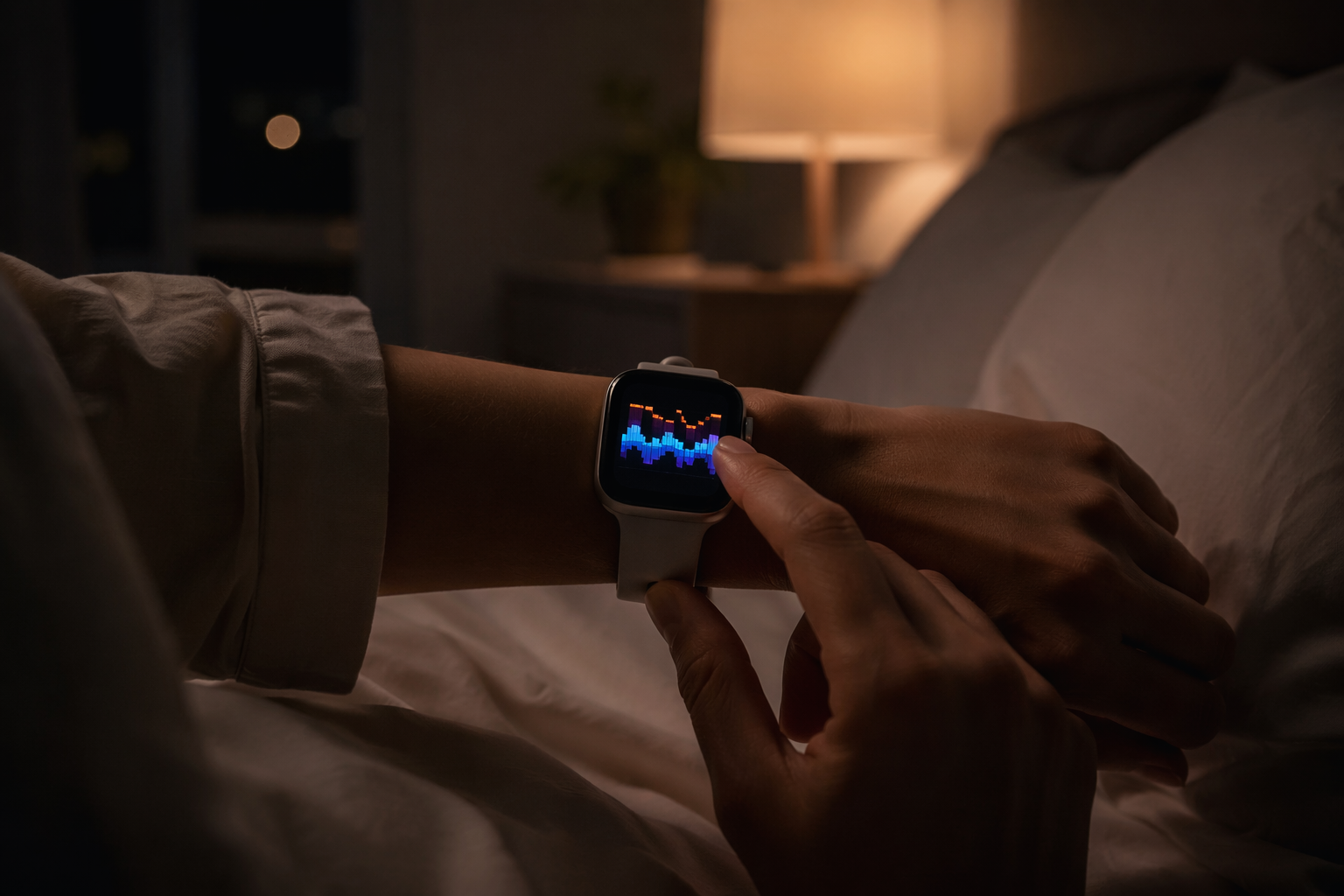
“My Apple Watch says I only got 30–45 minutes of deep sleep. Is that normal?” For many people using a sleep tracker on Apple Watch, yes — that number can be normal, especially if the rest of your sleep looks reasonably steady and you feel basically functional during the day.
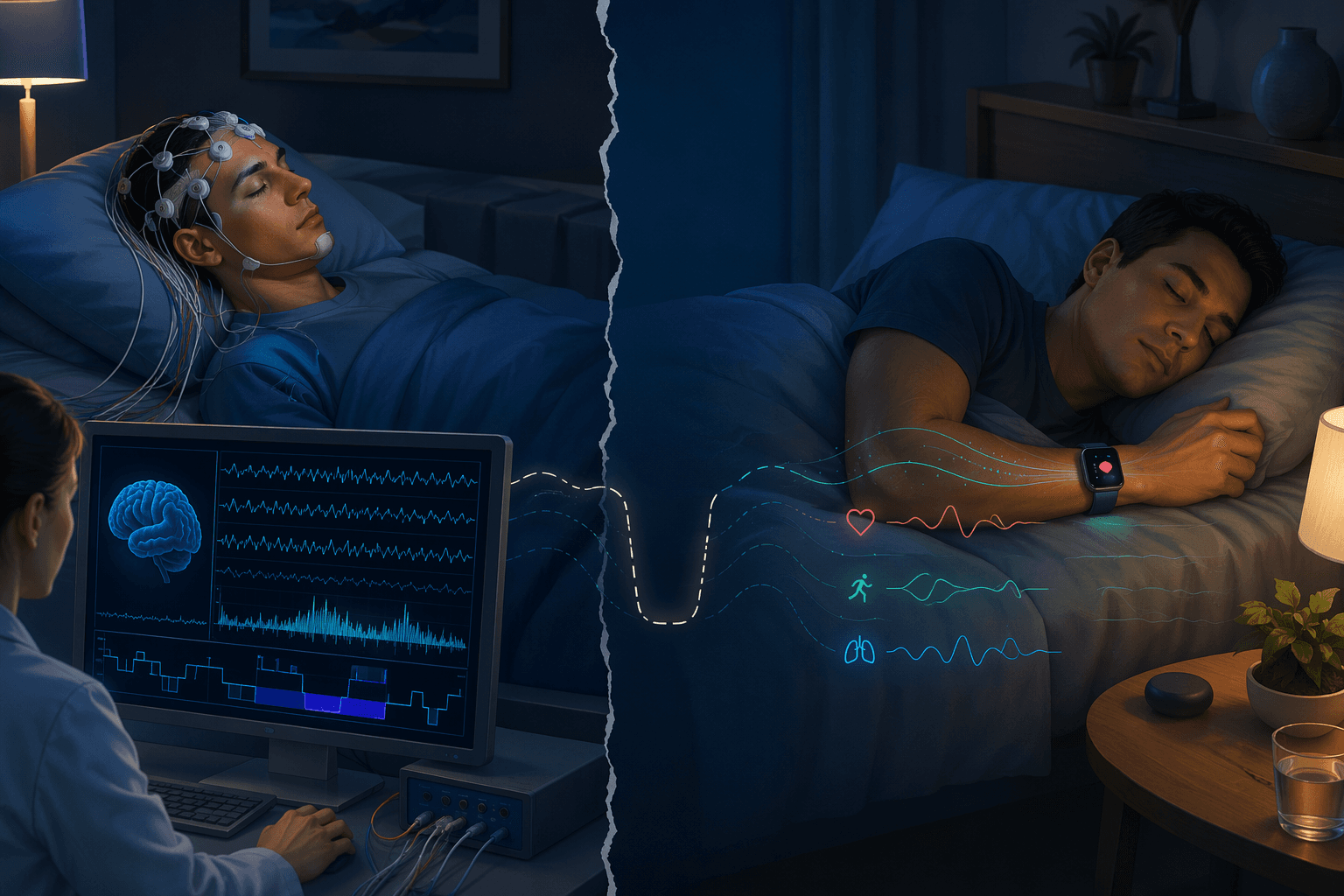
The important catch is that the watch is not measuring deep sleep the way a sleep lab does. Polysomnography, the clinical gold standard, uses signals such as brain waves. Apple Watch estimates sleep stages from wrist-based signals, mainly movement and heart-rate patterns. That difference matters most for the stage people tend to worry about: deep sleep.
A useful reality check: normal deep sleep by PSG is often described as roughly 13–23% of total sleep, while aggregated Apple Watch user data puts median deep sleep at about 12%, or about 49 minutes. Empirical Health’s summary of Apple Watch user data also reports that, using Apple’s October 2025 white-paper confusion matrix, deep sleep detection was 62% accurate, with 38% of deep sleep classified as core sleep instead. [1]
So if your chart keeps showing 30, 40, or 45 minutes, the first explanation should not be “my body forgot how to sleep.” The first explanation should be “this wrist sensor may be missing some of the deep sleep that a brain-wave study would see.”
The Apple Watch is better at sleep versus wake than deep sleep
The strongest reason to take this seriously comes from a 2024 validation study that compared Apple Watch Series 8 sleep tracking with polysomnography. The watch performed very well at detecting sleep versus wake, with 97% sensitivity for sleep detection, and its total sleep time estimate showed excellent concordance with PSG, with an ICC of 0.85. But deep sleep was a different story: deep sleep sensitivity was about 50.5%, meaning the watch identified only about half of PSG-scored deep sleep as deep sleep. The study also reported that the watch failed to record data for 6 of 35 participants. [2]
That combination is easy to misunderstand. A device can be good at telling whether you were asleep and still be shaky at dividing that sleep into light, core, deep, and REM. Those are not the same task.
| What you are looking at | What the evidence suggests |
|---|---|
| Total sleep time | One of the more useful Apple Watch sleep metrics; validation data shows strong agreement with PSG. |
| Sleep versus wake | Generally the watch’s strongest sleep-tracking job. |
| Deep sleep minutes | Much less stable; the watch can miss true deep sleep and label it as core or light sleep. |
| One bad night | Too noisy to treat as a verdict. |
This is also why switching from “minutes” to “percent” often does not calm anything down. If you slept 6 hours and the watch says 42 minutes of deep sleep, that looks like 12%. If you slept 8 hours and it says 48 minutes, it suddenly looks like 10%. The chart feels precise, but the underlying stage estimate is still an estimate.
Why your deep sleep number looks so low
Deep sleep has a particular electrical pattern in the brain. A wristwatch does not read that electrical pattern. It infers stages from body signals that tend to move with sleep architecture: motion, heart rate, and related changes. That can work reasonably well for broad patterns. It becomes less reliable when the question is, “Was this exact 30-second window deep sleep or core sleep?”
The most common misread is not dramatic. It is usually that real deep sleep gets filed under core sleep. That is why a low deep-sleep bar on the Apple Watch can coexist with a night that was restorative enough in real life.
Apple’s own sleep features also push users toward a composite view rather than treating every stage as a standalone medical finding. Apple Support describes Sleep Score as a weighted score based on duration, consistency, and interruptions: duration contributes 50 points, consistency 30 points, and interruptions 20 points. [3]
That does not make Sleep Score a diagnosis either. It just shows the more sensible hierarchy: how long you slept, whether your schedule is stable, and whether your night was broken up are usually more actionable than whether one colored band says 38 minutes instead of 58.
If you want the methodological deep dive, the fuller breakdown is in How Accurate Is Apple Watch Sleep Tracking? What the Research Says. But for the specific “why is my deep sleep so low?” problem, the practical answer is simpler: Apple Watch is estimating deep sleep from indirect signals, and the available validation data shows that this is one of its weaker sleep-stage calls.
When low deep sleep might actually matter
A low deep-sleep estimate by itself is usually not the thing to panic over. The context around it matters more. The number becomes more worth discussing when it lines up with signs that your sleep is short, fragmented, or medically disrupted.
- Your total sleep time is regularly very short, especially if you are often under about 6 hours in bed or asleep.
- Your night is repeatedly broken up by long awake periods, frequent awakenings, or obvious restlessness.
- You snore loudly, wake up gasping, have witnessed breathing pauses, or have morning headaches — signs that can fit sleep apnea and deserve medical attention.
- You feel persistently sleepy, impaired, or unsafe during the day despite spending enough time in bed.
- The watch’s low deep-sleep number matches a real change you already noticed: worse sleep, new medication effects, increased alcohol use, illness, pain, stress, or a major schedule disruption.
In those situations, do not bring your doctor a single screenshot and ask them to treat the deep-sleep bar. Bring the pattern: total sleep time, wake-ups, symptoms, snoring or breathing concerns, and how long it has been going on. The watch can be a useful note-taking tool. It should not be promoted into a sleep lab.
This distinction is especially important for sleep apnea. Apple Watch features may flag breathing-related patterns depending on model and region, but a consumer wearable cannot rule sleep apnea in or out. If the real-world symptoms are there, the next step is clinical evaluation, not another week of staring at deep-sleep minutes.
For more context on Apple’s composite score and apnea-related features, see Apple Watch Sleep Score and Sleep Apnea Notifications: What the Data Actually Means.
The part the chart cannot show: whether tracking is making you sleep worse
There is a particular trap here: the number starts as information, then becomes a nightly judgment. You wake up, check the chart, see 37 minutes of deep sleep, and retroactively decide the day is going to be bad. By bedtime, you are trying to manufacture more deep sleep, which is one of the least sleep-friendly mental states available.
Clinicians have a name for this pattern when it becomes excessive: orthosomnia. In a 2017 case series, Baron and colleagues described patients whose pursuit of “perfect” tracker sleep data contributed to anxiety and sleep-related preoccupation. [4]
That does not mean everyone who checks an Apple Watch is in trouble. Most people can use sleep tracking without spiraling. The warning sign is when the data starts overruling your body. If you feel fine but the watch says your deep sleep was low, and now you feel worried because of the watch, the tracker has stopped being a neutral observer.
Northwestern Medicine’s clinical guidance is blunt about this situation: people who become anxious about tracker data may need to “stop tracking data and start paying attention to how you feel.” [5]
If that sounds uncomfortably familiar, the more detailed version is here: Orthosomnia and the Apple Watch: When Sleep Tracking Makes Sleep Worse — and How to Break the Cycle.
A steadier way to use Apple Watch sleep data
The useful rule is not “ignore the watch.” It is “use the parts of the watch that are least likely to mislead you.”
- Look at total sleep time over a longer window, especially about 14 days, instead of grading a single night.
- Treat deep sleep minutes as approximate stage estimates, not a measure of whether your sleep “worked.”
- Pay more attention to repeated short sleep, frequent awakenings, and daytime symptoms than to one low deep-sleep bar.
- If the data makes you anxious before bed or disappointed the moment you wake up, take a break from stage tracking.
- Talk to a clinician if low numbers come with snoring, gasping, severe daytime sleepiness, persistent insomnia, or obviously disrupted sleep.
A watch that says 30–45 minutes of deep sleep is not automatically reporting a broken night. Very often, it is reporting the limits of wrist-based staging. Let the longer trend help you notice real changes. Do not let one small colored segment become the most powerful voice in the room.
References
- Deep Sleep Percent. Empirical Health. https://www.empirical.health/metrics/deep-sleep-percent/
- Robbins et al. 2024 Apple Watch Series 8 polysomnography validation study. PMC. 2024. https://pmc.ncbi.nlm.nih.gov/articles/PMC11511193/
- Apple Watch User Guide. Apple Support. https://support.apple.com/guide/watch
- Orthosomnia: Are Some Patients Taking the Quantified Self Too Far? Journal of Clinical Sleep Medicine. 2017. https://pmc.ncbi.nlm.nih.gov/articles/PMC5263088/
- Do Sleep Trackers Work? Northwestern Medicine. https://www.nm.org/
Comments
Join the discussion with an anonymous comment.