
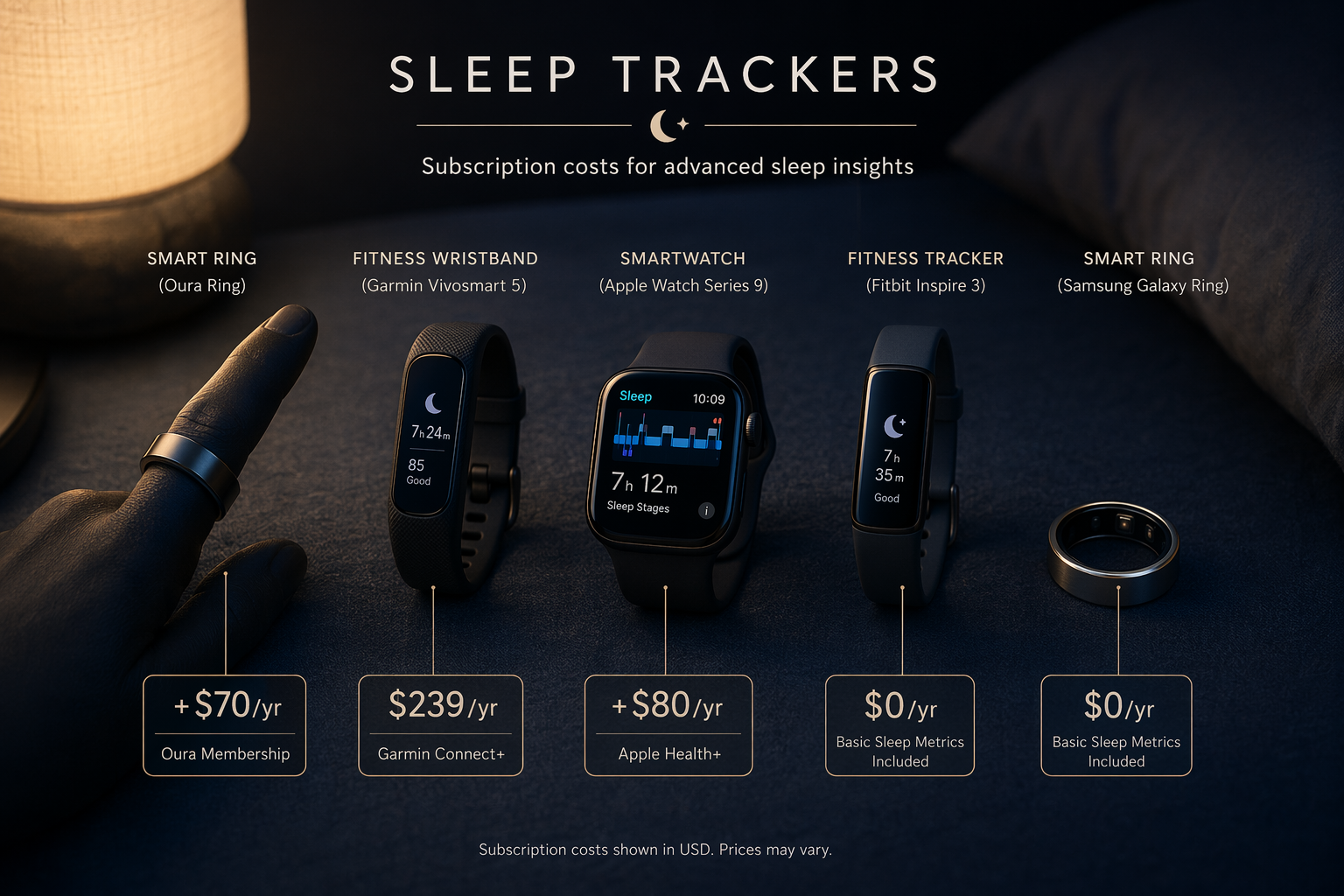
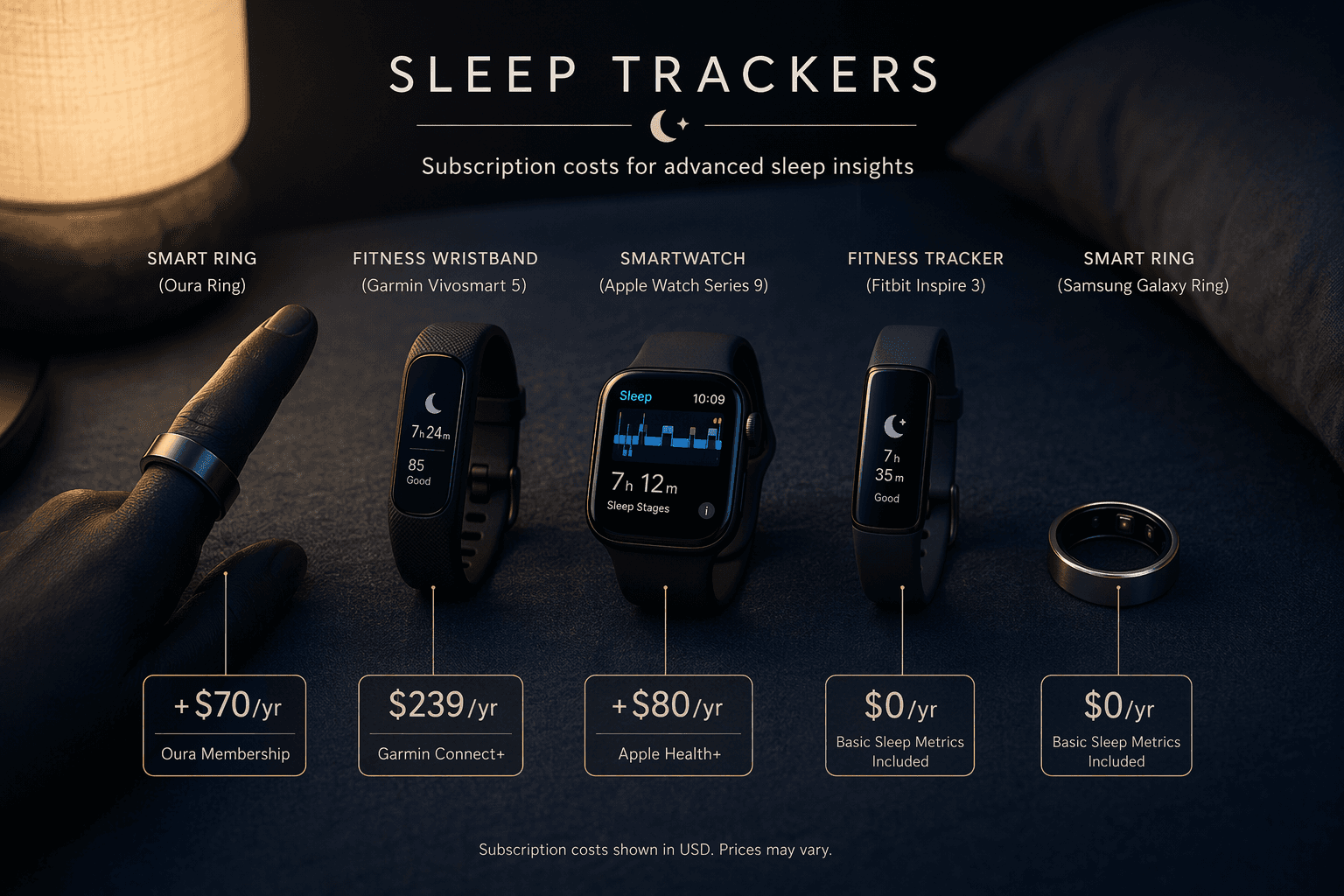
Why the Sticker Price of a Sleep Tracker Is Just the Beginning
When you search for the best wearable for sleep tracking, the first number you see is almost always the upfront hardware cost. A Fitbit Inspire 3 for under $100 looks like a bargain. An Oura Ring 4 at $349 feels like a serious investment. A Whoop 5.0 with no hardware cost at all seems almost too good to be true. That last impression is the most revealing: Whoop's $0 upfront price conceals a $239 annual subscription that makes it the most expensive option over three years.
The sleep tracking market has quietly shifted from a hardware-sale model to a subscription-revenue model. Devices that once gave you full access to your data for a one-time payment now gate essential features — sleep stage breakdowns, readiness scores, HRV trends, and personalized recommendations — behind monthly or annual fees. The result is that the cheapest device on the shelf can cost nearly as much as a premium ring over a typical ownership period, while a subscription-free device like the Samsung Galaxy Ring or Garmin Forerunner 165 can end up saving you hundreds of dollars.
This article breaks down the real financial commitment for six popular sleep trackers — Oura Ring 4, Whoop 5.0, Fitbit Inspire 3, Samsung Galaxy Ring, Garmin Forerunner 165, and Withings ScanWatch 2 — over 1, 2, and 3 years. We separate mandatory subscriptions from optional ones, flag which devices lock meaningful sleep insights behind paywalls, and help you decide whether the long-term cost structure makes a given device worth buying at all.
Total Cost of Ownership: Device-by-Device Breakdown Over 1, 2, and 3 Years
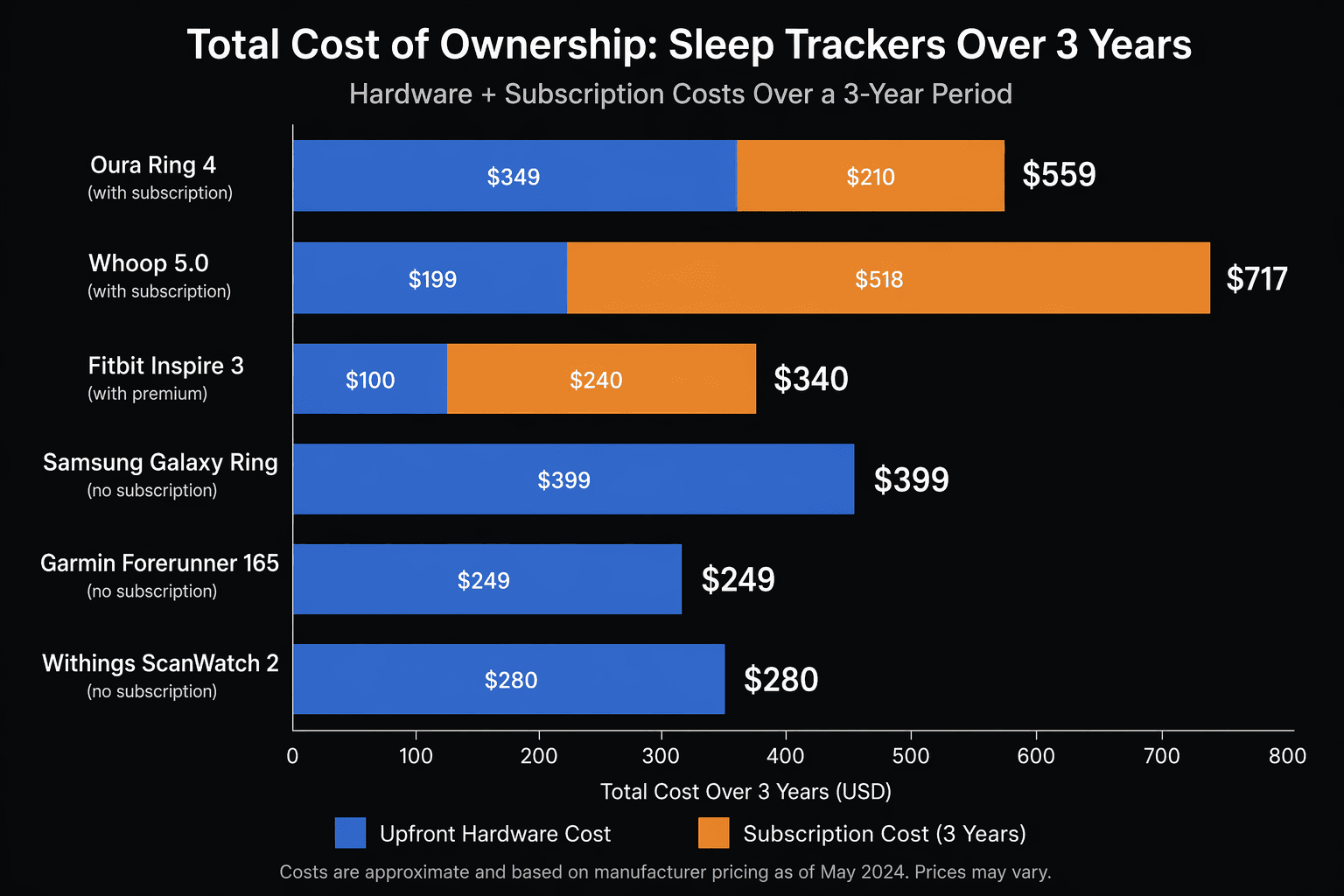
The table below calculates the total cost of ownership for each device assuming a three-year ownership period — a reasonable lifespan for a wearable before battery degradation or hardware obsolescence prompts an upgrade. We include the upfront hardware cost, the annual subscription fee, and whether that subscription is mandatory or optional.
| Device | Upfront Cost | Subscription (Annual) | Mandatory? | Year 1 Total | Year 2 Total | Year 3 Total |
|---|---|---|---|---|---|---|
| Oura Ring 4 | $349–$499 | $69.99 | Yes | $419–$569 | $489–$639 | $559–$739 |
| Whoop 5.0 | $0 | $239 (Peak) | Yes | $239 | $478 | $717 |
| Fitbit Inspire 3 | $99 | $80 (Premium) | No | $99–$179 | $99–$259 | $99–$339 |
| Samsung Galaxy Ring | $399 | $0 | N/A | $399 | $399 | $399 |
| Garmin Forerunner 165 | $249 | $0 | N/A | $249 | $249 | $249 |
| Withings ScanWatch 2 | $280 | $99.50 (Withings+) | No | $280–$380 | $280–$480 | $280–$580 |
A few observations stand out immediately:
- Whoop 5.0 is the most expensive option over three years despite having no hardware cost. The $239 annual Peak subscription adds up to $717, and the higher-tier Life plan at $359/year pushes the total to $1,077.
- Oura Ring 4, with its mandatory $69.99/year subscription, costs $559–$739 over three years depending on the finish you choose. That is roughly 1.6x the upfront price.
- Samsung Galaxy Ring at $399 and Garmin Forerunner 165 at $249 require no subscription at all. Their three-year TCO is exactly the upfront price.
- Fitbit Inspire 3, the cheapest device upfront at under $100, can cost $339 over three years if you subscribe to Fitbit Premium. That is nearly as much as the Samsung Galaxy Ring, which offers more advanced sleep tracking without any ongoing fee.
- Withings ScanWatch 2 sits in the middle: $280 upfront with an optional $99.50/year premium tier. The free tier still provides basic sleep tracking, making it a viable subscription-free option.
What You Actually Lose Without the Subscription
The decision to pay for a subscription should depend on what data you actually need. For some users, the free tier provides enough information to track trends and identify patterns. For others, the subscription unlocks the insights that make the device useful in the first place.
Oura Ring 4: Subscription Required for Core Sleep Insights
Oura's $69.99/year subscription is mandatory. Without it, the ring still tracks basic sleep data (duration, timing, and a simplified sleep score), but you lose access to sleep stage breakdowns (light, deep, REM), HRV trends, respiratory rate, body temperature variation, and the personalized readiness and sleep recommendations that many users consider the ring's primary value. In practice, the free tier is too limited to justify the hardware cost.
Whoop 5.0: Subscription Is the Product
Whoop has no free tier. The $239/year Peak subscription (or $199/year One, or $359/year Life) is the only way to access any data at all. You get sleep stage analysis, HRV, respiratory rate, strain tracking, and recovery scores — but you pay for every single day of access. There is no hardware to fall back on if you cancel.
Fitbit Inspire 3: Basic Data Is Free, Advanced Insights Are Not
Fitbit's free tier provides sleep duration, sleep stages (light, deep, REM), and a sleep score. The optional $80/year Fitbit Premium adds personalized sleep recommendations, detailed health metrics, guided programs, and deeper trend analysis. For many users, the free tier is sufficient for basic sleep tracking. However, if you want the kind of actionable insights that justify wearing a tracker, the premium tier becomes more attractive.
Samsung Galaxy Ring and Garmin Forerunner 165: Full Access, No Subscription
Both devices provide full sleep tracking — including sleep stages, HRV, and sleep scores — without any subscription. Samsung Health and Garmin Connect are free platforms that aggregate and display your data without gating features behind a paywall. This makes them the most cost-effective options for users who want comprehensive sleep data without recurring costs.
Withings ScanWatch 2: Free Tier Is Functional
Withings provides sleep duration, sleep stages, and a sleep score in its free tier. The optional Withings+ subscription ($9.95/month or $99.50/year) adds personalized coaching, deeper trend analysis, and health insights. The free tier is genuinely useful for basic sleep tracking, making the ScanWatch 2 a solid subscription-free option.
Can You Use FSA or HSA Funds? And What About Data Portability?
Two practical considerations can significantly affect the real-world cost and long-term value of a sleep tracker: whether you can pay with pre-tax health savings accounts, and whether you can take your data with you if you switch devices or cancel a subscription.
FSA/HSA Eligibility
Flexible Spending Accounts (FSAs) and Health Savings Accounts (HSAs) allow you to pay for eligible medical expenses with pre-tax dollars, effectively reducing the cost by your marginal tax rate (typically 20–30%). Among the devices covered in this comparison:
- Oura Ring 4 is FSA/HSA eligible, including both the hardware cost and the $69.99/year subscription.
- Whoop 5.0 is FSA/HSA eligible for the subscription cost.
- Fitbit devices are generally not FSA/HSA eligible unless prescribed by a healthcare provider for a specific medical condition.
- Samsung Galaxy Ring, Garmin Forerunner 165, and Withings ScanWatch 2 are not typically FSA/HSA eligible, though individual plan coverage may vary.
Data Portability and Lock-In Risk
A less obvious cost of subscription-based trackers is the risk of data lock-in. If you decide to switch devices or cancel a subscription, can you export your historical sleep data and use it elsewhere?
- Oura allows data export via its web dashboard in CSV format, including sleep stages, HRV, and readiness data. However, the export is not seamless — you lose the contextual insights and trends that the subscription provides.
- Whoop does not offer a straightforward data export feature. Your data is tied to the subscription; if you cancel, you lose access to all historical data.
- Fitbit allows data export via Google Takeout, but the process is cumbersome and the exported data is not formatted for easy import into other platforms.
- Samsung Health and Garmin Connect both offer data export options, though the format and completeness vary. Samsung Health allows CSV export; Garmin Connect offers TCX and FIT file exports.
- Withings allows data export via its web dashboard in CSV format, including sleep data.
Cost-Per-Meaningful-Insight: A Framework for Evaluating Value
Raw cost is only one dimension of value. A device that costs $399 but provides actionable, personalized sleep recommendations every morning may be worth more than a $249 device that simply records your sleep stages without interpretation. To help you evaluate value beyond the dollar amount, consider the following framework:
| Factor | What to Ask | Why It Matters |
|---|---|---|
| Actionable insights | Does the device tell you what to do differently, or just show you data? | A device that provides personalized recommendations (e.g., 'Go to bed 30 minutes earlier tonight') is more valuable than one that just displays a sleep score. |
| Subscription necessity | Are the insights you actually need locked behind a paywall? | If the free tier gives you enough data to make informed changes, the subscription is optional. If the subscription is required for any useful output, factor that into the TCO. |
| Device longevity | How long will the hardware last before battery degradation or obsolescence? | A device that lasts 4–5 years spreads the upfront cost over a longer period. A device that needs replacement every 2 years increases the effective annual cost. |
| Data portability | Can you export your data and use it elsewhere? | If you switch devices or cancel a subscription, can you take your historical data with you? Data lock-in reduces long-term value. |
| Ecosystem integration | Does the device integrate with other health platforms you already use? | Integration with Apple Health, Google Fit, or other platforms can increase the value of the data by allowing cross-platform analysis. |
Using this framework, the Samsung Galaxy Ring and Garmin Forerunner 165 score highly on subscription necessity (no subscription required) and device longevity (both are well-built and likely to last 3–4 years). Oura Ring 4 scores highly on actionable insights (its personalized readiness and sleep recommendations are among the best in the market) but poorly on subscription necessity (the subscription is mandatory for any useful output). Whoop 5.0 scores highly on actionable insights but poorly on both subscription necessity and data portability.
Which Sleep Tracker Should You Buy? Recommendations by Budget
Based on the total cost of ownership analysis, the value framework, and the practical considerations of FSA/HSA eligibility and data portability, here are our recommendations organized by budget tier.
Under $250 Total Cost of Ownership (3 Years)
- Garmin Forerunner 165 ($249) — The clear winner in this tier. No subscription required, full sleep tracking including sleep stages and HRV, and a robust fitness tracking platform. If you want a device that just works without ongoing costs, this is the best option.
- Fitbit Inspire 3 ($99–$339) — The cheapest upfront option, but the cost can climb to $339 over three years if you subscribe to Fitbit Premium. If you are comfortable with the free tier, it is a solid budget choice. If you want premium features, the Samsung Galaxy Ring is a better long-term value.
$250–$400 Total Cost of Ownership (3 Years)
- Samsung Galaxy Ring ($399) — The best subscription-free option in this tier. Full sleep tracking, no ongoing costs, and a sleek form factor. Ideal for users who want comprehensive data without recurring fees.
- Withings ScanWatch 2 ($280–$580) — A solid hybrid watch with optional subscription. The free tier is functional, and the device offers medical-grade features like ECG and SpO2 monitoring. Best for users who want a traditional watch form factor with sleep tracking.
Over $400 Total Cost of Ownership (3 Years)
- Oura Ring 4 ($559–$739) — The most feature-rich sleep tracker on the market, but the mandatory subscription adds significant cost. Best for users who want the most detailed sleep and readiness data and are willing to pay for it. FSA/HSA eligibility can reduce the effective cost.
- Whoop 5.0 ($597–$1,077) — The most expensive option over three years despite no hardware cost. Best for users who want a subscription-based service with no upfront investment and are comfortable with the ongoing cost. Not recommended for cost-conscious buyers.
Still unsure which form factor is right for you? Our form-factor guide to sleep tracking wearables compares rings, wristbands, and watches to help you decide based on comfort, compliance, and accuracy tradeoffs.


Comments
Join the discussion with an anonymous comment.