
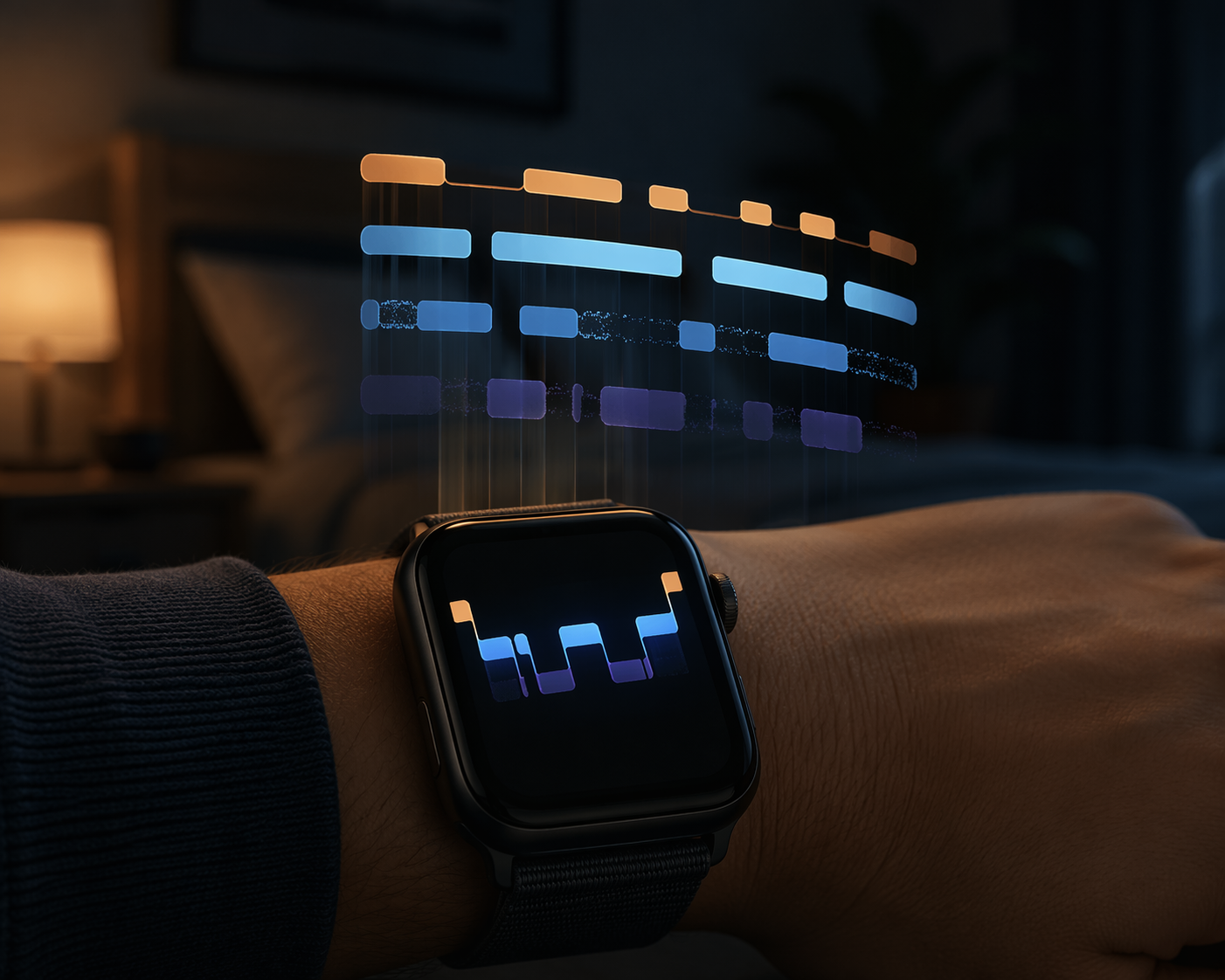
If your Apple Watch says you slept seven hours, you can usually treat that as a useful estimate of the night’s shape. If it says you got almost no deep sleep, slow down before deciding your body failed at sleep. The best published validation data supports a split answer: Apple Watch is strong at separating sleep from wake and reasonably useful for total sleep time trends, but its sleep-stage chart is much less precise, especially for deep sleep.
That distinction matters because the Apple sleep display makes all of these measurements look similarly polished. A clean block of “core,” “deep,” and “REM” can feel like a miniature sleep lab report. It is not. In a peer-reviewed validation study comparing Apple Watch Series 8 with polysomnography, the watch showed greater than 95% sensitivity for detecting sleep, 93% epoch-level agreement for sleep versus wake, and an intraclass correlation coefficient of 0.85 for total sleep time, which the authors classified as excellent reliability. The same study found deep sleep sensitivity of only 50.5% and an average deep sleep underestimation of about 43 minutes per night.[1]
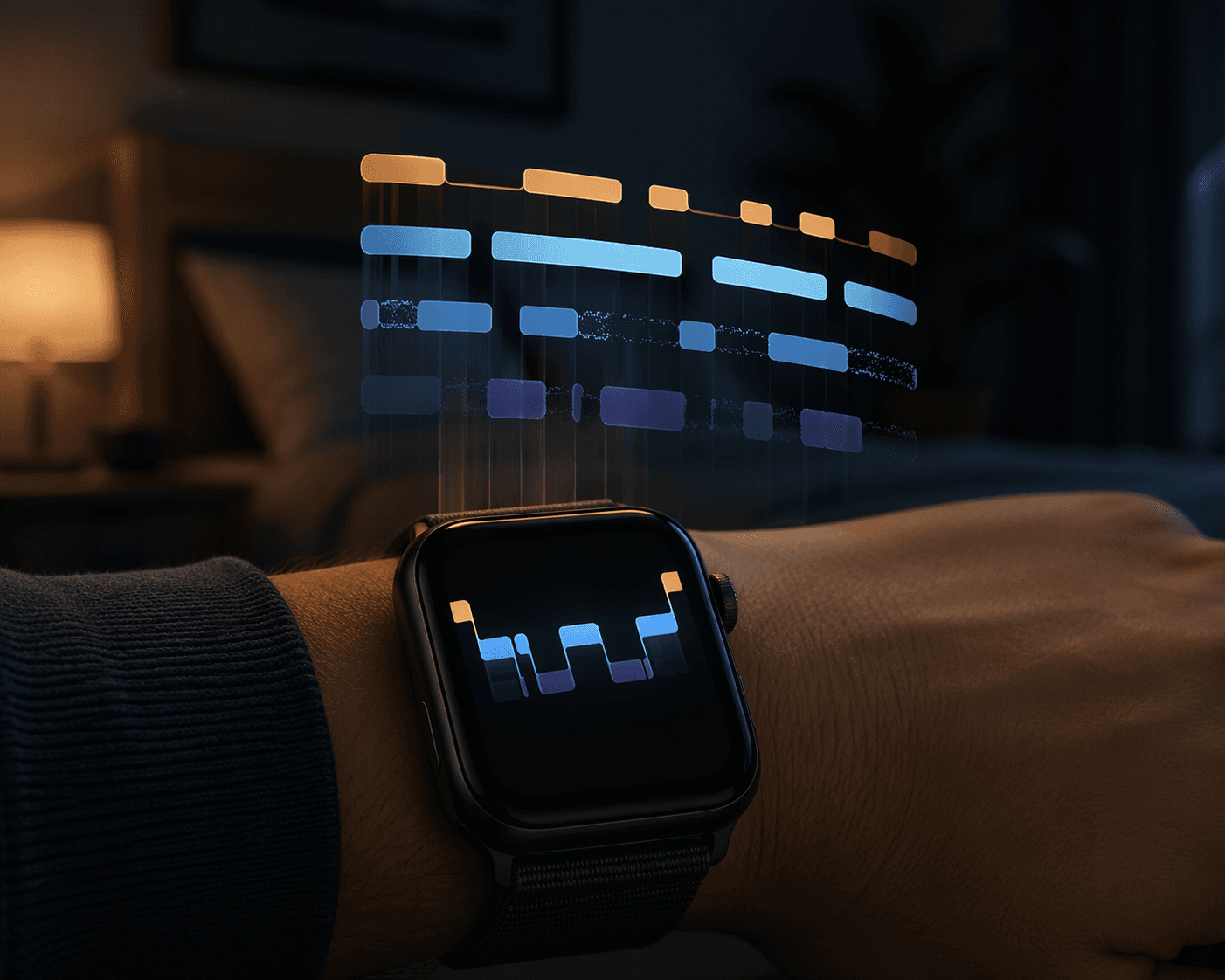
The short answer: trust the broad pattern more than the stage colors
For a sleep monitor, Apple Watch does its best work at the level most people actually need first: when you went to bed, when you woke up, how much of the night was probably sleep, and whether that pattern is drifting over days or weeks. That is different from saying it can accurately label every slice of sleep architecture.
A wrist device is inferring sleep from signals such as motion and physiology. Polysomnography, the clinical research standard used in sleep labs, records brain activity along with other body signals. Those are not equivalent measurement systems. The surprise is not that a watch makes mistakes; the useful question is where the mistakes concentrate.
| Apple Watch metric | How to treat it |
|---|---|
| Sleep vs. wake | Generally reliable for broad nightly tracking, especially when viewed over time |
| Total sleep time | Useful for trends and rough comparisons between nights; avoid treating the exact minute count as perfect |
| REM sleep | Performed better than deep sleep in the key validation study, but still not a clinical measurement |
| Core/light sleep | Often functions as a catch-all category; interpret cautiously |
| Deep sleep | Most likely to be underestimated or misclassified; do not panic over a single low reading |
So the practical calibration is simple: use Apple Watch to notice whether your sleep schedule is consistent, whether your total sleep time is moving up or down, and whether something changed after travel, alcohol, illness, stress, medication changes, or a new routine. Treat the colored stage breakdown as an estimate with known bias, not as a diagnosis of sleep quality.
What the strongest independent study actually found
The most useful evidence here is a 2024 Sensors validation study by Robbins and colleagues. It tested Apple Watch Series 8 against polysomnography in 35 healthy adults aged 20 to 50 during a single-night lab study at Brigham & Women’s Hospital in a Harvard-affiliated setting. The study also evaluated other consumer sleep devices, which gives some context without turning this into a brand ranking.[1]
For sleep/wake detection, Apple Watch looked good. Sleep sensitivity was greater than 95%, epoch-level sleep/wake agreement was 93%, Cohen’s kappa was 0.60, and total sleep time reliability reached an ICC of 0.85.[1] Put plainly, when the watch says you were probably asleep for most of a particular stretch, that is usually a defensible reading.
But those numbers do not transfer neatly to sleep stages. An epoch can be correctly identified as sleep while still being assigned to the wrong stage. That is the part many Apple Watch accuracy discussions blur. A device can be very good at recognizing “asleep” and still be much weaker at deciding whether that sleep was light, deep, or REM.
This is exactly what the Robbins study showed. Apple Watch overestimated light sleep by about 45 minutes per night, detected light sleep with 86.1% sensitivity, underestimated deep sleep by about 43 minutes per night, and detected deep sleep with only 50.5% sensitivity. REM sleep performed better, with 82.6% sensitivity and no statistically significant bias in that study.[1]
How high sleep detection and weak deep sleep detection can both be true
The easiest way to understand the mismatch is to separate two jobs. The first job is binary: was this person asleep or awake? The second job is finer-grained: if asleep, which stage was it?
A watch has a much easier time with the first job. If you are lying still, heart rate has settled, and the pattern continues for a while, sleep is a reasonable inference. It will still miss some quiet wakefulness and some restless sleep, but across a full night, the broad estimate can be useful.
The second job asks the watch to infer brain-defined sleep stages without directly measuring the brain. Deep sleep is especially vulnerable because the watch is not seeing the slow-wave brain activity that defines it in polysomnography. It is estimating from indirect signals and then placing each time segment into a category. When that estimate goes wrong, the app may still know you were asleep; it may simply put that sleep into the wrong colored band.
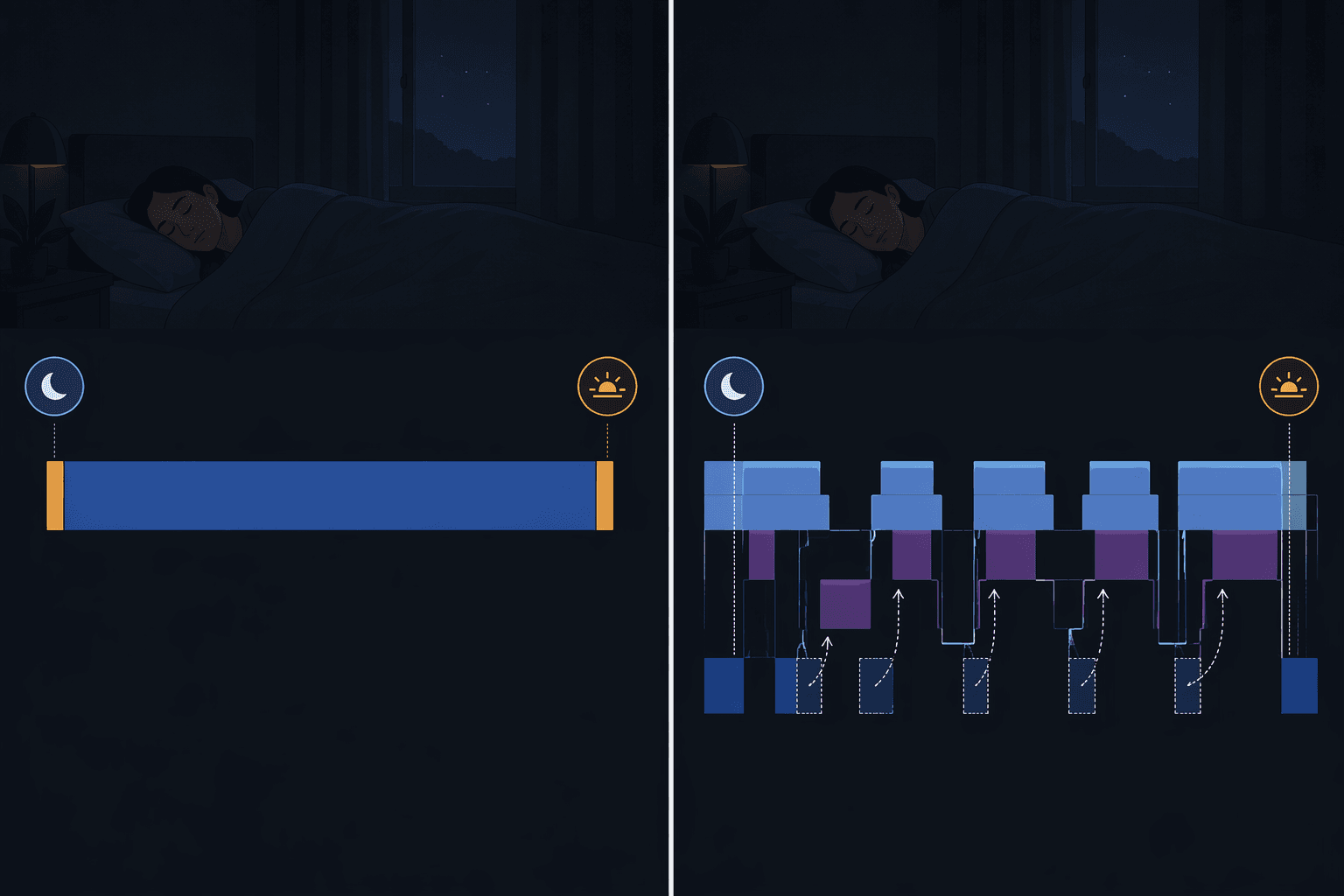
That is why a night can be recorded as a reasonably accurate seven hours of sleep while also showing too little deep sleep. The total sleep estimate and the stage estimate are not equally supported by the validation data. If you wake up feeling restored and the only alarming sign is one small deep-sleep bar, the bar deserves less authority than your broader pattern.
The deep sleep problem is not just random noise
Random error would be annoying enough. The deeper issue is systematic bias. In the Robbins study, Apple Watch did not merely scatter stage labels evenly around the truth. It overestimated light sleep and underestimated deep sleep by large average margins: about 45 minutes too much light sleep and about 43 minutes too little deep sleep per night.[1]
Apple’s own validation data, as summarized by Empirical Health, points in the same general direction. In Apple’s 2023 validation sample of 166 participants, Apple Watch detected 62% of deep sleep epochs accurately, while 38% of deep sleep epochs were misclassified as core sleep.[2] That does not mean every user’s deep sleep is wrong by the same amount. It does mean the “deep” number should not be treated as a precise nightly scorecard.
This also changes how to read “core.” Core sleep can become the bucket that absorbs sleep the algorithm does not confidently place elsewhere. If deep sleep is being misclassified as core, then a high core number is not necessarily a sign that your night was shallow or poor. It may partly reflect the watch’s classification limits.
REM looked better in the Robbins data than deep sleep did, with 82.6% sensitivity and no statistically significant bias.[1] That is encouraging, but it still does not make the REM bar a clinical reading. It is an estimate from a consumer wearable, and its reliability can vary with the person, the night, and the algorithm version.
A brief note on Oura, Fitbit, and device comparisons
The Robbins study also reported results for other consumer trackers. In that same study, Oura Ring did not significantly misestimate any sleep stage, while Fitbit overestimated light sleep by 18 minutes and underestimated deep sleep by 15 minutes.[1] That context is useful, but it should be handled carefully.
First, the study was funded by Oura Ring Inc., although it was independently designed and conducted by Brigham & Women’s Hospital researchers and published in a peer-reviewed journal.[1] That funding does not erase the findings, but it is part of the confidence calculation. Second, a single validation study is not the same as a permanent device hierarchy. Hardware, firmware, algorithms, and user populations all move.
If you are choosing among devices, the more useful question is not “Which tracker wins?” but “Which metric do I plan to act on?” A tracker that is good enough for bedtime consistency may not be good enough for stage-level decisions. For a broader comparison after this accuracy baseline, see our guide to Apple Watch, Oura, and Whoop sleep tracking.
The 2026 complication: watchOS 26 may be different, but it has not been independently validated yet
There is one important timing issue for anyone reading this in 2026. Apple’s sleep algorithm has continued to evolve. Empirical Health reports that the watchOS 26 sleep update, released in October 2025, incorporated foundation models trained on data from the Apple Heart & Movement Study.[3]
That is interesting, and it may matter. A model trained on a large movement and heart dataset could plausibly improve sleep classification. But a plausible improvement is not the same as independent polysomnography validation. As of the current evidence in this brief, no published independent PSG validation was found for the watchOS 26 algorithm on newer Apple Watch models such as Series 9, Series 10, Series 11, Ultra 2, or Ultra 3.
So the fairest reading is not “the old study no longer matters” and not “nothing has changed.” The Robbins study remains the clearest independent PSG comparison available here, but it tested Apple Watch Series 8 in a specific setting. Newer software may perform differently. Until the updated algorithm is tested against PSG and published, the cautious interpretation remains: broad sleep tracking is useful; stage precision is uncertain.
Study limits that should change how confidently you read the numbers
The Robbins study is valuable because it used polysomnography, but it is not a universal answer for every Apple Watch owner. It included 35 healthy adults aged 20 to 50 and measured a single night in a lab setting. Missing Apple Watch data occurred in 6 of the 35 participants.[1] Those details matter if you are older, have a diagnosed sleep disorder, take medications that affect sleep, work irregular shifts, or are trying to interpret months of home data rather than one lab night.
Single-night studies can also be distorted by the “first night” effect: people often sleep differently when wired up in a lab than they do at home. That does not make the comparison useless; polysomnography is still the right reference standard for staging. It does mean the exact error size from one study should not be pasted onto every user’s bedroom.
Funding deserves a measured reading too. Oura’s role as funder is a real limitation to disclose, especially because Oura performed well in the study. At the same time, the work was peer-reviewed, conducted independently, and reports enough detail to be useful.[1] The right response is neither dismissal nor blind acceptance; it is weighted confidence.
How to use Apple Watch sleep data without overreacting to it
The safest use of Apple Watch sleep tracking is trend reading. Look at bedtime, wake time, total sleep time, and broad changes across weeks. If your average sleep duration falls after a work schedule change, or your wake time becomes more irregular, that is the kind of signal a watch can help surface without asking you to keep a nightly diary.
Stage data needs a softer hand. A low deep-sleep estimate on one night should not send you into a supplement search, a training change, or a medical conclusion. Even several low deep-sleep readings should be interpreted alongside how you feel, your sleep opportunity, alcohol or illness, stress, medications, and whether the watch fit was consistent. The chart can start a question; it should not finish the answer.
- Reasonable to trust: whether your sleep schedule is consistent, whether total sleep time is generally increasing or decreasing, and whether a major routine change affects your nights.
- Reasonable to watch cautiously: recurring changes in REM, core, or deep sleep that line up with obvious lifestyle or health changes.
- Not reasonable to do: diagnose a sleep disorder, judge recovery from a single stage chart, or assume “low deep sleep” means your brain did not get restorative sleep.
If your Apple Watch sleep data consistently conflicts with how you feel, do not automatically assume your body is wrong. A person who wakes refreshed after a stable night does not need to treat a thin deep-sleep stripe as an emergency. A person who feels exhausted, sleepy during the day, or concerned about snoring, breathing pauses, insomnia, or unusual movements should not rely on a watch to rule out a clinical problem.
This is also where sleep tracking can become counterproductive. Baron and colleagues described “orthosomnia,” a pattern in which people become preoccupied with improving sleep-tracker numbers in ways that can increase anxiety around sleep.[4] The irony is obvious to anyone who has stared at a sleep app before coffee: trying to perfect the chart can make the night feel less restful.
If the data is making sleep feel more stressful, change the habit before changing the whole sleep routine. Check trends once or twice a week instead of every morning. Hide stage details for a while and look only at sleep duration and schedule. If even that keeps you preoccupied, take a break from wearing the watch overnight.
What this means for the Apple Watch as a sleep monitor
Apple Watch is a good passive sleep monitor for broad patterns. It is not a replacement for polysomnography, and its sleep-stage display is not equally accurate across stages. The evidence supports trusting sleep versus wake detection and total sleep time trends more than the exact minutes assigned to core, deep, or REM sleep.
The most important caveat is deep sleep. In the best independent PSG comparison available here, Apple Watch substantially underestimated it. Apple’s own validation summary also shows a meaningful share of deep sleep being labeled as core. That is enough to make the deep-sleep number useful only as a directional clue, not as a verdict on your recovery.
For readers comparing sleep-tracking watches more broadly, our guide to what a sleep tracker watch can and cannot tell you covers the same accuracy problem across device types. If you are specifically trying to understand newer Apple features, see our explainer on Apple Watch Sleep Score and apnea notifications. Those features should be interpreted alongside, not instead of, the validation limits above.
References
- Robbins et al. 2024 Apple Watch, Oura Ring, and Fitbit polysomnography validation study — Sensors, 2024.
- Deep Sleep Percent — Empirical Health.
- Apple Watch Deep Sleep Meaning — Empirical Health.
- Orthosomnia: Are Some Patients Taking the Quantified Self Too Far? — Journal of Clinical Sleep Medicine, 2017.
Comments
Join the discussion with an anonymous comment.