The most useful answer to “contactless sleep tracker accuracy” is not one number. Published studies point to a consistent split: contactless devices are often fairly good at deciding whether you were probably asleep or awake, and much less dependable when they label that sleep as light, deep, or REM.
That distinction matters because the app screen rarely looks uncertain. A clean hypnogram can make inferred sleep stages feel like measured physiology. But most consumer contactless trackers are not measuring brain waves. They are using signals such as movement, breathing, heart-related motion, and sometimes room conditions to infer what sleep probably looked like.
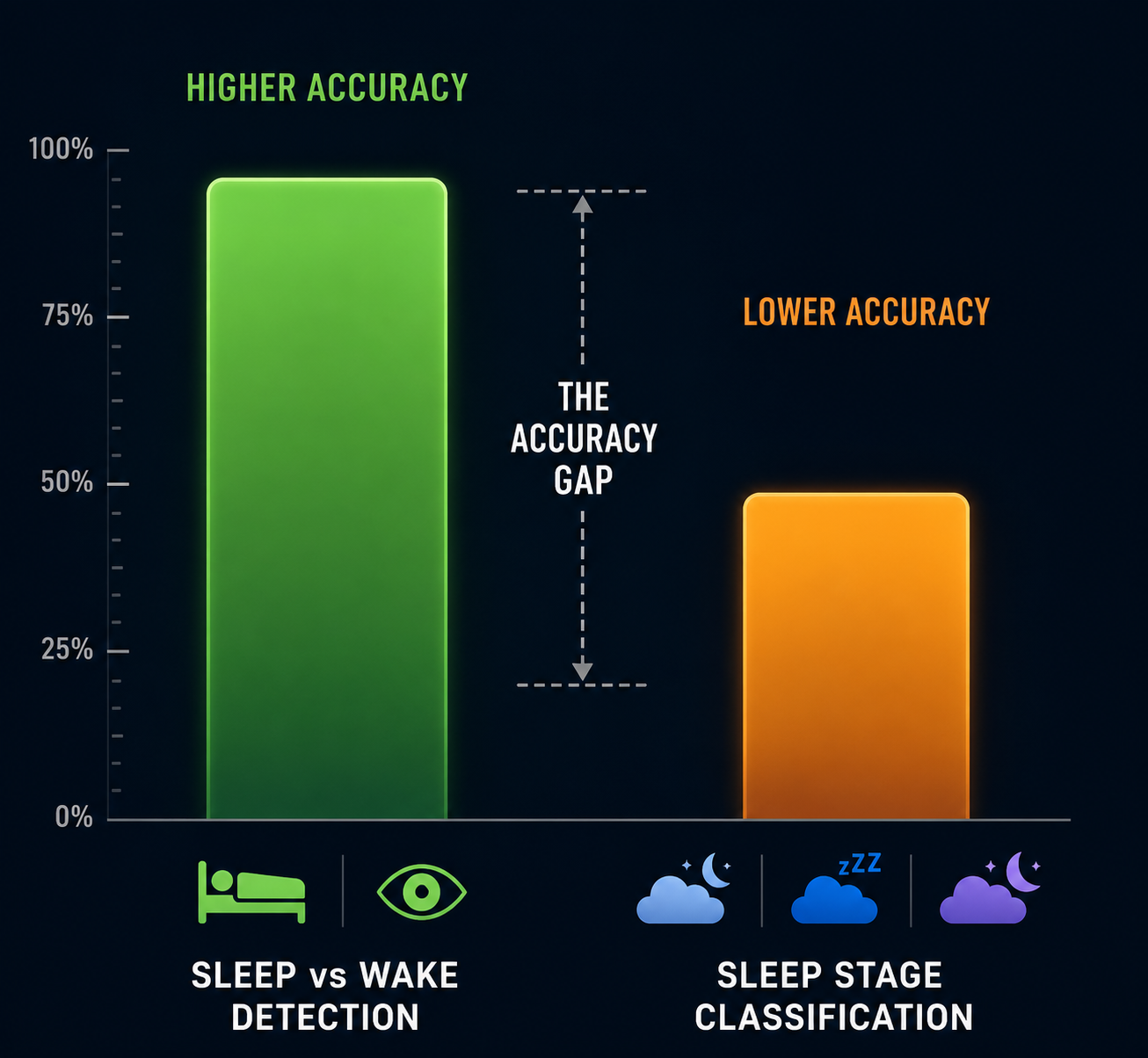
The accuracy gap shows up across device types
In a multicenter validation study of 11 consumer sleep trackers, nearable and airable devices showed a large gap between broad sleep-wake detection and more detailed sleep-stage classification. The same study reported that contactless nearables had a mean sleep latency bias of +29 minutes, meaning they tended to overestimate how long it took people to fall asleep; wearables in the same comparison had a mean bias of -2.7 minutes.[1]
That is a practical difference, not just a statistical one. If a tracker is reasonably close on total sleep time across many nights, it may help you notice a late bedtime pattern or weekend catch-up sleep. If it regularly stretches sleep latency or mislabels stages, a user may start correcting a problem the device has partly invented.
| Device or study | Sensor type | What looked stronger | What looked weaker | Important caveat |
|---|---|---|---|---|
| Withings Sleep Analyzer | Under-mattress ballistocardiography | 83–87% sleep-wake accuracy | 63% four-stage accuracy; light sleep overestimated by about 81 minutes and deep sleep underestimated by about 46 minutes per night | Study funded by Withings and authored by Withings-affiliated researchers[2] |
| Somnofy | Bedside 60 GHz millimeter-wave radar | 97% sleep sensitivity | 72% wake specificity; stage differentiation scores of 0.74–0.78 | Small healthy young sample; clinical performance not established[3] |
| Amazon Halo Rise | Radar | Included in multicenter validation against PSG | Macro F1 of 0.62 for sleep staging | Study included Asleep-affiliated authors, some with stock[1] |
| Withings Sleep Tracking Mat | Under-mattress mat | Included in multicenter validation against PSG | Macro F1 of 0.45 for sleep staging | Same multicenter study caveats apply[1] |
| Google Nest Hub 2 | Soli radar smart display | Contactless home-style sensing tested against PSG | Macro F1 of 0.30 and κ=0.06, with heavy bias toward light sleep classification | Controlled-lab data may not represent every home setup[1] |
| Sleepal AI Lamp | 60 GHz mmWave radar | 92.8% sleep-wake accuracy in a 1,022-night PSG dataset | 77.2% four-stage accuracy | Preprint as of July 2026; not yet peer-reviewed[4] |
The table is not a ranking. These studies used different samples, settings, algorithms, and reporting metrics. The pattern is still hard to miss: sleep-wake detection usually looks more credible than sleep-stage labeling.
The Withings Sleep Analyzer study is useful because it tested an under-mattress sensor at home against polysomnography across more than 400 nights and included both healthy and unhealthy sleep. It found 83–87% sleep-wake accuracy, but total sleep time was overestimated by 20–48 minutes per night. For stages, four-stage accuracy was 63% with Cohen’s κ=0.49, a moderate level of agreement rather than a clinical-grade substitute for PSG staging.[2]
The Somnofy radar study shows the same kind of asymmetry from another direction. Its 97% sleep sensitivity means it was very good at recognizing sleep epochs, but 72% wake specificity means wake was easier to miss. That distinction is especially relevant for people who lie still while awake, because a motion- and respiration-based system can mistake quiet wakefulness for sleep.[3]
The Sleepal AI Lamp preprint is the most eye-catching dataset in the group: 1,022 PSG nights, 92.8% sleep-wake accuracy, and 77.2% four-stage accuracy. The size is notable, and so is the caveat. As of July 2026, it is still a preprint, so it should not be weighted the same way as a peer-reviewed validation paper.[4]
Why sleep-wake is easier than light, deep, and REM
A contactless tracker can collect useful signals without asking you to wear anything. Under-mattress devices detect tiny body movements and cardiac-mechanical signals through the mattress. Bedside radar devices can detect movement and breathing from a nightstand or wall position. Smart displays using radar estimate patterns from nearby motion and respiration. For a restless sleeper, that lack of contact is a real advantage.
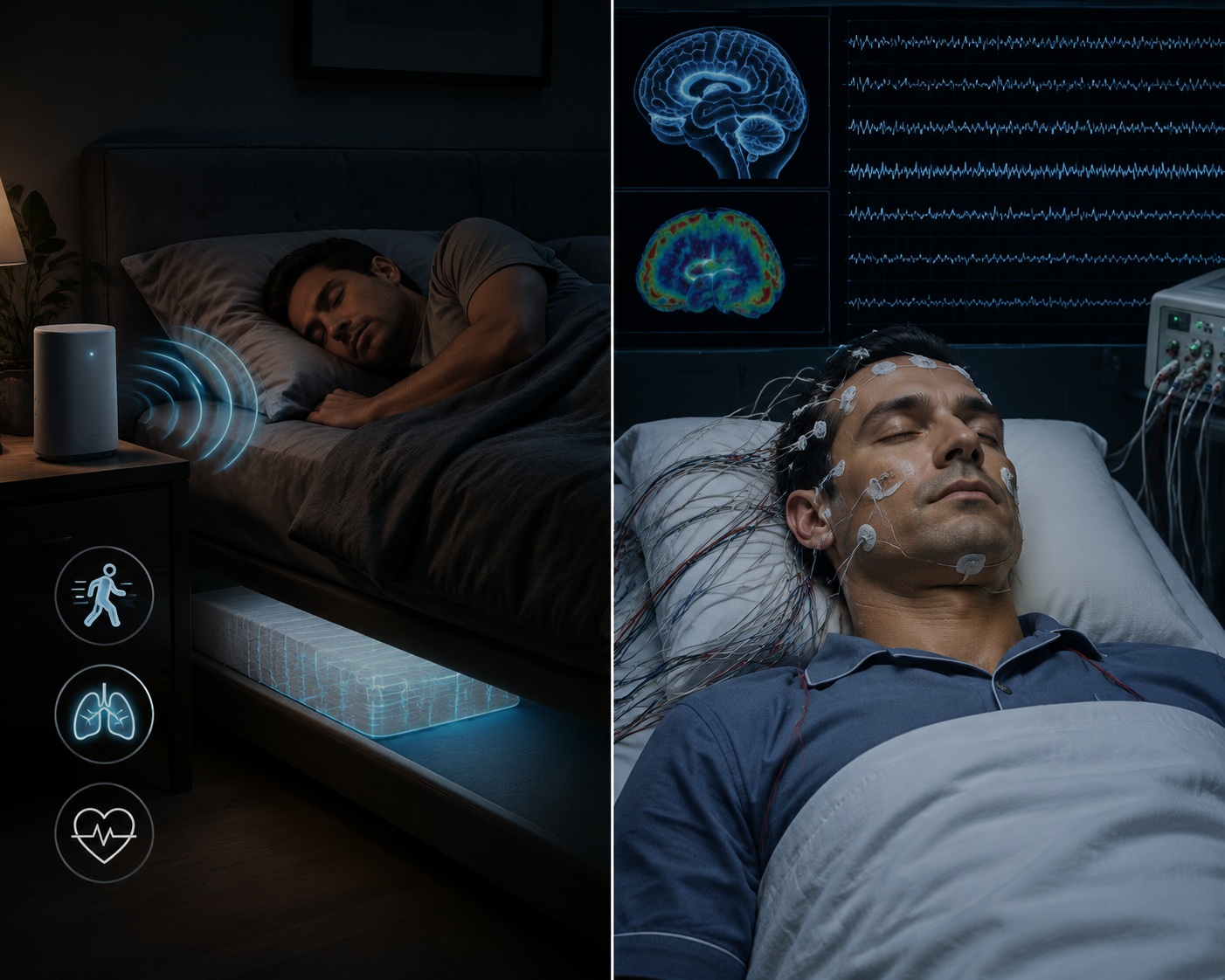
The problem is that sleep stages are not defined by mattress motion or bedroom radar. Polysomnography stages sleep using neurophysiological and physiological signals, including EEG brain-wave patterns, eye movements, and muscle tone. A contactless consumer device can estimate stage-like patterns, but it is working from indirect evidence.
This is why the “deep sleep” number deserves more caution than the “roughly how long did I sleep?” number. Deep sleep, REM sleep, and light sleep have overlapping external clues. Breathing changes, movement changes, and heart-related signals can be informative, but they are not the same as observing the brain and body signals used in PSG scoring.
Even PSG staging has human variability. Reviewer agreement around κ≈0.71 for light-versus-deep boundaries is a reminder that trained scorers do not treat those labels as perfectly crisp. Consumer devices start from a less direct signal set, then ask an algorithm to map those signals onto the same difficult labels.
That does not make the technology pointless. It makes the use case narrower. If a device repeatedly shows that you sleep less after late caffeine or that your schedule swings by two hours on weekends, that may be useful. If it tells you that deep sleep dropped by 38 minutes last night, the better response is curiosity, not alarm.
The sensor format changes convenience more than it changes the core limitation
Under-mattress pads, bedside radar devices, and radar-enabled displays are not interchangeable products. If you are comparing hardware, a broader form-factor guide such as How to Choose a Sleep Monitoring Device: Form Factors Compared is the more natural place to sort out setup and comfort. For accuracy, the larger issue is whether the signal can support the claim being made.
Under-mattress sensing can be pleasantly invisible. In the Withings Sleep Analyzer study, performance was reported as consistent regardless of mattress type, mattress thickness, or bed partner presence.[2] That is helpful if the main goal is a low-friction view of sleep timing across months.
Radar has its own appeal. A bedside device can monitor without touching the sleeper, and some radar systems add environmental sensing such as temperature, humidity, light, and sound. In the Somnofy validation, results were independent of whether the device was placed on a nightstand or mounted on a wall.[3]
Those practical advantages are worth considering, but they do not erase the measurement gap. A better placement experience does not turn a respiration-and-motion system into an EEG system. A richer room context may help explain why a night was disrupted, but it does not directly prove what happened in the cortex during REM or deep sleep.
Accuracy for what?
The buying question should be narrower than “Are contactless sleep trackers accurate?” A more useful version is: “Accurate enough for what decision?”
| If you want to use it for | Confidence level from current evidence | How to interpret the data |
|---|---|---|
| Broad sleep duration trends | Moderate | Look at multi-night and multi-week patterns rather than one-night precision. |
| Bedtime and wake-time regularity | Moderate | Useful for noticing schedule drift, especially if the device is worn by no one and therefore used consistently. |
| Sleep latency | Low to moderate | Be cautious; contactless nearables showed a +29-minute mean sleep latency bias in one multicenter study.[1] |
| Light, deep, and REM sleep | Low | Treat stage labels as estimates, not measured brain states. |
| Sleep disorder screening or self-diagnosis | Low | Use concerning patterns as a reason to discuss symptoms, not as a diagnosis. |
This distinction also helps explain why a single accuracy percentage in marketing copy can be misleading. If the number refers to sleep-wake classification, it may not tell you much about REM, deep sleep, or sleep latency. If the number comes from a healthy adult sample, it may not hold for someone with insomnia, sleep apnea, periodic limb movements, or fragmented sleep.
That last point is not theoretical. In the Withings Sleep Analyzer evaluation, accuracy dropped from 89% in healthy sleepers to 81% in disordered sleepers.[2] The people most tempted to scrutinize every night of data may be the same people for whom the device has a harder job.
If the tracker starts changing your behavior in a way that makes sleep more stressful, step back from the graph. A consumer sleep score is not a sleep study; if symptoms are persistent, disruptive, or safety-relevant, the better comparison is clinical testing, not another app chart. The distinction is covered more directly in Your sleep tracker is not a sleep study.
How much should conflicts and updates change your confidence?
Validation studies do not become useless because a company is involved, but the relationship should stay visible. The Withings Sleep Analyzer study was funded by Withings and included Withings-affiliated researchers.[2] The Lee et al. multicenter study included authors affiliated with Asleep, and some held stock.[1] Those facts do not erase the data; they affect how confidently a buyer should generalize from it.
Sample size and sample type matter just as much. Somnofy’s radar validation is interesting because the sleep sensitivity was high, but the study used 23 healthy young participants in a lab setting.[3] That is not the same as showing reliable performance in older adults, children, people with insomnia, or people with diagnosed sleep disorders.
The Sleepal preprint has the opposite shape: a large PSG dataset, but no peer-reviewed paper yet as of July 2026.[4] A large dataset is worth attention. Peer review is still part of how methods, exclusions, scoring assumptions, and claims get pressure-tested.
There is also a moving-target problem. Consumer devices can change through firmware and algorithm updates after a study is published. That means an older validation may not describe the current product perfectly. It also means a current product claim should ideally be backed by current validation, not only by a general statement that the company has tested sleep tracking before.
A practical way to use contactless sleep data
For most healthy adults, the best use of a contactless sleep tracker is boring in a good way: sleep duration, sleep timing, and regularity. These are the patterns most likely to survive the limitations of indirect sensing. They are also the patterns you can act on without pretending the bedroom has become a sleep lab.
- Use several weeks of data before drawing conclusions about your typical sleep schedule.
- Treat one bad night of REM or deep sleep as a weak signal, especially if you feel fine.
- Watch for consistent mismatch: if the tracker says you slept well but you are exhausted, believe the symptom enough to investigate.
- Avoid using stage numbers to self-treat insomnia, sleep apnea, or other suspected disorders.
- Prefer studies that report separate sleep-wake and stage results, not a single blended accuracy claim.
The fairest reading of the evidence is neither “these devices are fake” nor “the graph knows your sleep.” Contactless tracking can reduce friction enough that people actually use it, and 83–93% sleep-wake accuracy across device types is meaningful for broad trend awareness. The weaker point is stage interpretation: published stage performance is commonly far lower, with four-stage accuracy often in the 49–63% range, depending on the device and study design.
So use the device for what it is relatively good at: noticing when sleep is short, irregular, or disrupted over time. Treat sleep stages, sleep latency, and disorder-related conclusions as low-confidence signals. They can justify curiosity. They can support a clinical conversation. They should not become a diagnosis.
References
- Accuracy of 11 Wearable, Nearable, and Airable Consumer Sleep Trackers: Prospective Multicenter Validation Study — PubMed Central, 2023.
- Performance evaluation of an under-mattress sleep sensor versus polysomnography in >400 nights with healthy and unhealthy sleep — PubMed, 2025.
- Validation of sleep stage classification using non-contact radar technology and machine learning (Somnofy®) — PubMed, 2020.
- Evaluation of a Contactless Sleep Monitoring Device for Sleep Stage Detection against Home Polysomnography in a Healthy Population — medRxiv, 2025.
Comments
Join the discussion with an anonymous comment.