
The best sleep tracker is not the one with the prettiest sleep score. It is the one whose measurements are accurate enough for the decision you want to make. If you mainly need to know whether you slept six hours or seven and whether your schedule is drifting later, current consumer trackers are useful. If you want to treat last night’s “deep sleep” or “REM” number as a clinical fact, they are not there yet.
The cleanest practical split is this: sleep/wake detection and total sleep time deserve more trust; sleep stage percentages deserve caution. In a 2024 Brigham and Women’s Hospital validation study, Oura Ring Gen3, Fitbit Sense 2, and Apple Watch Series 8 all reached at least 95% sensitivity for detecting sleep versus wake in healthy adults when compared with polysomnography, the clinical sleep-lab standard.[1] That does not mean their stage graphs are equally dependable.
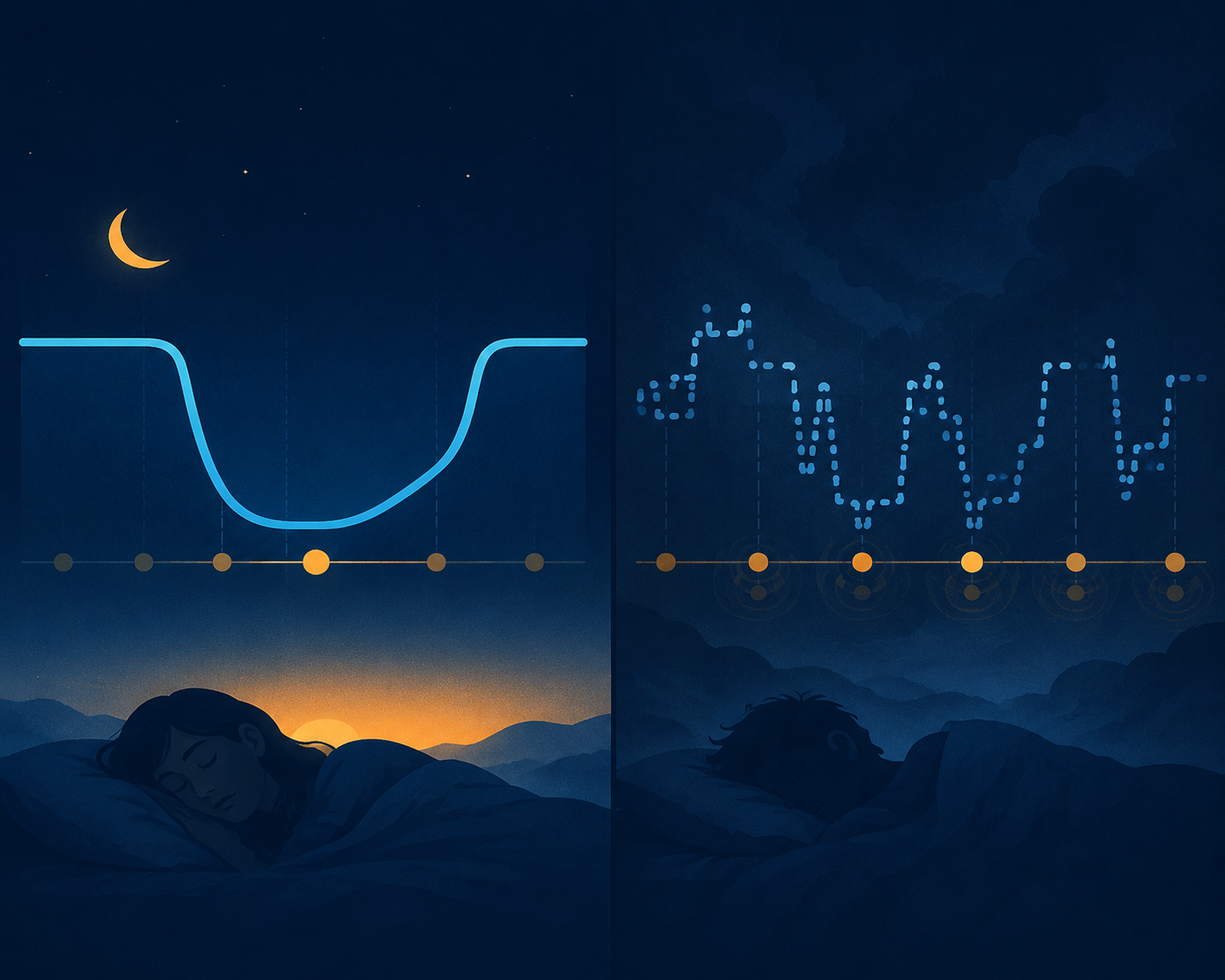
For most buyers, that makes the first question less glamorous and more useful: which number are you actually going to act on? Bedtime regularity, wake time, total sleep time, and long awake periods after falling asleep are closer to the strengths of today’s devices. A precise-looking breakdown of light, deep, and REM sleep is more likely to outrun the evidence.
The Short Accuracy Verdict
| If you need to trust... | How to treat consumer tracker data | Best-supported evidence in this brief |
|---|---|---|
| Sleep versus wake | Generally reliable enough for pattern tracking in healthy adults | Oura, Fitbit, and Apple Watch all showed >=95% sleep/wake sensitivity in Robbins 2024 |
| Total sleep time | Useful for trends and rough nightly estimates | Oura Gen3 had especially strong PSG comparison across nightly summary measures in Robbins 2024 |
| Sleep regularity | Often more actionable than stage percentages | Supported indirectly because onset, offset, latency, total sleep time, WASO, and efficiency are fundamental measures |
| Wake after sleep onset | Worth watching as a trend, not as a diagnosis | Included among fundamental sleep outputs and in PSG-comparison summaries |
| Light, deep, and REM sleep | Interesting, but too device- and algorithm-dependent to treat as precise | Apple Watch Series 8 showed large light/deep bias in Robbins 2024; macro F1 varied widely in Lee 2023 |
| A single readiness or sleep score | Convenient summary, but not the measurement itself | Scores combine assumptions that are usually less transparent than raw sleep timing measures |
That verdict is deliberately narrower than a product ranking. Oura has the strongest summary-measure evidence in the studies here, but the best choice can change if you care more about watch form factor, phone-only tracking, under-mattress sensing, subscription cost, or fitness metrics. For those broader tradeoffs, a separate form factor comparison or total cost of ownership guide will matter. Here, the question is accuracy.
What “Accurate” Means Depends on the Metric
Sleep tracking accuracy is easy to oversimplify because apps compress several different measurements into one confident-looking dashboard. A tracker may be good at detecting that you were asleep, less good at detecting brief awakenings, and much less consistent at assigning each minute to light, deep, or REM sleep.
The studies in this article do not all measure accuracy the same way. Robbins et al. compared Oura Ring Gen3, Fitbit Sense 2, and Apple Watch Series 8 against polysomnography in 35 healthy adults at Brigham and Women’s Hospital.[1] Lee et al. tested 11 consumer devices and apps in 75 Korean adults across 349,114 sleep epochs and reported macro F1 scores, which balance performance across sleep-stage classes rather than simply asking whether a device called sleep “sleep.”[2]
Those are not interchangeable answers. Sensitivity can look excellent when a device is mostly being asked to detect sleep, because people spend most of the night asleep. Macro F1 is less forgiving because it asks whether the device performs across classes, including harder distinctions such as wake, REM, and non-REM stages. A tracker can therefore look strong on sleep/wake sensitivity and mediocre on stage classification without the two findings contradicting each other.
The World Sleep Society’s 2025 framework helps separate useful outputs from overinterpretation. It identifies seven fundamental sleep measures that devices should report: sleep onset, sleep offset, sleep latency, total sleep time, wake after sleep onset, sleep efficiency, and stage durations. The same framework treats stage-level data as exploratory rather than diagnostic.[3] That is the right posture for consumer sleep tracking: use the timing and continuity measures first, then treat stage data as a rough signal.
What the PSG Study Says About Oura, Fitbit, and Apple Watch
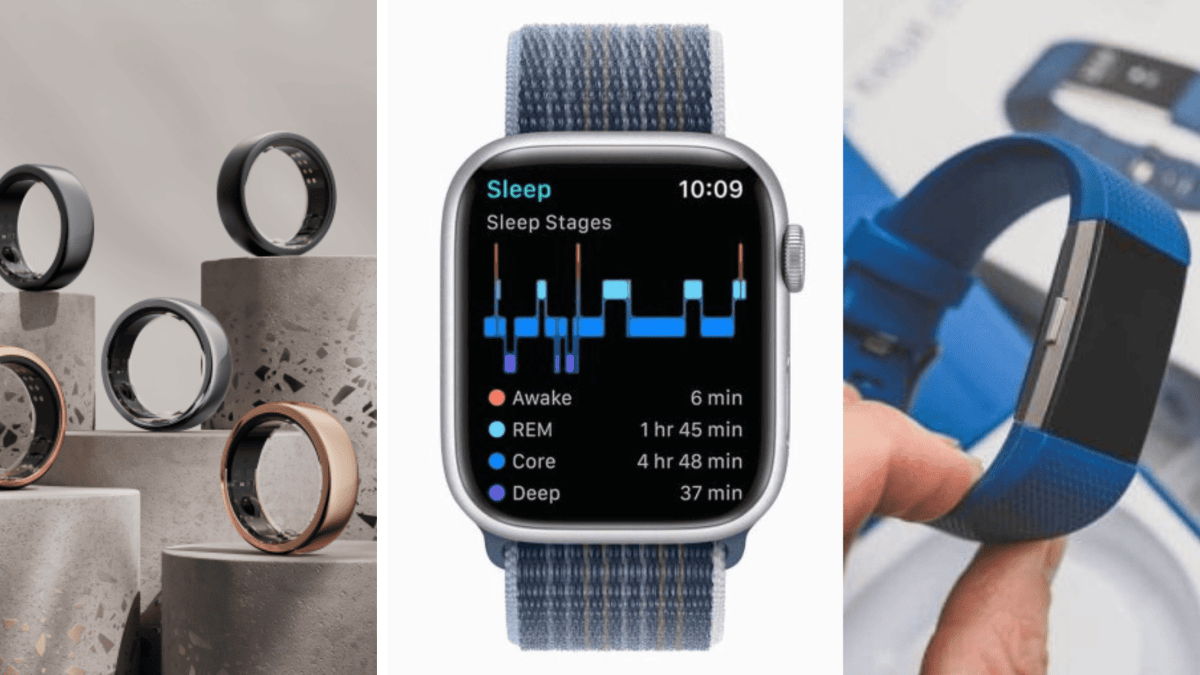
The Robbins study is the most useful evidence here for shoppers comparing the three familiar wearable names. It put Oura Ring Gen3, Fitbit Sense 2, and Apple Watch Series 8 against polysomnography during overnight sleep measurement in a clinical research setting. All three devices showed at least 95% sensitivity for sleep/wake detection in healthy adults.[1]
That finding matters. It means these devices are not just bedtime jewelry when the question is basic sleep quantity. If your practical concern is, “Am I consistently sleeping less than I think?” a modern ring or watch can often show the pattern well enough to change behavior. It may reveal that your seven-and-a-half-hour sleep opportunity is turning into six hours of actual sleep, or that weekend catch-up is masking a weekday deficit.
Oura Ring Gen3 stood out in that study. It was the only tested device that was not significantly different from polysomnography on 7 of 8 nightly sleep summary measures: total sleep time, wake, light sleep, deep sleep, REM sleep, wake after sleep onset, and sleep efficiency.[1] That is stronger evidence than a brand claim or a user forum consensus, and it is why Oura deserves serious consideration if your buying priority is sleep-summary accuracy.
The caution belongs in the same breath. Robbins et al. was partially funded by Oura Ring Inc., and the paper reports author consulting relationships with Oura and other wearable companies.[1] That does not invalidate the results, but it should slow down any coronation. The right conclusion is not “Oura is clinically perfect.” It is that, in this study, Oura Gen3 had the strongest agreement across nightly summary measures among the three devices tested.
Apple Watch Series 8 is a good example of why sleep stages need restraint. In the same PSG comparison, it overestimated light sleep by 45 minutes and underestimated deep sleep by 43 minutes compared with polysomnography.[1] A user could easily read that as a personal failure — too little deep sleep again — when part of the problem is the device’s stage allocation.
Fitbit Sense 2 sits in the same practical category as the others for sleep/wake detection, but the research brief does not support calling it the most accurate overall. If you want a closer look at Fitbit-specific evidence, the site’s Fitbit sleep tracker accuracy review is the better place to handle model-by-model detail.
The Wider Device Comparison Changes the Shape of the Answer
Lee et al. is useful because it widens the field beyond the usual ring-watch-Fitbit triangle. The study compared 11 consumer sleep tracking devices and apps in 75 participants, using 349,114 sleep epochs, and reported macro F1 scores that ranged from 0.26 for the Pillow app to 0.69 for the SleepRoutine app.[2]
| Device or app | Form factor | Macro F1 in Lee 2023 |
|---|---|---|
| SleepRoutine app | Phone app | 0.69 |
| Amazon Halo Rise | Nearable / bedside sensor | 0.62 |
| Galaxy Watch 5 | Watch | 0.58 |
| Fitbit Sense 2 | Watch | 0.58 |
| Google Pixel Watch | Watch | 0.57 |
| Oura Ring 3 | Ring | 0.52 |
| Apple Watch 8 | Watch | 0.49 |
| Withings Sleep Mat | Under-mattress sensor | 0.45 |
| Pillow app | Phone / app-based tracking | 0.26 |
Macro F1 is not the same thing as “percent accurate.” It is a stricter way to summarize classification performance across multiple classes. That makes Lee’s results especially useful for stage-level caution. The spread from 0.26 to 0.69 shows how much the answer depends on the device, the algorithm, and the sleep category being classified.[2]
The result also prevents an easy three-brand story. In Lee’s data, SleepRoutine and Amazon Halo Rise scored higher than the major wearables by macro F1, while Google Pixel Watch, Galaxy Watch 5, and Fitbit Sense 2 clustered close together among watches. Oura Ring 3 and Apple Watch 8 were lower on this particular metric than in the narrower story many buyers might expect.[2]
Two caveats matter. Lee et al. was conducted solely in a Korean population, so the results should not be treated as universal across all populations. The paper also reports that authors affiliated with Asleep, maker of SleepRoutine, held stock options.[2] Again, that does not erase the data. It does mean the unusually strong SleepRoutine result should be read with the disclosed conflict in view.
Which Tracker Fits Which Accuracy Need?
A useful purchase decision starts with the metric you plan to believe. The same person can make a good choice or a bad one with the same device, depending on whether they use it to track sleep timing or to audit every stage graph.
If You Care Most About Total Sleep Time
Oura Ring Gen3 has the strongest evidence in this research set for nightly sleep summary measures. The Robbins PSG comparison found it was not significantly different from PSG on 7 of 8 nightly summary measures, including total sleep time and sleep efficiency.[1] If you are buying primarily to understand whether your sleep opportunity is translating into actual sleep, Oura is the best-supported choice in the evidence here.
That judgment applies to the validated generation in the study, not automatically to every later device. Several 2026 products, including newer rings and wearables, may have different sensors or algorithms without the same independent PSG validation. A newer model is not automatically more accurate unless it has been tested.
For more detail on Oura’s strengths and limits, see the site’s Oura Ring sleep tracking accuracy review.
If You Want a Watch
Fitbit Sense 2, Apple Watch Series 8, Google Pixel Watch, and Galaxy Watch 5 all appear in the evidence base, but the answer changes by metric. Robbins supports Apple Watch and Fitbit for sleep/wake sensitivity, while Lee’s macro F1 comparison puts Galaxy Watch 5 and Fitbit Sense 2 at 0.58, Google Pixel Watch at 0.57, and Apple Watch 8 at 0.49.[1][2]
That does not make one watch the universal winner. A watch may be the right choice because you will actually wear it, because it also tracks workouts, or because it fits your phone ecosystem. But if the app tells you that your deep sleep was poor, remember the Apple Watch light/deep bias in the PSG study before you turn that number into a verdict on your body.[1]
If you are specifically comparing wrist-based devices, the watch-specific sleep tracker accuracy guide is a better companion than a generic best-products list.
If You Prefer Not to Wear Anything
Lee’s comparison gives non-wearables a real place in the discussion. Amazon Halo Rise had a macro F1 score of 0.62, SleepRoutine reached 0.69, and Withings Sleep Mat scored 0.45.[2] That range is the point: “not wearable” is not a single accuracy category. A bedside sensor, a phone app, and an under-mattress mat can behave very differently.
Non-wearable trackers can be attractive if a ring or watch disrupts sleep, because a device you will not use has no practical value. But couples, pets, mattress movement, room setup, and app assumptions can all complicate passive sensing. The available evidence supports comparing specific products, not assuming the form factor solves accuracy by itself.
If You Care About Recovery Scores
Recovery scores are more interpretive than total sleep time. They may combine sleep duration, heart-rate patterns, heart-rate variability, respiratory signals, recent activity, and proprietary weighting. That does not make them useless, but it makes them harder to validate as one number.
Karpathy’s 60-night real-world comparison is useful here as a sanity check, not as proof. Across one disciplined user’s nights, Oura and Whoop correlated at r=0.65, while Whoop and AutoSleep were essentially uncorrelated at r=0.14.[4] That kind of divergence is exactly why a recovery score should not be treated as a lab result.
The limitation is important: Karpathy’s test was an n=1 experiment, not a controlled trial. Still, it captures a real consumer problem. If two devices can observe the same person in ordinary life and disagree that much, the responsible response is not to keep buying trackers until one flatters you. It is to decide which raw measures you trust and use the score as a prompt, not an instruction.
For Whoop-specific evidence and limits, see the site’s Whoop sleep tracking accuracy review.
The Metrics Worth Acting On First
If you want a tracker to improve sleep rather than decorate anxiety, start with the numbers that connect cleanly to behavior.
- Total sleep time: useful for noticing chronic short sleep, especially when your time in bed is longer than your actual sleep.
- Sleep onset and wake time: useful for seeing whether your schedule is stable or drifting.
- Sleep latency: useful when the problem is taking a long time to fall asleep, though one-night readings should be treated cautiously.
- Wake after sleep onset: useful for spotting fragmented sleep patterns over time.
- Sleep efficiency: useful as a broad signal of how much time in bed is actually spent asleep.
- Stage durations: useful as rough trend signals only, not as diagnostic labels.
A practical example: if your tracker says you slept 5 hours 50 minutes on most work nights and 8 hours 20 minutes on weekends, the first action is not to optimize REM. It is to look at bedtime, wake time, workday constraints, caffeine timing, light exposure, and whether the sleep opportunity exists in the first place. The tracker’s strongest contribution is showing the pattern you might otherwise rationalize away.
A different example: if your total sleep time is steady but your app claims deep sleep collapsed last night, that is a weaker signal. Illness, alcohol, late exercise, stress, sensor fit, firmware changes, and classification error can all move the graph. The number may be worth watching across weeks. It is not worth letting one morning’s bar chart set your mood.
A Buying Rule That Survives the Evidence
Choose by validated strength, not brand identity. If your main concern is sleep duration and summary sleep continuity, Oura Ring Gen3 has the strongest support in the Robbins PSG study, with the funding disclosure kept in view.[1] If you want a watch, Fitbit Sense 2, Galaxy Watch 5, Google Pixel Watch, and Apple Watch Series 8 all have evidence worth reading, but stage-level claims should remain secondary.[1][2] If you want a non-wearable, Lee’s data suggests some options can compete, but performance varies too much to judge by form factor alone.[2]
Be careful with 2026 shopping pages that imply every new model inherits the validation of its predecessor. Evidence in this article applies to the devices studied: Oura Ring Gen3, Fitbit Sense 2, Apple Watch Series 8, Google Pixel Watch, Galaxy Watch 5, Amazon Halo Rise, Withings Sleep Mat, SleepRoutine, and other products included in Lee’s and Robbins’s papers. Newer devices such as Oura Ring 5, Whoop 5.0, and Samsung Galaxy Ring may be appealing, but the research brief does not provide independent PSG validation for them.
It is also worth separating comfort from accuracy without pretending comfort is trivial. A slightly less validated tracker that you wear every night may be more useful than a better-validated one that sits on the charger. Battery life, subscription friction, skin comfort, and app clarity matter because they affect whether you collect enough consistent data to see a pattern. They just do not turn a sleep-stage graph into PSG.
If you want a broader overview of tracker accuracy across categories, start with how accurate fitness trackers are for sleep or the site’s multi-form-factor validation comparison.
Do Not Let the App Become the Sleep Problem
There is a known trap in sleep tracking: the more precise the dashboard looks, the more tempting it is to treat every bad number as something to fix immediately. Baron et al. described “orthosomnia” in 2017 as a pattern in which people became preoccupied with improving wearable sleep data, sometimes in ways that worsened anxiety around sleep.[5]
The risk is not owning a tracker. The risk is giving the least certain numbers the most emotional power. Stage graphs are especially good at this because they look biological and personal. A device says your deep sleep was poor, and suddenly a normal tired morning becomes a performance review.
Use the tracker as a pattern recorder. If it shows short sleep, irregular timing, long sleep latency, or repeated awakenings over time, that is useful information. If persistent sleep problems continue, clinical context matters more than refreshing the app. For a deeper look at this behavior loop, see the site’s guide to orthosomnia and sleep trackers.
The restrained answer to “which sleep tracker is best?” is therefore: pick the tracker whose validated strengths match the metric you need, give the most weight to total sleep time and sleep regularity, and treat sleep stages as trend signals at most.
References
- Performance of Three Commercial Wearable Sleep-Tracking Devices Against Polysomnography in Healthy Adults, Brigham and Women's Hospital, 2024.
- Validation of Consumer Sleep-Tracking Devices and Mobile Applications Using Polysomnography in Korean Adults, 2023.
- The World Sleep Society International Sleep Medicine Guidelines: Sleep Tracker Data and Fundamental Sleep Measures, World Sleep Society, 2025.
- Finding the Best Sleep Tracker, Andrej Karpathy, 2025.
- Orthosomnia: Are Some Patients Taking the Quantified Self Too Far?, Journal of Clinical Sleep Medicine, 2017.
Comments
Join the discussion with an anonymous comment.