A sleep tracker can be useful without being a sleep study. That distinction matters most when the question is sleep apnea. If your ring, watch, or band says you slept badly, woke often, or had a strange recovery score, it may be pointing to a pattern worth noticing. It is not measuring the breathing signals a clinician uses to diagnose or rule out obstructive sleep apnea.
So the answer to “sleep tracker vs sleep study at home” is not that one is modern and the other is old-fashioned. They are built for different jobs. A consumer tracker is mainly a trend tool: bedtime, wake time, estimated sleep duration, movement, heart rate, and sometimes temperature or blood oxygen estimates. A home sleep apnea test is a clinical test aimed at breathing: airflow, oxygen drops, respiratory effort, and related events during the night.
The sensor gap is the whole story
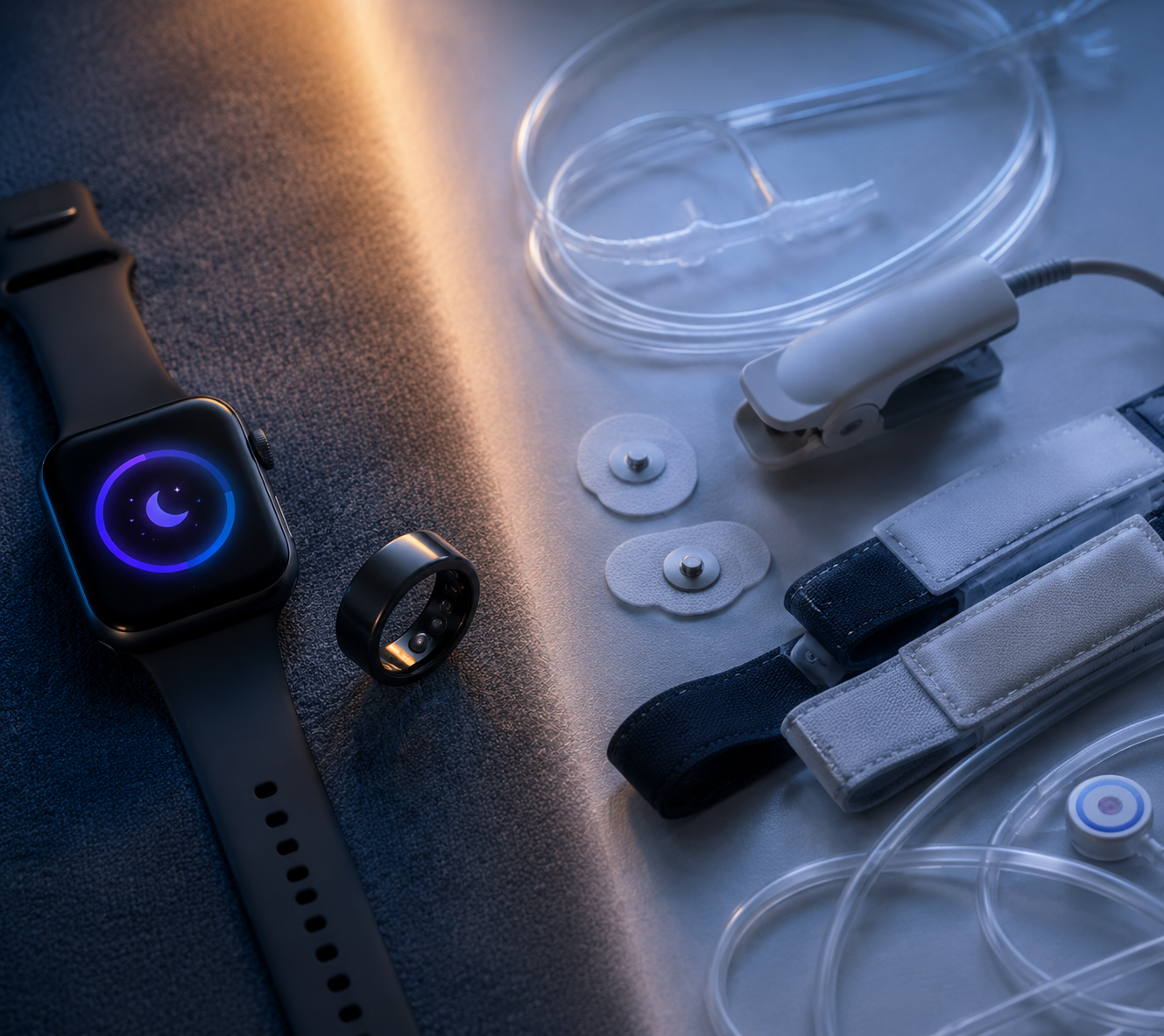
Most consumer sleep trackers infer sleep from signals they can collect comfortably every night. The common ingredients are accelerometry, which detects movement, and photoplethysmography, or PPG, which uses light to estimate pulse-related changes. Johns Hopkins Medicine describes consumer trackers as devices that estimate sleep from indirect signals such as movement and heart rate, while noting that formal sleep testing measures more physiological channels than a wearable can capture from a wrist or finger.[1]
That setup is good enough for a narrow and useful question: were you probably asleep or awake? It is much weaker for a clinical question: did your airway repeatedly narrow or close, did your oxygen level drop, and did your body work harder to breathe?
A home sleep apnea test is not just a tracker with a less attractive app. Depending on the test, it can include a nasal pressure cannula to measure airflow, a pulse oximeter to measure oxygen saturation, respiratory effort belts around the chest or abdomen, and sometimes additional channels such as EEG. Those sensors are closer to the thing being investigated. They do not merely infer that your sleep was restless; they look for breathing-related events.
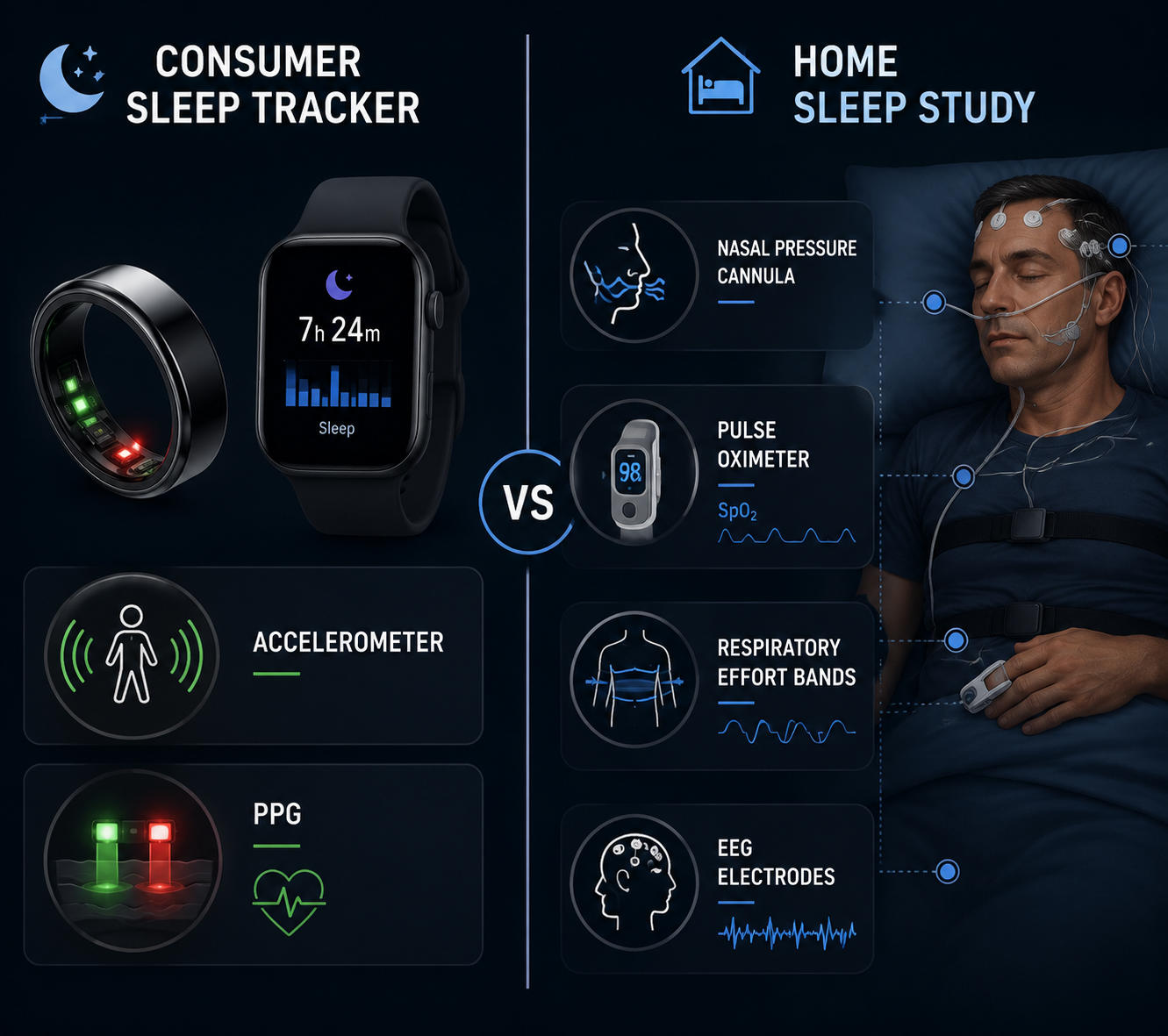
This is why a tracker can estimate that you slept seven hours and still be unable to tell you whether you stopped breathing often enough to meet criteria for sleep apnea. The missing measurements are not decorative. They are the clinical substance of the test.
| Question | Consumer sleep tracker | Home sleep apnea test |
|---|---|---|
| Did my sleep schedule drift? | Usually useful over time | Not designed for continuous lifestyle tracking |
| How much did I probably sleep? | Often reasonably useful as a trend | Can record one test night, but that is not its main purpose |
| What sleep stage was I in? | Much less reliable than sleep/wake | May include more clinical channels depending on the test |
| Did I have apneas or hypopneas? | Cannot diagnose | Designed to evaluate breathing-related sleep events |
| Can it rule out sleep apnea? | No | A clinician can interpret the result in context |
Good at sleep/wake is not the same as good at diagnosis
The better consumer trackers have become impressive at the thing they are mechanically positioned to do: estimate sleep and wake across many nights. A 2024 scoping review in npj Digital Medicine examined 35 articles and 62 wearable setups and found average sleep/wake accuracy of 87.2%. The same review found four-stage sleep classification accuracy of only 65.2%.[2]
Those two numbers should live in separate drawers in your mind. Sleep/wake accuracy asks whether the device can roughly tell asleep from awake. Sleep staging asks whether it can correctly sort sleep into categories such as light, deep, and REM. Apnea diagnosis asks for something else again: breathing events, oxygen drops, and related physiology.
A 2023 multicenter validation study of 11 sleep trackers, 75 participants, and 349,114 scored epochs found four-stage sleep classification macro F1 scores ranging from 0.26 to 0.69, with many wearables clustered around 0.49 to 0.58.[3] That study included authors affiliated with Asleep, so it should not be treated as a perfectly detached consumer report. It is still useful for the category-level lesson: stage labels from wearables are not interchangeable with clinical sleep measurement.
This is also where brand arguments can get overcooked. Oura, Apple Watch, Fitbit, and similar devices can all be studied, updated, and improved. But a better algorithm cannot create a nasal airflow signal from a wrist accelerometer. For readers who want the device-by-device weeds, a separate guide to sleep tracker accuracy evidence is the right place to linger. For the sleep-study question, the category boundary matters more than the leaderboard.
Device studies are useful, but they age quickly
A 2024 Brigham and Women’s Hospital validation study compared several consumer devices against polysomnography in 35 adults. In that study, the Oura Ring Gen3 showed no significant difference from polysomnography for 7 of 8 summary measures, including total sleep time, wake, light, deep, REM, wake after sleep onset, and sleep efficiency. At the epoch level, however, deep and REM concordance was weak, with intraclass correlation coefficients of 0.27 to 0.32.[4]
The same study found device-specific biases: Apple Watch Series 8 underestimated deep sleep by about 43 minutes and overestimated light sleep by about 45 minutes, while Fitbit Sense 2 underestimated deep sleep by about 15 minutes and overestimated light sleep by about 18 minutes.[4] The study was funded by Oura Ring Inc., and the findings apply to the tested device generations and algorithms, not every future model.
This is why a single night of “low deep sleep” on a wearable deserves less drama than most apps give it. It may reflect your night. It may reflect the device’s classification habits. It may reflect both. If the metric is guiding small habit experiments, fine. If it is making you think you have diagnosed a disorder, it has wandered out of its lane.
The nights you worry about may be the nights your tracker handles worst
There is a mean little twist in wearable sleep data: performance can drop on difficult nights. Chinoy and colleagues reported in 2021 that devices performed significantly worse on nights with lower sleep efficiency and longer sleep latency.[5] In plain English, the restless nights that send people scrolling through every graph may be exactly the nights when the estimates deserve extra skepticism.
That does not make the data worthless. If your tracker shows that your bedtime has drifted later every week, or that weekends are pushing your schedule two hours out of rhythm, the pattern may be real enough to act on. The problem starts when a shaky single-night score becomes a verdict about your health.
A practical way to read wearable sleep data is directional rather than diagnostic. Look for repeated patterns over weeks. Compare like with like. Treat unusually bad nights as prompts to notice context, not as lab results. The same logic applies to adjacent metrics such as heart-rate variability; HRV sleep data is about trends, not nightly numbers.
What a tracker cannot tell you about sleep apnea
Sleep apnea is not diagnosed from a vague sense that sleep was poor. Clinicians are looking for breathing-related events and their consequences. Consumer trackers do not measure the apnea-hypopnea index, oxygen desaturation index, respiratory effort, or airflow in the way a sleep apnea evaluation requires. Unity Health Network’s patient guidance makes the same point directly: wearable devices may raise awareness of sleep patterns, but they do not diagnose sleep apnea.[6]
The 2023 multicenter validation study also found performance drops in people with higher apnea-hypopnea index, with some devices’ macro F1 score falling by up to 0.09 in high-AHI subgroups.[3] That finding is not proof that every tracker fails every person with apnea. It is a warning about substitution: the more medically interesting the night becomes, the less comfortable we should be treating a consumer classifier as clinical evidence.
This is the part many tracker owners need stated plainly: a normal-looking sleep score does not rule out sleep apnea. A bad score does not diagnose it. A high “restlessness” number does not tell you whether you had obstructive events. A blood oxygen dip on a consumer device may be worth discussing, especially if it repeats or fits symptoms, but it is not the same as a clinician-interpreted oxygen desaturation index.
For wrist-worn device users, it can help to separate the metrics that are generally more trustworthy from the ones that are mostly educated guesses. A deeper breakdown of which sleep tracker metrics you can trust is useful, as long as the conclusion stays grounded: breathing complaints belong in a clinical pathway.
What a home sleep study actually adds
A home sleep apnea test is usually ordered or interpreted through a clinician because the result has medical consequences. It may support a diagnosis, guide treatment, or lead to more testing. It is not there to admire your sleep architecture. It is there to answer a narrower question: are there breathing abnormalities during sleep that meet clinical concern?
It also has limits. A home test is typically a single-night snapshot. It will not show you three months of bedtime drift, alcohol effects, travel disruption, or how consistently you wake at the same time. A tracker is better for that boring-but-important lifestyle feedback because it is easy to wear repeatedly.
This is the sensible division of labor: use the tracker for repeated observation; use the sleep study when the clinical question is breathing, oxygen, or a suspected disorder. Neither tool becomes better by pretending to be the other.
When your tracker is enough
A consumer tracker is enough when the question is behavioral and the consequence is a habit adjustment. It can be genuinely helpful for noticing that you go to bed later after evening work, that alcohol shortens or fragments your estimated sleep, that your wake time is inconsistent, or that your total sleep time drops during stressful weeks.
- Use it to track bedtime and wake-time consistency.
- Use it to watch total sleep time trends across weeks, not to litigate one night.
- Use it to identify schedule drift before it feels obvious.
- Use it to compare habit experiments, such as caffeine timing, alcohol, exercise, light exposure, or wind-down routines.
- Use it as a conversation starter with a clinician if the data matches symptoms.
Sleep Care Online and Dreem Health both frame consumer trackers as tools for pattern awareness and possible prompts for medical follow-up, not as replacements for diagnostic testing.[7][8] That is the sweet spot. A tracker can reduce the amount of guessing you do about your routines. It should not increase the amount of diagnosing you do alone at 2 a.m.
When the next step is a clinician, not a better score
The strongest reason to seek a sleep apnea evaluation is not a low readiness score. It is a symptom pattern. Consider talking with a clinician about a sleep study if you or someone who sleeps near you notices loud snoring, witnessed breathing pauses, gasping or choking during sleep, unexplained daytime sleepiness despite enough time in bed, morning headaches, or dry mouth on waking. Sleep Care Online lists symptoms such as snoring, breathing pauses, daytime sleepiness, morning headaches, and dry mouth as reasons a tracker user may need formal sleep testing.[7]
Risk factors also change the threshold for taking symptoms seriously. High BMI, larger neck circumference, family history, and hypertension are commonly discussed apnea risk factors in patient-facing sleep testing guidance.[7] Symptoms can also present less stereotypically in women, which is why a narrow mental picture of “the typical apnea patient” can miss people; an atypical sleep apnea symptom checklist for women may be useful if fatigue, insomnia-like complaints, mood changes, or morning symptoms do not match the classic script.
A tracker can support that conversation by showing patterns: short sleep opportunity, frequent awakenings, irregular timing, or repeated oxygen-related alerts if your device offers them. Bring the data if you have it. Just do not ask the wearable to answer a question it was not built to measure.
If the data is making sleep worse, step back
There is a real behavioral trap here. Orthosomnia, a term described in a 2017 Journal of Clinical Sleep Medicine case series, refers to sleep difficulty or anxiety driven by trying to optimize sleep tracker data. The American Academy of Sleep Medicine’s Sleep Education site reports that 48% of U.S. adults use sleep trackers and that 76% have lost sleep worrying about sleep problems.[9]
The case-series part matters: orthosomnia is a recognized clinical phenomenon, not proof that every tracker user is doomed to become anxious. Still, if checking the app changes how you feel before bed, makes you afraid of a number, or pushes you to chase perfect deep sleep, the answer is not automatically more tracking. It may be fewer metrics, less frequent checking, or a direct conversation with a clinician.
If that sounds familiar, a more focused guide to orthosomnia and sleep tracker anxiety is worth reading before you buy another device or add another dashboard.
A calm way to choose
Choose the tool based on the question you are asking.
| If your main question is... | Use... |
|---|---|
| Am I keeping a consistent sleep schedule? | A consumer sleep tracker |
| Am I giving myself enough time in bed? | A consumer sleep tracker |
| Do caffeine, alcohol, stress, or travel change my sleep pattern? | A consumer sleep tracker |
| Am I snoring loudly or having breathing pauses? | A clinician-directed sleep apnea evaluation |
| Why am I sleepy despite apparently adequate sleep? | A clinician-directed sleep evaluation |
| Can I rule out sleep apnea? | Not a consumer tracker |
The reasonable middle is not to throw away the tracker or worship it. Let it do the thing it does well: show repeated patterns in timing, duration, and habit response. If the concern is breathing, oxygen, gasping, snoring, witnessed pauses, or persistent daytime sleepiness, the next tool is not a cleaner score. It is a clinician-directed sleep study.
References
- Do Sleep Trackers Really Work?, Johns Hopkins Medicine.
- A scoping review of sleep tracking wearables in consumer and research applications, npj Digital Medicine, 2024.
- A Multicenter Validation of Sleep Tracking Devices: Sleep Stage Classification Performance, JMIR, 2023.
- A Validation of Six Wearable Devices for Estimating Sleep, Heart Rate and Heart Rate Variability in Healthy Adults, 2024.
- Performance of seven consumer sleep-tracking devices compared with polysomnography, 2021.
- Debunking Myths: Sleep Trackers, Wearable Devices, and Sleep Apnea, Unity Health Network.
- Do Sleep Trackers Indicate Need for Sleep Test?, Sleep Care Online.
- The Real Deal on Sleep Tracking: Is It Worth Your Time?, Dreem Health.
- Sleep trackers: how accurate are they?, AASM Sleep Education.
Comments
Join the discussion with an anonymous comment.