
What Does "Accuracy" Actually Mean for Sleep Trackers?
Before comparing devices, it is essential to understand how researchers measure accuracy. The gold standard for sleep staging is polysomnography (PSG), a clinical setup that records brain waves (EEG), eye movements, muscle activity, heart rhythm, and breathing in a controlled laboratory environment. Consumer devices do not measure brain activity directly — they infer sleep from proxy signals like movement and heart rate. The question is how closely those inferences match PSG.
The most common metric in validation studies is epoch-by-epoch agreement: researchers divide the night into 30-second windows (epochs), compare each epoch classified by the device against the PSG classification, and calculate agreement rates. A more nuanced metric is the macro F1 score, which averages precision and recall across all sleep stages (wake, light, deep, REM) and penalizes devices that perform well on common stages but poorly on rare ones.
A second important distinction is between sleep/wake detection and four-stage classification (wake, light, deep, REM). Most consumer devices achieve respectable sleep/wake accuracy — the Birrer review reported an average of 87.2% across 53 assessed devices. But four-stage classification is substantially harder. The same review found that average accuracy for 4-stage classification dropped to 65.2% across 9 devices. When reading marketing claims, check whether the number refers to sleep/wake detection or full sleep staging.
Sensor Technologies: What Each Can and Cannot Measure
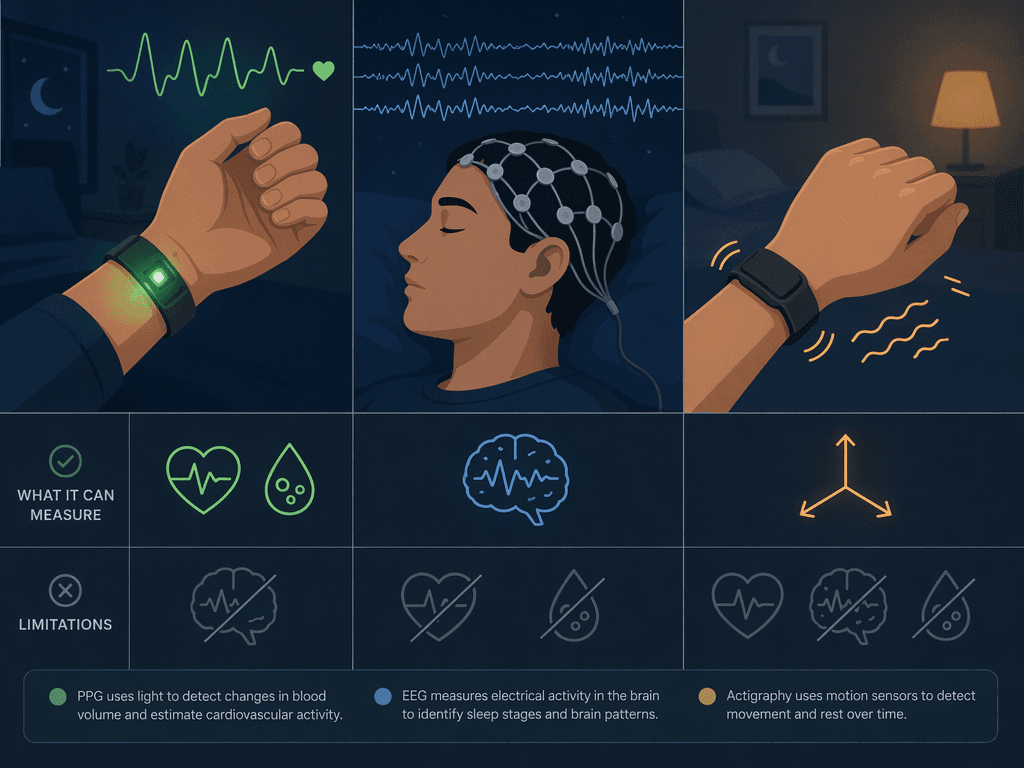
Consumer sleep monitors rely on three primary sensor technologies, each with distinct strengths and limitations. Understanding these differences is the first step in evaluating accuracy claims.
| Sensor Type | What It Measures Directly | What It Infers | Common Form Factors |
|---|---|---|---|
| Actigraphy (accelerometer) | Movement and body position | Sleep/wake state, sleep timing | Wristbands, smartwatches, rings |
| PPG (photoplethysmography) | Blood volume pulse (heart rate, HRV) | Sleep stages, sleep depth, respiratory rate | Smartwatches, rings, some headbands |
| EEG (electroencephalography) | Brain wave activity | Sleep stages directly (NREM, REM) | Headbands, some in-ear devices |
| Ballistocardiography (BCG) | Vibrations from heartbeat and breathing | Heart rate, respiratory rate, movement, sleep/wake | Under-mattress sensors, smart beds |
| Microphone / sonar | Sound, breathing patterns | Snoring, respiratory rate, movement | Phone apps, bedside devices |
PPG-based devices (the majority of smartwatches and rings) use green or red LEDs to detect blood volume changes under the skin. From this signal, they calculate heart rate and heart rate variability, then apply algorithms to estimate sleep stages. These algorithms are proprietary and vary significantly between manufacturers. EEG-based devices, by contrast, measure electrical activity from the cortex directly, which is the same signal PSG uses to define sleep stages. This gives EEG headbands a theoretical advantage for sleep stage precision, though practical accuracy depends on electrode placement, signal processing, and algorithm quality.
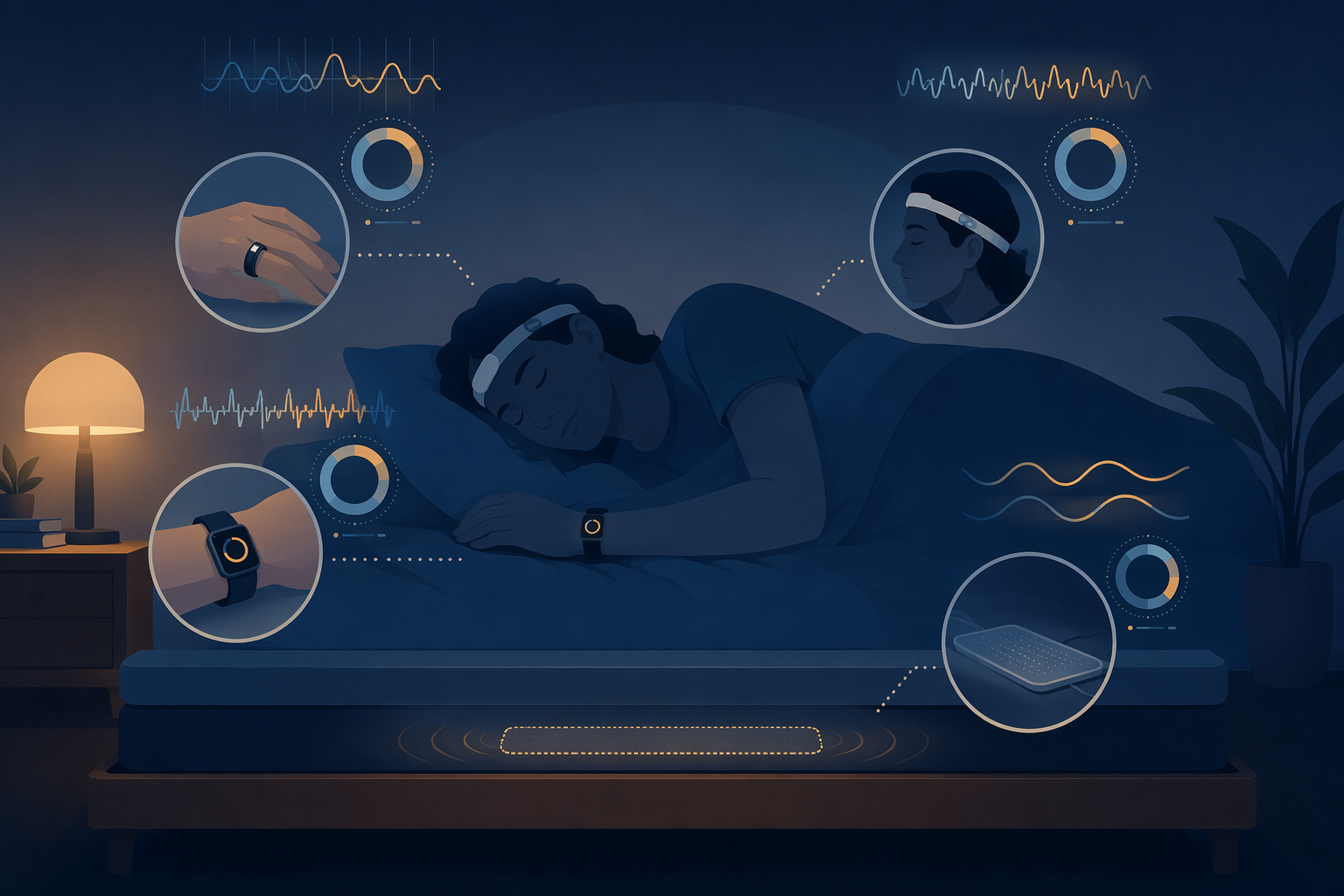
Nearables — devices placed under the mattress or on the nightstand — use ballistocardiography or sonar to detect movement and breathing patterns. They require no charging or wearing, which makes them attractive for long-term trend tracking, but they capture far less physiological data than on-body sensors. Airables (phone apps) use the phone's microphone and accelerometer to estimate sleep from sound and movement. Their accuracy is limited by phone placement, background noise, and the fact that the phone is not on the body.
Head-to-Head Accuracy Data from Major Validation Studies
The most comprehensive head-to-head comparison of consumer sleep monitors to date is the 2023 multicenter validation study published in JMIR by Lee et al. The study enrolled 75 participants across two Korean institutions, collected 3890 hours of consumer sleep tracker data and 543 hours of polysomnography, and performed epoch-by-epoch analysis on 349,114 epochs. Eleven devices were tested across three categories: wearables, nearables, and airables.
| Device | Category | Macro F1 Score | Deep Sleep F1 | Wake F1 | REM F1 |
|---|---|---|---|---|---|
| SleepRoutine (app) | Airable | 0.69 | 0.59 | 0.71 | 0.76 |
| Amazon Halo Rise | Nearable | 0.62 | 0.51 | 0.62 | 0.67 |
| Fitbit Sense 2 | Wearable | 0.58 | 0.56 | 0.57 | 0.62 |
| Galaxy Watch 5 | Wearable | 0.58 | 0.52 | 0.56 | 0.63 |
| Google Pixel Watch | Wearable | 0.57 | 0.59 | 0.56 | 0.57 |
| Oura Ring 3 | Wearable | 0.52 | 0.48 | 0.50 | 0.57 |
| Apple Watch 8 | Wearable | 0.49 | 0.46 | 0.49 | 0.53 |
| Withings Sleep Tracking Mat | Nearable | 0.45 | 0.40 | 0.44 | 0.50 |
| SleepScore (app) | Airable | 0.40 | 0.36 | 0.40 | 0.45 |
| Google Nest Hub 2 | Nearable | 0.30 | 0.27 | 0.30 | 0.33 |
| Pillow (app) | Airable | 0.26 | 0.23 | 0.26 | 0.29 |
The Birrer et al. 2024 scoping review provides broader context. Across 35 studies and 62 wearable setups, PPG+accelerometer devices averaged approximately 75% sleep stage agreement with PSG. The best reported accuracy for 4-stage classification was 79%, achieved using a machine learning model that combined PPG, accelerometer, and temperature features. This suggests that algorithmic improvements — not just sensor hardware — are a major driver of accuracy differences between devices.
Performance by Device Category: Wearables, Nearables, Airables, and EEG Headbands
The validation data reveals clear performance tiers by form factor. Understanding these tiers helps readers calibrate expectations before choosing a device category.
Wearables (Smartwatches and Rings)
Wearables are the most studied category and generally achieve macro F1 scores between 0.49 and 0.58 for four-stage classification. The American Academy of Sleep Medicine (AASM) notes in a September 2025 comparison that smartwatches "overestimate total sleep time and underestimate wake after sleep onset" due to high sensitivity for sleep but lower specificity for wake. This is a particular concern for people with insomnia, who may lie still while awake and have that time misclassified as light sleep.
Within the wearable category, the Google Pixel Watch and Fitbit Sense 2 led for deep sleep detection (F1 of 0.59 and 0.56 respectively) in the Lee et al. study. The Oura Ring 3 showed no proportional bias in sleep efficiency measurement — meaning it did not systematically over- or under-estimate sleep efficiency across different sleep quality levels — but its overall macro F1 of 0.52 was mid-pack. The Apple Watch 8 scored lowest among tested wearables at 0.49.
Nearables (Under-Mattress Sensors and Bedside Devices)
Nearables offer the convenience of zero wearable commitment, but their accuracy is substantially lower. The Amazon Halo Rise was the top performer in this category with a macro F1 of 0.62 — competitive with some wearables. However, the Withings Sleep Tracking Mat scored 0.45, and the Google Nest Hub 2 scored just 0.30. The wide range within this category reflects differences in sensor technology: the Halo Rise uses a low-power radar sensor, while the Nest Hub 2 uses Soli radar primarily designed for gesture detection, not sleep monitoring.
CNET notes that wearable trackers are generally more accurate than bed trackers, and that finger or wrist devices outperform under-mattress sensors. This is consistent with the validation data: nearables cannot capture heart rate variability or blood volume changes with the same fidelity as on-body PPG sensors.
Airables (Phone Apps)
Phone-based sleep tracking apps showed the widest performance range in the Lee et al. study. SleepRoutine, which uses the phone's microphone to analyze breathing sounds, achieved the highest macro F1 of any device tested at 0.69. SleepScore scored 0.40, and Pillow scored 0.26. The dramatic gap between SleepRoutine and other apps suggests that algorithm quality — and the specific acoustic features being analyzed — matters far more than the general approach of using a phone microphone.
EEG Headbands
EEG headbands were not included in the Lee et al. 2023 study, but they represent a distinct category with a different accuracy profile. The Muse S Athena, which combines EEG with fNIRS (functional near-infrared spectroscopy), claims 88-96% PSG-validated sleep stage accuracy based on a manufacturer-published peer-reviewed study. If independently replicated, this would substantially outperform all PPG-based wearables and nearables.
The theoretical advantage of EEG is clear: it measures brain activity directly, the same signal PSG uses to define sleep stages. PPG-based devices must infer brain state from heart rate and movement, which is an inherently lossy transformation. However, practical EEG headband accuracy depends on electrode contact quality, signal processing algorithms, and the ability to distinguish EEG from muscle and movement artifacts during sleep. These engineering challenges mean that not all EEG headbands achieve the same accuracy.
Key Findings: What the Research Actually Shows
Several important patterns emerge from the combined validation data that can guide purchasing decisions.
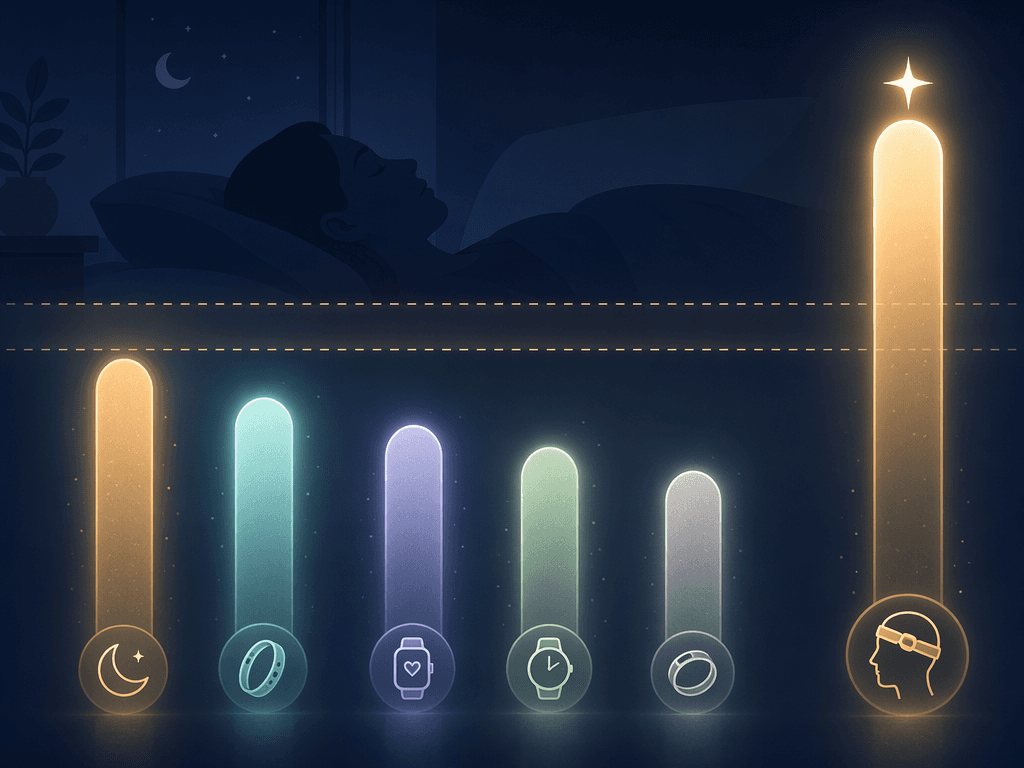
- No consumer device matches PSG for clinical-grade sleep staging. Even the best-performing devices in the Lee et al. study (SleepRoutine at 0.69 macro F1) misclassify roughly 30% of epochs. The Birrer et al. review confirms that average 4-stage classification accuracy across PPG+accelerometer devices is approximately 75%, with the best reported system reaching 79%.
- SleepRoutine (airable) led all tested devices with a macro F1 of 0.69, but the study was funded by its manufacturer. Independent replication is needed.
- Amazon Halo Rise (nearable) scored 0.62, making it the best non-wearable option in the study and competitive with mid-range wearables.
- Google Pixel Watch and Fitbit Sense 2 led wearables for deep sleep detection (F1 of 0.59 and 0.56), which matters for readers specifically interested in tracking slow-wave sleep.
- Oura Ring 3 showed no proportional bias in sleep efficiency measurement — a positive signal for trend tracking — but its overall macro F1 of 0.52 was below several wrist-worn competitors.
- WHOOP 3.0 validation from a 2021 study showed 64% stage agreement with PSG. Note that WHOOP's frequently cited 99.7% heart rate accuracy during sleep (from a Central Queensland University study) measures HR accuracy, not sleep stage accuracy — a common conflation in marketing and media coverage.
- Muse S Athena claims 88-96% PSG alignment, which would be a step change in accuracy, but the claim comes from a manufacturer-linked study and has not been independently replicated.
Practical Recommendations: Matching Devices to Reader Priorities
Rather than declaring a single "best" device, the evidence supports matching devices to specific reader priorities. The table below organizes options by primary use case, with accuracy data and cost considerations.
| Priority | Recommended Category | Top Performer (by evidence) | Key Tradeoff | Subscription Cost |
|---|---|---|---|---|
| Maximum sleep stage precision | EEG headband | Muse S Athena (88-96% claim, unverified independently) | Requires nightly headwear; accuracy claim not independently replicated | No subscription ($380 device) |
| Best validated wearable accuracy | Smartwatch | Google Pixel Watch or Fitbit Sense 2 (F1 0.57-0.58) | Must wear on wrist; battery life 1-2 days | No subscription (Pixel Watch $350, Fitbit $300) |
| Comfort + trend tracking | Ring | Oura Ring 3 (F1 0.52, no proportional bias) | Lower stage accuracy than top watches; subscription required | $70/year (ring $349-499) |
| No wearable commitment | Nearable | Amazon Halo Rise (F1 0.62) | Lower accuracy than wearables; limited metrics | No subscription (discontinued, check availability) |
| Budget-conscious tracking | Airable (phone app) | SleepRoutine (F1 0.69) | Requires phone in bedroom; study funded by manufacturer | Free or low-cost subscription |
| Fitness + sleep integration | Fitness band | Whoop 5.0 (64% stage agreement from 2021 study) | Subscription cost is high; HR accuracy ≠ sleep stage accuracy | $199-359/year |
| No subscription, full features | Smartwatch (Samsung) | Galaxy Watch 5 (F1 0.58) | Best performance among no-subscription wearables | No subscription ($300-400) |
For readers who want the best available sleep stage precision and are willing to wear a headband, the EEG category is the most promising direction — but independent validation is urgently needed. For readers who prioritize comfort and long-term trend tracking without wrist wear, a ring like the Oura Ring 4 (the current generation, which builds on the Ring 3's algorithm) offers a reasonable balance, though its stage accuracy is lower than top smartwatches. For readers who want fitness integration alongside sleep tracking, the Google Pixel Watch and Fitbit Sense 2 offer the best validated sleep accuracy among multi-purpose wearables.
For deeper dives into specific devices, see our detailed reviews: Oura Ring accuracy analysis, Apple Watch sleep tracking review, Fitbit sleep tracking review, and our wrist-worn comparison for a narrower focus on watches and bands.
Limitations and Caveats
The data presented here comes from specific studies with important limitations that readers should consider before making a purchase decision.
- The Lee et al. 2023 study, while the largest head-to-head comparison to date, was funded by Asleep (maker of SleepRoutine) and conducted on a Korean population. Generalizability to other demographics and sleep patterns is unknown.
- Muse S Athena's 88-96% PSG accuracy claim comes from a manufacturer-published peer-reviewed study with commercial ties. Independent replication by researchers without financial conflicts has not been published.
- WHOOP's frequently cited 99.7% heart rate accuracy during sleep measures HR accuracy, not sleep stage accuracy. These are fundamentally different metrics, and conflating them overstates the device's sleep tracking capability.
- Product generations change rapidly. The Oura Ring 4 and Whoop 5.0 are now on the market, and their algorithms may differ from the Ring 3 and Whoop 3.0 tested in the studies cited here. Validation studies often lag device releases by 1-2 years.
- Consumer sleep trackers are not medical devices. They cannot diagnose sleep disorders such as sleep apnea, narcolepsy, or periodic limb movement disorder. If you suspect a clinical sleep condition, a formal sleep study (PSG or home sleep apnea test) is necessary.
- The orthosomnia phenomenon — a perfectionistic preoccupation with achieving ideal sleep data — was documented in a 2017 JCSM study. For some users, particularly those with anxiety or insomnia, focusing on sleep scores can paradoxically worsen sleep quality.
For readers specifically interested in under-mattress tracking, see our Sleep Number smart bed accuracy analysis for a detailed look at ballistocardiography-based tracking. For readers with insomnia who are concerned about sleep tracker data making their sleep worse, our article on Garmin sleep tracking and insomnia discusses when tracking data helps versus harms.


Comments
Join the discussion with an anonymous comment.