
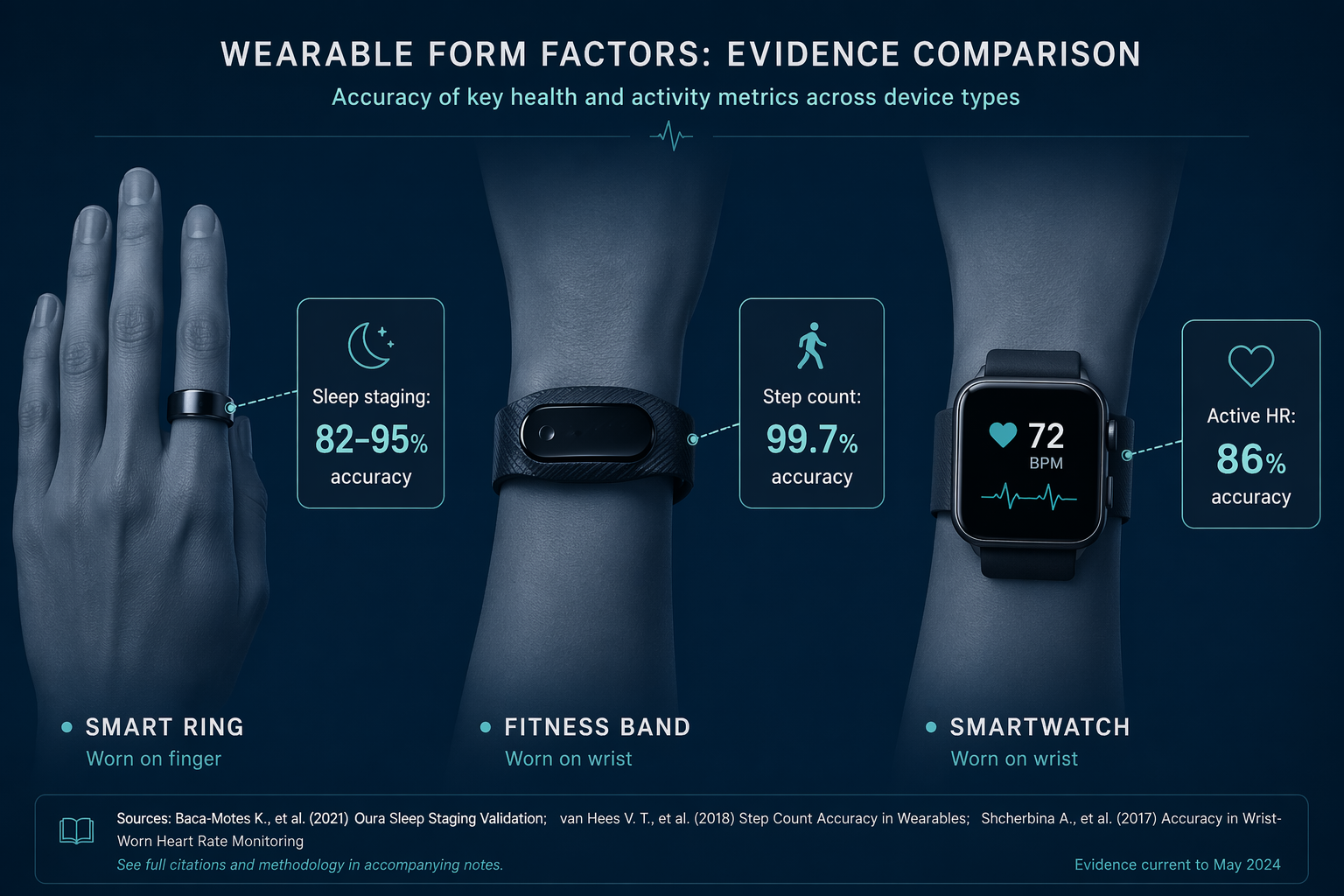
Why the combined sleep + fitness tracker category is harder than reviewers admit
Most review sites publish a single "best overall" winner for sleep and fitness tracking. That approach actively misleads buyers because no device leads across all metrics. The device that captures the most accurate nocturnal heart rate variability (HRV) data is not the same one that records the most precise step count. The tracker with the best deep sleep detection sensitivity often underperforms during a high-intensity interval workout.
This article does not crown a single champion. Instead, it presents metric-specific accuracy data from peer-reviewed studies, explicitly discloses study funding sources, and provides a decision matrix that maps your top 2–3 priorities to the right device. If you care most about sleep staging accuracy, you will end up with a different recommendation than if your primary concern is active heart rate fidelity during runs.
For readers who want a deep dive on sleep-only metrics before reading the integrated analysis, see our evidence-based comparison of fitness trackers for sleep accuracy using PSG validation data. The rest of this guide adds the fitness dimension — active heart rate, step count, and SpO2 — alongside sleep metrics in a single integrated comparison.
Accuracy by metric: what the peer-reviewed studies actually show
The table below compiles metric-specific accuracy data from multiple studies. Because no single study tested all devices head-to-head, the data is stitched together from independent and industry-funded research. Each device generation tested is noted, and funding sources are flagged.
| Metric | Oura Ring (Gen3/4) | Apple Watch (Series 8/9/10) | Whoop (4.0/5.0) | Fitbit Inspire 3 | Garmin (Fenix 6 / Forerunner 165) |
|---|---|---|---|---|---|
| Sleep staging (kappa vs PSG) | κ=0.65 (substantial, Brigham study, Oura-funded); κ=0.35 (fair, Korean multicenter, independent) | κ=0.53 (Antwerp study, independent); κ=0.30 (Korean study) | κ=0.45–0.50 (Antwerp study, independent) | κ=0.42 (Korean study, independent) | Not tested in primary sleep staging studies |
| Deep sleep detection (sensitivity) | ~60% (Brigham study) | ~55% (Antwerp study) | 69.6% (Antwerp study, independent) | ~50% (Korean study) | Not tested |
| REM detection (sensitivity) | ~65% (Brigham study) | 68.6% (Antwerp study, independent) | ~60% (Antwerp study) | ~55% (Korean study) | Not tested |
| Nocturnal HRV (CCC vs ECG) | CCC 0.99 (Gen4, Dial et al. 2025, independent, 536 nights) | CCC ~0.90 (multiple studies) | CCC ~0.85 (independent studies) | Not validated for HRV | CCC ~0.80 (independent studies) |
| Active heart rate accuracy | Not designed for active HR; ~70–75% during exercise | 86.3% (Antwerp study, independent) | ~80% (independent studies) | ~78% (independent studies) | 82.6% (independent studies) |
| Step count accuracy (error rate) | ~5–8% error (independent tests) | ~3–5% error (independent tests) | Not designed for step counting; ~10–15% error | 0.32% error (Wirecutter, 2-day test) | ~2–4% error (independent tests) |
| SpO2 accuracy (MAE) | MAE ~3% (independent studies) | MAE 2.2% (Antwerp study, independent) | MAE ~3.5% (independent studies) | Not validated for SpO2 | MAE ~3% (independent studies) |
Several patterns emerge from the data. Oura Ring 4 leads for nocturnal HRV accuracy — its CCC of 0.99 against a Polar H10 ECG reference in a 536-night independent study is the highest among consumer wearables. However, its sleep staging performance varies dramatically depending on which study you read. Apple Watch leads for active heart rate (86.3% accuracy) and REM detection (68.6% sensitivity) in independent testing. Whoop 4.0 shows the best deep sleep detection sensitivity at 69.6%. Fitbit Inspire 3 is the most accurate step counter, with only 0.32% error over two days in Wirecutter testing.
For detailed analysis of Oura's accuracy across multiple validation studies, see our data-driven analysis of Oura Ring sleep tracking accuracy.
The fitness dimension: why sleep leaders often underperform on active metrics
The design tradeoffs between sleep-optimized and fitness-optimized wearables are not accidental. Rings like the Oura are engineered for nocturnal data collection — their form factor maximizes skin contact during sleep and minimizes disturbance. But that same design makes them poor at capturing accurate heart rate during movement. The Oura Ring's active heart rate accuracy hovers around 70–75%, far below the 86.3% achieved by the Apple Watch in the same independent Antwerp study.
Conversely, wrist-based devices that excel at active heart rate monitoring — like the Apple Watch and Garmin Forerunner series — are often bulkier and less comfortable for sleep. The Apple Watch Series 11 overestimated light sleep by 45 minutes and underestimated deep sleep by 43 minutes in the Brigham study (p<0.001), a significant distortion that may mislead users about their sleep quality.
| Device | Sleep staging accuracy (kappa) | Active HR accuracy | Step count error | Best use case |
|---|---|---|---|---|
| Oura Ring 4 | κ=0.35–0.65 (study-dependent) | ~70–75% | ~5–8% | Sleep-focused users who prioritize HRV and sleep staging |
| Apple Watch Series 11 | κ=0.30–0.53 (study-dependent) | 86.3% | ~3–5% | Fitness-focused users who also want sleep tracking |
| Whoop 5.0 | κ=0.45–0.50 | ~80% | ~10–15% | Athletes focused on recovery and deep sleep |
| Fitbit Inspire 3 | κ=0.42 | ~78% | 0.32% | Budget-conscious users who want accurate step counts |
| Garmin Forerunner 165 | Not tested in primary sleep studies | 82.6% | ~2–4% | Runners and outdoor athletes who want no subscription |
The practical implication is clear: if you run or cycle regularly and want accurate heart rate data during workouts, a wrist-based device like the Apple Watch or Garmin Forerunner is the better choice, even if its sleep staging accuracy is lower. If your primary concern is understanding your overnight recovery and sleep architecture, the Oura Ring or Whoop band will serve you better — but you will sacrifice workout heart rate precision.
Form factor tradeoffs: ring vs band vs watch for sleep comfort and fitness utility
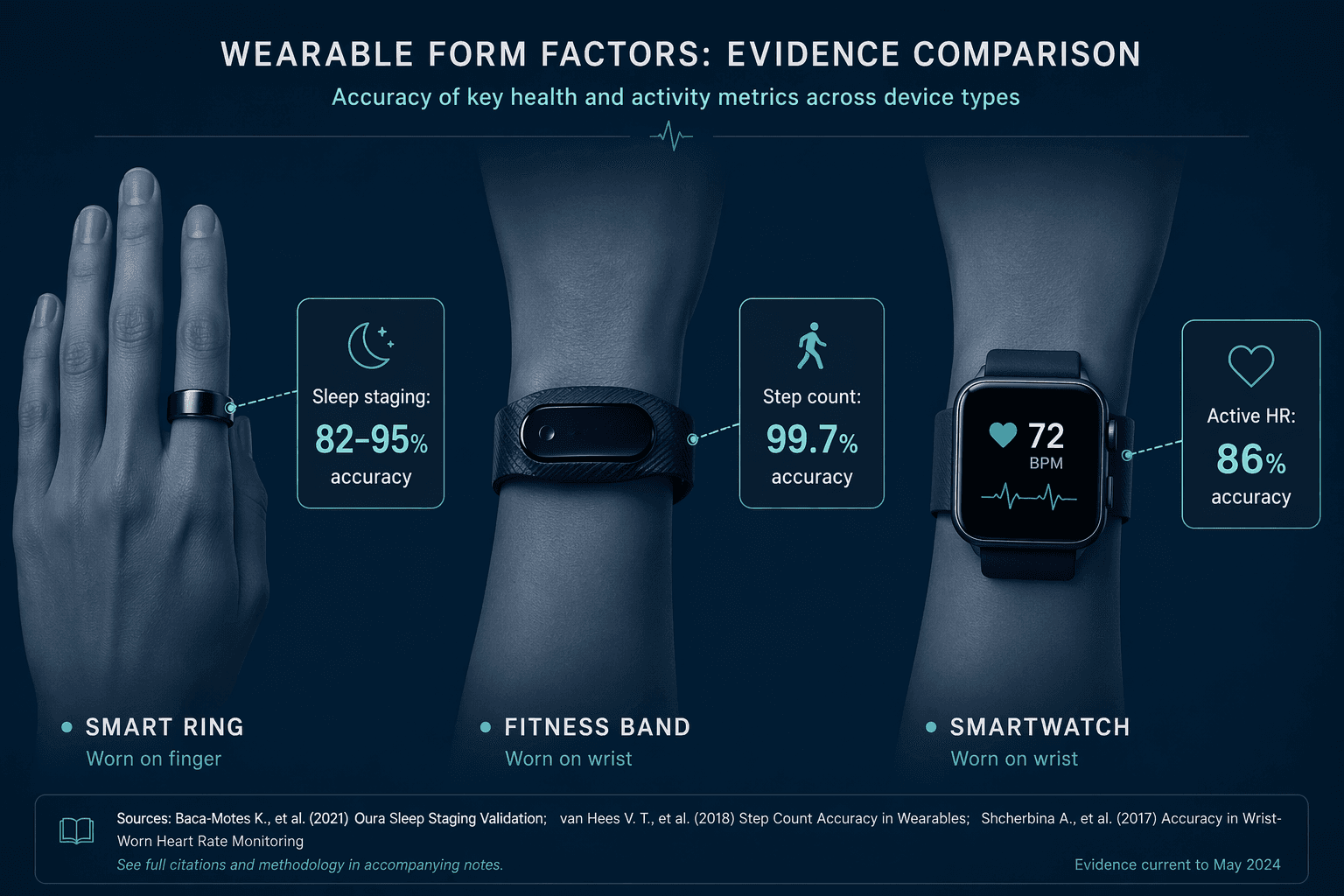
Form factor is not just about aesthetics — it directly affects data quality and wearability. The table below summarizes the key tradeoffs across the three main form factors, anchored by the accuracy data from the previous sections.
| Dimension | Ring (Oura Ring 4) | Band (Whoop 5.0 / Fitbit Inspire 3) | Watch (Apple Watch / Garmin) |
|---|---|---|---|
| Sleep comfort | Excellent — unobtrusive, no wrist bulk | Good — lightweight but may feel scratchy (Whoop fabric noted in Consumer Reports) | Fair — bulkier, may disturb sleep for side sleepers |
| Screen utility for workouts | None — no display | Limited — basic display on Fitbit; no screen on Whoop | Excellent — real-time pace, HR zones, GPS maps |
| Data comprehensiveness | Strong on sleep metrics, weak on active HR and step count | Moderate — Whoop strong on recovery; Fitbit strong on steps | Strong across both domains, but sleep staging less accurate than rings |
| All-day wearability | Good — easy to forget, but may interfere with weightlifting | Good — lightweight, but band may irritate skin | Fair — heavier, may be removed during sleep |
| Best accuracy strength | Nocturnal HRV (CCC 0.99) and sleep staging (κ up to 0.65) | Deep sleep detection (Whoop 69.6% sensitivity); step count (Fitbit 0.32% error) | Active HR (86.3%) and SpO2 (MAE 2.2%) |
For readers who want a deeper look at Whoop's screenless design and its implications for sleep tracking, see our WHOOP Band sleep tracking review.
Subscription cost analysis: one-time vs recurring pricing across devices
The total cost of ownership over 2–3 years varies dramatically across devices, and subscription fees can exceed the upfront hardware cost. The table below compares upfront prices and ongoing subscription requirements for the devices discussed in this guide.
| Device | Upfront cost | Subscription required? | Annual subscription cost | Total cost over 3 years |
|---|---|---|---|---|
| Oura Ring 4 | $349 | Yes | $72 ($6/month) | $565 |
| Whoop 5.0 | $0 (hardware included with subscription) | Yes | $199–$359 (depending on plan) | $597–$1,077 |
| Apple Watch Series 11 | $399 | No | $0 | $399 |
| Fitbit Inspire 3 | $100 | No (basic features); Premium available at $10/month | $0 (basic) or $120 (Premium) | $100 (basic) or $460 (Premium) |
| Garmin Forerunner 165 | $249 | No | $0 | $249 |
The cost analysis reveals a clear pattern: devices that require subscriptions (Oura, Whoop) often provide deeper sleep and recovery analytics, but their total cost over three years can exceed that of a premium smartwatch like the Apple Watch Series 11. The Garmin Forerunner 165 offers the lowest total cost of ownership among devices with strong fitness tracking capabilities, though its sleep staging accuracy has not been validated in the same studies as Oura or Apple Watch.
Decision matrix: match your top priorities to the right device
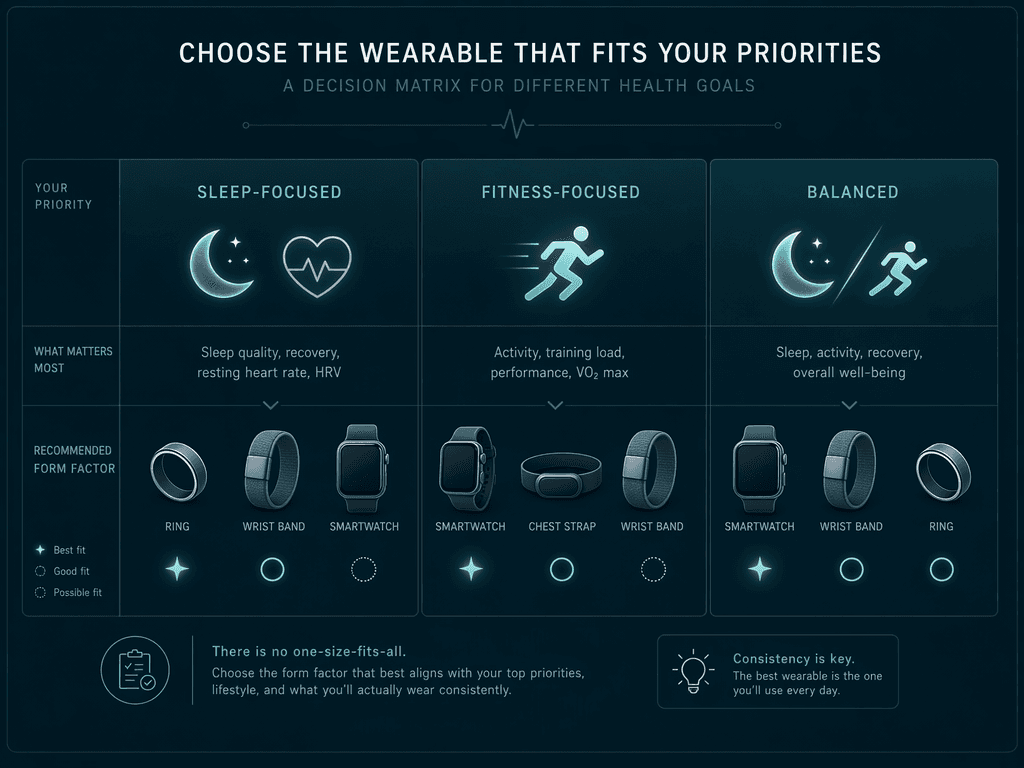
The following decision matrix maps common reader priorities to the devices that best fit each profile. This is the organizing framework that differentiates this guide from sleep-only comparisons — it explicitly includes fitness metrics and subscription costs alongside sleep accuracy.
| Your priority | Best device | Why | Key tradeoff |
|---|---|---|---|
| Sleep-focused (HRV, sleep staging, deep sleep) | Oura Ring 4 or Whoop 5.0 | Oura leads nocturnal HRV (CCC 0.99); Whoop leads deep sleep detection (69.6% sensitivity) | Weak active HR and step count accuracy; subscription required |
| Fitness-focused (active HR, step count, SpO2) | Apple Watch Series 11 or Garmin Forerunner 165 | Apple Watch leads active HR (86.3%) and SpO2 (MAE 2.2%); Garmin leads step count (82.6%) | Lower sleep staging accuracy; bulkier form factor |
| Balanced (sleep + fitness, no subscription) | Apple Watch Series 11 | Best all-around accuracy across both domains; no subscription required | Sleep staging less accurate than Oura; higher upfront cost than Fitbit |
| Budget-conscious | Fitbit Inspire 3 | Lowest upfront cost ($100); best step count accuracy (0.32% error) | No HRV or SpO2 validation; basic sleep staging accuracy |
| Subscription-averse | Garmin Forerunner 165 or Apple Watch Series 11 | No subscription required; strong fitness tracking; decent sleep tracking | Garmin lacks validated sleep staging data; Apple Watch bulkier for sleep |
| Athlete focused on recovery | Whoop 5.0 | Best deep sleep detection; strain and recovery scores; no screen distraction | Subscription cost over 3 years can exceed $1,000; weak step count accuracy |
For readers who want to understand how Fitbit calculates its sleep score and how to interpret it, see our guide to the Fitbit Sleep Score.
Summary: what to do next based on your top 2–3 metrics
The core takeaway is simple: choose based on your top 2–3 metrics, not brand rankings. No device leads across all sleep and fitness metrics, and every "best overall" ranking hides tradeoffs that may matter more to you than to the reviewer.
| Device | Best for | Sleep staging (kappa) | Active HR accuracy | Step count error | Subscription cost (3 years) |
|---|---|---|---|---|---|
| Oura Ring 4 | Sleep-focused users | κ=0.35–0.65 | ~70–75% | ~5–8% | $565 |
| Apple Watch Series 11 | Fitness-focused or balanced users | κ=0.30–0.53 | 86.3% | ~3–5% | $399 (no subscription) |
| Whoop 5.0 | Athletes focused on recovery | κ=0.45–0.50 | ~80% | ~10–15% | $597–$1,077 |
| Fitbit Inspire 3 | Budget-conscious users | κ=0.42 | ~78% | 0.32% | $100 (basic) |
| Garmin Forerunner 165 | Runners and subscription-averse users | Not validated | 82.6% | ~2–4% | $249 (no subscription) |
If you are still unsure, start by identifying your top two metrics. Write them down. Then check the decision matrix to see which device appears for your combination. If you prioritize sleep staging and nocturnal HRV, the Oura Ring 4 is the clear choice despite its subscription cost. If you prioritize active heart rate and step count accuracy, the Apple Watch Series 11 or Garmin Forerunner 165 will serve you better. If you want the best deep sleep detection and are willing to pay a subscription, Whoop 5.0 is the leader.
For deeper dives on specific devices, see our Oura Ring accuracy analysis, WHOOP Band review, and Fitbit Sleep Score guide.


Comments
Join the discussion with an anonymous comment.