
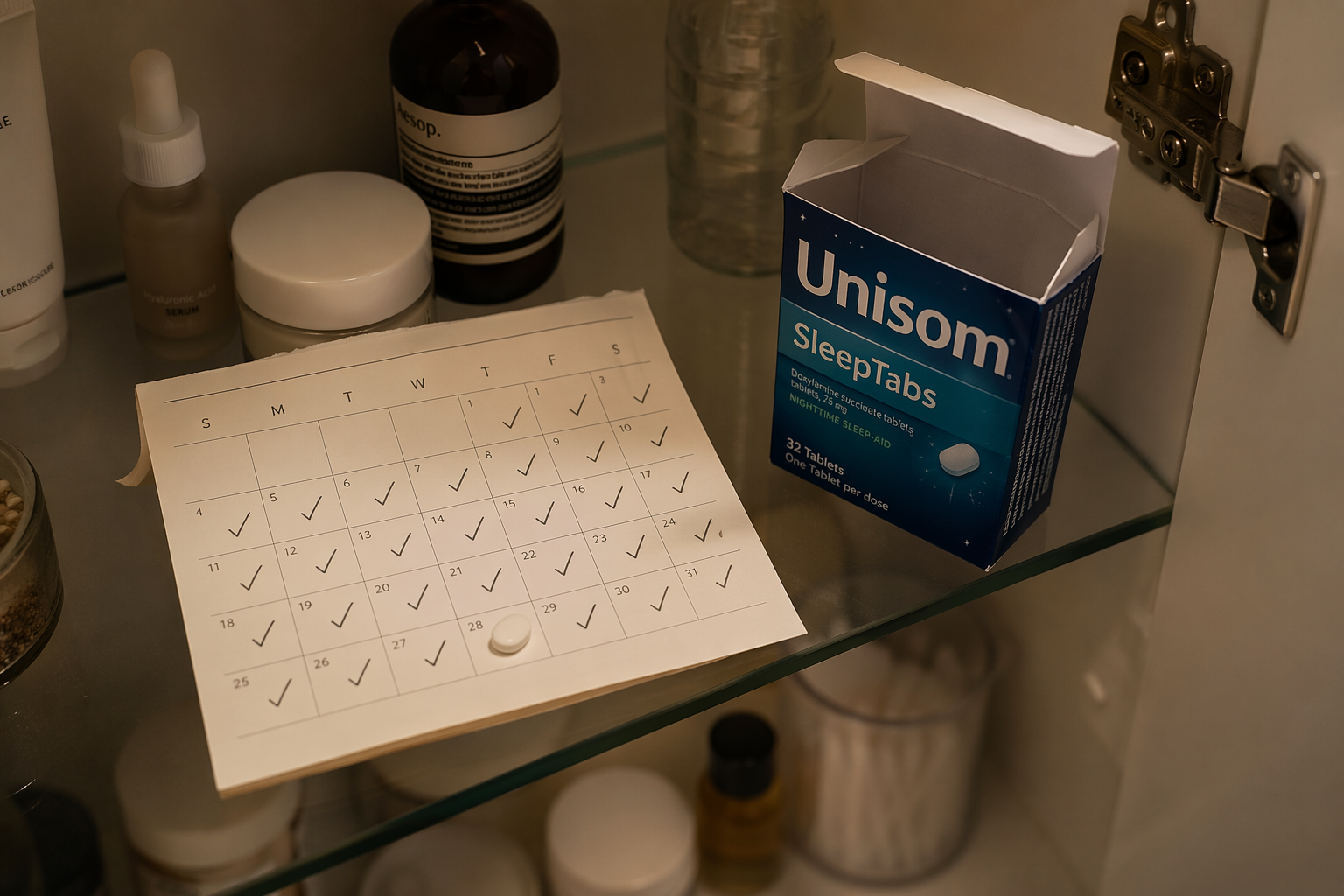
If Unisom SleepTabs have moved from “bad-night backup” to “I take one most nights,” the answer is no: that is not the use the label recommends. The DailyMed label for Unisom SleepTabs tells users to stop and ask a doctor if “sleeplessness persists continuously for more than two weeks,” adding that insomnia may be a symptom of a serious underlying medical illness.[1]
That warning is easy to miss because the box sits in the same bathroom cabinet as toothpaste, allergy tablets, and pain relievers. But it is the important dividing line. Taking Unisom SleepTabs for an occasional short stretch is different from needing doxylamine every night to sleep.
What Unisom SleepTabs are actually doing
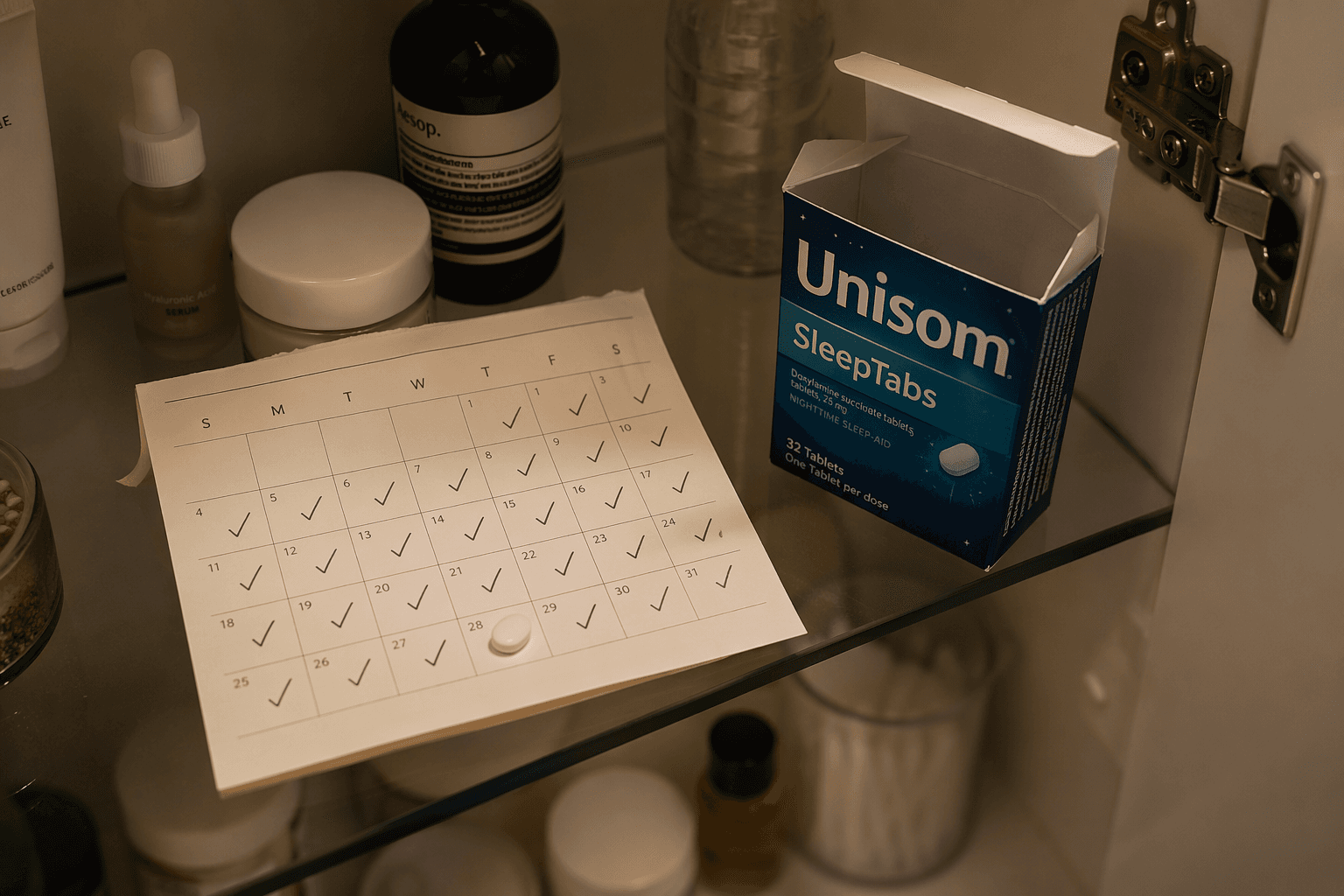
Unisom SleepTabs contain doxylamine succinate 25 mg, a first-generation antihistamine used as an over-the-counter nighttime sleep aid.[1] It is not melatonin, an herbal product, or a general “relaxation” supplement. It is a sedating drug with a regulated OTC label.
For a fuller ingredient background, see this doxylamine sleep aid guide. If you are comparing doxylamine with diphenhydramine, melatonin, valerian, or other sleep products, this OTC sleep medicine ingredients guide is the better place for that shopping-level comparison. The point here is narrower: what happens when Unisom SleepTabs become a nightly routine.
Doxylamine works largely by blocking H1 histamine receptors. Histamine helps promote wakefulness, so blocking that signal can make a person sleepy. That is why the medication can feel very effective on the night it works.
But the same mechanism helps explain why nightly use becomes a poor bargain. Repeated dosing can lead to pharmacodynamic tolerance as H1 receptors desensitize, with tolerance developing within about 3 to 7 days.[2] In plain terms: the body can start adapting to the sedating signal faster than many people expect.
The two-week label limit is not just legal caution
The label’s two-week warning is doing several jobs at once. It recognizes that OTC sleep aids are intended for occasional sleeplessness, that tolerance can develop quickly, and that ongoing insomnia may be a symptom rather than the whole problem.[1][2]
Short-term evidence also should not be stretched into a long-term promise. A 2022 network meta-analysis in The Lancet found doxylamine superior to placebo at 4 weeks, with a standardized mean difference of 0.47 and a 95% confidence interval of 0.06 to 0.89, rated as moderate-certainty evidence; the same research did not provide longer-term trial evidence for doxylamine beyond that time frame.[3]
So the fair reading is limited: doxylamine can help some people sleep in the short term. That does not answer whether it is a good nightly medication for months, and it does not erase the label instruction to stop and seek medical advice when sleeplessness continues.
Tolerance can make the pill look necessary
The difficult part is that tolerance does not announce itself politely. A person may simply notice that one tablet no longer feels as strong, that sleep is lighter, or that the same dose now leaves them awake again at 2 a.m. The tempting conclusion is that the insomnia has become more powerful. Sometimes that may be true. But another possibility is that the sedating effect has weakened because the body has adapted.
That is where dose escalation can enter. The person is not necessarily chasing a high or misusing medication in the way people often imagine. They may be trying to get back to the first few nights when the tablet worked reliably. Still, increasing the dose to overcome tolerance also increases exposure to doxylamine’s anticholinergic effects.
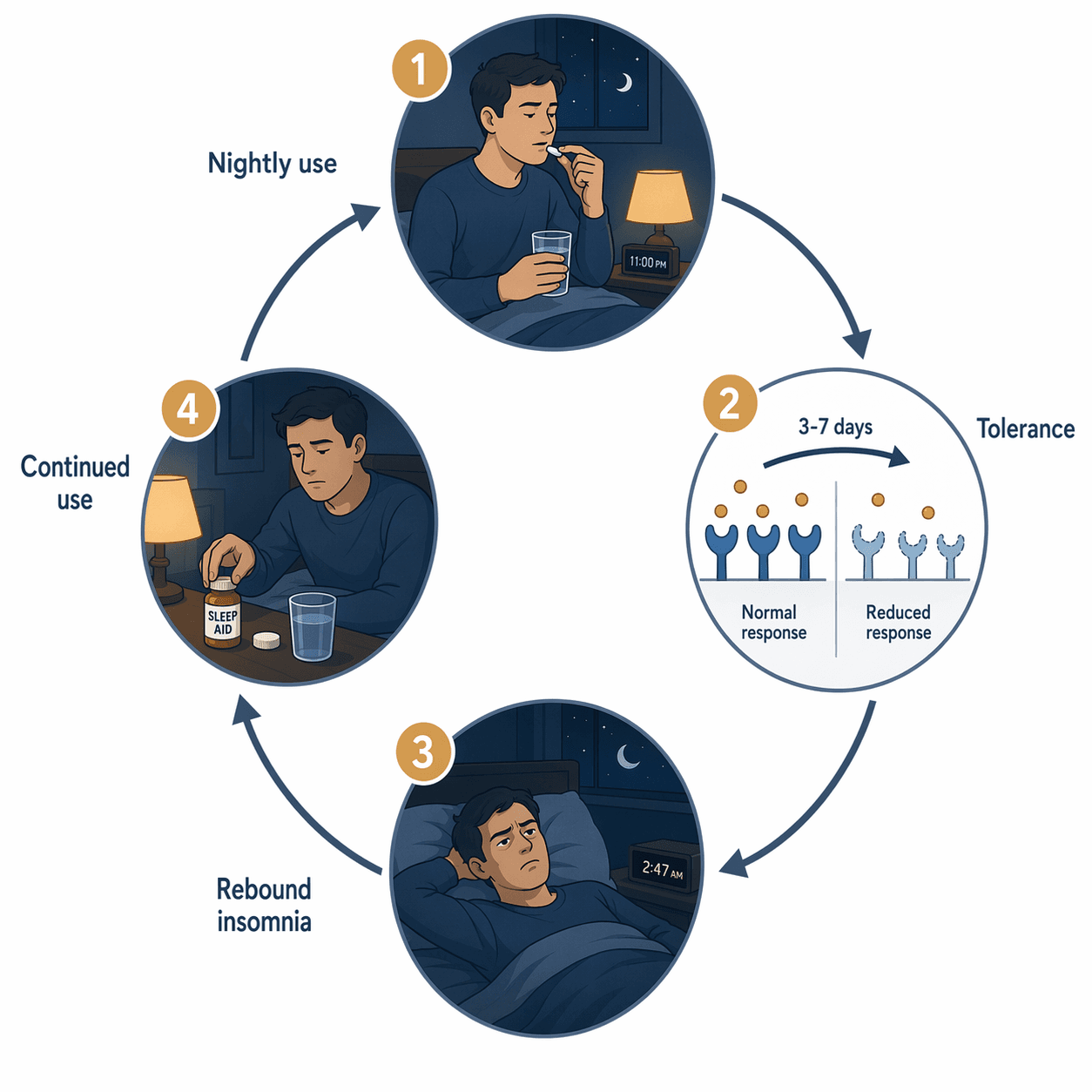
Stopping after sustained use can create its own trap. Harvard Health and Consumer Reports both warn that drugstore sleep aids can be associated with dependence patterns and rebound insomnia, in which sleep feels worse after discontinuation.[4][5] Rebound can make the original decision seem vindicated: “See, I really can’t sleep without it.” Sometimes the more useful interpretation is that the nervous system is reacting to the removal of a nightly sedating drug.
The next morning matters too
Unisom SleepTabs are not designed for a night when you have five hours before the alarm. The label tells users to take the product only if they have time for a full night’s sleep, and doxylamine’s elimination half-life is about 10 to 12 hours in healthy adults.[1][2]
That half-life is the practical reason for morning grogginess. If a drug is still meaningfully present when someone gets up, the next day can start with slowed thinking, dry mouth, blurred attention, or a heavy “drugged” feeling. For people who drive early, supervise children, make clinical or mechanical decisions, or care for another adult, that residual sedation is not a minor inconvenience.
The time window becomes even tighter for older adults. Doxylamine’s half-life may extend to about 12 to 15 hours in older adults, increasing the chance that last night’s sleep aid is still affecting balance and alertness the next day.[2]
Why adults 65 and older get a stronger warning
For adults 65 and older, doxylamine is not just another OTC product to be used with a little extra caution. The 2023 American Geriatrics Society Beers Criteria lists doxylamine among first-generation antihistamines with strong anticholinergic properties and recommends avoiding it in older adults.[6]
Anticholinergic effects come from blocking acetylcholine, a chemical messenger involved in memory, alertness, bowel and bladder function, and other body systems. That is why the side effect list can feel oddly scattered: confusion, constipation, urinary retention, dry mouth, blurred vision, and increased fall risk all belong to the same pharmacologic neighborhood.
The Beers Criteria also notes concern about cumulative anticholinergic exposure, including risks such as falls, delirium, and dementia.[6] That does not mean a single Unisom tablet causes dementia. It means repeated exposure to medications with anticholinergic activity is a clinical signal worth taking seriously, especially when several such medicines are being used at the same time.
Large observational studies have found that higher cumulative use of strong anticholinergic medications is associated with increased dementia risk.[7][8] Observational association is not proof that doxylamine alone causes dementia, and it should not be written that way. But for an older adult already vulnerable to falls, confusion, urinary retention, or constipation, nightly doxylamine is a hard habit to defend.
Readers caring for an older parent or reviewing their own medication list may want the fuller explanation in this Beers Criteria guide to OTC sleep aids. The most important point for this article is simple: “available without a prescription” is not the same as “low-risk for nightly use,” particularly after 65.
If you need it every night, the insomnia needs attention
Nightly Unisom use often begins with a reasonable story: a stressful week, travel, grief, a new schedule, pain, menopause symptoms, a noisy household, or anxiety that gets louder after midnight. No one needs to be scolded for wanting sleep.
But after two continuous weeks, the question changes. The next step is not to build a stronger OTC routine. The next step is to ask why sleep is not returning without medication.
Mayo Clinic notes that persistent insomnia can be related to conditions such as sleep apnea, depression, anxiety, restless legs syndrome, or medication side effects.[9] Those problems do not get solved by repeatedly sedating the symptom. They need to be recognized, named, and treated on their own terms.
That clinical step can be especially important if poor sleep comes with loud snoring, gasping, morning headaches, worsening mood, panic symptoms, leg discomfort that improves with movement, new pain, alcohol use, medication changes, or daytime sleepiness that is affecting driving or work. For a broader look at when insomnia becomes more than a rough patch, see this insomnia FAQ.
Where CBT-I fits
For chronic insomnia, cognitive behavioral therapy for insomnia, or CBT-I, is the pathway that deserves to be discussed before a person settles into nightly antihistamine use. It is not just a nicer name for sleep hygiene. CBT-I works on the learned patterns that keep insomnia going: time in bed while awake, fear of not sleeping, irregular sleep timing, and the cycle of monitoring the night too closely.
A clinician may still consider medication in certain situations. But the presence of nightly Unisom use should be useful information in that visit. It tells the clinician how long the sleep problem has lasted, how often medication is needed, whether next-day sedation is occurring, and whether stopping leads to rebound insomnia.
A note on pregnancy
Doxylamine has a different safety context in pregnancy when used short term, and it is commonly discussed in pregnancy care for nausea and vomiting in combination with vitamin B6. That does not turn long-term nightly sleep-aid use into a studied or self-directed plan. Pregnant readers should treat ongoing insomnia as a reason to ask their obstetric clinician what is appropriate for their specific situation.
The practical bottom line
Unisom SleepTabs can have a place for occasional, short-term sleeplessness. They are not meant to become the plan every night.
If you have taken them nightly or nearly nightly for more than two weeks, the label’s advice is the right place to start: stop and talk with a doctor.[1] The important fact is not that you “failed” at sleep. It is that persistent insomnia is information. It may be pointing to a treatable condition, a medication side effect, rebound insomnia, or a chronic insomnia pattern that needs CBT-I rather than another night of doxylamine.
References
- UNISOM SLEEPTABS- doxylamine succinate tablet — DailyMed.
- Doxylamine — StatPearls, NIH/NLM.
- Comparative effectiveness of pharmacological treatments for the acute and long-term management of insomnia disorder in adults: a systematic review and network meta-analysis — The Lancet, 2022.
- Are drugstore sleep aids safe? — Harvard Health.
- Is it safe to take Unisom long-term? — Consumer Reports.
- American Geriatrics Society 2023 updated AGS Beers Criteria® for potentially inappropriate medication use in older adults — Journal of the American Geriatrics Society / PMC, 2023.
- Cumulative Use of Strong Anticholinergics and Incident Dementia: A Prospective Cohort Study — JAMA Internal Medicine, 2015.
- Anticholinergic Drug Exposure and the Risk of Dementia: A Nested Case-Control Study — BMJ, 2019.
- Sleep aids: Understand options sold without a prescription — Mayo Clinic.


Comments
Join the discussion with an anonymous comment.