
Yes. Cognitive behavioral therapy for insomnia, usually shortened to CBT-I, can help with insomnia during pregnancy, and it is the best-supported first-line option when a pregnant woman wants to avoid medication unless it is truly needed. The important point is not just that CBT-I is “natural” or “behavioral.” It has pregnancy-specific randomized trial evidence, including remission rates of 64% in one in-person trial and 44% in one digital trial.[1][2]
That matters because insomnia during pregnancy is common enough to deserve treatment, not just sympathy. A 2024 meta-analysis of 44 studies with more than 47 million participants estimated that 43.9% of pregnant women experience insomnia symptoms.[3] Clinical education pages from Cleveland Clinic and Sleep Foundation also describe insomnia as rising to roughly 60% to 80% by the third trimester.[4][5]

Pregnancy does complicate the usual insomnia conversation. Many people have heard that sleep medications can be harder to evaluate during pregnancy. Fewer have heard that there is a structured, non-medication insomnia treatment with randomized trial data in pregnant patients. That awareness gap leaves too many exhausted people stuck between “try another pillow” and “ask whether a drug is safe.” CBT-I gives the conversation a better first step.
What the pregnancy trials actually showed
The strongest case for CBT-I in pregnancy rests on two randomized controlled trials. They are not a massive evidence base, and they should not be dressed up as one. But they are exactly the kind of evidence prenatal care needs when the alternative is vague reassurance.
| Trial | Delivery | Main remission finding | Why it matters |
|---|---|---|---|
| Manber 2019 | Five-session CBT-I | 64% remission with CBT-I versus 52% in the control group; median time to remission was 31 days versus 48 days | Shows CBT-I can work during pregnancy and may help patients improve sooner |
| Felder 2020 | Digital CBT-I, six weekly sessions of about 20 minutes | 44% remission with digital CBT-I versus 22.3% with standard care | Shows a lower-barrier format can still produce clinically meaningful results |
In the Manber trial, pregnant participants assigned to five-session CBT-I reached insomnia remission at a higher rate than the control group: 64% versus 52%. They also got there faster, with a median of 31 days to remission compared with 48 days in the control group.[1] The speed finding deserves attention. When someone is pregnant and barely sleeping, improvement “eventually” is not the same as improvement within the next month.
The Felder trial answers a different, very practical question: what if there is no trained CBT-I clinician nearby, no open appointment, or no realistic way to add another in-person visit? In that randomized clinical trial, digital CBT-I consisted of six weekly sessions of about 20 minutes. Remission occurred in 44% of the digital CBT-I group compared with 22.3% of the standard-care group, and benefits were sustained at two-month follow-up.[2]
That does not mean every app calling itself CBT-I is automatically equivalent to trial-tested digital CBT-I. It does mean digital delivery should not be dismissed as a convenience prize. In the pregnancy trial, a lower-barrier format produced a remission rate roughly double standard care.[2] For a patient who cannot access specialty sleep care, that is a real clinical opening.
Both trials also matter because insomnia during pregnancy is not just a nighttime annoyance. CBT-I was associated with small but significant improvements in depressive symptoms in these pregnancy studies.[1][2] That finding should be kept in proportion. It does not prove CBT-I prevents postpartum depression. It does support treating sleep as part of prenatal mental health, rather than treating it as a disposable comfort issue.
CBT-I is not just sleep hygiene with a better name
A lot of pregnant people with insomnia have already heard the easy advice: limit caffeine, reduce screens, use pillows, keep the room comfortable, try a bedtime routine. Some of that can help at the margins. It is not the same as CBT-I.
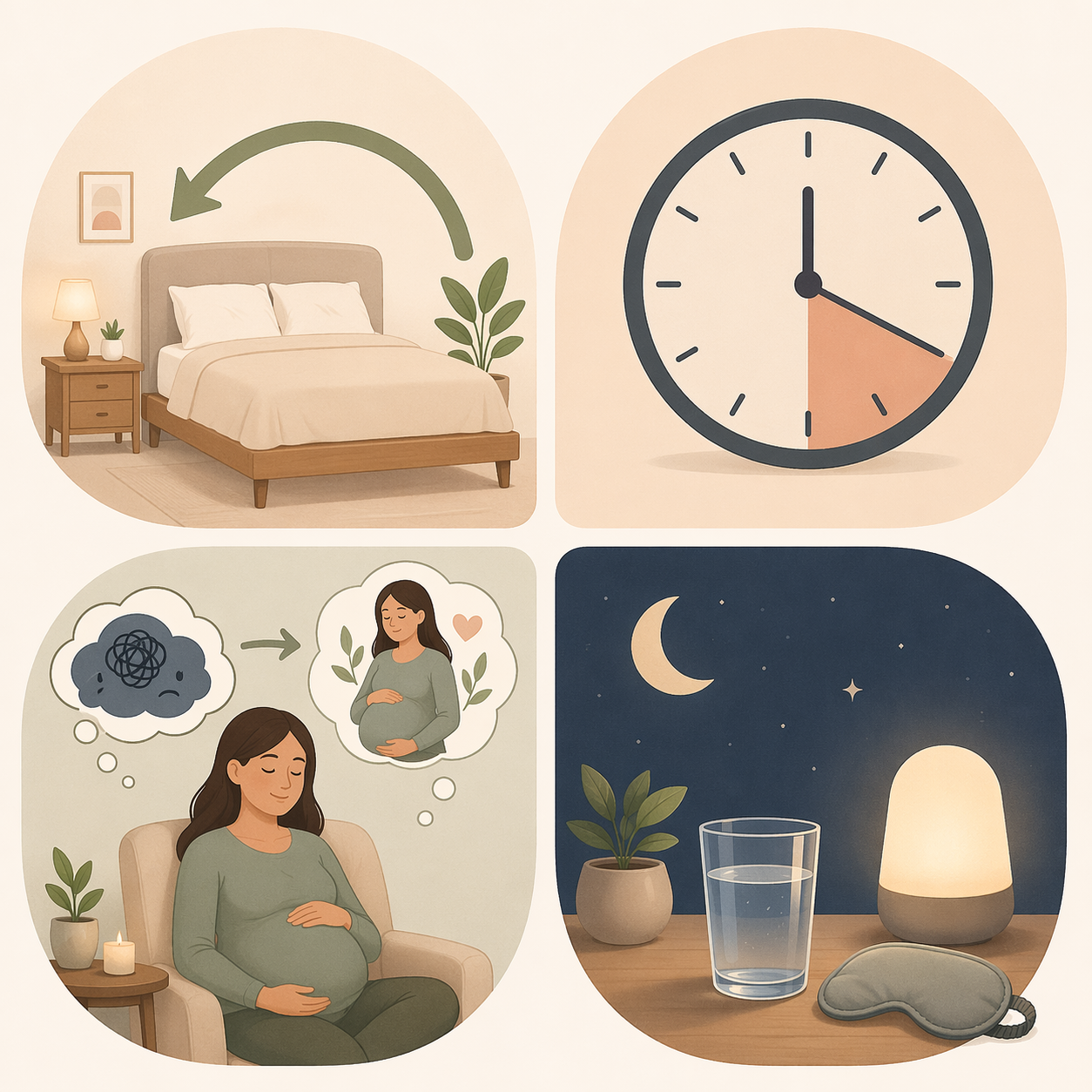
CBT-I is a structured treatment that changes the behaviors and thought patterns that keep insomnia going. In pregnancy, the physical triggers may be real: reflux, fetal movement, hip pain, urinary frequency, anxiety before delivery. But insomnia often becomes self-reinforcing. The bed starts to feel like a place for monitoring, calculating, worrying, and waiting. CBT-I works on that loop.
Stimulus control rebuilds the bed-sleep connection
Stimulus control asks the patient to stop using the bed as the place where insomnia gets rehearsed. A clinician may recommend going to bed only when sleepy, getting out of bed when unable to sleep, and returning when sleepiness comes back. The goal is not punishment. The goal is to make the bed a stronger cue for sleep rather than wakeful effort.
Sleep restriction consolidates sleep, but it needs supervision
Sleep restriction is often the part of CBT-I that sounds least appealing during pregnancy. It usually means temporarily limiting time in bed to better match the amount of sleep a person is actually getting, then gradually expanding the sleep window as sleep becomes more consolidated. This is not a casual tip to “sleep less.” It is a supervised strategy that can temporarily increase sleepiness and should be adjusted for safety, pregnancy symptoms, work demands, driving, and daytime functioning.
Cognitive restructuring addresses the 2 a.m. spiral
Pregnancy can make insomnia thoughts feel especially high-stakes: “If I do not sleep, I am hurting the baby,” “I will not cope with labor,” “I am already failing,” or “Tomorrow is ruined.” Cognitive restructuring does not pretend those fears are silly. It helps separate realistic concern from catastrophic prediction, so the brain has less fuel for another hour of alertness.
Sleep hygiene supports the plan; it is not the plan
Sleep hygiene still has a place. A consistent wake time, a darker room, less clock-checking, and thoughtful caffeine timing can remove friction. But sleep hygiene alone is usually too thin for persistent insomnia. Readers who want a practical checklist can use this evidence-based sleep hygiene guide as a supporting tool, not as a substitute for CBT-I.
How to access CBT-I during pregnancy
The most useful treatment is the one a patient can actually start. CBT-I access varies widely, so the right route depends on local availability, symptom severity, insurance coverage, schedule, and whether other mental health concerns are present.
| Option | Best fit | Main barrier | Practical note |
|---|---|---|---|
| In-person CBT-I | Patients who want direct clinical support or have more complex symptoms | Limited number of trained clinicians; scheduling and travel | Ask an OB, midwife, primary care clinician, sleep clinic, or behavioral sleep medicine provider |
| Telehealth CBT-I | Patients who need clinician guidance without travel | Licensing, coverage, and appointment availability | Often easier to fit around work, childcare, fatigue, or late pregnancy discomfort |
| Digital CBT-I | Patients who need the lowest-barrier starting point | Program quality varies; not every app is evidence-based | The Felder trial supports digital CBT-I as more than a convenience option |
In-person CBT-I is still the most supported format in traditional sleep medicine. It gives a clinician room to tailor sleep restriction, troubleshoot anxiety, and coordinate with prenatal care if symptoms are severe. The drawback is access. Behavioral sleep medicine specialists are not available in every community, and pregnancy does not pause while someone waits months for an appointment.
Telehealth CBT-I can solve part of that problem. It keeps clinician oversight while removing travel, which can matter more in late pregnancy than a generic access discussion usually admits. It may also be easier for patients who are working, parenting, managing nausea or reflux, or trying not to add another exhausting appointment day.
Digital CBT-I is the access route with the clearest pregnancy-specific trial result. In Felder 2020, pregnant women completed six weekly digital sessions of about 20 minutes, and remission was 44% with digital CBT-I versus 22.3% with standard care.[2] That is the reason digital CBT-I belongs in this conversation: not because apps are trendy, but because a digital intervention was tested in pregnant patients and showed benefit.
The caution is quality control. A relaxation app, white-noise app, meditation library, or pregnancy sleep tracker is not automatically CBT-I. A true CBT-I program should include core behavioral components such as stimulus control, sleep scheduling or sleep restriction, and cognitive work around insomnia. If the digital route is the realistic one, this guide to choosing a CBT-I app can help readers separate structured CBT-I from general wellness software.
A practical starting script for a prenatal visit can be simple: “I am having insomnia symptoms and I would like to try CBT-I. Do you know a behavioral sleep medicine clinician, telehealth CBT-I provider, or evidence-based digital CBT-I program that is appropriate during pregnancy?” That is more actionable than asking only whether sleep medication is safe.
Where medication fits
CBT-I being first-line does not mean medication is never appropriate. It means the first serious treatment conversation does not have to start with a drug-risk calculation. Some people will still need medication because symptoms are severe, CBT-I is unavailable, another condition is driving sleep loss, or the risks of ongoing insomnia are becoming too high.
For readers who want the broader decision tree, this pregnancy sleep-aid treatment ladder places CBT-I alongside over-the-counter and prescription options. Readers specifically looking for medication safety details can use this guide to which sleep aids are safe during pregnancy.
What CBT-I cannot promise
The evidence is encouraging, but it has boundaries. The pregnancy-specific CBT-I literature is anchored by two strong randomized trials, not dozens. The Manber trial also excluded women with major psychiatric disorders, so its results may not fully generalize to pregnant patients with more complex depression, anxiety, trauma, bipolar disorder, or other psychiatric conditions.[1]
CBT-I also asks something of the patient. It may involve getting out of bed when every part of the body wants to stay put. It may involve a tighter sleep schedule before sleep improves. It may require keeping a sleep diary, resisting naps that are making nighttime sleep worse, or changing habits that feel comforting in the moment. Presenting CBT-I as effortless does pregnant patients no favors.
It is also not a replacement for medical evaluation. New or worsening insomnia can sit beside pain, reflux, restless legs symptoms, anxiety, depression, breathing problems, medication effects, or other pregnancy-related issues. If sleep loss is severe, if daytime functioning is unsafe, or if mood symptoms are escalating, prenatal care should be involved promptly.
For context on why persistent pregnancy insomnia deserves attention rather than endurance, readers can review the research on insomnia during pregnancy and risks to mother and baby. The point is not to frighten anyone awake. It is to make treatment feel legitimate.
The useful answer
CBT-I is the first option pregnant women and prenatal care providers should know about for insomnia during pregnancy. It is non-pharmacologic, structured, and supported by randomized trial evidence showing meaningful remission rates, faster improvement in one trial, sustained digital benefits in another, and small but significant improvements in depressive symptoms.[1][2]
It is not magic, and it is not always easy to access. But it is far more concrete than “try to relax,” and it gives pregnancy insomnia a treatment path before the conversation narrows to medication safety alone.
References
- Essential Reads: Cognitive Behavioral Therapy for Insomnia During Pregnancy. MGH Center for Women's Mental Health.
- Efficacy of digital cognitive behavioral therapy for the treatment of insomnia symptoms among pregnant women: A randomized clinical trial. JAMA Psychiatry, 2020.
- The global prevalence of insomnia symptoms during pregnancy: A meta-analysis of observational studies. 2024.
- Pregnancy Insomnia. Cleveland Clinic.
- Pregnancy and Insomnia. Sleep Foundation.





Comments
Join the discussion with an anonymous comment.