
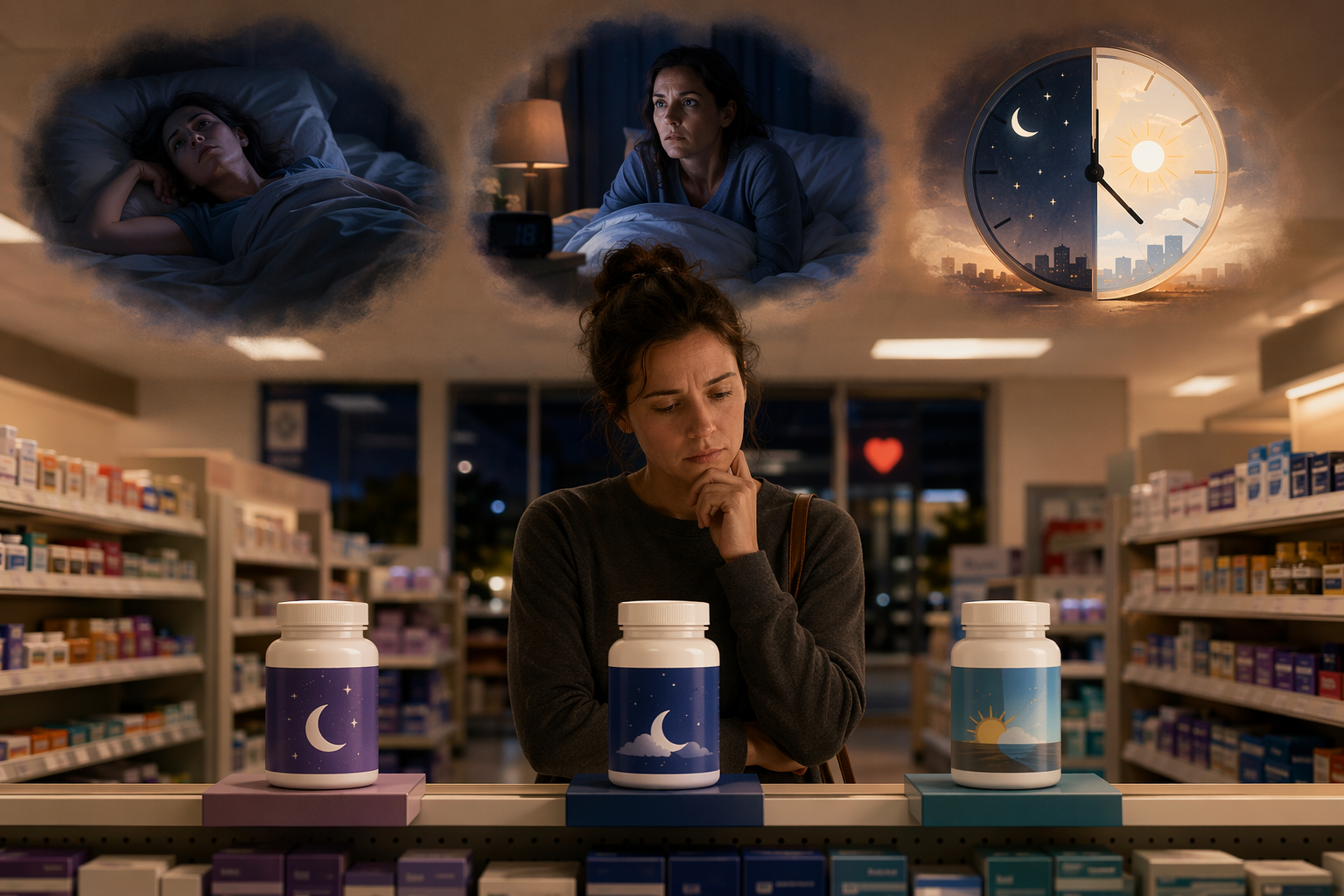
A CVS sleep aid can be a perfectly reasonable store-brand choice when the active ingredient matches the sleep problem. The part worth checking first is not the purple bottle, the tablet count, or whether the box says “compare to” a familiar national brand. Turn the package to the Drug Facts panel and look for one of three names: diphenhydramine, doxylamine, or melatonin.
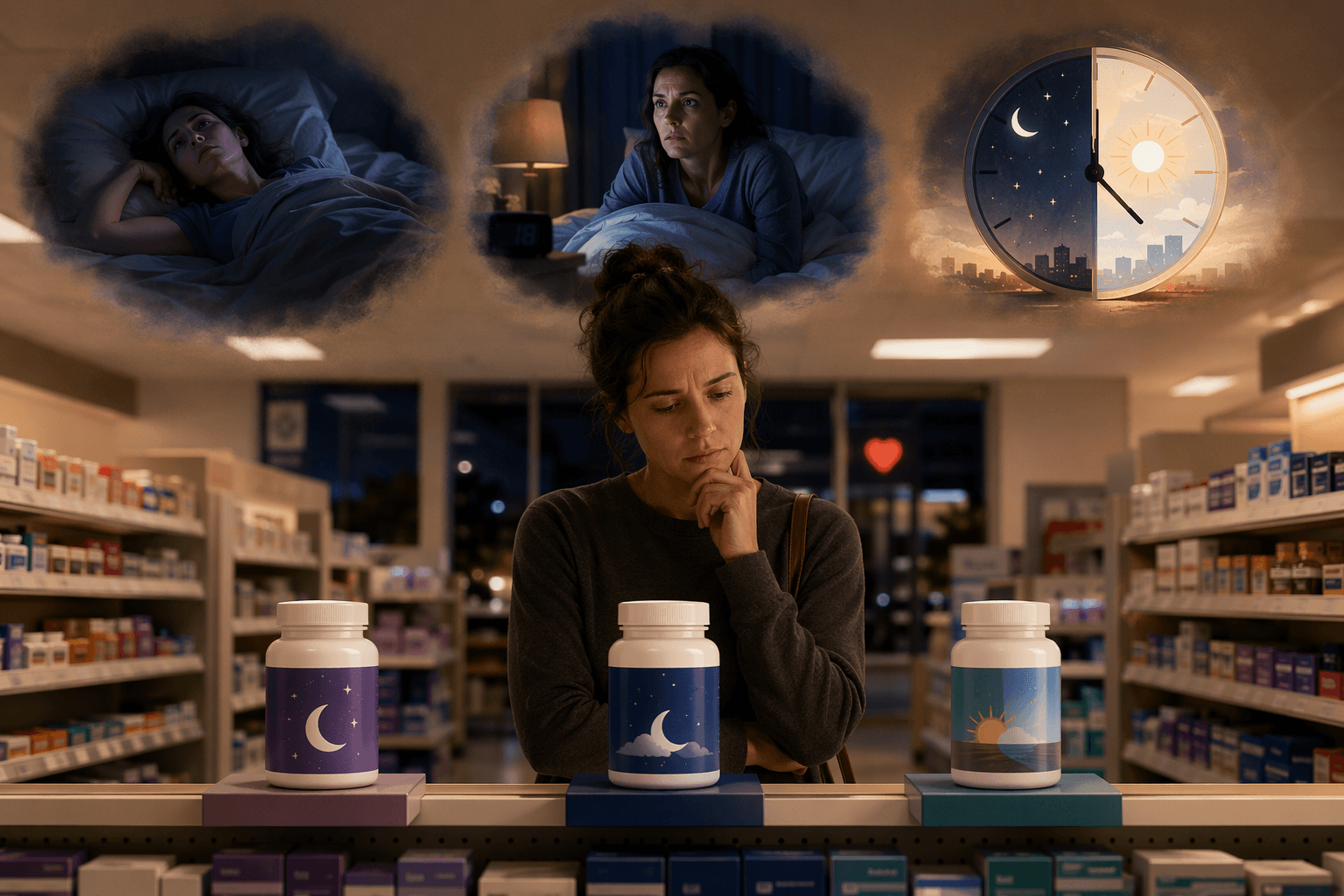
Those three options do different jobs. Diphenhydramine is usually the better fit when the main problem is falling asleep. Doxylamine lasts longer, which can make it more relevant when waking during the night is the problem, but also makes next-day grogginess more likely. Melatonin is not a conventional sedative at all; it is mainly useful when the timing of sleep is off, as with jet lag or shift-work schedules.
| If this is your main problem | CVS active ingredient to look for | Why it fits | Main caution |
|---|---|---|---|
| You cannot fall asleep | Diphenhydramine HCl | Fast-onset sedating antihistamine | Short-term use only; avoid or ask a clinician if age 65+ |
| You fall asleep but wake too early or too often | Doxylamine succinate | Longer-lasting sedating antihistamine | More next-day hangover risk; avoid or ask a clinician if age 65+ |
| Your sleep timing is shifted by travel, late shifts, or a mistimed schedule | Melatonin | Helps signal circadian timing | Not recommended as a general insomnia treatment |
Store Brand Equivalence Helps Only After the Ingredient Choice
CVS store-brand sleep aids are often designed to match national-brand active ingredients. CVS Health Diphenhydramine HCl sleep-aid products correspond to the same active ingredient used in Benadryl and ZzzQuil sleep products, while CVS Health Doxylamine Succinate 25 mg tablets are labeled to compare with the active ingredient in Unisom SleepTabs.[1][2]
That is useful, especially if the store brand costs less. The research brief for this article notes typical CVS store-brand savings of about 30–50% versus national brands, and the FDA’s generic-drug framework is built around the idea that approved generics match the brand-name medicine in active ingredient, strength, dosage form, route of administration, quality, performance characteristics, and intended use.[3] But a cheaper equivalent is still the wrong purchase if it is equivalent to the wrong drug.
One practical caveat: CVS product pages were not directly crawled for this article. The ingredient confirmation here comes from FDA DailyMed labels, which is the better source for Drug Facts-level verification anyway. Packaging formats such as gummies, liquids, liquid gels, and PM combinations can vary, so the final check still happens on the label in your hand.
Diphenhydramine: Best Fit for Occasional Trouble Falling Asleep
If you are awake in bed and the problem is getting sleep started, diphenhydramine is the CVS aisle’s most familiar sedating antihistamine. CVS Health Diphenhydramine HCl products include 25 mg tablets and a 50 mg liquid sleep aid; the DailyMed label for the 50 mg liquid identifies diphenhydramine HCl as the active ingredient.[1]
Mechanistically, this is not a “natural sleep support” product. Diphenhydramine blocks histamine signaling, and drowsiness is the desired side effect. That can be helpful for an occasional bad night, but it is a blunt tool. Harvard Health’s sleep-medicine guidance notes that tolerance to antihistamine sleep aids can develop quickly, and Mayo Clinic likewise cautions against using antihistamine sleep aids for more than short-term insomnia.[4][5]
The label details matter for people with medical restrictions. The DailyMed label for CVS Health Diphenhydramine HCl 50 mg liquid lists 10 mg sodium and 5 mg potassium per dose.[1] That is not the main reason most adults choose or avoid the product, but it is exactly the kind of small print that matters for someone tracking electrolytes, sodium intake, or multiple liquid medicines.
The cleanest use case is narrow: an otherwise appropriate adult, an occasional sleepless night, and a primary problem of sleep onset. If the real issue is waking repeatedly at 3 a.m., diphenhydramine may not last long enough to solve the problem. If the real issue is a body clock that is set to the wrong time zone, it is the wrong mechanism.
Doxylamine: More Staying Power, More Morning Cost
CVS Health Doxylamine Succinate 25 mg tablets are the store-brand route to the active ingredient used in Unisom SleepTabs. The DailyMed label for CVS Health doxylamine succinate 25 mg tablets identifies the active ingredient and lists the product under ANDA040167.[2]
Doxylamine is still a sedating antihistamine, but its longer duration changes the shopping decision. Its half-life is about 8 hours, which is why it may fit someone who can fall asleep but wakes during the night.[2] That same longer duration is also the reason it can punish the next morning: grogginess, slowed reaction time, and a heavy-headed commute are not rare surprises so much as predictable consequences of a drug that is still hanging around.
The DailyMed label for CVS Health doxylamine also states that the product is not for children under 12 years.[2] For adults, the bigger decision is whether the extra duration is actually needed. If you only need help falling asleep, choosing doxylamine because it sounds stronger can trade one short night for a slow morning.
Melatonin: For Timing Problems, Not Ordinary Insomnia
Melatonin belongs in a different mental drawer. It is not Benadryl without the brand name, and it is not a weaker version of doxylamine. Melatonin is a hormone signal involved in circadian timing, which is why it is most relevant when the question is “Why does my body think bedtime is at the wrong hour?” rather than “What will knock me out tonight?”
That distinction matters because the American Academy of Sleep Medicine’s clinical practice guideline does not recommend melatonin for chronic insomnia treatment in adults.[6] Harvard sleep specialist Dr. Lawrence Epstein has described lower-dose melatonin use in the 0.5–3 mg range, which is why more is not automatically better when the goal is shifting the body clock rather than sedating the brain.[4]
For jet lag, rotating shifts, or a schedule that has drifted late, melatonin may be the more logical CVS choice than an antihistamine. For a person with ongoing insomnia and no clear timing problem, it can become another bottle that feels gentle but does not address the real complaint. Readers who need a deeper dosing discussion should use a dedicated melatonin dosage guide rather than treating every gummy or tablet strength as interchangeable.

The Safety Filter Comes Before the Checkout Screen
For adults 65 and older, diphenhydramine and doxylamine deserve a much harder stop than the shelf signage suggests. The American Geriatrics Society Beers Criteria lists first-generation antihistamines, including diphenhydramine and doxylamine, as potentially inappropriate for many older adults because of anticholinergic effects such as confusion, dry mouth, constipation, and other risks.[7]
This is not a theoretical concern tucked away in a geriatric textbook. A 2017 study by Abraham and colleagues found that 59% of older adults who reported using over-the-counter sleep aids were using products containing diphenhydramine or doxylamine.[8] That statistic is a warning signal: many older adults are reaching for exactly the ingredients that geriatric prescribing guidance tries to move them away from.
Johns Hopkins has also cautioned that anticholinergic drugs, including some common sleep aids, have been linked with dementia-risk signals.[9] That kind of finding should not be inflated into “one pill causes dementia,” but it is enough to change the shelf decision for an older adult, especially if the product is being used repeatedly.
Age is not the only screen. Mayo Clinic’s January 2026 guidance warns people to check with a clinician before using antihistamine sleep aids if they have glaucoma, peptic ulcer, urinary retention, or breathing problems.[5] These conditions do not always announce themselves at the sleep-aid shelf, which is why the Drug Facts warnings are more important than the front label.
- If you are 65 or older, do not treat diphenhydramine or doxylamine as casual nightly sleep tools.
- If you have glaucoma, urinary retention, peptic ulcer disease, or breathing problems, ask a clinician before using antihistamine sleep aids.
- If you must drive, work early, operate equipment, or care for someone overnight, weigh next-day impairment as part of the purchase decision.
- If you are already taking medicines with anticholinergic effects, adding an OTC sleep aid may stack side effects rather than simply add sleep.
Skip PM Pain Relievers Unless Pain Is Actually the Problem
The PM shelf is where a simple sleep problem can quietly become a combination-drug problem. If you do not need pain relief, do not choose a PM pain reliever just because it looks like a stronger sleep product. Adding acetaminophen, ibuprofen, or another pain-relief ingredient exposes you to drug-specific risks without solving the active-ingredient question any better.
This is where label-first shopping saves trouble. The sleep-inducing ingredient in many PM products is still an antihistamine. If that is the ingredient you are trying to use, choose it intentionally. If pain is part of the reason you cannot sleep, the decision becomes different and should account for the pain reliever’s own warnings.
How to Choose at CVS Without Turning It Into a Brand Contest
A quick shelf process works better than ranking bottles. First, name the problem: falling asleep, staying asleep, or mistimed sleep. Second, match that problem to the active ingredient. Third, screen for age, health conditions, next-day responsibilities, and other medicines. Only then does price comparison make sense.
| Shelf question | What to check |
|---|---|
| Is this the same kind of product as a national brand? | Compare the active ingredient and strength, not the front-panel color or sleep claim. |
| Will it help my specific problem? | Use diphenhydramine for occasional sleep-onset trouble, doxylamine for a longer-lasting antihistamine effect, and melatonin for circadian timing problems. |
| Could it make tomorrow worse? | Consider hangover effects, especially with doxylamine and with any antihistamine taken too late. |
| Am I in a higher-risk group? | Older adults and people with certain eye, urinary, stomach, or breathing conditions should not treat these as routine self-care products. |
For more ingredient-level detail, a deeper OTC sleep medicine ingredient guide can help separate diphenhydramine, doxylamine, melatonin, and other common options. If the main worry is whether CVS store brand is truly comparable to the national brand, the more relevant next read is the CVS sleep aid versus national brands explanation of FDA generic equivalence.
When the CVS Shelf Is the Wrong Place to Keep Looking
Occasional sleeplessness and chronic insomnia are different problems. Mayo Clinic advises contacting a doctor if insomnia lasts more than 2 weeks.[5] That threshold is a useful boundary: after that point, rotating through CVS sleep aids can delay a better evaluation of stress, medications, pain, breathing issues, restless legs, schedule disruption, depression, anxiety, or another driver.
If antihistamines are a poor fit, or if the sleep complaint is more specific than “I need something tonight,” a broader mechanism-based sleep supplement guide or sleep supplement matching guide may be more useful than another brand comparison.
The best CVS sleep aid is not the cheapest bottle or the national-brand lookalike with the most familiar packaging. It is the product whose active ingredient, duration, and safety profile match the sleep problem you actually have.
References
- DailyMed - CVS Health Diphenhydramine HCl Liquid Drug Facts
- DailyMed - CVS Health Doxylamine Succinate 25 mg Tablets Drug Facts
- U.S. Food and Drug Administration - Generic Drugs: Questions & Answers
- Harvard Health Publishing - Melatonin for sleep: Does it work?
- Mayo Clinic - Sleep aids: Understand options sold without a prescription, January 2026
- American Academy of Sleep Medicine - Clinical Practice Guideline for the Pharmacologic Treatment of Chronic Insomnia in Adults
- American Geriatrics Society - American Geriatrics Society 2023 Updated AGS Beers Criteria for Potentially Inappropriate Medication Use in Older Adults, 2023
- Abraham et al. - Use of over-the-counter sleep aids among older adults in the United States, 2017
- Johns Hopkins Medicine - Common Anticholinergic Drugs Like Benadryl Linked to Increased Dementia Risk


Comments
Join the discussion with an anonymous comment.