
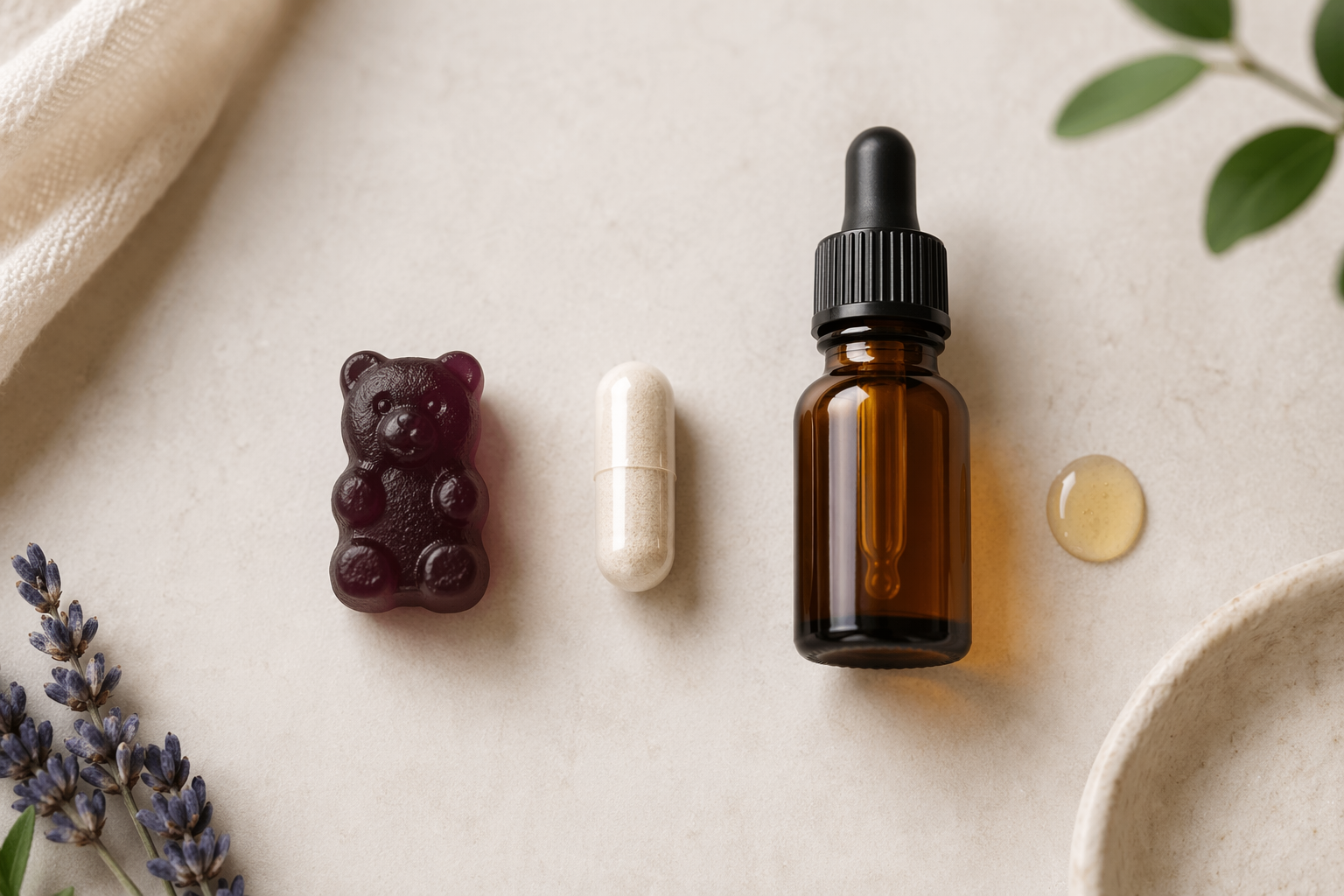
If you are choosing between sleep gummies melatonin products, capsules, and liquids, the form itself is not the part that has been proven to make sleep better. The more useful question is whether the form lets you take the dose you intend, avoid ingredients you do not want, and store it safely in the house.
That makes the choice less like picking the “strongest” sleep aid and more like choosing the least misleading container for a hormone sold as a dietary supplement. Liquids are usually the best fit when tiny dose adjustments matter. Capsules are the plainest adult option when you want a fixed dose without sugar. Gummies make sense mainly when taste and chewability are the reason you would take melatonin at all, and even then the label deserves more skepticism than the candy-like format invites.
| Form | Best fit | Main tradeoff | What to check before buying |
|---|---|---|---|
| Liquid | Adults who need low-dose titration or condition-specific timing, such as jet lag or circadian timing use | More measuring responsibility; some formulas may contain sweeteners or sugar alcohols | Drop size, mg per drop or mL, serving instructions, and whether the bottle makes small dosing realistic |
| Capsule or tablet | Adults who want a simple fixed dose with no candy-like format and usually no added sugar | Harder to fine-tune if the dose is higher than you want | Dose per unit, third-party testing, and whether a lower-dose version exists |
| Gummy | Adults who cannot tolerate pills and will only take melatonin if it is chewable and palatable | Label accuracy, added sugar, and higher child-attraction risk | Credible third-party certification, child-resistant storage, and added sugar per serving |
Start With Dose Control, Not Flavor
A gummy can feel like the gentler option because it looks familiar and tastes pleasant. That has almost nothing to do with dose control. Most gummies are fixed-dose products: you take one, sometimes two, and the label tells you what that should mean. Splitting a gummy is imprecise, and it does not solve the larger problem if the product itself contains more or less melatonin than declared.
Dose control matters because melatonin is not simply a stronger-is-better sleep sedative. Older experimental work cited in the JAMA gummy analysis found that as little as 0.1 to 0.3 mg of exogenous melatonin could raise plasma melatonin into the normal nighttime range, which makes large label overages more than a clerical nuisance.[1]
This is where liquids earn their place. Some liquid labels allow adjustment in very small increments, down to about 0.15 mg per drop in one label example. That does not prove the liquid will make you fall asleep faster. It does mean a person trying to start around a low dose, or adjusting timing for jet lag or a circadian schedule problem, has a more realistic way to make small changes than biting pieces off a gummy.
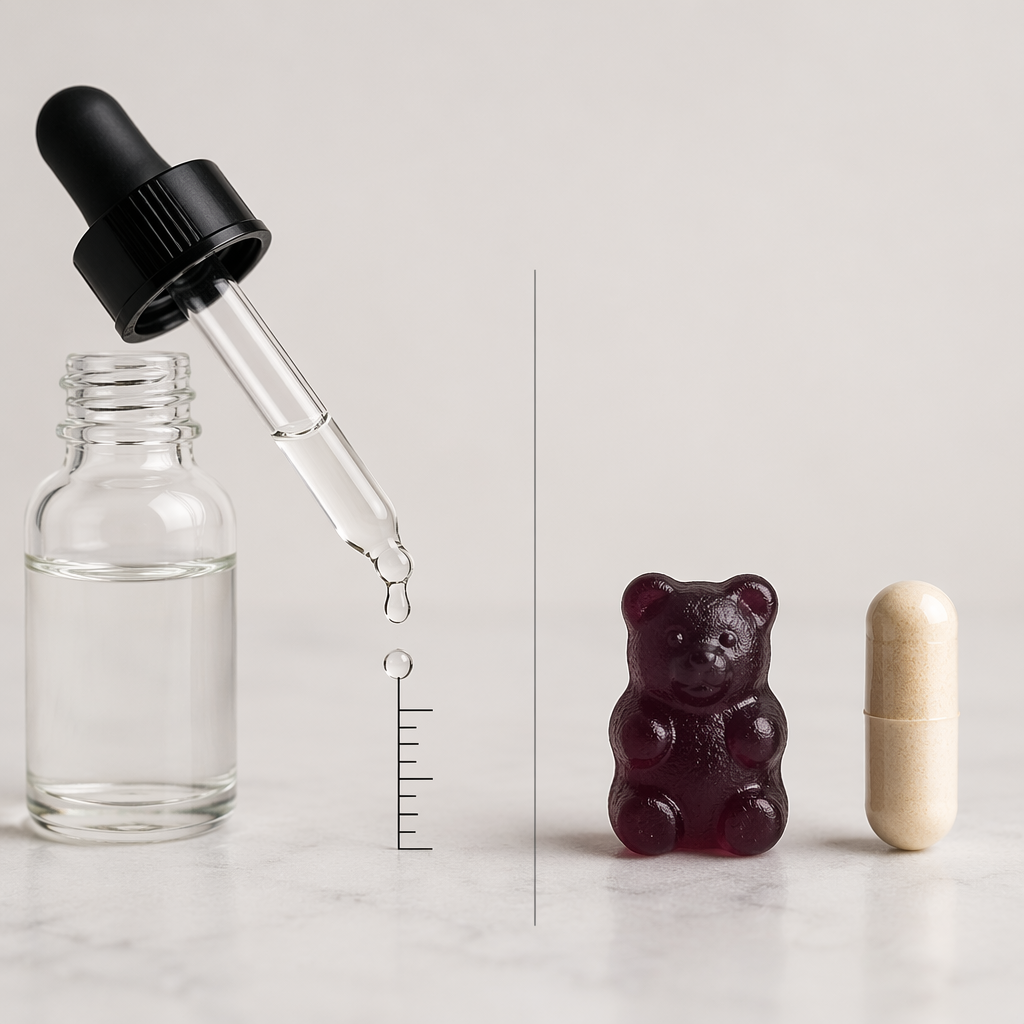
Capsules sit in the middle. They are usually not as adjustable as a liquid, but they are straightforward: one unit, one labeled amount, no need to count drops. If the available capsule is 3 mg and you want to try much less, that simplicity becomes a limitation. If you have already settled on a dose and want a plain adult product, it can be a virtue.
Gummy Labels Deserve Extra Scrutiny
The strongest evidence against treating gummies as just another cute delivery form comes from product testing. In a 2023 JAMA research letter, investigators tested 25 melatonin gummy products sold in the United States. Twenty-two were inaccurately labeled. Actual melatonin content ranged from 74% to 347% of the declared amount, and one product contained no detectable melatonin but did contain 31.3 mg of CBD.[1]
That study was not a census of every gummy on the market. It tested one sample each from 25 products in September 2022, so it cannot tell you the current accuracy of a specific bottle in your cart. But it is not an isolated warning. A 2017 Canadian analysis of melatonin supplements also found substantial variability, with chewable products showing the greatest variability among the forms tested.[2]
The practical conclusion is narrow but important: a melatonin gummy label may not be a dependable dosing instrument unless there is credible independent verification. If you want the deeper dive on gummy label accuracy, see how accurate melatonin gummies are likely to be.
Child Safety Is a Form-Factor Issue
For a household with young children, gummies change the safety problem. A capsule bottle can still be opened by a child if it is left within reach, but a gummy looks and tastes much closer to candy. That is not a moral failing by the child or the adult buyer. It is a predictable storage hazard.
CDC researchers reported that among 11,000 emergency department visits for unsupervised melatonin ingestion in children age 5 or younger from 2019 through 2022, 47.3% involved gummy formulations.[3] A separate CDC report found pediatric poison control reports for melatonin rose 530% from 2012 through 2021, totaling 260,435 reports.[4]
Those figures do not mean every gummy is dangerous or that capsules are harmless. They do mean a gummy purchase should include a storage decision at the same time: out of sight, out of reach, and in packaging a child cannot easily defeat. If that sounds unrealistic in your home, the friendlier form may be the wrong one.
Sugar, Sweeteners, and Swallowability Can Still Decide the Purchase
Gummies often contain added sugar. Common label examples put servings around 1 to 3 g of added sugar. That is not a large dessert, but it is still an ingredient you are taking at bedtime for no sleep-specific reason. If you use melatonin occasionally, this may not matter. If you are comparing daily products or managing blood sugar, it becomes part of the decision.
Liquids can avoid the candy problem, but they are not automatically cleaner. Some formulas use sweeteners or sugar alcohols such as xylitol, which can bother the gut in some people. The front label may not tell you enough; the inactive ingredients panel is where this decision usually gets made.
Swallowability is the one place where gummies deserve a fair hearing. For an adult who cannot swallow capsules, dislikes liquids, or has repeatedly abandoned pill-based supplements, palatability is not frivolous. A product you can take consistently is different from a product you leave in the cabinet. The tradeoff is that the easier form needs a higher bar for verification and storage.
What Third-Party Testing Can and Cannot Fix
Because melatonin is sold as a dietary supplement, it is not reviewed by the FDA for safety and effectiveness the way a sleep drug would be before marketing. That regulatory gap is why third-party testing matters. Look for programs such as USP, NSF, or ConsumerLab when available, and treat vague phrases like “lab tested” as incomplete unless the company says who tested it and what was tested.
For gummies, independent verification matters even more because the published variability signal is strongest there. A verified gummy may be a reasonable choice for an adult who needs a chewable form. An unverified gummy with a high labeled dose is harder to defend when liquids and capsules offer simpler ways to control the problem.
Industry groups have noticed the same pressure. In April 2024, the Council for Responsible Nutrition announced voluntary melatonin supplement guidelines addressing child-deterrent packaging, label warnings, and manufacturing overage limits for gummies.[5] Voluntary is the important word. These guidelines can raise the floor for companies that follow them, but they do not make every bottle on a store shelf equivalent.
If you need a practical primer on what certifications do and do not mean, the site’s adult melatonin guide covers the major testing marks. For a concrete example of a verified gummy, see the review of Nature Made melatonin gummies.
A Simple Way to Choose
Use the form to solve the real constraint, not to chase a promise the evidence does not establish.
- Choose a liquid if you want to start very low, adjust gradually, or match timing-sensitive use where small dose changes matter.
- Choose a capsule or tablet if you want the simplest adult format, usually without added sugar, and you are comfortable with the labeled dose.
- Choose a gummy only if palatability or chewability is the deciding factor, and give preference to products with credible third-party testing.
- Avoid gummy formats in homes where a child could mistake the product for candy or where secure storage is unlikely to happen every time.
- Do not assume sprays or liquids work better for sleep just because absorption may differ; clinical sleep-outcome advantages by form have not been established.
For broader questions about whether melatonin is the right sleep aid in the first place, start with the general melatonin sleep aid overview. For this purchase decision, stay closer to the bottle in your hand: Can you measure the dose, trust the label, avoid unwanted sugar or sweeteners, and store it safely? That is where the forms actually separate.
References
- Quantity of Melatonin and CBD in Melatonin Gummies Sold in the US, JAMA, 2023.
- Melatonin Natural Health Products and Supplements: Presence of Serotonin and Significant Variability of Melatonin Content, PubMed, 2017.
- Notes from the Field: Emergency Department Visits for Unsupervised Pediatric Melatonin Ingestion — United States, 2019–2022, CDC MMWR, 2024.
- Pediatric Melatonin Ingestions — United States, 2012–2021, CDC MMWR, 2022.
- CRN Adopts New Guidelines for Melatonin Supplements to Promote Responsible Usage, Council for Responsible Nutrition, April 2024.


Comments
Join the discussion with an anonymous comment.