
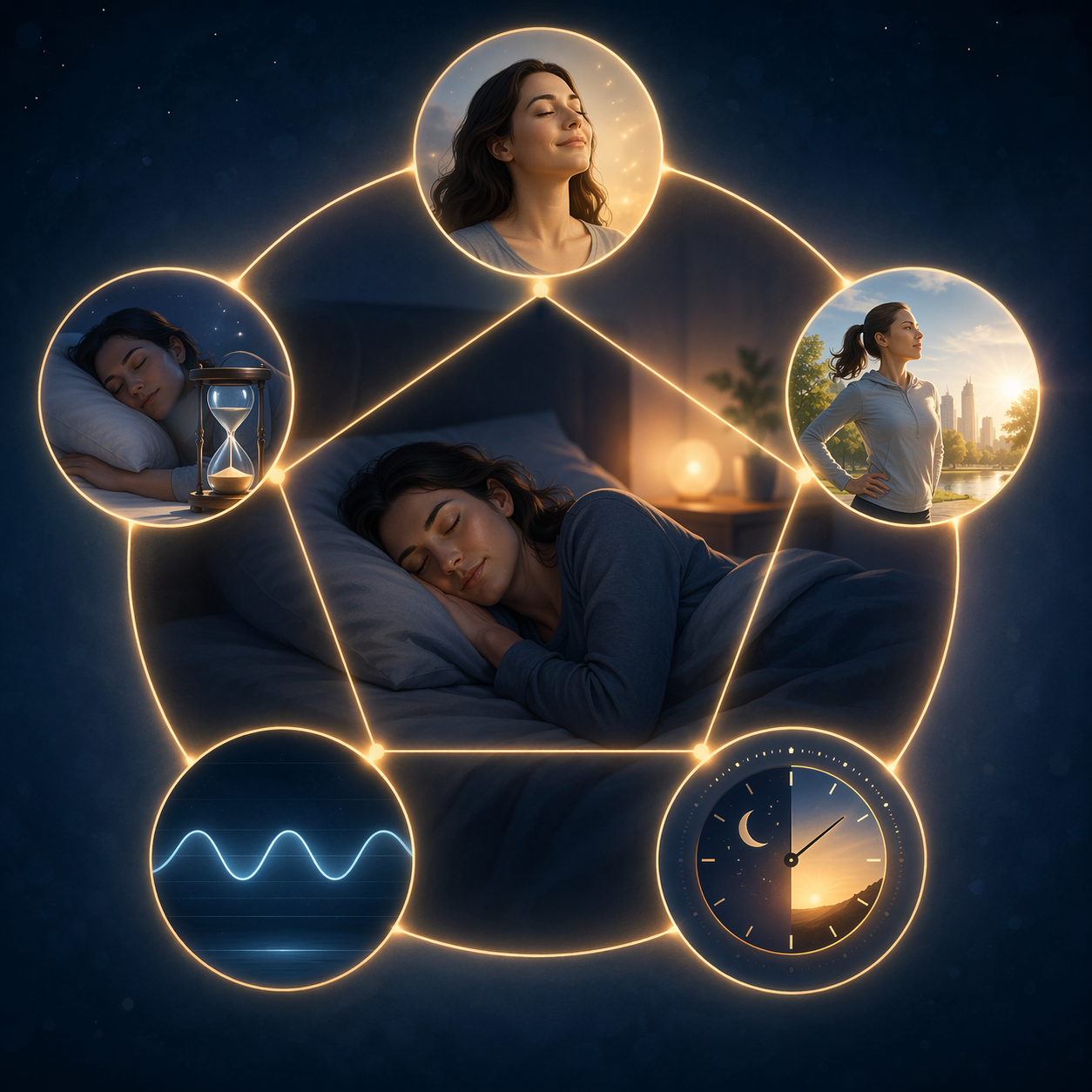
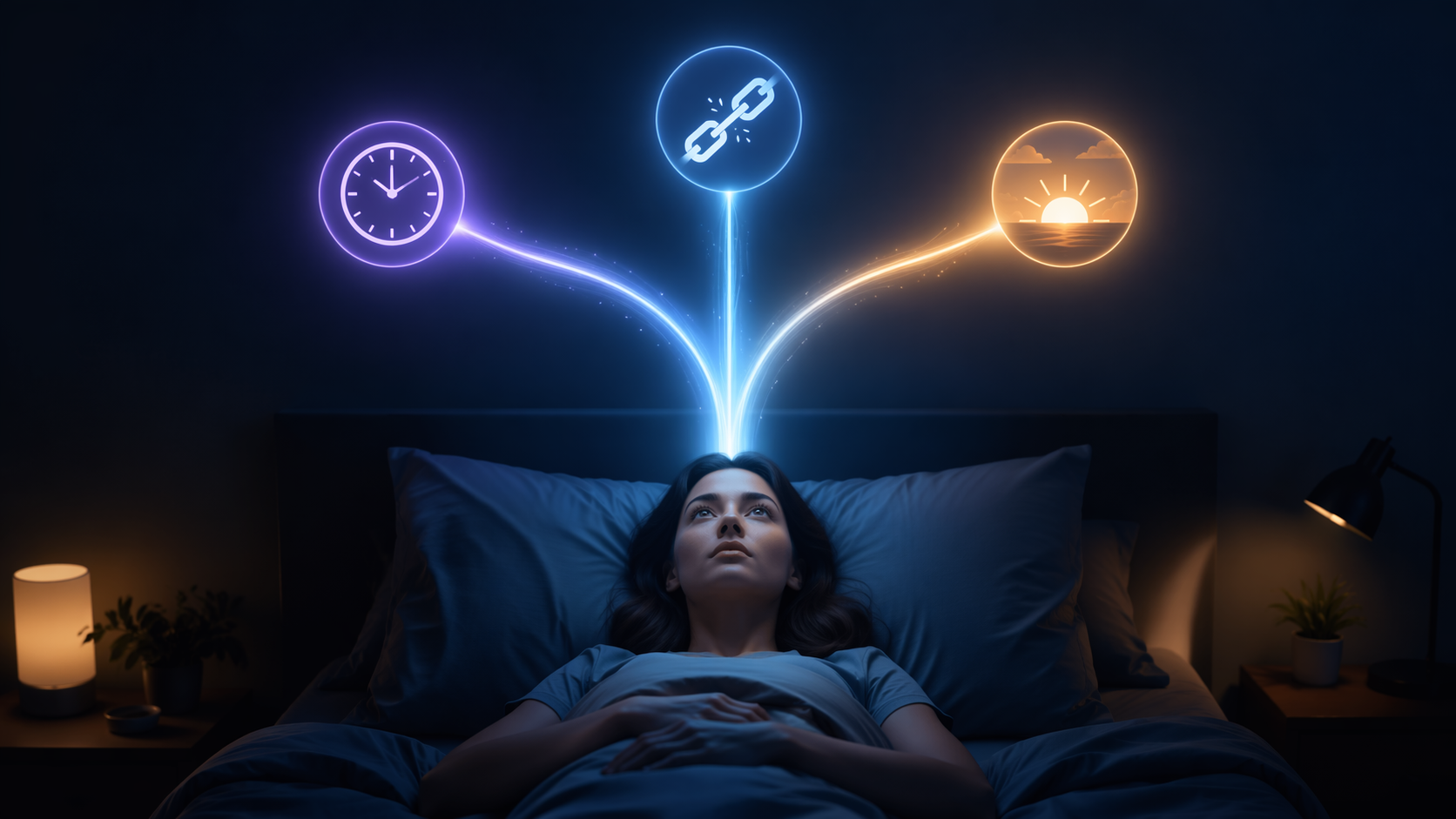
“I slept eight hours” is a useful fact, but it is not yet a medical answer. In sleep medicine, sound sleep is better treated as a pattern than as a single score: how satisfied the person feels on waking, whether they stay alert the next day, whether sleep happens at the right circadian time, whether it is continuous and efficient, and whether the total amount is enough. Buysse’s SATED framework is the clearest positive definition of that pattern [1].
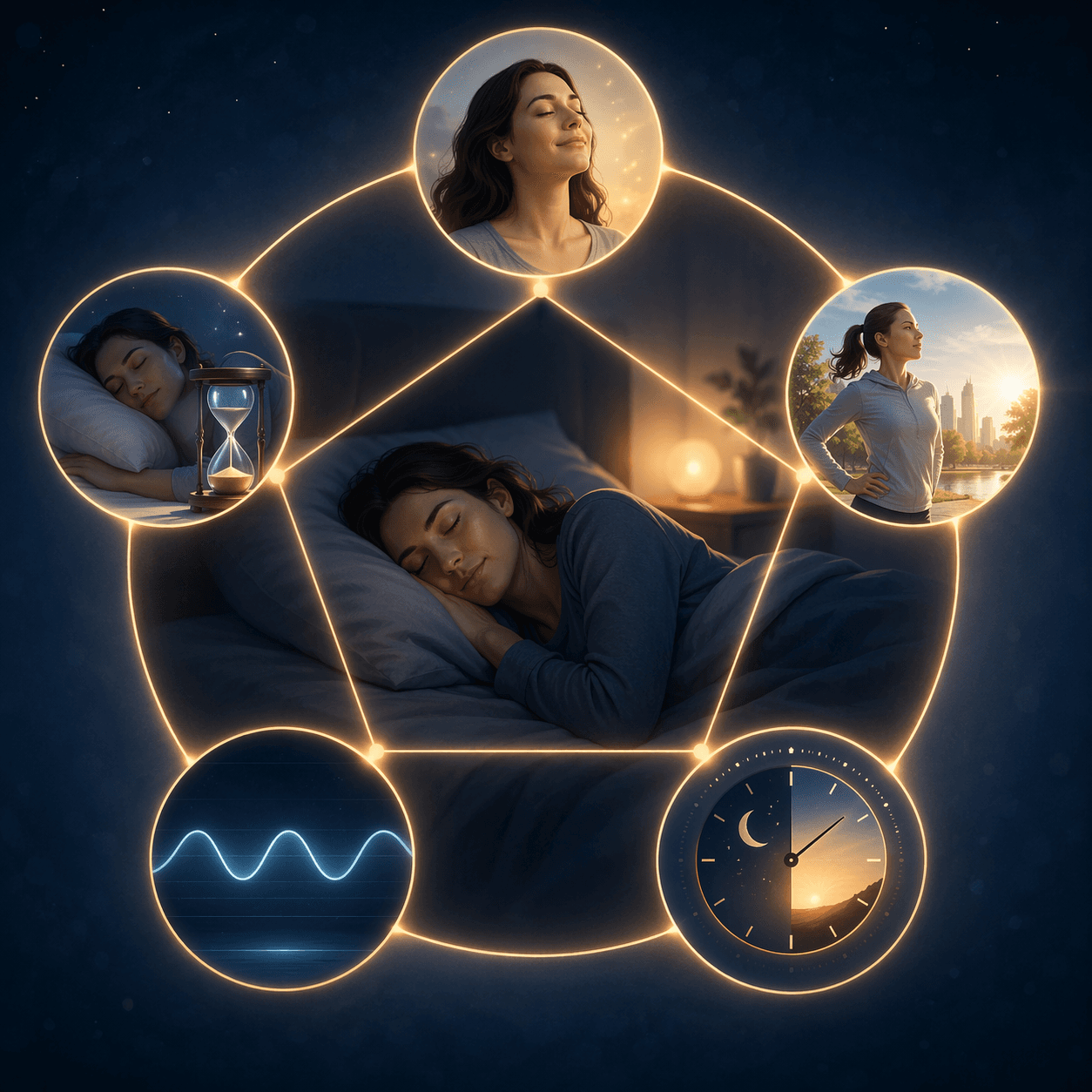
SATED is the most useful starting point
SATED was proposed as a conceptual model rather than a clinic-ready diagnostic instrument, which is part of why it works: it asks better questions without pretending to be a score. Each dimension gives ordinary language to something patients and clinicians already notice, but often talk about only in fragments.
- Satisfaction: did sleep feel restorative, or did waking still feel like a deficit?
- Alertness: was daytime wakefulness intact, or was sleepiness getting in the way of work, driving, or attention?
- Timing: did sleep land at a biologically sensible time, not just a convenient bedtime?
- Efficiency: did sleep start reasonably quickly and stay consolidated, or was too much of the night spent awake in bed?
- Duration: was the total amount of sleep enough, not merely the amount of time spent lying down?
The point of the model is not that every dimension has to be perfect. It is that a person can have enough hours and still miss the alertness or efficiency pieces, or have an apparently tidy schedule that still leaves them dissatisfied.
A 2026 ResMed survey of 30,000 adults across 13 markets found that 84% knew quality sleep can extend lifespan, while more than half said they achieved good sleep only four nights a week or fewer. That gap is useful context, but it should stay in the background because the survey was commissioned by a CPAP manufacturer [4].
What the NSF quality benchmarks add
SATED gives the map; the National Sleep Foundation’s 2024 consensus statement gives four measurable continuity and efficiency markers for adults under 65. These are expert-derived thresholds, not biological commandments, and the cutoffs are different for older adults [2].
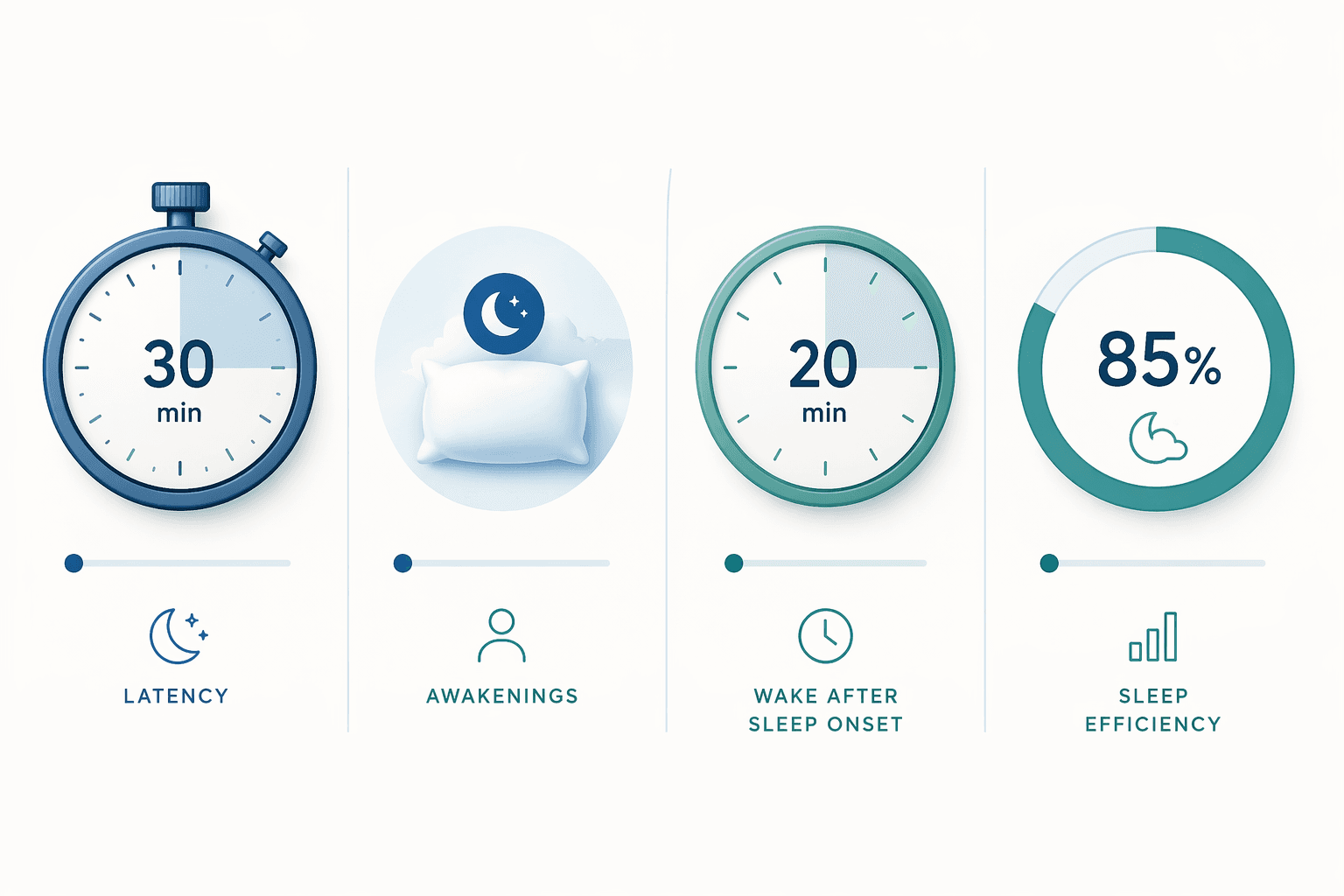
| Metric | NSF 2024 benchmark for adults under 65 | What it means |
|---|---|---|
| Sleep latency | ≤30 minutes [2] | How long it takes to fall asleep |
| Awakenings | ≤1 awakening [2] | Whether sleep is repeatedly broken |
| Wake after sleep onset | ≤20 minutes [2] | How much awake time appears after sleep begins |
| Sleep efficiency | ≥85% [2] | How much of the time in bed is actually spent asleep |
These measures stop the conversation from collapsing into “I was in bed for a long time, so I must have slept well.” A night can be long but inefficient, or shorter but comparatively consolidated; the useful question is which part of the night is actually failing.
How duration fits the model
The AASM and Sleep Research Society recommended 7 or more hours per night for adults 18–60 after a 12-month evidence review using the RAND Appropriateness Method and input from 15 experts. The panel deliberately left the upper bound undefined [3].
If the evidence review itself matters, What the 7-Hour Sleep Recommendation Actually Means for Adults covers it in more detail.
The stage mix matters biologically, but it should not be mistaken for the whole answer. For a concise look at why REM and NREM cycling still matter without turning deep sleep into a marketing claim, see Natural Remedies for Deep Sleep: Separating Biology from Marketing.
A disciplined self-check
- Did sleep feel satisfying enough that waking did not feel like a loss?
- Did daytime alertness hold up, or did sleepiness keep returning in ordinary tasks?
- Was sleep timed in a way that fit the body’s clock, not just the calendar?
- Did sleep fall within the NSF continuity and efficiency range often enough to count as consolidated?
- If you are 18–60, was total sleep usually at least 7 hours; if not, is the issue really duration, or something else?
When the pattern looks adequate on paper but the person still feels unrefreshed, the mismatch matters. Persistent dissatisfaction, regular daytime impairment, or a sleep schedule that is repeatedly out of sync is a better reason to look closer than the raw number of hours alone.
If that mismatch is ongoing, a triage approach such as Insomnia Self-Care: How to Match Your Approach to Your Symptoms or Help Me Sleep Without Pills is more useful than trying to grade sleep more aggressively.
That is the medical meaning of sound sleep: enough sleep, at the right time, with reasonable continuity and efficiency, leaving the person satisfied and alert. The frameworks are there to sharpen judgment, not to replace clinical evaluation.
References
- “Sleep Health: Can We Define It? Does It Matter?” — SLEEP, 2014.
- “What Is Sleep Quality?” — National Sleep Foundation, 2024.
- “Seven or more hours of sleep per night: A health necessity for adults.” — AASM, 2015.
- “ResMed Global Sleep Survey 2026” — ResMed, 2026.


Comments
Join the discussion with an anonymous comment.