
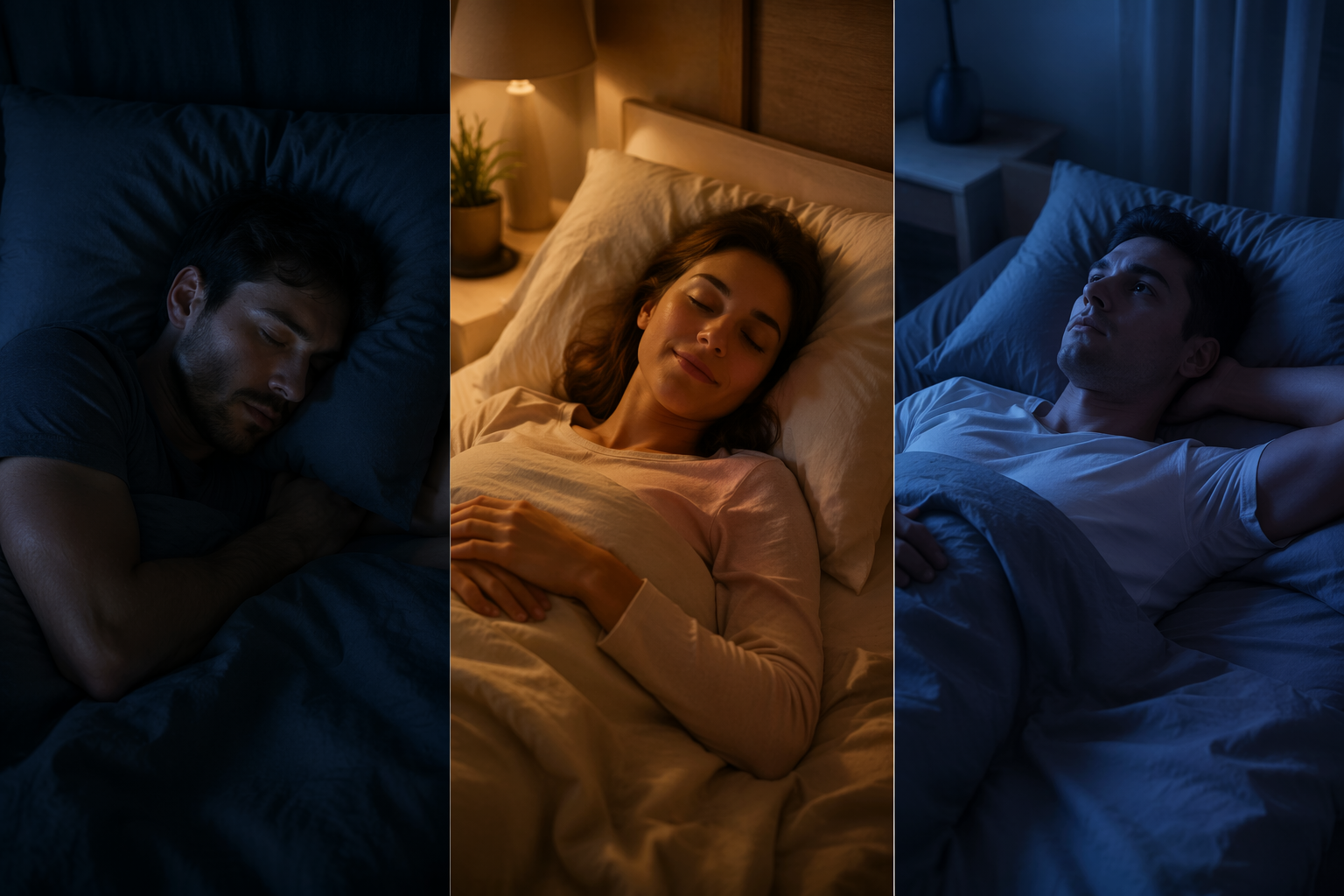
If you can't fall asleep, the first useful number is not eight hours. It is how long it usually takes you to drift off after you intend to sleep. For many healthy adults, normal sleep onset is roughly 10 to 20 minutes. In a large 2023 analysis of multiple sleep latency test data from 4,058 healthy adults, average sleep latency was about 11.7 to 11.8 minutes, which fits that practical range well.[1]
That means lying awake for 12 or 18 minutes is not a failed night. It is often just the body crossing from wakefulness into sleep at a normal pace. The more important question is whether your usual pattern sits in one of three zones: very fast, fairly normal, or regularly prolonged.
| Usual sleep-onset time | What it may suggest | How to read it |
|---|---|---|
| Under 8 minutes | Possible excessive sleepiness or accumulated sleep debt | Fast sleep is not automatically a sign of excellent sleep |
| About 10–20 minutes | Typical range for many healthy younger and middle-aged adults | Usually reassuring if daytime functioning is fine |
| Regularly over 20–30 minutes | Possible sleep-onset insomnia pattern | The pattern matters more than one bad night |
| 30 minutes or more, at least 3 nights per week, for 3 months, with daytime impairment | Consistent with clinical insomnia disorder criteria | Worth discussing with a health professional |
The 10–20 Minute Range Is a Calibration, Not a Grade
Sleep latency is the time between trying to sleep and actually falling asleep. In real life, people usually estimate it from memory, which can be imprecise, especially on anxious nights. Still, the range is helpful because it keeps a normal delay from turning into a crisis.
A person who turns out the light at 11:00 and is still awake at 11:14 is not automatically developing insomnia. The brain does not have to shut down on command. A short period of settling, drifting, and losing track of thoughts is part of ordinary sleep onset.
The 10–20 minute norm is most useful for younger and middle-aged adults. Sleep often becomes more fragmented with age, and older adults may have more wakeful time in bed. That does not mean older adults should ignore distressing or persistent sleep problems; it means the same number may need more individualized interpretation.
Falling Asleep Instantly Is Not Always the Goal
Many people treat instant sleep as proof that they are “good sleepers.” It can be, in the casual sense, a relief. But falling asleep in under 8 minutes can also point to excessive sleepiness or accumulated sleep debt, especially if it happens often or comes with daytime drowsiness.[2]
This matters because the target is not the shortest possible sleep latency. The target is a sleep system that can stay awake when wakefulness is needed, fall asleep within a reasonable window at night, and support alertness the next day. If you are asleep almost as soon as your head touches the pillow, the question is not whether you have mastered sleep. It is whether your body has been asking for more sleep than it has been getting.
That is especially relevant for people who feel proud of being able to sleep anywhere but also need caffeine to function, nod off unintentionally, or feel foggy in quiet situations. The fast sleep onset may be a clue, not a trophy.
When Taking Too Long Starts to Matter
The gray zone begins when falling asleep regularly takes longer than about 20 to 30 minutes. That range should be treated as a zone, not a tripwire. A 28-minute night after a hard conversation, late work, travel, or too much evening stimulation does not carry the same meaning as a months-long pattern of lying awake for an hour.
Clinical insomnia is not diagnosed from one frustrating night. A commonly used threshold includes sleep latency of 30 minutes or more, at least 3 nights per week, lasting at least 3 months, along with daytime impairment.[3] The last part matters. Insomnia is not only what happens in bed; it is also what the night does to the next day.
- How long it usually takes you to fall asleep, not just the worst night this week
- How often it happens across a typical week
- How many weeks or months the pattern has lasted
- Whether you feel impaired during the day: sleepiness, poor concentration, irritability, low energy, or difficulty functioning
- Whether the main problem is falling asleep, staying asleep, waking too early, or some combination
That last distinction is not academic. Sleep-onset difficulty and sleep-maintenance difficulty can point toward different treatment decisions. If your main problem is the first hour of the night, it may help to compare trouble falling asleep versus staying asleep before you lump every bad night under the same label.
A Bad Week Is Different From a Chronic Pattern
Short-term insomnia can last days to weeks and is often tied to stress. Chronic insomnia is generally defined by symptoms that persist for at least 3 months and may become self-perpetuating.[4] The difference is not that acute insomnia feels mild. It may feel awful. The difference is duration, repetition, and whether the pattern has started to maintain itself.
This is why tracking a few nights can be useful, but interrogating the clock every 10 minutes usually is not. If you are lying there doing arithmetic—11:00, 11:23, 11:47—the clock may become part of the arousal loop. The useful record is the pattern you can bring to a clinician or use for triage, not a minute-by-minute trial of your worth as a sleeper.
Why Sleep Onset Drifts Later
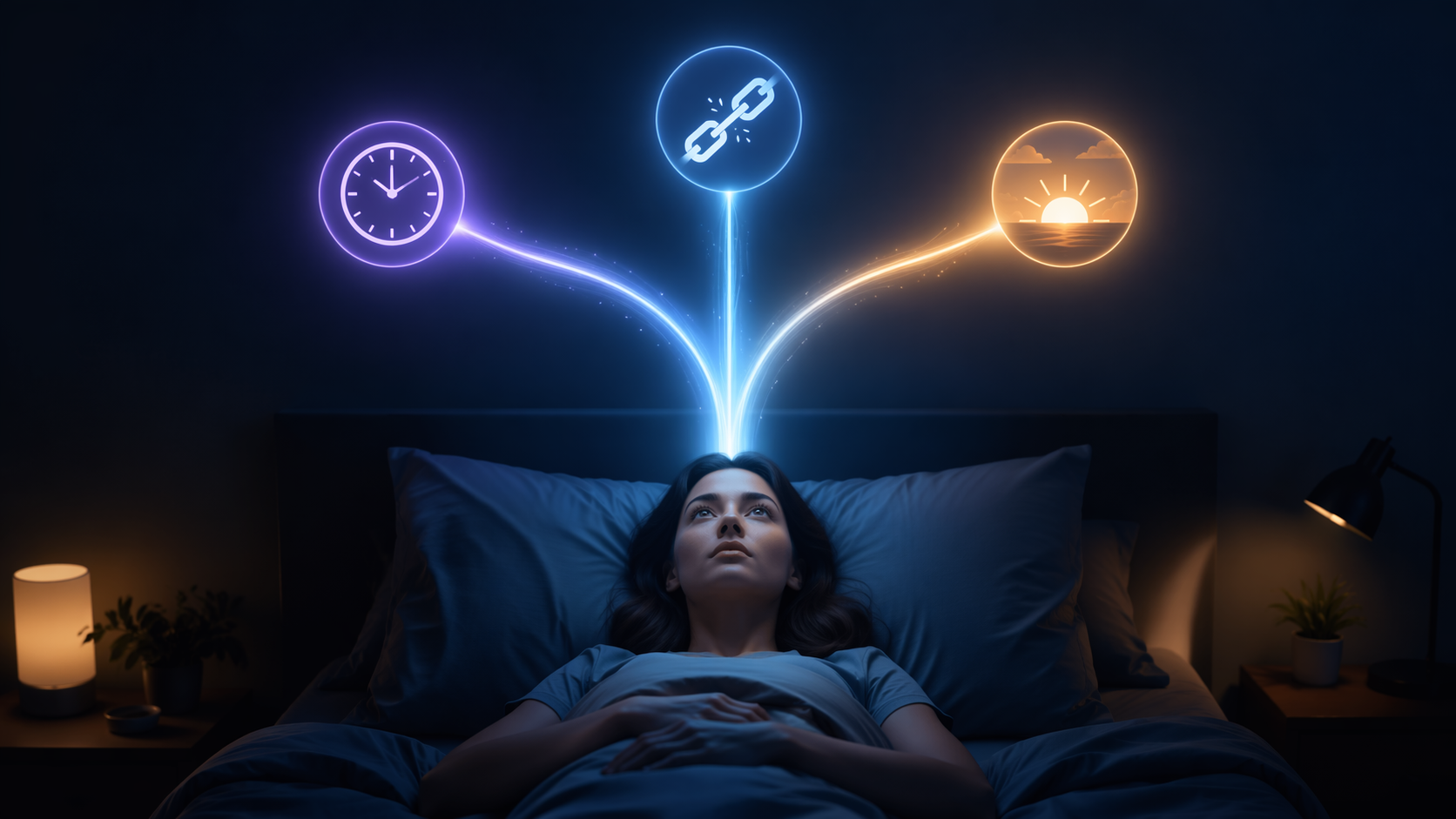
Longer sleep latency can come from several directions. Stress can keep the mind rehearsing. Caffeine can keep the body more alert than the hour suggests. Evening screen use can push alerting cues later. Circadian misalignment can make bedtime arrive before the body is biologically ready. Age-related sleep changes can also make the night feel lighter or more interrupted.[5]
Those causes do not all call for the same response. Someone whose mind is racing at a biologically reasonable bedtime is not in the same situation as someone who is exhausted at 10:00 p.m. but whose body clock is behaving as if it is earlier. If the delay feels like a mind-versus-clock problem, a more specific next step is to sort out whether it is your mind or your clock. If you feel tired but strangely unable to sleep, the issue may be a sleep drive mismatch rather than a simple lack of willpower.
For older adults, generic sleep hygiene advice can miss the point because age-related changes may alter sleep timing, depth, and wakefulness. If that describes you, more tailored guidance on why sleep hygiene advice often fails older adults is a better route than another list of bedtime rules.
How Common Is This?
Trouble falling asleep is common enough that your experience is not unusual, even if it is distressing. In 2020, 14.5% of U.S. adults reported having trouble falling asleep most days or every day. The rate was higher among women, at 17.1%, and among adults ages 18–44, at 15.5%.[6]
That figure is useful for perspective, not for self-diagnosis. The data came from 2020, when pandemic conditions may have affected sleep. It also measures reported difficulty falling asleep, not whether every respondent met criteria for insomnia disorder.[6]
When to Treat It as a Clinical Signal
If you usually fall asleep within 10 to 20 minutes and feel reasonably functional during the day, the number is generally reassuring. If you fall asleep in under 8 minutes most nights and still feel sleepy during the day, consider whether your total sleep opportunity is too short or your sleep is not restorative.
If you regularly take longer than 20 to 30 minutes to fall asleep, look at frequency, duration, and daytime effects. The strongest signal for professional evaluation is a pattern near or beyond 30 minutes, at least 3 nights per week, for 3 months or longer, with daytime impairment.[3]
For people who meet that pattern, the next question is treatment, not another round of reassurance. Cognitive behavioral therapy for insomnia is often discussed as a first-line approach, and a focused explanation of CBT-I is a better next read than a general sleep tips article. If you are still unsure whether your pattern is occasional sleeplessness or insomnia, use a broader sleeping problem versus insomnia triage framework to place the symptom in context.
One long night does not diagnose insomnia. A regular pattern does deserve attention. And falling asleep instantly is not the prize if it is your body collecting on a sleep debt.
References
- Normal multiple sleep latency test values in adults — PubMed, 2023.
- How Sleep Latency Impacts the Quality of Your Sleep — Sleep Foundation.
- Insomnia — Symptoms and Causes — Mayo Clinic.
- Types of Insomnia: Chronic vs. Acute Insomnia — Sleep Foundation.
- 8 reasons why you're not sleeping — Harvard Health.
- Sleep Difficulties in Adults: United States, 2020 — NCHS Data Brief No. 436, CDC.

Comments
Join the discussion with an anonymous comment.