
The useful question in suvorexant vs melatonin for insomnia is not which one is the “better sleep pill.” Melatonin and suvorexant are built for different biological jobs. Melatonin is most plausible when the problem is mild, timing-related, or tied to a body clock that is drifting later. Suvorexant is the stronger evidence-backed option when insomnia is chronic, impairing, and includes sleep maintenance trouble: long awakenings, repeated wake bouts, or the familiar 3 a.m. stretch when sleep will not restart.
That distinction matters before dose, brand, or “natural” status. Someone who cannot fall asleep until midnight after wanting sleep at 10 p.m. is not describing the same pattern as someone who falls asleep quickly and then spends 90 minutes awake before dawn. If that split is still fuzzy, it is worth mapping your symptoms against sleep onset vs. sleep maintenance insomnia before comparing treatments.

The Mechanisms Point in Different Directions
Melatonin is a timing signal. Endogenous melatonin is synthesized from serotonin in the pineal gland under control of the suprachiasmatic nucleus, the brain’s central clock. Supplemental melatonin acts mainly at MT1 and MT2 receptors, and its half-life is generally short, about 1 to 2 hours.[1] That profile fits circadian nudging better than it fits a night-long sedative effect.
This is why melatonin can be reasonable when the issue is “my sleep window is shifted,” especially when timing, light exposure, and dose are handled carefully. It is less convincing when the complaint is “I wake for long stretches and cannot stay asleep.” For that narrower use case, when melatonin actually works for insomnia is usually a question about circadian timing, not simply about taking more milligrams.
Suvorexant works on a different system. Orexin neurons project from the lateral hypothalamus to wake-promoting regions including the locus coeruleus, tuberomammillary nucleus, and raphe nuclei; loss of orexin signaling is tied to narcolepsy. Suvorexant blocks orexin A and orexin B from binding to OX1R and OX2R receptors, with reported Ki values of 0.55 nM and 0.35 nM, respectively.[2] Its purpose is not to imitate the body’s darkness signal. It reduces a wakefulness drive that may be too active at the wrong time.
That difference prevents a lot of false equivalence. Suvorexant has no affinity for GABA, histamine, acetylcholine, dopamine, serotonin, or melatonin receptors, which distinguishes it from older sedative-hypnotic categories and helps explain why it is discussed as a wake-blocking drug rather than a broad central nervous system depressant.[3] For people whose main complaint is persistent wakefulness after sleep has already started, that mechanism is directly relevant.
Efficacy: A Small Signal Versus a Larger Insomnia Trial Program
Melatonin is not useless. The problem is that the average benefit in insomnia studies is modest. In the Ferracioli-Oda meta-analysis, melatonin reduced sleep onset latency by about 7 minutes and increased total sleep time by about 8 minutes versus placebo.[4] Those results can be statistically significant and still feel underwhelming to someone who is losing hours of sleep several nights a week.
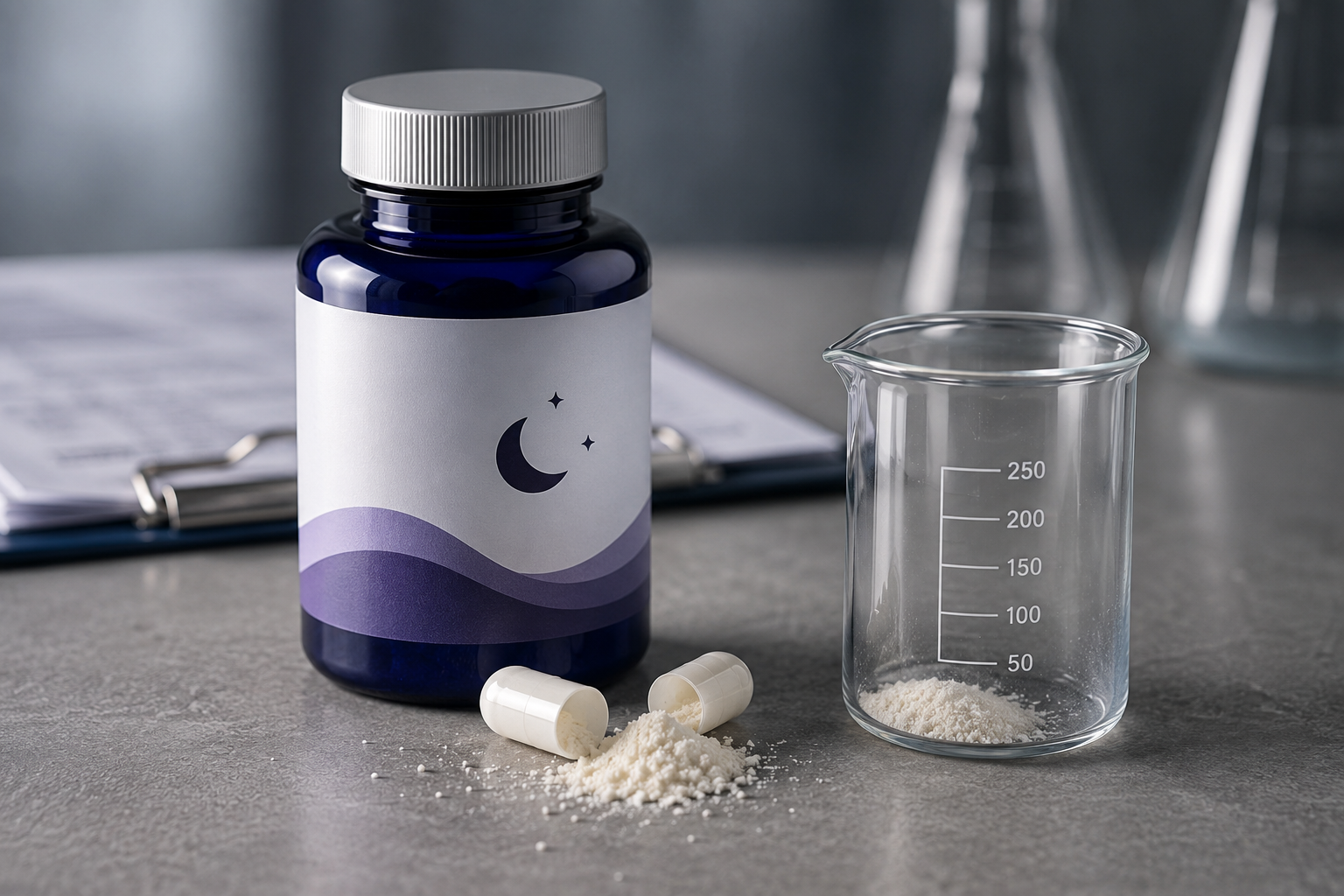
The practical dosing picture is also messy. In an analysis of commercial melatonin products, actual melatonin content ranged from 83% below the labeled amount to 478% above it.[5] That does not mean every bottle is unreliable, and it does not prove a specific person’s supplement failed because of labeling error. It does mean that a patient who says “3 mg did nothing” may not always have taken something close to 3 mg.
Guidelines add an awkward but important tension. Some clinical summaries describe melatonin as a first-line pharmacologic option because it is accessible and generally well tolerated. The American Academy of Sleep Medicine, however, recommends against melatonin for chronic sleep onset or sleep maintenance insomnia in adults.[6] Those statements are not as contradictory as they first sound: low-risk access can make a short trial reasonable, while the evidence can still be too weak to recommend it as a chronic insomnia treatment.
Suvorexant has stronger evidence for chronic insomnia, though the comparison is indirect. There are no head-to-head trials showing suvorexant beating melatonin in the same randomized study. The best comparison comes from separate placebo-controlled trials, and that matters because study populations, doses, outcomes, and expectations differ.
In phase III suvorexant trials, higher 40/30 mg doses improved subjective total sleep time by 19 to 25 minutes versus placebo, while approved-range 20/15 mg doses improved subjective total sleep time by 10 to 22 minutes; subjective time to sleep onset fell by 8 to 13 minutes.[7][8] A separate analysis found that time spent in long wake bouts decreased by 32 to 54 minutes on Night 1 versus placebo.[9] That long-wake-bout outcome is especially relevant for people who do not merely take too long to fall asleep, but spend large pieces of the night awake.
A 2025 network meta-analysis of dual orexin receptor antagonists, including 8 trials and 5,198 participants, reported that suvorexant 20/15 mg outperformed placebo across subjective time to sleep onset, subjective total sleep time, subjective wake after sleep onset, and Insomnia Severity Index outcomes. It also found no evidence of tolerance, withdrawal, or rebound insomnia after abrupt discontinuation.[10] That finding is helpful, but not the same as a direct melatonin comparison, and the analysis was industry-sponsored, so it should carry weight without being treated as the final word.
| Question | Melatonin | Suvorexant |
|---|---|---|
| Main biological target | Circadian timing through MT1/MT2 signaling | Orexin-mediated wakefulness through OX1R/OX2R blockade |
| Best fit | Mild insomnia, delayed sleep timing, circadian misalignment | Moderate-to-severe chronic insomnia, especially with maintenance difficulty |
| Average trial signal | About 7 minutes faster sleep onset and about 8 minutes more total sleep time vs. placebo | Approved-range doses improved subjective total sleep time by 10 to 22 minutes vs. placebo in phase III trials |
| Major practical limitation | Weak maintenance-insomnia evidence and variable supplement content | Prescription access, Schedule IV status, next-day impairment warnings, and cost |
Safety and Access Change the Decision
Melatonin’s appeal is partly that the downside is usually limited. It is available over the counter in the United States, has minimal dependence concern, and is generally associated with mild side effects. The tradeoff is that it is not FDA-approved for insomnia treatment, its maintenance-insomnia evidence is weak, and supplement variability makes precise dose experiments less clean than they appear on the label.[5][6]
Suvorexant has a more formal risk-and-access profile. Belsomra is FDA-approved for insomnia characterized by difficulties with sleep onset and/or sleep maintenance, and it is a Schedule IV controlled substance.[11] In trials and labeling discussions, somnolence is a central adverse effect, with reported rates of 7% to 13% versus 3% for placebo, and the drug carries next-day driving impairment warnings.[11]
The absence of observed physiological tolerance, withdrawal, or rebound insomnia in clinical trials is reassuring, but it does not erase the everyday safety question: will you be alert enough the next morning for your commute, your job, caregiving, or fall-risk situation?[10][11] Older adults should treat that question as central, not secondary; the same is true for anyone already taking sedating medications. Readers weighing sleep aids later in life may need a broader safety review of sleep aids for people over 65.
Cost is not a footnote. In 2026, the brand-only cash price for suvorexant is commonly in the range of about $435 to $475 per month without insurance, though manufacturer savings may reduce eligible patients’ cost to about $30 per month.[12] That price gap can decide the answer even when the biology points toward suvorexant. A medication that works on paper but is unaffordable or repeatedly denied at the pharmacy is not a stable treatment plan.
Which Situation Fits Which Option?
If your main problem is delayed timing, melatonin is usually the more coherent starting point. That means patterns like feeling sleepy too late, waking too late when allowed, or struggling after a schedule shift. The details matter: timing, light exposure, consistency, and dose can matter more than simply increasing the amount. For a deeper mechanism view, it helps to understand how circadian rhythm mechanisms regulate sleep and wake cycles.
If your main problem is sleep maintenance, suvorexant is often the more biologically matched option to discuss. Waking for long bouts after initially falling asleep suggests that the issue may not be a missing sleep-onset cue. It may involve wakefulness systems reasserting themselves during the night. That is why sleep maintenance insomnia often needs a different treatment conversation than delayed sleep onset.
If your insomnia is mild and recent, the case for jumping quickly to suvorexant is weaker. A short, carefully timed melatonin trial may be reasonable, especially if your clinician agrees that the pattern looks circadian. But if you have spent months changing gummy doses, waking unrefreshed, and losing functioning during the day, the more useful question is not whether you were patient enough. It is whether the treatment matched the complaint.
Perimenopause can complicate the choice because night sweats, mood symptoms, changing sleep architecture, and early-morning awakenings can overlap. Melatonin may still help a timing problem, and suvorexant may still help maintenance insomnia, but neither one treats every driver of midlife sleep disruption. A broader review of perimenopause insomnia treatments may be more useful than escalating one sleep aid in isolation.
Other prescriptions may also enter the conversation. For example, very-low-dose doxepin is sometimes considered for sleep maintenance symptoms, and a separate discussion of Silenor for 3 a.m. wake-ups may be relevant if cost, insurance rules, or next-day impairment concerns make suvorexant difficult.
What to Bring to the Clinician Conversation
The most productive visit is not “melatonin failed, can I have something stronger?” It is more specific: I fall asleep in this many minutes; I wake this many times; the longest wake bout is usually around this long; the worst part of the night is sleep onset, sleep maintenance, or early-morning awakening; and the daytime consequence is sleepiness, impaired work, mood symptoms, unsafe driving, or something else.
Also bring the melatonin details: product type, labeled dose, timing, how many nights you used it, whether it helped sleep onset at all, and whether it changed morning grogginess or dreams. Because supplement content can vary widely, it is fair to tell your clinician that your trial was real but not perfectly controlled.[5]
For suvorexant, the conversation should include driving, work schedule, fall risk, other sedating medications, substance-use history, insurance coverage, and what you would do if the pharmacy price is too high. It should also include the size of benefit you would consider meaningful. For one person, 20 more minutes of sleep is not enough. For another, fewer long wake bouts may change the whole next day.
The clearest answer is pattern-based. Melatonin is a reasonable tool when the insomnia is mild or timing-driven. Suvorexant has stronger evidence when chronic insomnia includes meaningful sleep maintenance difficulty. Neither choice is a character test, and neither should be treated as automatically sensible without matching the biology of the complaint to the strength, risks, and affordability of the intervention.
References
- Melatonin. StatPearls, NCBI Bookshelf, 2024.
- Suvorexant in the Treatment of Insomnia: Evidence to Date. Psychopharmacology Bulletin, 2022.
- Suvorexant: Efficacy, Safety and Place in Therapy. Therapeutic Advances in Drug Safety, 2015.
- Meta-Analysis: Melatonin for the Treatment of Primary Sleep Disorders. PLOS ONE, 2013.
- Melatonin Natural Health Products and Supplements: Presence of Serotonin and Significant Variability of Melatonin Content. Journal of Clinical Sleep Medicine, 2017.
- Clinical Practice Guideline for the Pharmacologic Treatment of Chronic Insomnia in Adults: An American Academy of Sleep Medicine Clinical Practice Guideline. Journal of Clinical Sleep Medicine, 2017.
- Suvorexant in Patients With Insomnia: Results From Two 3-Month Randomized Controlled Clinical Trials. Biological Psychiatry, 2016.
- Safety and Efficacy of Suvorexant During 1-Year Treatment of Insomnia With Subsequent Abrupt Treatment Discontinuation: A Phase 3 Randomised, Double-Blind, Placebo-Controlled Trial. The Lancet Neurology, 2014.
- Evaluation of the Effect of Suvorexant on Time in Long Wake Bouts in Patients With Insomnia. Sleep, 2018.
- Comparative Efficacy and Safety of Dual Orexin Receptor Antagonists for Insomnia: A Systematic Review and Network Meta-Analysis. Translational Psychiatry, 2025.
- BELSOMRA (suvorexant) Prescribing Information. U.S. Food and Drug Administration.
- BELSOMRA Savings Coupon. Belsomra.com, 2026.


Comments
Join the discussion with an anonymous comment.