
You survived the crash. The car is no longer moving, the glass is gone, the police report is filed, and yet your body may still act as if danger is close every time the room gets quiet. That is the part many people are not prepared for: the accident can be over in the outside world while the nervous system is still scanning, bracing, and replaying it at night.
If you want the broader overview of post-crash sleep disruption, start with why you can’t sleep after a car accident. This article goes deeper into one specific problem: how car accident stress causes insomnia through hyperarousal, why generic sleep hygiene often falls short, and when the pattern has lasted long enough to deserve professional help.
The short version is this: post-accident insomnia is often less about “bad sleep habits” and more about a threat system that has not stood down. That does not mean every sleepless person after a crash has PTSD. It does mean the insomnia deserves more respect than “just relax.”

Why the Brain Keeps Replaying Danger at Night
A crash is not processed like an ordinary bad day. During and after a frightening event, the brain has to decide what is dangerous, what should be remembered, and what must be avoided next time. The amygdala helps detect threat. The hippocampus helps place memories in time and context. When the system stays activated, sleep can become another place where the brain keeps checking for danger instead of letting go.
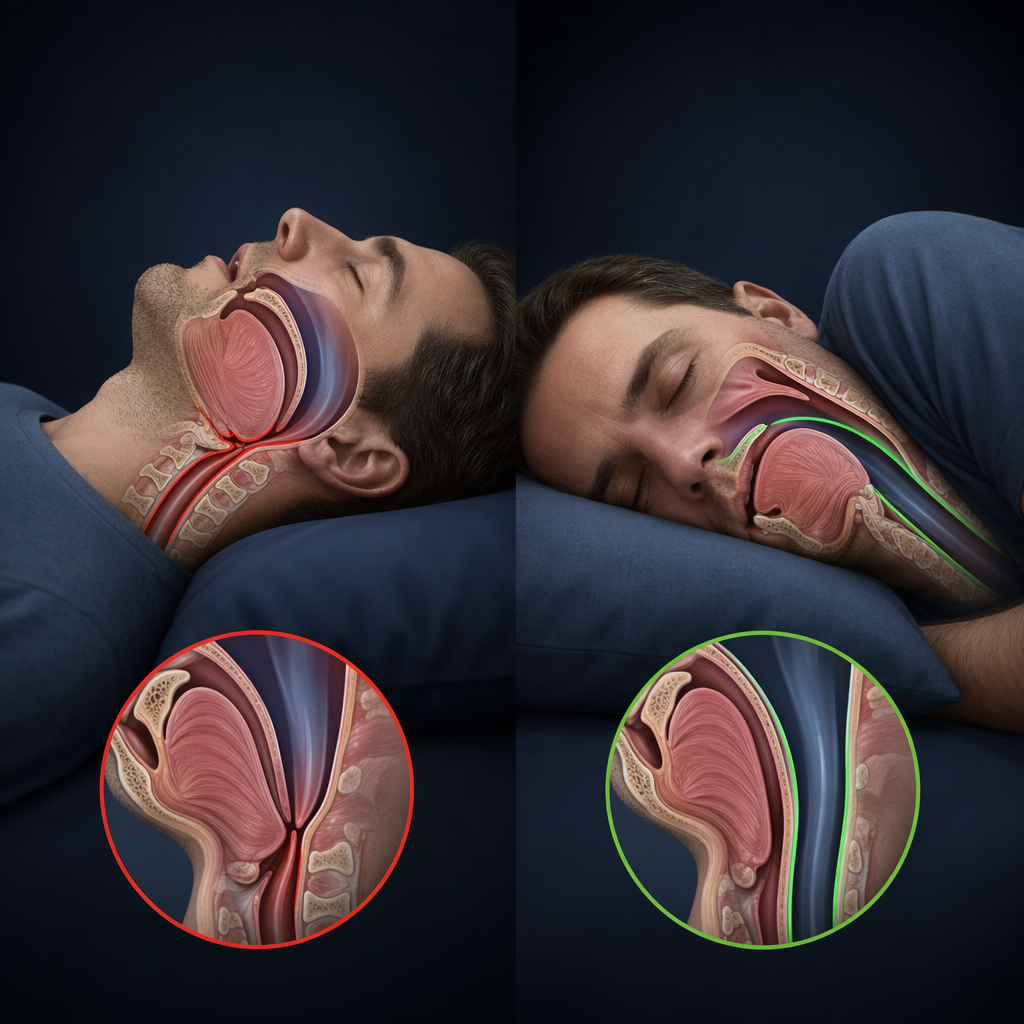
That state is often called hyperarousal. It can show up as a racing heart when you lie down, sudden alertness at a small sound, a jolt awake just as you drift off, or the feeling that your body is tired but your brain will not release its grip. The VA National Center for PTSD describes PTSD-related sleep problems as involving a body that remains on alert, with more light stage 1 sleep and fragmented REM sleep rather than the stable architecture sleep needs to feel restorative.[1]
That matters because REM is one of the stages involved in emotional memory processing. When REM is repeatedly broken, and the night contains too much shallow sleep, people may wake up feeling as if they never truly went offline. Sleep Foundation similarly describes PTSD as disrupting sleep through nightmares, hyperarousal, and changes in REM sleep, though not every trauma survivor develops PTSD.[2]
The numbers are sobering, but they should be used carefully. A 2025 systematic review and meta-analysis estimated that 20.3% of road traffic accident survivors develop PTSD, with rates varying by country and study context.[3] Among people who do have PTSD, insomnia is very common: estimates commonly place insomnia in the 80–90% range among PTSD cases, and the VA also describes sleep problems and nightmares as central concerns for many people with PTSD.[1]
So if you are awake at 3 a.m. replaying the impact, listening for every passing car, or avoiding sleep because you fear another nightmare, the reaction is not strange. It is also not proof, by itself, that you have PTSD. The first weeks after trauma can include intense, distressing reactions that later settle. The question is whether the cycle is loosening or tightening.
The Hyperarousal-Insomnia Loop
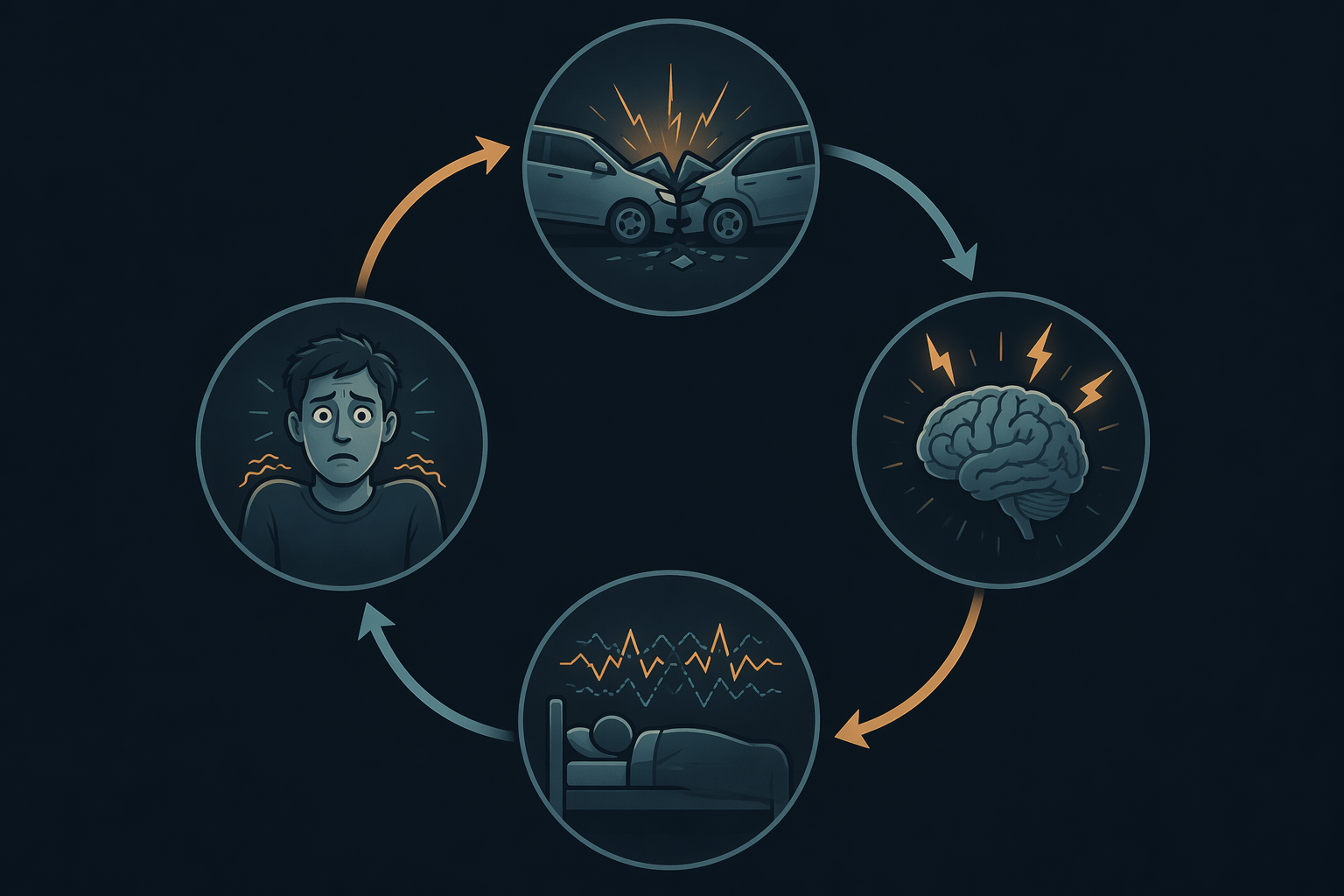
The loop usually does not begin with a single thought. It begins with a body state. The nervous system learned, very recently, that danger can arrive fast. At night, when distractions fall away, the brain has fewer competing signals. The bed becomes quiet enough for memory fragments, body sensations, and threat scanning to get louder.
| Part of the loop | How it can feel in bed | What it can feed next |
|---|---|---|
| Crash stress | Images, sounds, or body sensations from the accident return | Fear of another replay or nightmare |
| Hyperarousal | Heart racing, muscle tension, startle response, checking noises | Longer sleep onset and lighter sleep |
| Fragmented sleep | Waking often, waking early, feeling unrefreshed | Daytime irritability, pain sensitivity, vigilance |
| Avoidance | Staying up late, sleeping on the couch, using alcohol, avoiding driving reminders | The bed and nighttime become linked with danger |
Once insomnia starts, it can become its own source of threat. You may begin watching the clock, calculating how ruined tomorrow will be, or bracing for the same nightmare. The bed stops being a neutral place. It becomes the place where your body expects another round.
This is where help for car accident stress and insomnia has to be more specific than “make your room dark.” Darkness can support sleep, but it does not retrain a brain that has started treating sleep as unsafe. The target is the loop: threat activation, conditioned wakefulness, fragmented sleep, and the daytime consequences that keep the system on edge.
Pain can tighten the same loop. In a 2023 Scientific Reports study of people with road traffic injuries, approximately 69% of motor vehicle accident survivors with PTSD experienced a mutually reinforcing cycle of pain and sleep disruption.[4] That finding comes from a specific study context, so it should not be treated as a universal rate for every crash survivor. But the clinical pattern is recognizable: pain wakes you, poor sleep lowers your tolerance for pain, and the next night begins with more dread.
Why Sleep Hygiene Alone Usually Is Not Enough
A steady bedtime, a cooler room, morning light, and less late caffeine can still matter. They reduce extra friction. They are worth doing, especially when your sleep system is already strained. But they are support beams, not the main repair, when the central problem is trauma-linked hyperarousal.
The problem with ordinary sleep hygiene advice is that it often assumes the person wants to sleep and simply has an unhelpful routine. After a crash, the person may want sleep desperately and still have a body that treats sleep as a vulnerable state. A lavender bath does not teach the brain that waking at 2:13 a.m. after a nightmare is survivable. A darker room does not stop clock-watching from becoming a nightly alarm system.
For routine foundations, sleep hygiene fundamentals can help you remove obvious sleep disruptors. Just do not mistake those foundations for a full treatment plan if the insomnia is being driven by accident memories, nightmares, avoidance, pain, or persistent vigilance.
What Works Better: CBT-I and Targeted Self-Regulation
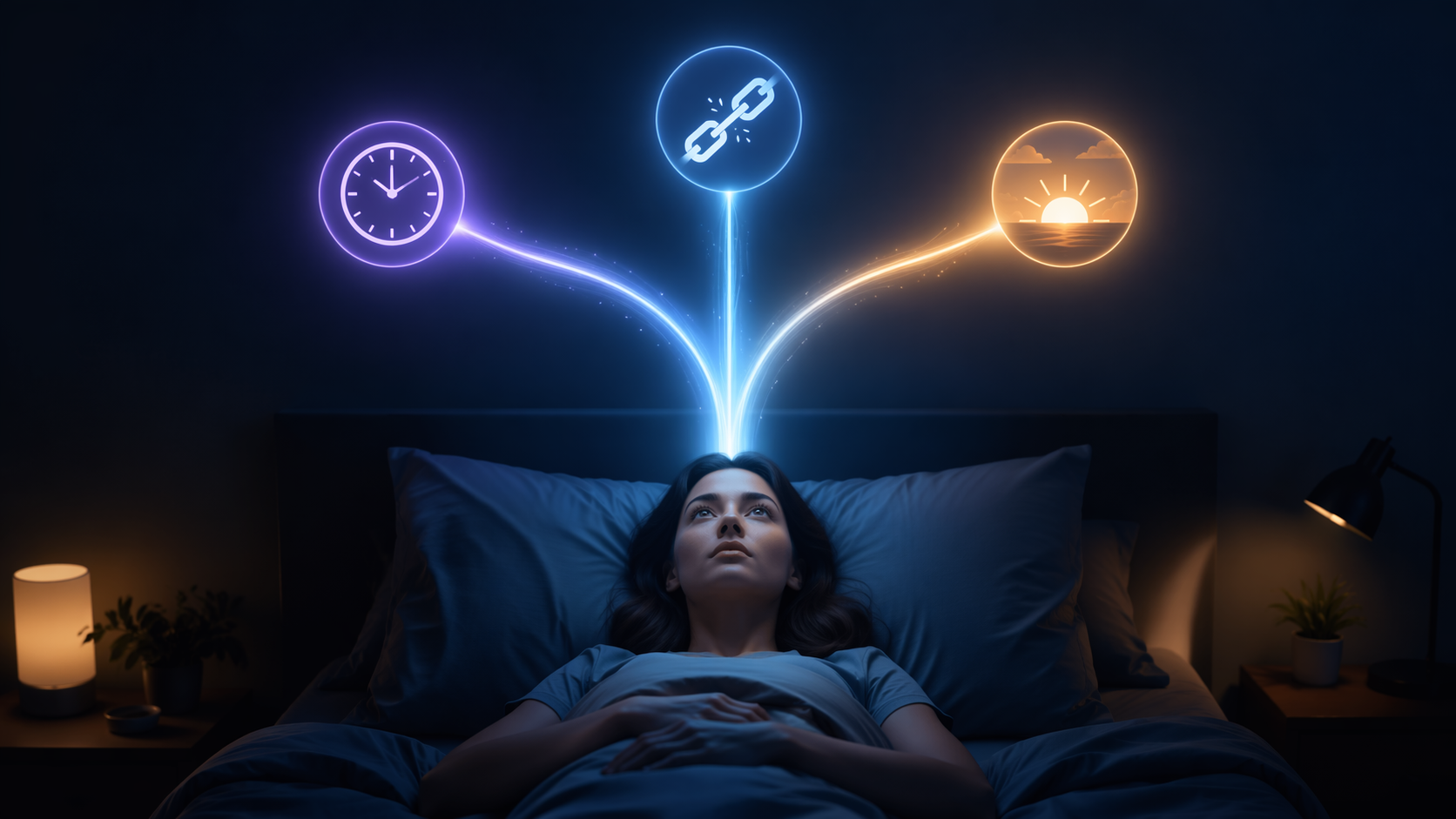
Cognitive behavioral therapy for insomnia, or CBT-I, is the main evidence-based treatment to know about because it changes the sleep system directly. It is not general talk therapy and it is not just relaxation. CBT-I works on the behaviors and beliefs that keep insomnia going: time spent awake in bed, conditioned arousal, irregular sleep timing, catastrophic sleep thoughts, and the mismatch between sleep opportunity and actual sleep ability.
Sleep Foundation describes CBT-I as a first-line treatment for chronic insomnia and notes that it is recommended by major medical groups including the American College of Physicians and the American Academy of Sleep Medicine.[5] The VA’s PTSD sleep materials also state that about 7 in 10 people who complete CBT-I improve.[1] That does not mean every person improves quickly or completely. It does mean CBT-I has a stronger claim than a pile of calming tips.
If you want a fuller explanation of the model, see what actually cures insomnia with CBT-I. For post-crash insomnia, the most relevant CBT-I pieces are usually stimulus control, sleep scheduling, and cognitive work around fear of the night.
Stimulus Control: Stop Teaching the Bed to Mean Danger
Stimulus control is the part many people resist because it sounds too simple: if you are awake and activated in bed for long stretches, you get out of bed and return when sleepy. The point is not punishment. The point is to stop pairing the bed with panic, replay, clock-watching, and helpless waiting.
This has to be done gently after trauma. You are not trying to win a discipline contest at 3 a.m. You are giving the nervous system a different script: bed is for sleep; if danger mode turns on, you move to a quiet, low-light place and do something boring or regulating until sleepiness returns. No phone scrolling, no crash videos, no legal paperwork, no searching symptoms until dawn.
Paced Breathing and Muscle Relaxation: Useful, but Not Magic
Paced breathing and progressive muscle relaxation can help bring the body down from fight-or-flight. They are especially useful when your main obstacle is physical activation: tight chest, clenched jaw, raised shoulders, restless legs, or the sense that sleep is close but your body keeps jerking itself awake.
- For paced breathing, choose a rhythm that feels comfortable rather than impressive; the goal is steadiness, not breath-holding.
- For progressive muscle relaxation, tense and release one muscle group at a time, skipping any injured areas.
- Use these skills before the peak of panic when possible; they are harder to learn for the first time during a full adrenaline surge.
- If focusing on the body increases flashbacks or panic, stop and use an external anchor instead, such as naming objects in the room.
The VA’s free CBT-i Coach app includes tools for sleep tracking, stimulus control, and relaxation practice.[6] It is not a replacement for a clinician when symptoms are severe or persistent, but it can give structure in the early weeks when “try to relax” is too vague to be useful.
Cognitive Work: Separate Memory From Current Threat
After a crash, the mind often makes nighttime predictions with the intensity of facts: “If I fall asleep, I’ll have the nightmare.” “If I stop replaying it, I won’t be prepared.” “If I’m exhausted tomorrow, I’ll lose control.” CBT-I does not ask you to pretend those fears are silly. It asks you to test whether they are helping and whether they are accurate enough to deserve control of the night.
This overlaps with the racing-mind pattern many insomnia patients recognize. If rumination is the main thing keeping you awake, strategies for a racing mind at night may help, especially when paired with stimulus control rather than done while lying in bed for hours.
What Can Backfire After a Crash
Some well-meant responses can deepen the loop. Alcohol is a common one. It may make sleep onset feel easier, but it can fragment sleep and weaken the brain’s ability to learn that nighttime is safe. Avoidance can also spread. At first, you avoid the intersection. Then you avoid driving at night. Then you avoid sleeping because nightmares feel like another collision.
There is also a caution about forced, single-session psychological debriefing immediately after a crash. Beck and Coffey’s review of PTSD after motor vehicle collisions notes that single-session psychological debriefing has not been shown to prevent PTSD and may worsen outcomes for some people.[7] That does not mean people should stay silent. It means being pushed through a one-size-fits-all emotional processing session is not the same as receiving trauma-informed care.
How to Tell Early Stress From a Pattern That Needs Help
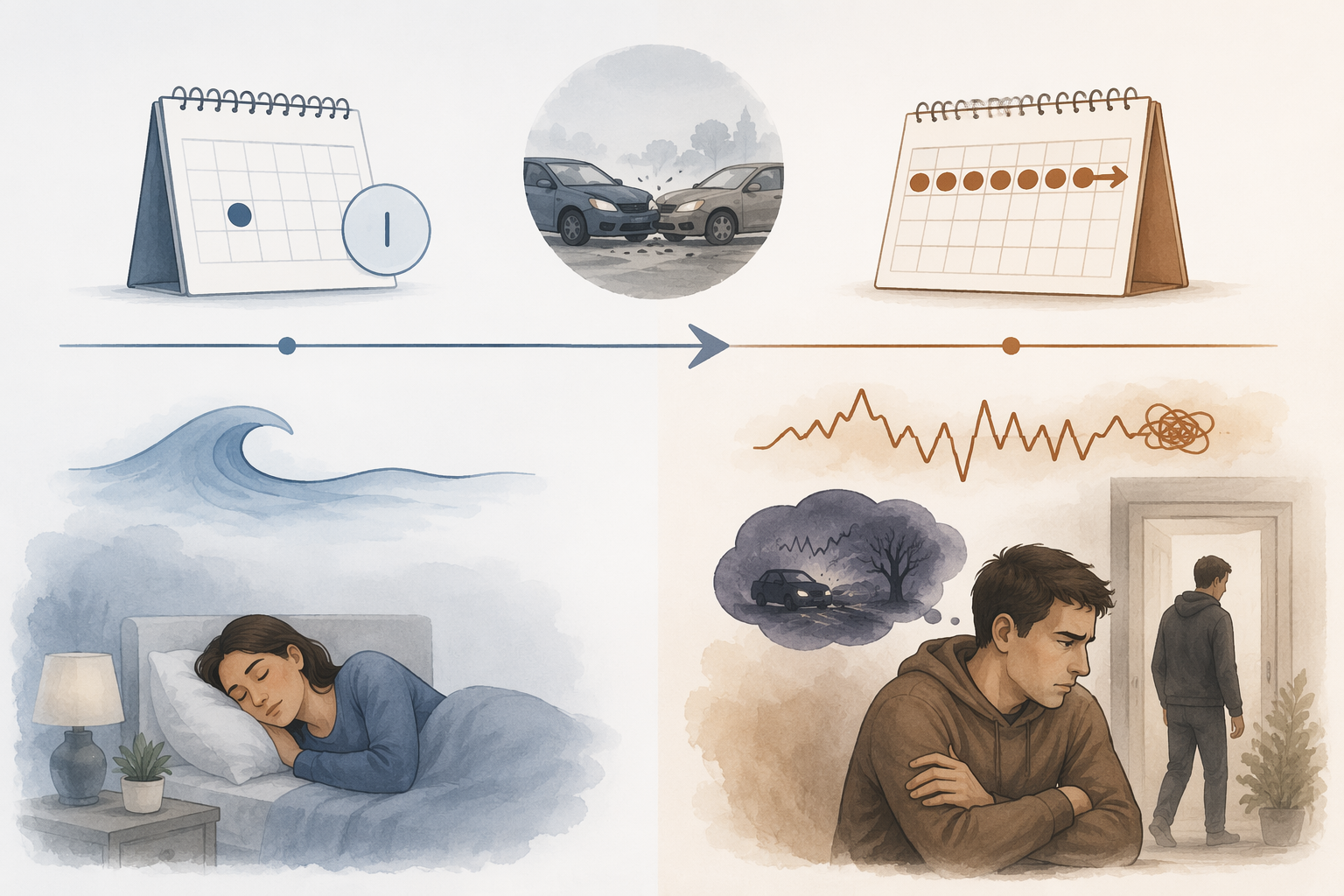
The first month after a traumatic event can be rough without meaning you are broken. Sleep Education from the American Academy of Sleep Medicine describes sleep disturbance after trauma as common and notes that symptoms may improve over time, while persistent or worsening symptoms deserve attention.[8] The VA also notes that about half of people with PTSD improve within 3 months without treatment, which is a reason for hope, not a reason to ignore a worsening pattern.[1]
Use time and function together. A few bad nights right after the crash are different from weeks of escalating avoidance, nightmares, panic, pain, and daytime impairment. The practical question is not “Am I reacting correctly?” It is “Is my system recovering, stuck, or getting more trapped?”
| What you notice | What it may suggest | Reasonable next step |
|---|---|---|
| Sleep is disrupted in the first days or weeks, but gradually improving | Acute stress response may be settling | Use structure, support, and self-regulation; keep watching the trend |
| You dread bedtime, replay the crash, or wake easily, but still function most days | Hyperarousal is active and may be becoming conditioned | Start CBT-I-style tools early; consider professional support if it persists |
| Nightmares, avoidance, startle response, and daytime impairment continue beyond 1 month | Possible trauma-related disorder or insomnia disorder needing evaluation | Seek assessment from a clinician familiar with trauma and sleep |
| Pain and poor sleep keep escalating together | Pain-insomnia loop may be maintaining both problems | Ask for coordinated help rather than treating sleep and pain as separate problems |
| You feel unsafe with yourself, unable to function, or at risk while driving from sleep loss | Urgent safety concern | Contact emergency help or a qualified clinician promptly |
For a broader time-based framework, see this adult insomnia self-triage guide. After a crash, though, the threshold should be especially clear: symptoms lasting beyond one month, especially when nightmares, hyperarousal, avoidance, worsening function, or pain-sleep escalation are present, deserve professional evaluation.
What to Do This Week
If you are still in the first several weeks after the accident and the symptoms are not dangerous or rapidly worsening, start with actions that match the mechanism rather than actions that merely sound soothing.
- Track the pattern for a few nights: bedtime, wake time, nightmares, pain, alcohol, naps, and how long you lie awake in bed.
- Use stimulus control when the bed becomes a replay chamber: leave the bed during prolonged alert wakefulness and return when sleepy.
- Practice one body-downshift skill daily, such as paced breathing or progressive muscle relaxation, before you need it urgently.
- Protect sleep opportunity without extending time in bed endlessly; too much awake time in bed can strengthen conditioned insomnia.
- If pain is waking you, treat pain management as part of sleep treatment, not a separate issue to tolerate silently.
- If symptoms pass the one-month mark or keep intensifying, look for CBT-I and trauma-informed care rather than waiting passively.
There is no shame in a nervous system acting changed after it was forced through danger. There is also no virtue in suffering through treatable insomnia because someone told you time alone would fix it. The crash may have taught your brain to stay awake for protection; recovery often means teaching it, carefully and repeatedly, that sleep is allowed again.
References
- Sleep Problems and PTSD — VA National Center for PTSD
- How Post-Traumatic Stress Disorder Affects Sleep — Sleep Foundation
- A systematic review and meta-analysis of the prevalence of PTSD in road traffic accident survivors — PMC, 2025
- Sleep disorders among patients suffering from road traffic injuries — Nature Scientific Reports, 2023
- Cognitive Behavioral Therapy for Insomnia (CBT-I): How It Works — Sleep Foundation
- Mobile App: CBT-i Coach — VA National Center for PTSD
- Assessment and treatment of PTSD after a motor vehicle collision — PMC, 2007
- Sleeping after a trauma — Sleep Education, AASM

Comments
Join the discussion with an anonymous comment.