
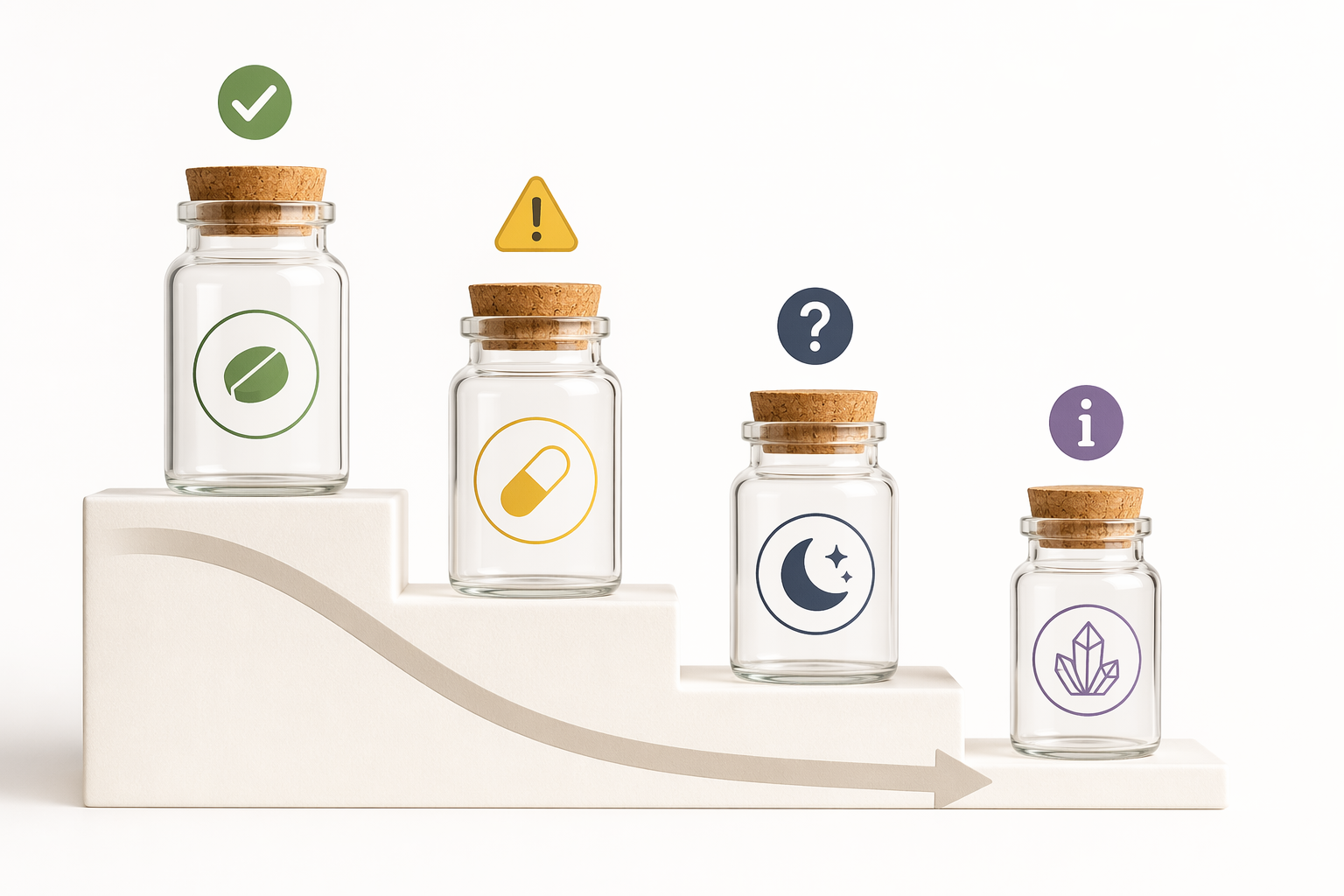
If you are comparing safe sleep aids for pregnancy insomnia tonight, the most useful question is not which bottle looks familiar. It is which option has pregnancy-specific safety evidence behind it, and what kind of use that evidence actually covers. Cognitive behavioral therapy for insomnia and behavioral treatment remain the preferred path for ongoing insomnia in pregnancy, especially when sleeplessness is frequent rather than occasional, but many people still face a very practical decision before their next prenatal visit.[1]
| Option | How it is sold | Pregnancy-specific safety evidence | Best-supported reading |
|---|---|---|---|
| Doxylamine | FDA-regulated OTC antihistamine; also part of prescription doxylamine-pyridoxine products for nausea | Strongest of the four. Doxylamine with pyridoxine is identified by ACOG as safe for nausea in pregnancy, and clinical references describe a long safety record for the doxylamine-pyridoxine formulation.[2][3] | Most evidence-supported OTC drug option in this comparison, though sleep use should still be discussed if frequent. |
| Diphenhydramine | FDA-regulated OTC antihistamine | Generally considered acceptable for occasional use, but the pregnancy literature is less tidy, with some conflicting birth-defect findings and rare concerns with daily late-pregnancy exposure.[4] | Reasonable to ask about for occasional nights; less clean than doxylamine. |
| Melatonin | Dietary supplement | Uncertain. It crosses the placenta, and human fetal safety trials have not established safety for insomnia treatment in pregnancy.[5] | Not on the same evidence footing as older antihistamines, despite being marketed as natural. |
| Magnesium | Dietary supplement or nutrient in prenatal nutrition | Ordinary supplemental pregnancy limits are a nutrition question; insomnia benefit in pregnant populations has not been validated in controlled trials. | May be appropriate for nutrition when indicated, but not proven as a pregnancy insomnia treatment. |
That ranking separates two issues that are often blurred together on labels and in forum replies. Doxylamine and diphenhydramine are OTC drugs. Their active ingredients, manufacturing, and labeling sit in a different regulatory world from dietary supplements. Melatonin and magnesium may be easy to buy from the same pharmacy aisle, but that does not make their evidence comparable.
It also separates safety from effectiveness. A substance can be a generally safe nutrient and still not be a proven treatment for pregnancy insomnia. A medication can have reassuring pregnancy data in one context and still deserve a more careful conversation if the plan is nightly use for sleep.
Why doxylamine ranks first
Doxylamine is the active antihistamine in Unisom SleepTabs and is also part of the prescription doxylamine-pyridoxine combination used for nausea and vomiting of pregnancy. That second history matters. ACOG’s patient guidance describes vitamin B6 plus doxylamine as safe and notes that a prescription combination is FDA-approved for morning sickness.[2]
Clinical references also describe the doxylamine-pyridoxine formulation as having an unusually reassuring pregnancy record. StatPearls notes that the combination has been classified historically as FDA Category A, meaning adequate and well-controlled studies in pregnant women did not show risk to the fetus, and it describes the older 1970s birth-defect controversy around Bendectin as later disproven by multiple studies and meta-analyses.[3]
The old Category A language needs translation, not nostalgia. FDA pregnancy labeling no longer relies on the old A, B, C, D, and X letters; current labeling asks for a narrative risk summary. So the point is not that a letter grade should settle the question in 2026. The point is that doxylamine, especially in the doxylamine-pyridoxine pregnancy literature, has a deeper and more pregnancy-specific safety record than the other OTC sleep-aid choices in this comparison.
That does not make every sleep-use pattern identical to nausea treatment. Nausea regimens may involve different timing, symptom goals, and clinical follow-up than taking a sedating antihistamine because you cannot sleep. For a single rough night, the practical question for an OB-GYN is usually different from the question for nightly use across weeks.
- Ask whether doxylamine is appropriate for your trimester, medical history, and other medications.
- Clarify whether you mean occasional use or repeated use; those are not the same exposure pattern.
- Check the exact product. Unisom SleepTabs contain doxylamine, while some other sleep products use diphenhydramine instead.
- Avoid stacking sedating products unless your clinician specifically reviews the combination.
Diphenhydramine is common, but the evidence is messier
Diphenhydramine is the active ingredient many people recognize from Benadryl and some nighttime sleep products. It is also an older antihistamine, and it is often treated as a familiar pregnancy option. Familiar is not meaningless, but it is not the same as having the cleanest pregnancy-specific evidence.
MotherToBaby’s diphenhydramine fact sheet gives the kind of careful answer that is more useful than a quick yes or no. It states that occasional use at recommended doses is not expected to increase the chance of birth defects, while also noting that some studies have reported a higher chance for certain birth defects and others have not; importantly, no consistent pattern has been confirmed.[4]
That is what “conflicting data” means here. It does not mean a clear, repeated signal that diphenhydramine causes a specific defect. It means scattered findings have appeared in some studies, have not lined up consistently across the broader evidence, and should be weighed differently from the long doxylamine-pyridoxine pregnancy record.
The timing and frequency question matters more with diphenhydramine than many labels make obvious. MotherToBaby notes reports of withdrawal symptoms in newborns when diphenhydramine was used daily throughout pregnancy, and it also flags that use near delivery can be associated with temporary newborn symptoms such as tremors and diarrhea.[4]
For a patient conversation, that narrows the point: diphenhydramine may be reasonable for occasional use when a clinician agrees, but daily late-pregnancy use is a different question. If insomnia has become frequent enough that you are considering taking it most nights, the issue is no longer just which OTC box to buy. It is whether the insomnia itself needs treatment planning.
Melatonin has two separate uncertainty problems
Melatonin is where “natural” can become a misleading shortcut. The body makes melatonin, and melatonin supplements are widely marketed for sleep, but pregnancy safety is not established simply because a hormone exists naturally.
The first uncertainty is fetal safety. A pharmacotherapy review on sleep disorders in pregnancy notes that melatonin crosses the placenta freely and that human studies establishing safety for insomnia treatment in pregnancy are lacking.[5] That does not prove harm. It means the evidence has not done the work people often assume it has done.
The second uncertainty is product quality. Melatonin is sold as a dietary supplement, not as an FDA-regulated OTC drug. Supplement labels can vary in how accurately they reflect the actual dose in the bottle, which makes a pregnancy risk conversation harder: the clinician is not only asking whether melatonin is appropriate, but also what exposure the patient is truly getting.
Those are different problems. A perfectly labeled melatonin product would still face the fetal-safety evidence gap. An inaccurately labeled product adds a dosing problem on top of that gap. For pregnancy insomnia, melatonin should not be treated as safer than doxylamine or diphenhydramine just because it sits in the supplement aisle.
Magnesium is a nutrition discussion before it is a sleep-aid discussion
Magnesium deserves a calmer answer than melatonin, but not a stronger one. It is an essential mineral, and ordinary supplemental use within pregnancy nutrition limits is a different kind of concern from taking an unreviewed sedative. But the claim being examined here is narrower: magnesium as a sleep aid for pregnancy insomnia.
The pregnancy-specific evidence for magnesium does not support saying that it has been validated in controlled trials for insomnia in pregnant populations. Evidence sometimes cited for magnesium and sleep comes from nonpregnant adult or older-adult populations, which cannot simply be moved over to pregnancy and treated as proven pregnancy insomnia care.
So the useful question is not “Is magnesium good or bad?” It is whether you have a nutrition indication, whether the dose fits prenatal guidance, and whether insomnia is being treated with something that has actually been studied for that purpose in pregnant patients.
When OTC sleep aids are the wrong size for the problem
A single bad night and persistent insomnia should not be managed as if they are the same problem. The MGH Center for Women’s Mental Health review notes that insomnia in pregnancy is common and discusses behavioral treatment as part of the clinical approach; it also cites a UCSF study in which women with severe sleep disruption had a 4.5-fold higher risk of cesarean section, a finding that should be understood as coming from that study rather than as a universal rule.[1]
That is one reason “just tough it out” is not a satisfying safety plan. Poor sleep can have consequences, and avoiding every medication is not automatically the lowest-risk option. But the answer is still not to flatten all nonprescription choices into one reassuring category.
For an OB-GYN visit or message, bring the comparison in concrete terms: the product name, the active ingredient, the dose on the label, how often you expect to use it, your trimester, and whether you are also taking nausea medicine, allergy medicine, antidepressants, anti-anxiety medication, pain medication, or other sedating products. That is the information that turns a brief “ask your doctor” into an actual safety conversation.
Among the four options compared here, doxylamine has the strongest pregnancy-specific safety track record, diphenhydramine can be reasonable for occasional use but carries more mixed evidence, and melatonin and magnesium should not be recommended as pregnancy insomnia sleep aids on the same evidence footing. If the need is frequent, late in pregnancy, or tied to anxiety, pain, restless legs, reflux, or breathing symptoms, the next step is shared decision-making with your OB-GYN rather than a different bottle from the same aisle.
References
- Treatment of Insomnia During Pregnancy, MGH Center for Women's Mental Health
- Sleep Health and Disorders, ACOG
- Doxylamine, StatPearls
- Diphenhydramine, MotherToBaby
- Sleep Pharmacotherapy for Common Sleep Disorders in Pregnancy, PMC




Comments
Join the discussion with an anonymous comment.