
On July 20, 2026, Detroit’s air quality index reached 650, the worst reading in the city’s recorded history since tracking began in 1999. One east-side PurpleAir monitor showed 874. For context, the “hazardous” AQI category begins at 300, so this was not a bad-air day in the ordinary sense. It was a wildfire-smoke emergency layered over a city where many people already go to bed with irritated lungs, closed windows, and too few affordable ways to clean the air in the room where they sleep.[1]
That distinction matters. The July 2026 numbers should not be treated as Detroit’s normal air. They came from Canadian wildfire smoke, and they describe a crisis episode. But the reason so many Detroit-area sleepers felt the event in their throats, chests, and sleep schedules is that it did not arrive in a clean-air city. The American Lung Association’s 2025 “State of the Air” report ranked Detroit sixth worst nationally for year-round particle pollution and worst in its region, with 8.5 short-term unhealthy particle days per year, up from 4.8 the prior year.[2]

So yes: Detroit air quality and sleep issues belong in the same sentence. Not because every restless night has one cause, and not because an AQI app can explain a whole life. They belong together because fine particles can inflame the airways, worsen breathing during sleep, and appear to affect nervous-system pathways involved in sleep regulation. When the outdoor air is smoky or particle-heavy, the usual advice to “keep a consistent bedtime” starts to sound thin unless the bedroom air is part of the plan.
The July 2026 smoke crisis was acute. Detroit’s particle burden is chronic.
A wildfire smoke spike and year-round particle pollution are not the same exposure. A smoke emergency can turn the sky strange, drive the AQI into extreme territory, and make even healthy people notice burning eyes, scratchy throats, coughing, chest tightness, headache, and poor sleep over a short window. Chronic particle pollution is quieter. It is the repeated background exposure from sources such as traffic, industry, and regional transport that can make lungs more reactive before the next crisis arrives.
Detroit’s baseline matters because sleep is not protected evenly across the city. Planet Detroit reported in March 2026 that mobile emissions contribute about 40% of local PM2.5, the fine-particle pollution small enough to penetrate deep into the lungs.[3] NBC News reported in 2022 that Southwest Detroit’s asthma hospitalization rates were three times higher than the Michigan state average, and that Detroit’s overall asthma rate was three times that of other Michigan cities.[4]
Those asthma numbers are not sleep statistics, but they change how a smoke night lands. A child who already coughs with weather shifts, an older adult with asthma, or a shift worker trying to sleep after a polluted morning does not start from neutral. The lungs have a memory of repeated irritation. When particles rise, sleep can be the place where that stress becomes impossible to ignore.
| Exposure pattern | What it means for sleep |
|---|---|
| Acute wildfire smoke episode | Short-term particle surge can trigger coughing, throat irritation, chest tightness, closed-window heat, anxiety, and immediate sleep disruption. |
| Chronic year-round particle pollution | Repeated exposure can contribute to airway inflammation and respiratory vulnerability that make bad-air nights harder to tolerate. |
| High-risk respiratory baseline | Asthma and other breathing conditions can turn a pollution spike into more nighttime symptoms and more interrupted sleep. |
How dirty air can disrupt sleep
The sleep connection is not just “pollution feels unpleasant.” A 2020 systematic review by Liu and colleagues looked at 22 studies across 17 countries and found that 21 of the 22 reported positive associations between air pollution exposure and adverse sleep health. The sleep outcomes included sleep duration, sleep-disordered breathing, sleep quality, and daytime sleepiness, across ages from childhood through older adulthood.[5]
That kind of review does not prove that every pollutant causes every sleep problem in every person. It does show that the association keeps appearing across different populations and sleep measures. For Detroit readers, the useful question is narrower: which pathways are plausible enough to guide what you do in the bedroom tonight?
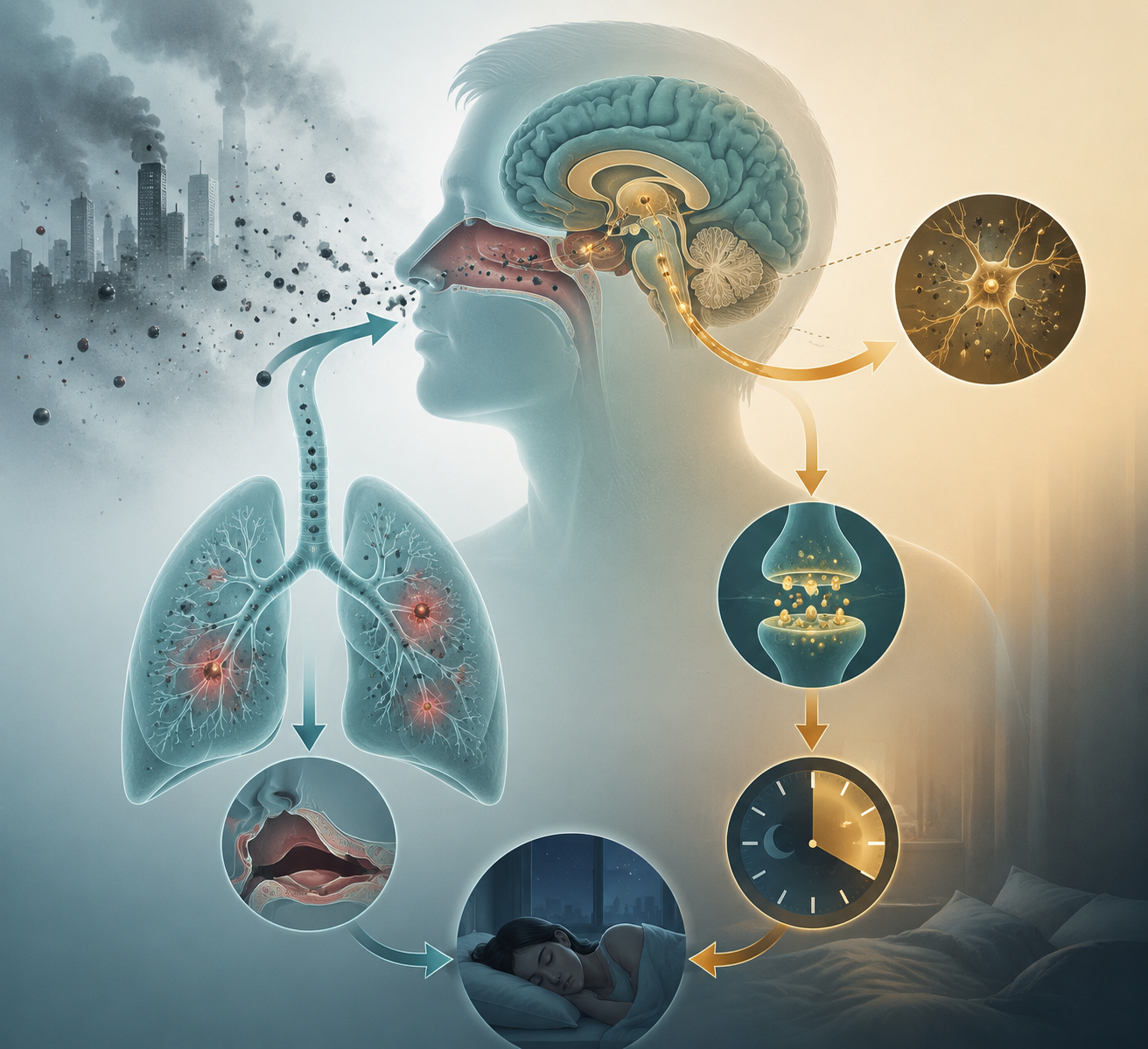
The lung pathway: inflammation, coughing, and sleep-disordered breathing
Fine particles are small enough to travel deep into the respiratory tract. When they irritate the airways, the body responds with inflammation, mucus, bronchial sensitivity, and sometimes tighter breathing. At night, that can mean coughing just as the body is trying to settle, more awakenings, and worse tolerance for any existing sleep-disordered breathing.
For someone with asthma, this can look very ordinary from the outside: a window gets shut because the air smells smoky, the room gets warmer, a child coughs after lying down, and the parent has to decide whether the fan helps or makes things worse. For someone with snoring or suspected sleep apnea, airway irritation may add another burden to breathing that is already unstable during sleep. The review evidence is broad, but the nightly experience is concrete: more effort to breathe usually means less stable sleep.[5]
The nervous-system pathway: particles, the nose, and sleep regulation
The second pathway is less visible but important. The Liu review describes evidence that air pollutants may affect the central nervous system, including through olfactory-nerve-related routes and neuroinflammation. That matters for sleep because the brain systems involved in sleep timing and stability depend on chemical signaling, including serotonin and circadian regulation.[5]
This does not mean a smoky night rewires the brain in a simple, dramatic way. It means air pollution is biologically capable of reaching beyond the lungs. A person may feel the event as a headache, wired fatigue, light sleep, or repeated wake-ups without being able to point to one symptom as the cause. When the nose and airway are irritated and the nervous system is on alert, sleep has to compete with a body that is still defending itself.
If wildfire smoke also makes you feel watchful or unsafe at night, that is another layer. The physical airway burden and the threat-response burden can run together. For more on that stress pathway, see why wildfire smoke keeps your brain on high alert at night.
What the bigger sleep studies can and cannot tell Detroit
Population research is helpful here because no one bedroom tells the whole story. The Guardian reported in 2025 on a Li et al. metastudy of 1.2 million people across six countries, which estimated that cutting average PM2.5 exposure in half could reduce the likelihood of poor sleep in middle-aged and older adults by roughly one in ten.[6]
That finding should be read carefully. It comes through secondary reporting here, and it describes a population-level estimate, not a promise that one household device will improve one person’s sleep by a fixed amount. Still, it points in the same direction as the review literature: particle exposure and sleep quality are linked strongly enough that reducing exposure is a reasonable sleep-health intervention, not just a respiratory-health intervention.
The most useful frame is not “pollution explains all insomnia.” It is “air pollution can be one of the loads the sleeping body has to carry.” In Detroit, where chronic particle pollution and asthma disparities are already documented, that load deserves more respect than it often gets.
The bedroom is where exposure becomes practical
Outdoor air policy is not solved at the nightstand. But the bedroom is still the place where many Detroit residents can reduce the dose that reaches their lungs overnight. The goal is not to create a perfect indoor bubble. It is to lower particle exposure during the hours when the body is trying to repair, regulate breathing, and maintain sleep.
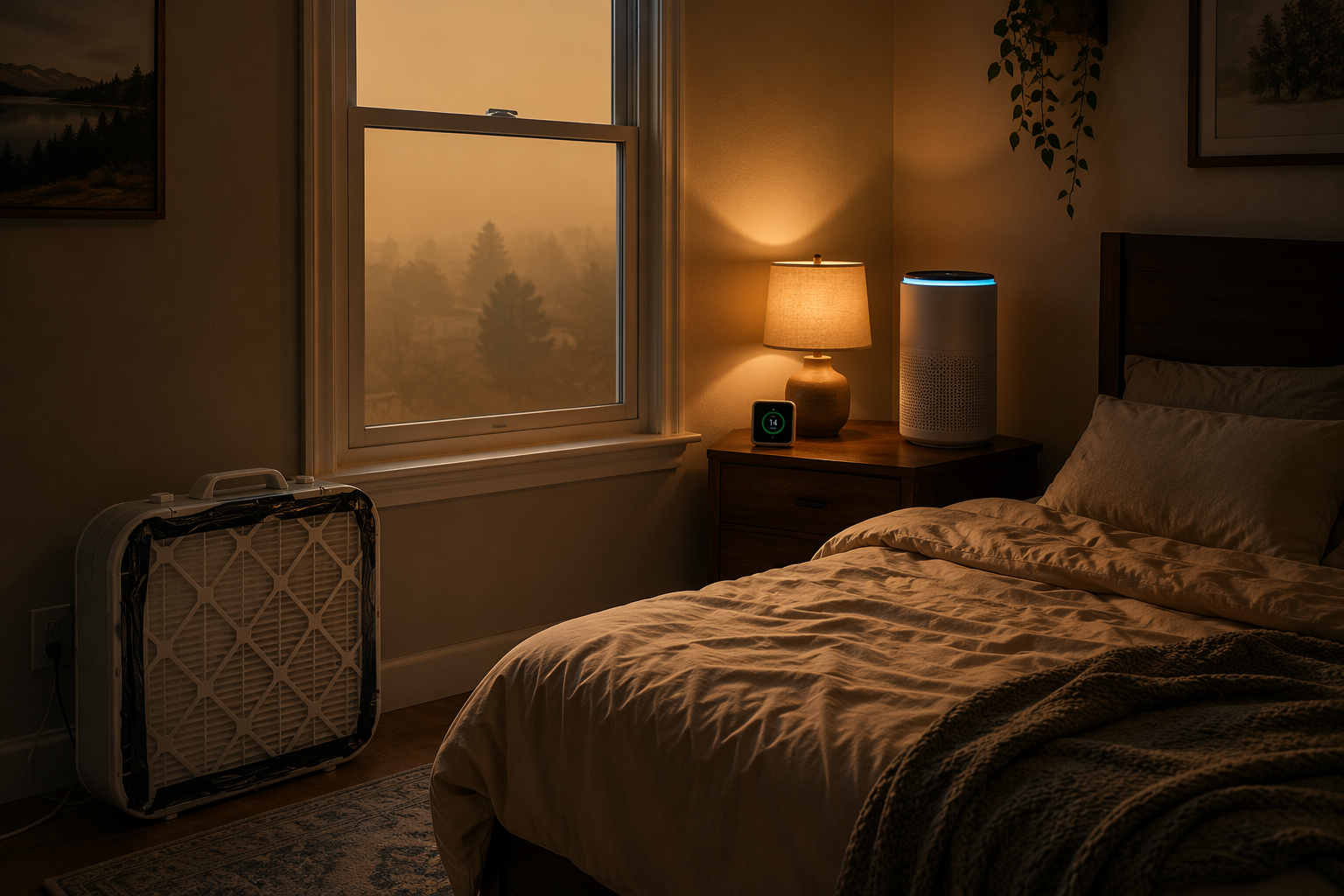
Use HEPA filtration where sleep actually happens
A portable HEPA air purifier belongs in the room where the most vulnerable person sleeps, not in the largest room by default. During a smoke event, a smaller clean room can be more realistic than trying to clean the whole home. Shut the bedroom door if that helps the purifier keep up, reduce obvious particle sources indoors, and let the unit run continuously instead of only turning it on at bedtime.
The intervention evidence is modest but real. In a 2022 randomized controlled crossover pilot study of 30 healthy adults, Lamport and colleagues found that HEPA air purifier use increased total sleep time by an average of 12 minutes per night and total time in bed by 19 minutes per night compared with placebo.[7]
Twelve minutes is not a miracle. It is also not nothing, especially over repeated nights. The study was small, short, and conducted in healthy adults, so it cannot be stretched into a guarantee for Detroit households with asthma, COPD, older housing, or wildfire-level smoke. But it supports a practical point: cleaning bedroom air can move sleep in the right direction.
A box-fan filter can be a useful smoke tool, with limits
During wildfire events, a DIY box-fan purifier made with a box fan and a MERV-13 filter can be a lower-cost way to reduce indoor PM2.5. Planet Detroit described this kind of setup as a community tip, with an estimated cost around $40.[1]
This is where practical caution matters. Use a newer box fan when possible, follow the fan manufacturer’s safety guidance, do not leave a homemade unit running unattended if you are not comfortable with the setup, and keep it away from small children, loose fabrics, and water. A DIY filter is not the same as a certified purifier, but for a smoke episode, it can be a reasonable harm-reduction tool when the alternative is breathing unfiltered indoor air all night.
Ventilation is a tradeoff, not a rule
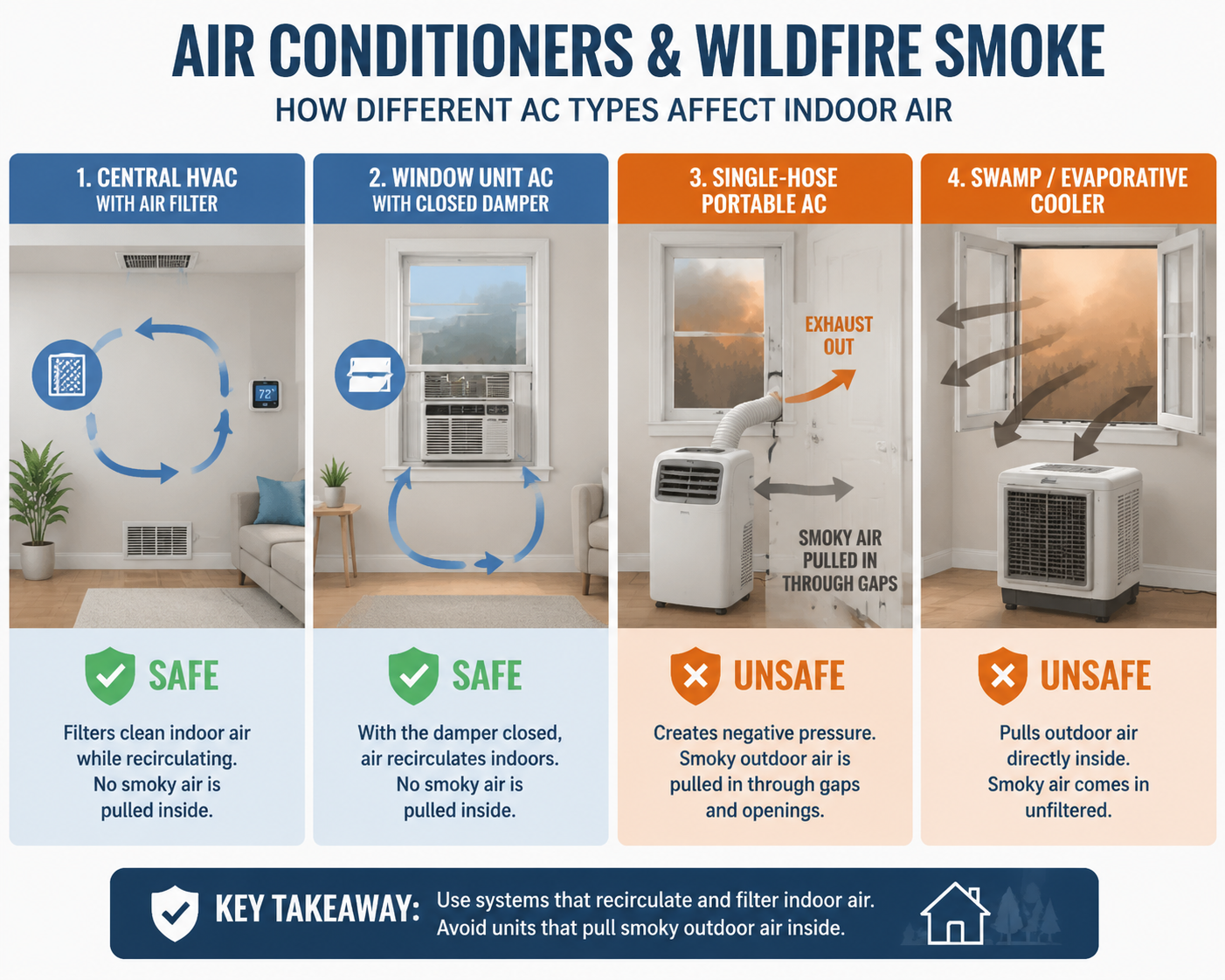
On a clean, mild night, fresh outdoor air can help a bedroom feel breathable. On a smoke night, opening the window may bring fine particles directly to the pillow. But sealing a room completely has its own problems: heat can build, humidity can rise, and carbon dioxide can accumulate in a closed, occupied bedroom. That is why “keep windows closed” is sometimes necessary and still incomplete.
During wildfire smoke, check outdoor AQI before ventilating. If the outdoor air improves for a window of time, brief ventilation may help release heat and stale air. If the AQI remains dangerous, prioritize filtration, cooling, and reducing indoor particle sources. The hard nights are the hot, smoky ones, when opening the window and closing the window both feel like bad choices. For a deeper look at that heat-smoke-CO2 problem, see summer heat and wildfire smoke create a triple threat to sleep.
Keep humidity in the boring middle
Humidity does not remove wildfire smoke, but it can change how irritated the airway feels. Very dry air can aggravate the nose and throat. Very damp air can make a bedroom feel heavy and may worsen mold or dust-mite problems in susceptible homes. The useful target is not perfection; it is avoiding extremes while particles are already stressing the respiratory system.
In practice, that means using air conditioning or a dehumidifier if the room is damp and hot, avoiding aggressive humidifier use during smoke events unless there is a clear need, and cleaning any humidifier carefully. If a bedroom smells musty, a humidifier is usually the wrong first move.
A realistic bad-air sleep plan for Detroit homes
The most useful plan is simple enough to follow when the AQI alert comes in late, the room is already warm, and someone is coughing. It starts with choosing one sleep room to protect.
- Check the outdoor AQI before opening windows, especially during wildfire smoke.
- Pick the bedroom or sleep space used by the person with asthma, the youngest child, the older adult, or the person who must sleep soonest.
- Run a HEPA purifier in that room if available, with the door closed if the unit is struggling to keep up.
- Use a properly assembled MERV-13 box-fan filter during wildfire episodes if a certified purifier is not available or not enough.
- Reduce indoor particle sources: skip candles, incense, smoking, unnecessary frying, and vacuuming without good filtration during the worst air.
- Manage heat and humidity so the protected room does not become a sealed, overheated box.
The order matters. People often start with the device: Which purifier should I buy? The better first question is who needs the cleanest sleeping air tonight, and which room can realistically be made cleaner. A purifier that is too small for an open-plan apartment may still help in a closed bedroom. A box-fan filter in the wrong spot may stir air without protecting the sleeper. A sealed room may reduce smoke but worsen heat stress if there is no cooling.
For more general detail on why wildfire smoke disrupts sleep through respiratory, neuroinflammatory, and stress pathways, see why does wildfire smoke disrupt your sleep. The Detroit-specific point is that wildfire smoke is landing on top of a documented local particle problem, not visiting a blank slate.
When poor air turns into a medical sleep problem
Home air steps are not a substitute for care when breathing symptoms escalate. If poor air days bring wheezing, chest tightness, repeated nighttime coughing, rescue-inhaler use beyond the person’s usual plan, morning headaches with loud snoring, or daytime sleepiness that feels unsafe for driving or work, the sleep problem has crossed into medical territory. That is especially true for children, older adults, pregnant people, and anyone with asthma, COPD, heart disease, or suspected sleep apnea.
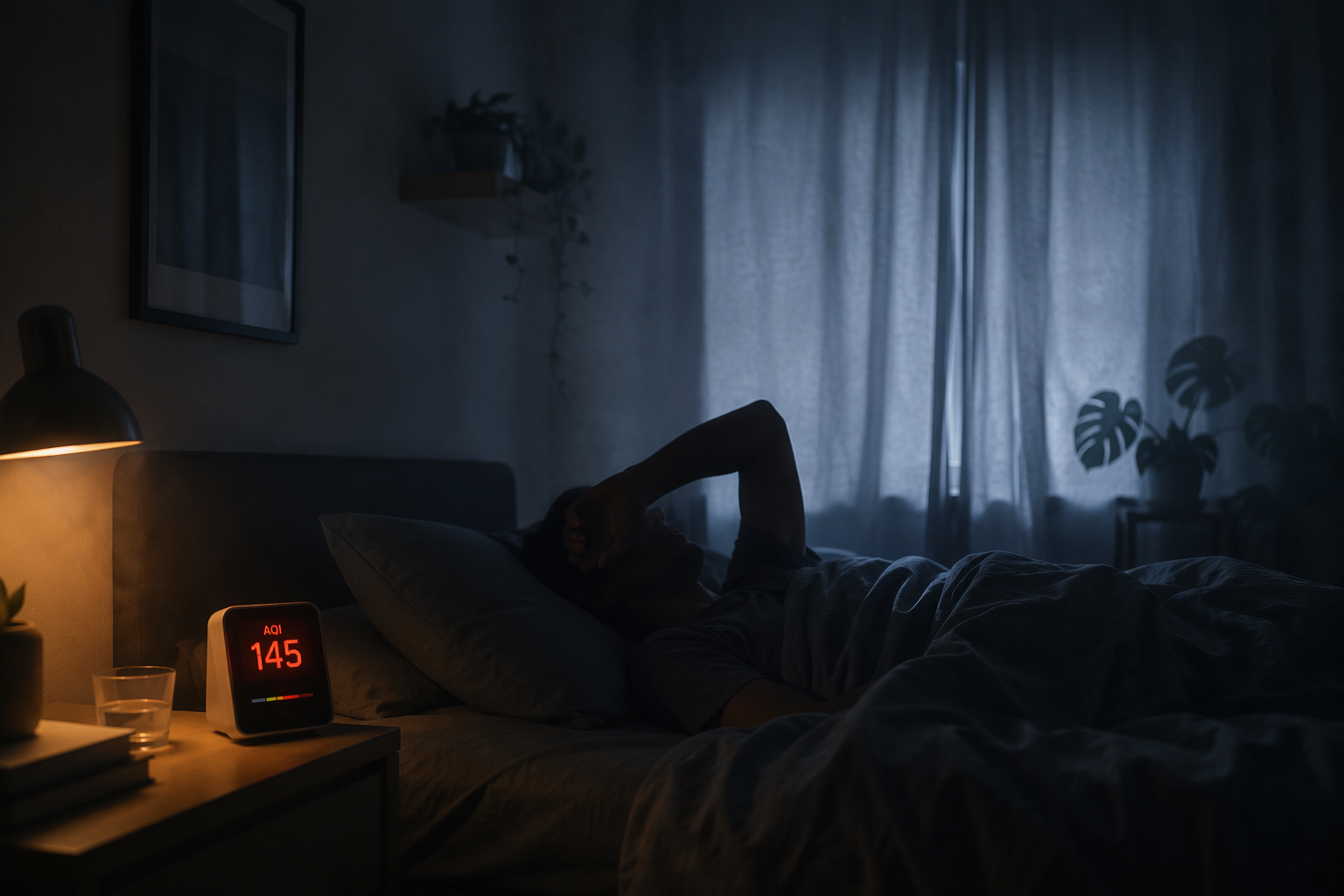
This is not meant to make every bad night alarming. It is meant to keep blame in the right place. If you slept badly when Detroit’s AQI was extreme, that may have been your body responding appropriately to an environmental insult. If you sleep badly every time particle levels rise, that pattern is worth taking seriously.
Detroit’s air quality can measurably harm sleep through respiratory inflammation and nervous-system disruption. Bedroom filtration, careful ventilation, and humidity control can reduce exposure enough to matter, especially during acute wildfire smoke. But the need to build a cleaner-air sleep room inside your own home is also evidence of a larger public health failure: too many Detroit residents are being asked to recover overnight in air that keeps the body on defense.
References
- Canadian wildfires push Detroit AQI to worst in city history, Planet Detroit, 2026-07-20
- New Report Finds Detroit has the Worst Year-Round Particle Pollution in the Region, American Lung Association, 2025
- What’s behind Detroit’s recent poor morning air quality?, Planet Detroit, 2026-03
- Black residents of Detroit brace for rougher air quality, NBC News, 2022
- The Effect of Air Pollution on Sleep: A Systematic Review and Meta-analysis, PMC
- Air pollution can affect how well we sleep, scientists discover, The Guardian, 2025-09-19
- The effect of air purification on sleep quality: a randomized controlled crossover pilot study, PubMed


Comments
Join the discussion with an anonymous comment.