
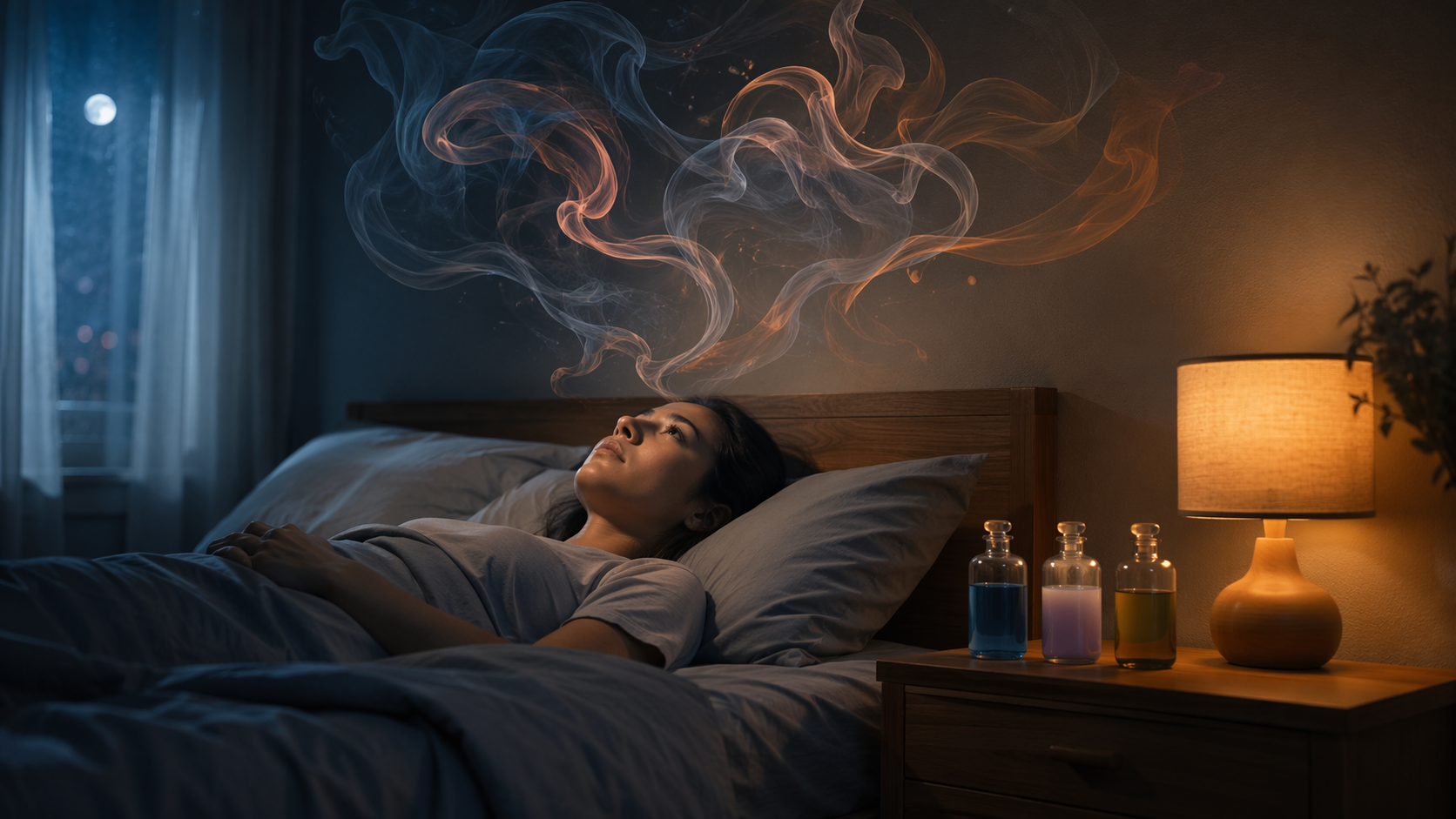
A Code Purple alert changes the usual bedtime math. You close the windows because the outdoor air is unsafe, then the bedroom can start behaving like a sealed box: less smoke coming in, but also less dilution of whatever is already indoors. If the door is closed, the purifier is off or undersized, and two people are breathing in the room for hours, “stay inside” may protect the lungs from the worst outdoor exposure while still leaving sleep vulnerable.
In the EPA Air Quality Index system, Code Purple means AQI 201–300, labeled “Very Unhealthy.” At that level, the warning is not limited to people with asthma or heart disease; everyone faces increased health risk, while older adults, children, and people with respiratory or cardiovascular conditions need extra protection sooner. [1]
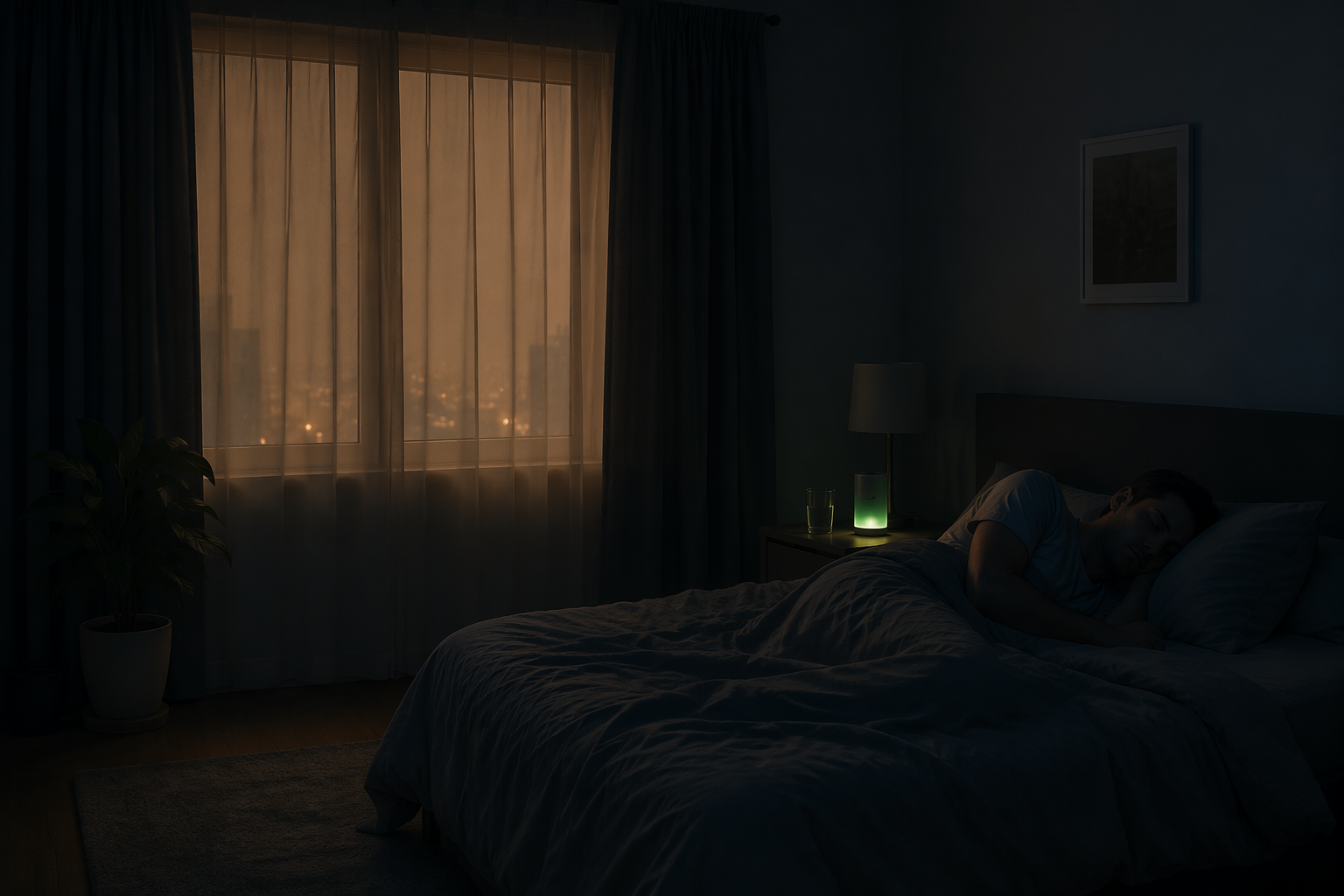
The sleep problem is not only that smoke smells bad or that the alert is stressful. Fine particles, especially PM2.5, are small enough to reach deep into the respiratory tract. Once there, they can irritate the airway, trigger inflammatory signaling, and interfere with the hormones and neurotransmitters that help the brain keep sleep consolidated. That is why a Code Purple night can feel different from an ordinary restless night: the room itself may be pushing the body toward lighter, more fragmented sleep.
Why Code Purple Nights Hit Sleep So Hard
One inconvenient detail is timing. A systematic review on air pollution and sleep noted that ambient PM2.5 concentrations tend to peak between 9:00 PM and 11:00 PM globally, in part because sunset removes the solar convection that helps disperse pollutants during the day. [2] That is exactly when many bedrooms are being closed up, lights are dimming, and people are hoping their airway will calm down.
The same review found that 21 of 22 included studies reported positive associations between air pollution and sleep problems, although the studies varied too much in methods for the authors to run a meta-analysis. [2] That matters. The evidence is not clean enough to say that every bad night during a smoke event was caused by PM2.5 alone. But the convergence is strong enough that poor air quality belongs in the sleep conversation, not off to the side as a respiratory footnote.
Large observational studies point in the same direction. In the MESA study, people in the highest PM2.5 exposure group had about 50% higher odds of low sleep efficiency than those with lower exposure. [3] A Taipei City study of 5,108 participants found that each 1 μg/m³ increase in PM2.5 was associated with 1.61 times the odds of hypnotic-treated insomnia after adjustment for age, sex, education, and chronic disease. [4] That Taipei result used hypnotic prescriptions as an insomnia proxy, so it may capture people who reached treatment more than everyone who slept poorly. Still, it is hard to dismiss when placed beside the broader sleep-efficiency and sleep-duration findings.
A UK Biobank analysis also linked PM2.5 and PM10 exposure with shorter sleep duration. [5] These studies do not make the bedroom a laboratory, and they do not remove every confounder. They do give a useful warning: when air quality deteriorates, sleep can deteriorate through measurable pathways, not just through annoyance.
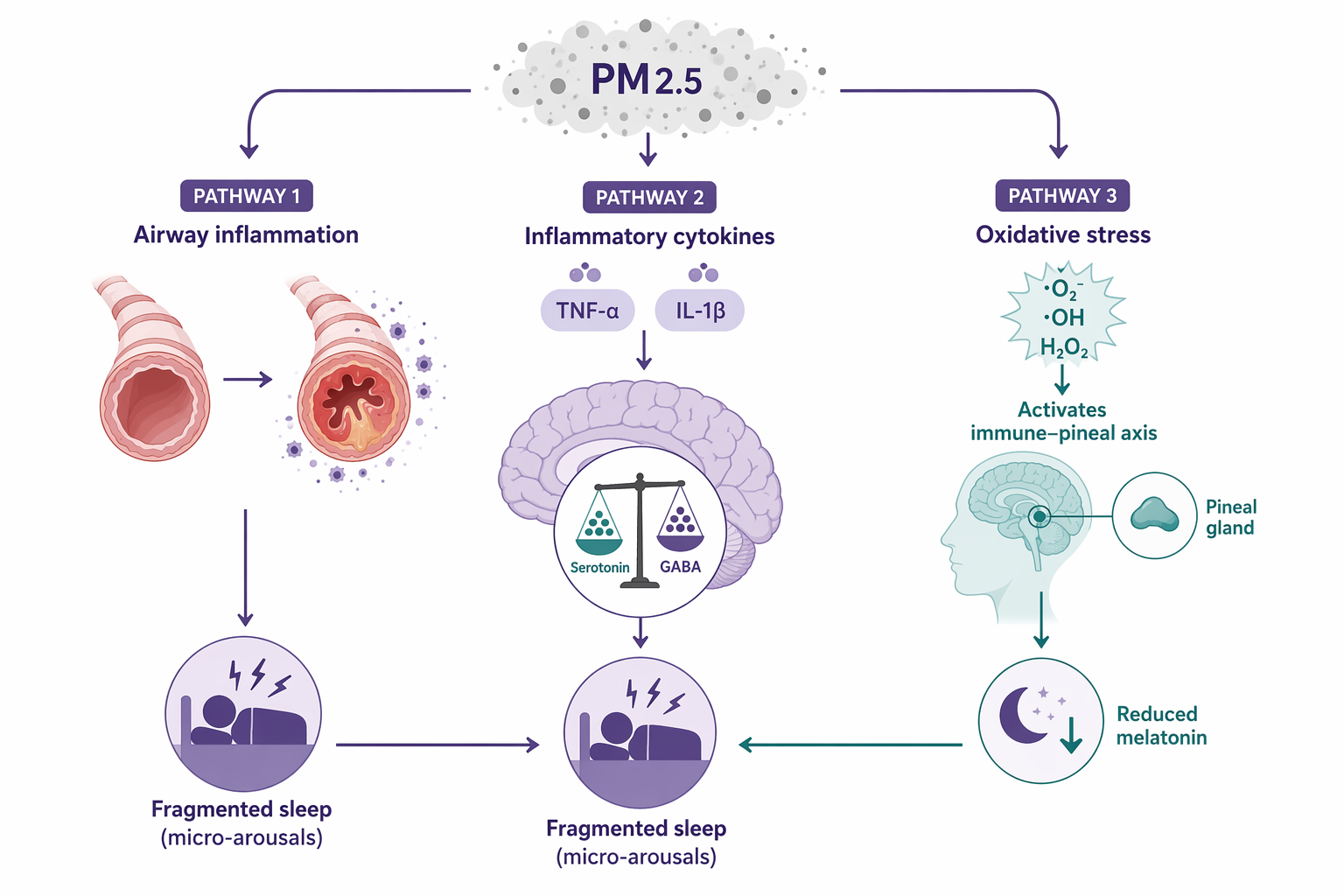
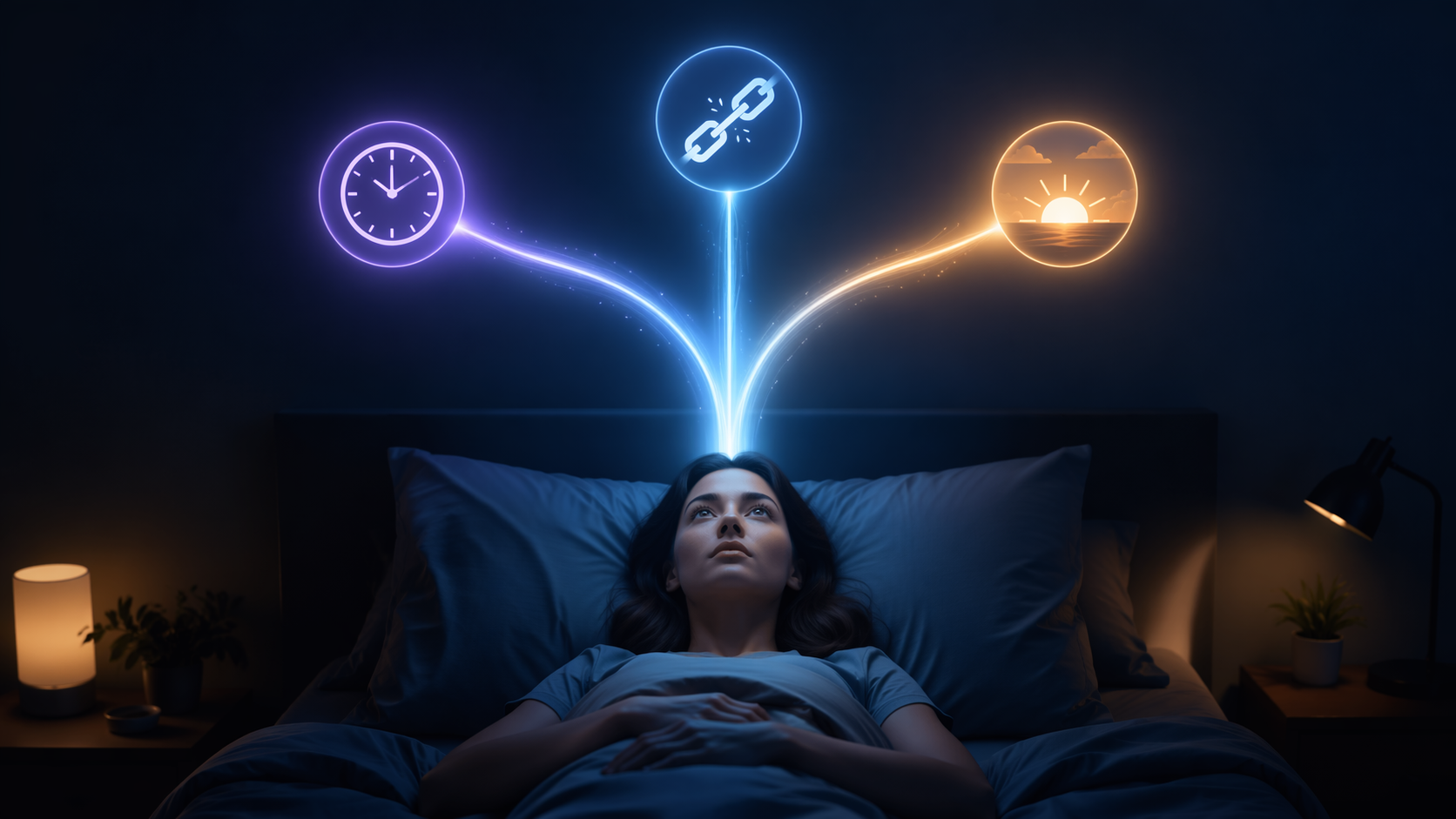
The Three Pathways That Turn PM2.5 Into Fragmented Sleep
The first pathway is mechanical and familiar: airway irritation. PM2.5 can inflame the nose, throat, and lower airway. A sleeper may not fully wake up, sit up, and remember it. Instead, the body may register the irritation as a brief arousal: breathing changes, muscle tone shifts, sleep lightens, then the person drops back under. Enough of these micro-arousals can leave the night looking “long enough” on the clock but thin in recovery.
The second pathway runs through inflammatory neurotransmitter changes. The sleep review describes evidence that inflammatory cytokines such as TNF-α and IL-1β may alter serotonin and GABA balance, both of which are involved in sleep initiation and maintenance. [2] Animal evidence on ozone exposure also points to changes in 5-HIAA in sleep-regulating brain regions, which supports the idea that pollution can reach beyond the airway and into sleep-control chemistry. [2]
The third pathway involves melatonin. PM2.5-related oxidative stress can activate the immune-pineal axis, a signaling route that can reduce pineal melatonin synthesis. [6] Melatonin is not a knockout drug; it is a timing signal. If that signal is blunted on a night when the airway is already irritated and inflammatory signaling is up, sleep may become easier to fragment and harder to sustain.
This is also why purely behavioral sleep advice can feel insulting during smoke season. A calmer wind-down routine may help, but it cannot remove particles from the breathing zone. On a Code Purple night, the bedroom routine has to include the air itself.
The Bedroom Workflow for a Code Purple Night
The goal is not to make outdoor air safe. It is to lower the main sleep-disrupting exposures in the room where you will spend the next several hours. That means reducing PM2.5 before sleep, not adding new indoor pollutants, and preventing the sealed-room CO₂ problem from becoming its own sleep disruptor.
| Bedroom task | Why it matters on a Code Purple night |
|---|---|
| Check the alert and close windows before the evening PM2.5 peak | Code Purple means AQI 201–300, and PM2.5 often peaks around typical bedtime. |
| Run HEPA filtration with the bedroom door closed before sleep | Particle reduction needs time in the actual sleeping space, not just somewhere else in the house. |
| Avoid candles, incense, and unvented cooking near bedtime | Indoor PM2.5 and VOC sources can erase some of the benefit of sealing the room. |
| Watch CO₂ if the room is tightly closed | A cleaner but stale room can still feel physiologically uncomfortable overnight. |
| Adjust the door, airflow, or pre-sleep airing when feasible | The best setup balances outdoor particle protection with enough dilution to avoid high-CO₂ sleep. |
Start filtration before you are tired
If you wait until lights-out to turn on the purifier, you are asking the first part of the night to do cleanup duty. The practical target is the bedroom air before your head hits the pillow. Evidence cited for bedroom interventions indicates that a HEPA purifier with activated carbon can reduce bedroom PM2.5 by 70–90% within 30 minutes when run with the door closed before sleep. [7]
The closed door matters because it turns the bedroom into a smaller air volume the purifier can actually cycle. If the purifier is in the hallway, the bedroom door is shut, and smoke has already leaked in earlier, the bed may not be getting the cleanest air in the home. The useful sequence is simple: close windows, close the bedroom door, run the purifier on a higher setting for at least the pre-sleep cleaning period, then decide whether the overnight setting is tolerable for sound and airflow.
Do not add particles after you have sealed the room
This is the unglamorous part of smoke-night sleep hygiene: skip incense, scented candles, and anything that adds combustion particles near bedtime. If a gas stove has been used, exhaust ventilation matters, but during Code Purple conditions the decision can be awkward because ventilation may pull in outdoor air. The cleaner solution is to avoid late cooking that creates indoor pollution in the first place, especially close to the sleeping area.
VOCs are not the same as PM2.5, and activated carbon is not a magic sponge for every gas in every room. Still, on a night when the airway is already under load, adding fragrance, smoke, or cooking byproducts is a bad trade. The room does not need a sleep scent. It needs fewer irritants.
Then deal with the CO₂ trap
A sealed bedroom can solve one problem and create another. With windows and door closed, exhaled CO₂ can build overnight, especially in small rooms or shared bedrooms. For sleep, the useful line is practical rather than diagnostic: closed-bedroom CO₂ above 1,000 ppm can further degrade sleep quality. If you use a basic CO₂ monitor, that threshold is a useful warning that the room may be too stagnant for comfortable sleep.
The hard part is that the usual fix for CO₂ is fresh air, while the Code Purple fix for PM2.5 is keeping outdoor air out. That tension is the whole bedroom problem. If outdoor smoke is surging, throwing open a window may undo the particle control you just created. If the room is tightly sealed all night, CO₂ may climb high enough that the air feels heavy and sleep becomes more fragmented.
A workable compromise is to use brief pre-sleep airing only when outdoor conditions allow, then close the window and run filtration before bed. If the outdoor AQI remains Code Purple, a cracked bedroom door to a cleaner interior space may be safer than a cracked window, especially if the purifier can keep running. In a home with central HVAC and good filtration, using the fan setting may help mix and filter indoor air; in a leaky home without effective filtration, it may not.
For readers dealing with heat at the same time, the decision gets more complicated because a closed bedroom can also overheat. The broader overlap of heat, smoke, and CO₂ is covered in Summer Heat and Wildfire Smoke Create a Triple Threat to Sleep; for a Code Purple night, the narrower priority is to reduce particles without letting the room become stale enough to disturb sleep.
What To Do Tonight
- Check the AQI before dinner and again before bed. If it is Code Purple, treat the bedroom as a controlled space, not just a room with closed windows.
- Close windows before the evening pollution peak when possible, then run a HEPA purifier in the bedroom with the door closed for the pre-sleep cleaning period.
- Keep indoor sources quiet: no candles, incense, smoking, or late unvented cooking near the sleeping area.
- If you have a CO₂ monitor, check the room after it has been closed for a while. Readings above 1,000 ppm are a sign to improve dilution if you can do so without pulling in heavy smoke.
- If CO₂ climbs but outdoor air is still very unhealthy, try opening the bedroom door to cleaner indoor air rather than opening a window directly to the smoke.
- If you are older, caring for a child, or living with respiratory or cardiovascular disease, use a lower threshold for moving to the cleanest room available and following medical advice.
There is one more reason to focus on the room rather than the alert alone. A Penn Medicine sleep-efficiency figure, cited by PurpleAir, reported a 3.2% sleep efficiency decline per PM2.5 increase, but that finding comes from a single 2023 study and needs replication across more populations and housing conditions. [7] It is useful as a signal, not as a universal calculator for tonight’s sleep.
The stronger conclusion is more practical: Code Purple sleep disruption is biologically plausible, supported by converging observational evidence, and worth treating as part of sleep hygiene. The best response is not panic and not perfect certainty. It is a bedroom plan that lowers PM2.5 exposure before sleep, avoids new indoor irritants, and keeps CO₂ from turning a protected room into a stagnant one.
On a Code Purple night, success is modest but real: fewer particles in the breathing zone, less airway irritation, fewer conditions that invite micro-arousals, and a better chance that the hours in bed become consolidated sleep rather than a long series of almost-wakeups.
References
- AQI Basics — AirNow.gov — EPA AQI Basics
- The association between air pollution and sleep: A systematic review — PMC — 2020 — PMC7877449
- The association of ambient air pollution with sleep apnea: The Multi-Ethnic Study of Atherosclerosis — PMC — 2019 — PMC6394120
- The association between air pollution and insomnia in Taipei City — Nature Scientific Reports — 2022 — s41598-022-21964-0
- Association between long-term exposure to ambient air pollution and sleep duration in Chinese adults: A cross-sectional study — ScienceDirect — S1389945720303361
- Role of endogenous melatonin in the oxidative stress and inflammation induced by air pollutant exposures — ScienceDirect — S0048969721007774
- PurpleAir blog citing Penn Medicine research — PurpleAir — PurpleAir blog
Comments
Join the discussion with an anonymous comment.