
After one large earthquake, sleep can be awful for obvious reasons. The bed no longer feels neutral. A truck outside may sound like the start of shaking. The body may spend several nights braced for aftershocks, replaying what happened and checking every vibration against memory.
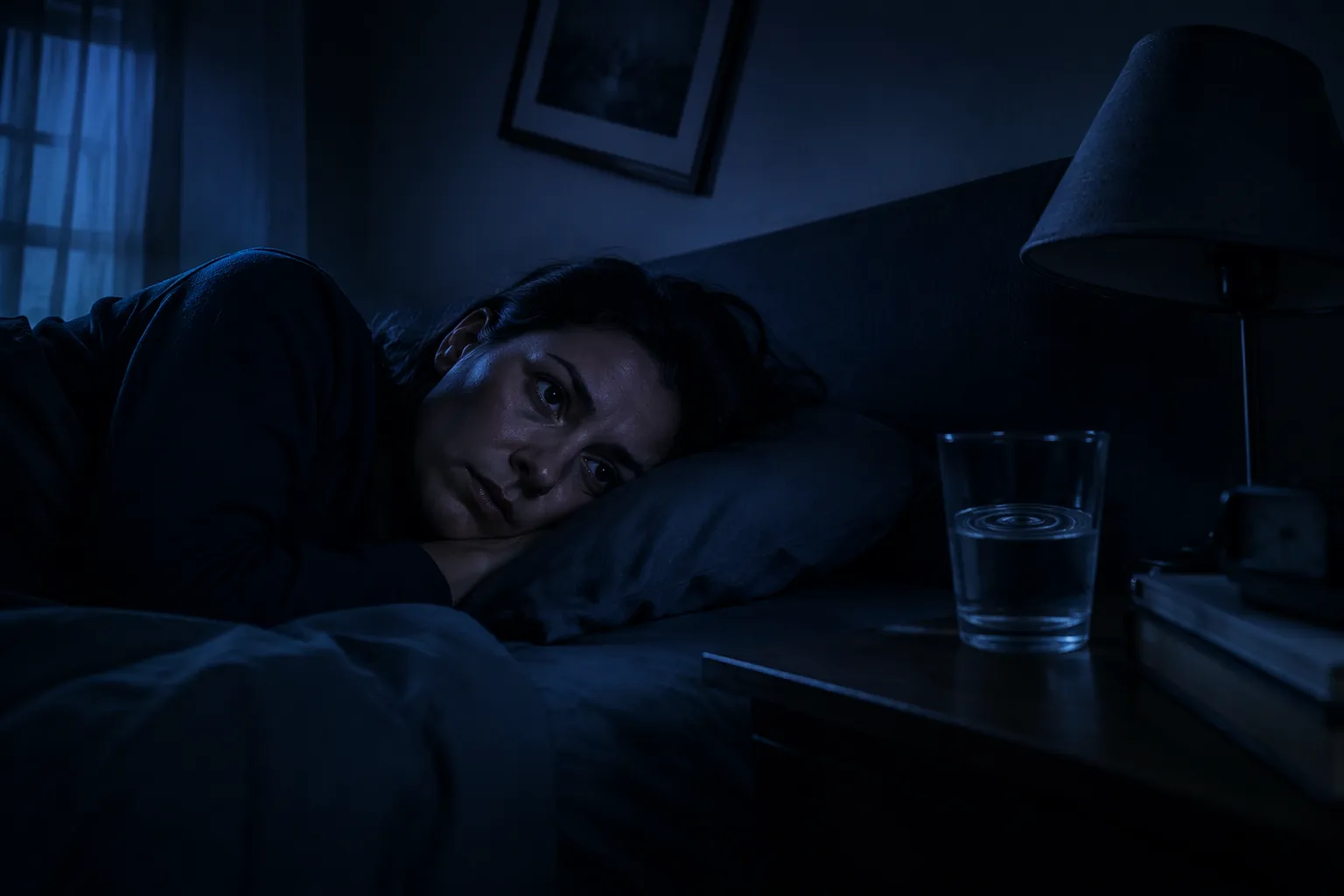
An earthquake swarm can feel different because the question never closes. It is not simply “That was terrifying.” It is “Is another one starting now?” at midnight, 1:40 a.m., 3:12 a.m., and again before dawn. The sleep problem is not only fear of a past event. It is the nervous system trying to sleep inside an unfinished threat.
Why A Swarm Does Not Give The Brain An All Clear
The geologic distinction matters. The U.S. Geological Survey describes earthquake swarms as sequences of many earthquakes over days to weeks that do not follow the usual mainshock-aftershock pattern. In a typical mainshock sequence, one largest event is followed by aftershocks that generally decay. In a swarm, there may be no single obvious largest earthquake and no reassuring decline in the same way; USGS describes fluid interaction with faults as part of a positive feedback process rather than the stress-shadow decay expected after a mainshock sequence.[1]
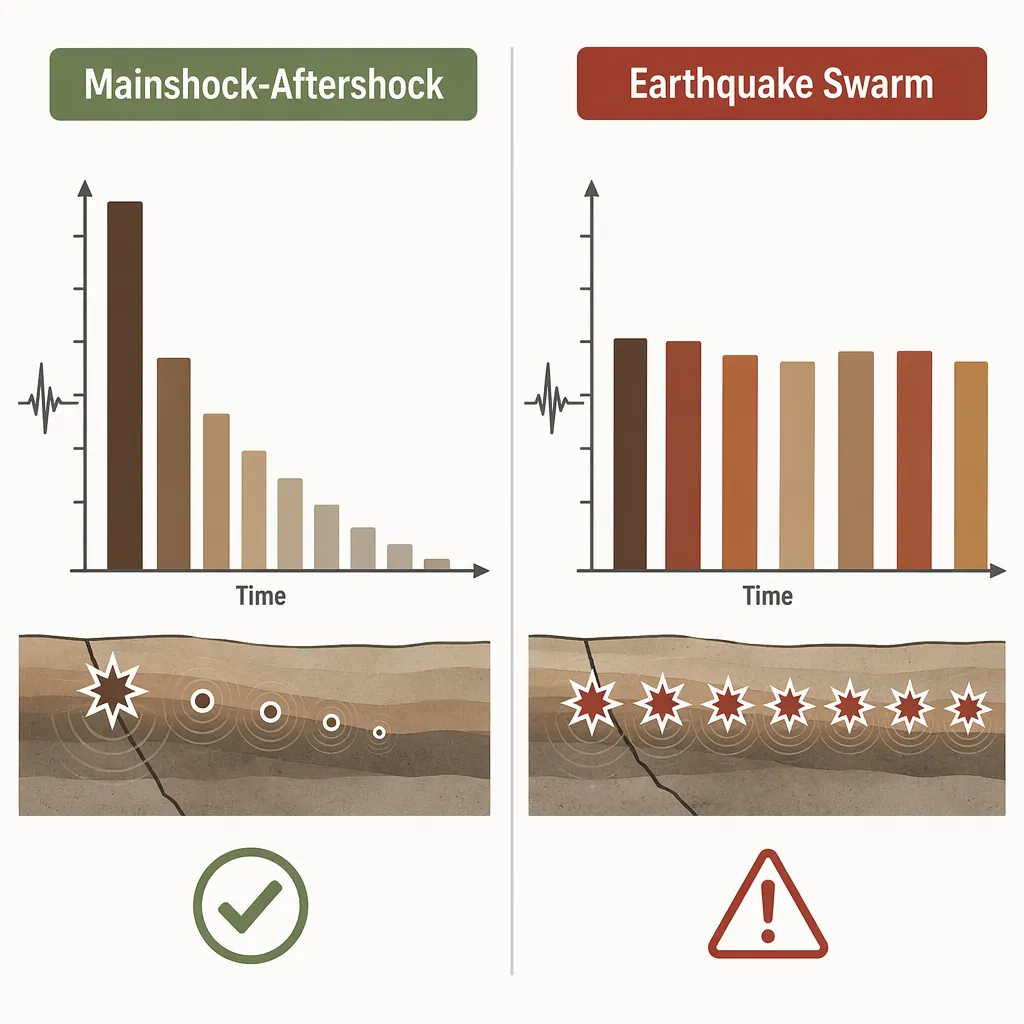
That difference is not academic when you are trying to sleep. After a single large event, even if the body is frightened, the mind has a shape to work with: something happened, now we are watching the aftermath. During a swarm, every small tremor reopens the same threat assessment. The floor moves, the house answers, and the brain has to ask again whether this is a harmless small event or the beginning of something larger.
Sleep depends on a permission signal. Not a perfect feeling of safety, but enough confidence that monitoring can be reduced. A swarm keeps interfering with that permission. The bedroom is quiet, but not settled. The lights are off, but the body is still listening. Ordinary wind-down cues—darkness, stillness, a familiar pillow—compete against a live environmental pattern that keeps saying, not yet.
The Sleep-Wake Switch Stays Biased Toward On
When people say they are “too wired to sleep” during an earthquake swarm, they are often describing a body doing exactly what threat detection asks it to do. The brain keeps sampling the environment. Muscles stay more ready than relaxed. Heart rate and breathing may be easier to provoke. Small sounds carry more meaning. The sympathetic nervous system does not have to be in full panic to interfere with sleep; it only has to remain available for action.
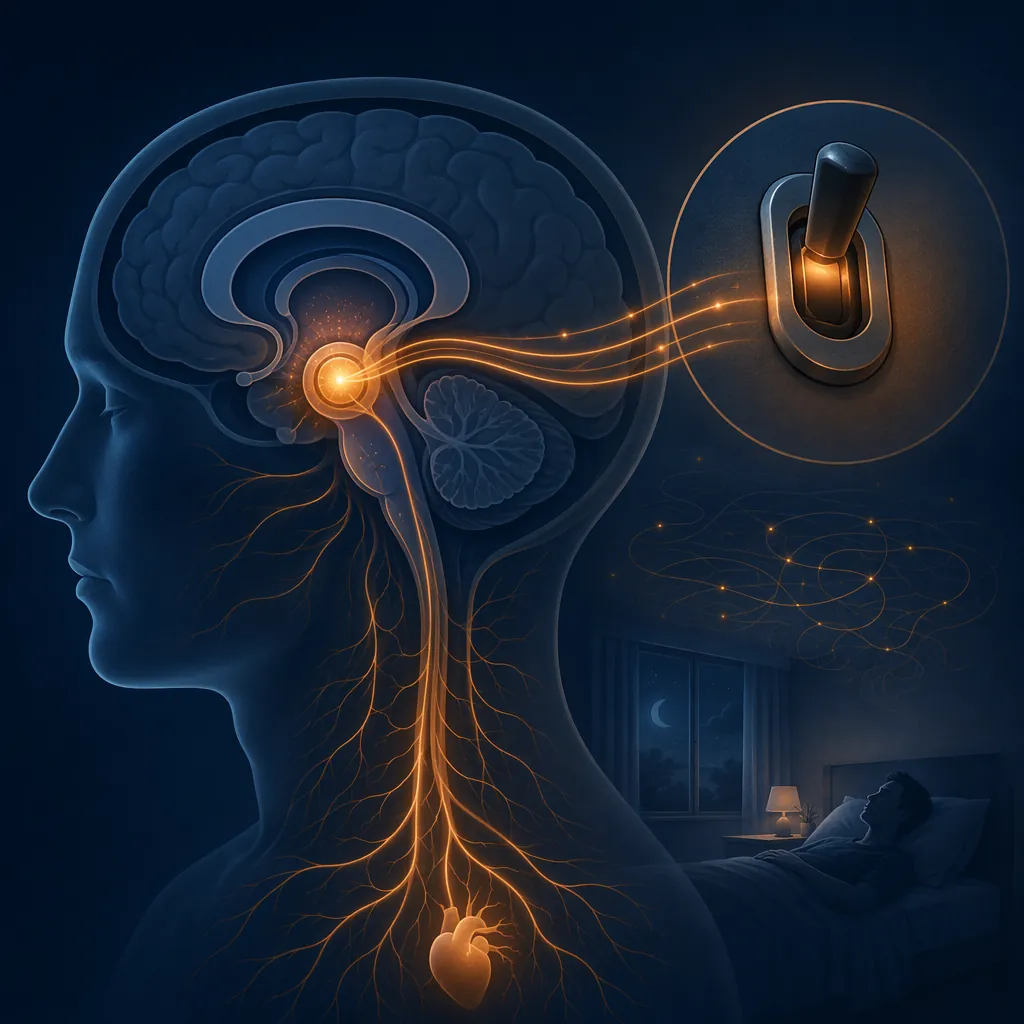
That is one reason earthquake swarm and sleep disturbance can feel so stubborn. The person in bed may not be thinking dramatic thoughts. They may not be imagining collapse. They may simply be unable to cross the threshold from monitoring into sleep because the brain keeps reserving capacity for the next tremor.
This is also why the disruption can outlast the shaking itself. A tremor may last seconds. The nervous system’s update takes longer: Was that local? Is there another one coming? Should I check the earthquake app? Did the pets react? Did the neighbor’s door just move? Each check may be understandable, but each check also feeds wakefulness by confirming that the night is still under surveillance.
The most frustrating part is that good sleep habits can still fail under these conditions. A dark room does not cancel uncertainty. A breathing exercise may lower arousal for a few minutes, then another vibration restarts the loop. This does not mean the routine is useless. It means the routine is working against a continuing signal, not just against ordinary bedtime restlessness.
What Earthquake Studies Can And Cannot Prove About Swarms
The careful caveat is important: direct sleep studies conducted during active earthquake swarms were not found in the available research. Most published sleep evidence comes from single major earthquakes and their aftermath. So the swarm-specific claim is an applied inference. We have evidence that earthquakes can damage sleep, evidence that earthquake anxiety is strongly associated with poor sleep, and a clear geologic reason swarms keep threat appraisal open. That is not the same as a clinical trial of sleep during swarms.
The earthquake sleep evidence is still useful because it shows that the body’s reaction is measurable, not imaginary. In a study of 4,993 people after the L’Aquila earthquake, sleep quality worsened in a distance-dependent pattern up to about 70 km from the epicenter. Pittsburgh Sleep Quality Index scores rose from 4.52 in the control group to 6.33 in the epicentral zone, and people in the epicentral zone scored 6.53 on the PSQI-A measure of disruptive nocturnal behaviors, above the 4.0 threshold used to discriminate PTSD. The study found that sleep disruption persisted for at least two years.[2]
That study was not about swarms. It was about a catastrophic earthquake. But it makes one point hard to dismiss: seismic exposure can leave a measurable sleep signature, and that signature can vary with proximity to danger. The sleeper is not merely being suggestible because the news is stressful. The body appears to register exposure.
A 2025 study of 402 adolescent earthquake survivors in Türkiye gives another piece of the picture. In that sample, 65.7% slept fewer than seven hours per night, and high earthquake anxiety increased the odds of poor sleep quality by 5.721 compared with mild anxiety.[3] Again, this is not swarm-specific evidence, and the study population was adolescents rather than adults. Still, it supports a mechanism that matters during swarms: earthquake anxiety and sleep quality are closely linked when the nervous system is trying to manage seismic threat.
This Is Not Just A Resilience Problem
People are often told, directly or indirectly, that if they were coping better they would be sleeping better. Disaster sleep data do not justify that moral lesson. After the Haiti earthquake, 94% of survivors reported insomnia symptoms and 42% had clinically significant PTSD two years later. The reported finding that resilience did not buffer against sleep disturbance is especially important, because it separates sleep disruption from the lazy accusation that a person simply lacks inner strength.[4]
Another study, a 2021 moderated mediation model of 1,342 adolescents, found that sleep problems partially mediated the relationship between earthquake exposure and PTSD, accounting for 29.93% of the total effect. High resilience buffered the PTSD pathway, but it did not eliminate sleep disruption.[5] In plainer terms: resilience may matter for some psychological outcomes, but sleep can still be hit hard.
That distinction is humane and clinically useful. A person can be competent, prepared, emotionally steady in the daytime, and still lose sleep when the ground keeps interrupting the brain’s safety signal. The night system is older than self-talk. It responds to vibration, uncertainty, and the need to be ready.
Why It May Feel Worse At Night
Night removes competing information. During the day, there are tasks, voices, daylight, movement, and other people’s reactions to compare against your own. At night, the body has fewer cues. A small tremor may feel larger because it arrives into silence. A house settling may become ambiguous. The bed itself becomes a sensor.
Wearable data after the 2014 Napa Valley earthquake offer a vivid, limited illustration of how sharply seismic events can disturb a night. Time reported Jawbone data indicating that 45% of people within 15 miles of the epicenter stayed awake the entire night.[6] That is not controlled clinical evidence, and it comes from a wearable company’s data rather than an independent sleep laboratory. Its value is narrower: it shows how a real earthquake night can produce large-scale wakefulness in ordinary sleepers.
In a swarm, the acute earthquake night can blur into a sequence of partially recovered nights. The person may fall asleep late, wake after a small tremor, scan for updates, doze shallowly, and then start the next day with a nervous system that never completed the downshift. After several nights, the problem is no longer just fear. It is fear plus sleep debt plus conditioned listening.
The PTSD Frame Is Sometimes Relevant, But It Is Not The Whole Story
Post-traumatic stress can absolutely disturb sleep after earthquakes. Nightmares, intrusive memories, avoidance, and exaggerated startle can all make nights harder. The L’Aquila, Haiti, and Wang findings all sit close to that territory.[2][4][5]
But if the swarm is still active, it is too narrow to treat every bad night as post-traumatic processing. Some of the insomnia is anticipatory. The nervous system is not only remembering danger; it is monitoring for the next signal. That difference matters because it changes the emotional meaning of the symptom. You are not necessarily “stuck in the past.” You may be trying to sleep while the present keeps refusing to become clearly safe.
What This Means If You Are Awake During A Swarm
The first practical implication is not a trick for forcing sleep. It is interpretation. If your body resists sleep during an active swarm, that resistance may be a threat-monitoring response, not evidence that you are handling the situation badly. The more the swarm lacks a clear pattern of decline, the harder it may be for the brain to reduce monitoring.
Safety preparation can help for a specific reason: it reduces unanswered questions. Knowing where your shoes are, keeping a light nearby, securing heavy objects, charging your phone, and agreeing on a household plan do not magically remove fear. They reduce the number of decisions your brain has to keep rehearsing at 3 a.m. The goal is not to convince the body that earthquakes cannot happen. The goal is to make the next action less uncertain if one does.
That also explains why some wind-down advice feels insulting when it is delivered without context. A warm shower or slow breathing may be useful, but only after the basic safety questions have been answered well enough that the body can stop treating sleep as negligence. For more step-by-step help, the practical companion on earthquake anxiety keeping you awake is the better place to go next.
If the swarm has ended and you are trying to rebuild sleep over days and weeks, the problem begins to look more like phased recovery after a seismic event. In that case, a post-earthquake sleep recovery guide may fit better than advice written for the middle of ongoing shaking. If the issue is mainly evening arousal once immediate safety is handled, an evidence-based wind-down routine can be useful as nervous system training rather than as a command to calm down.
During an active swarm, the most honest explanation is also the least blaming one. Your brain is not receiving a clean all clear. It is trying to protect sleep and readiness at the same time, and sleep is often the function that loses. Swarm-related insomnia is not proof that you are fragile. It is a predictable sleep response to an environment that keeps interrupting the signal that the danger has passed.
References
- What is an earthquake swarm? — U.S. Geological Survey
- Long-Term Impact of Earthquakes on Sleep Quality — PLOS ONE, 2013
- Earthquake anxiety and sleep quality among adolescent survivors — Scientific Reports, 2025
- Disturbed sleep and mental health problems in disaster survivors — American Academy of Sleep Medicine, 2019
- Sleep Problems Mediate the Relationship Between Earthquake Exposure and Posttraumatic Stress Symptoms in Chinese Adolescents: A Moderated Mediation Model — Frontiers in Psychiatry, 2021
- Napa Earthquake Woke Up Nearly Half of Jawbone Wearers Near the Epicenter — Time, 2014


Comments
Join the discussion with an anonymous comment.