
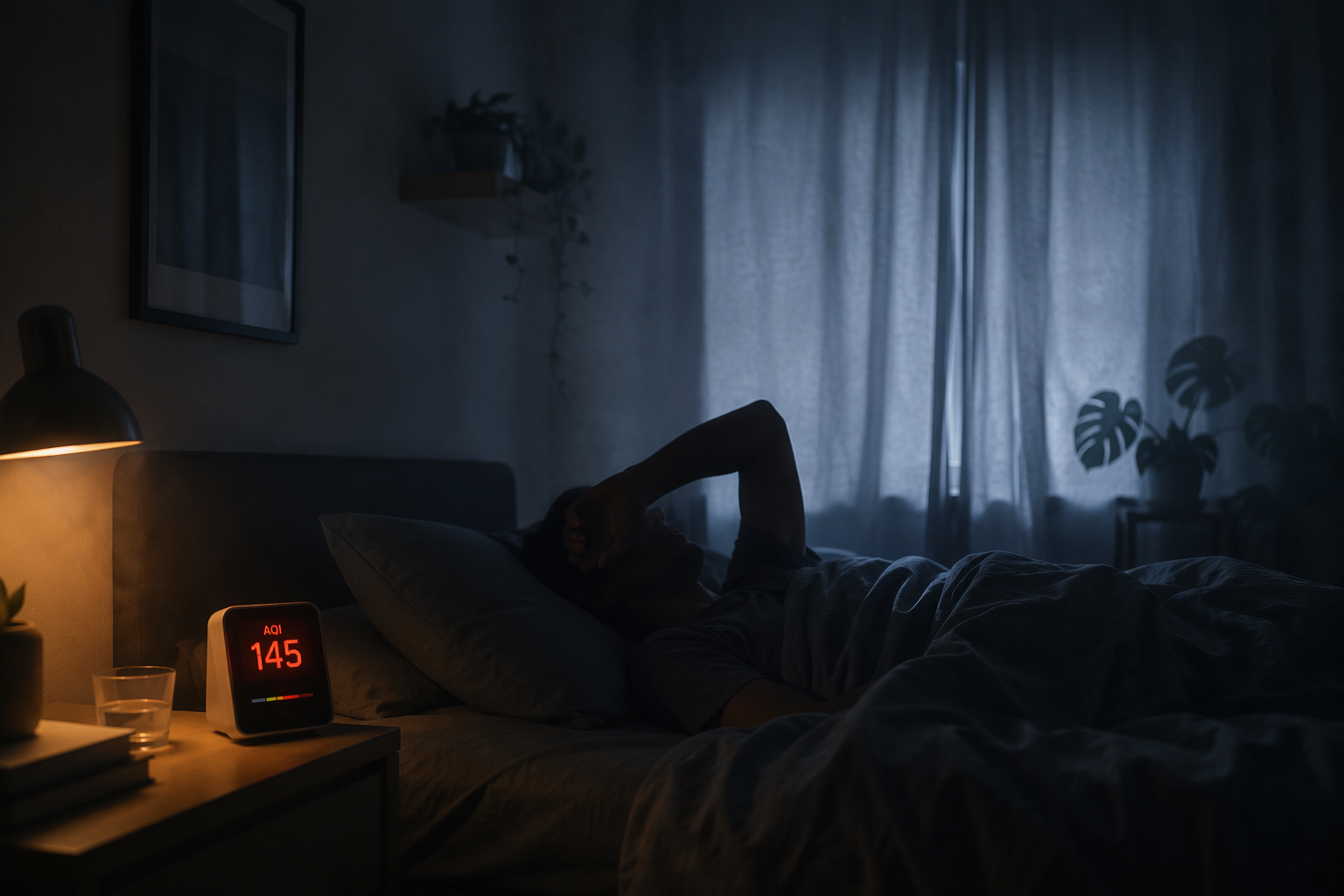
The frustrating thing about sleep quality during wildfire recovery is that the bedroom can look fixed before the body feels fixed. The windows are shut. The purifier is running. A towel may be blocking the door gap. Yet sleep still comes in pieces: dry throat at 2 a.m., a tight chest before dawn, a strange wired feeling, or a morning that starts as if the night never happened.
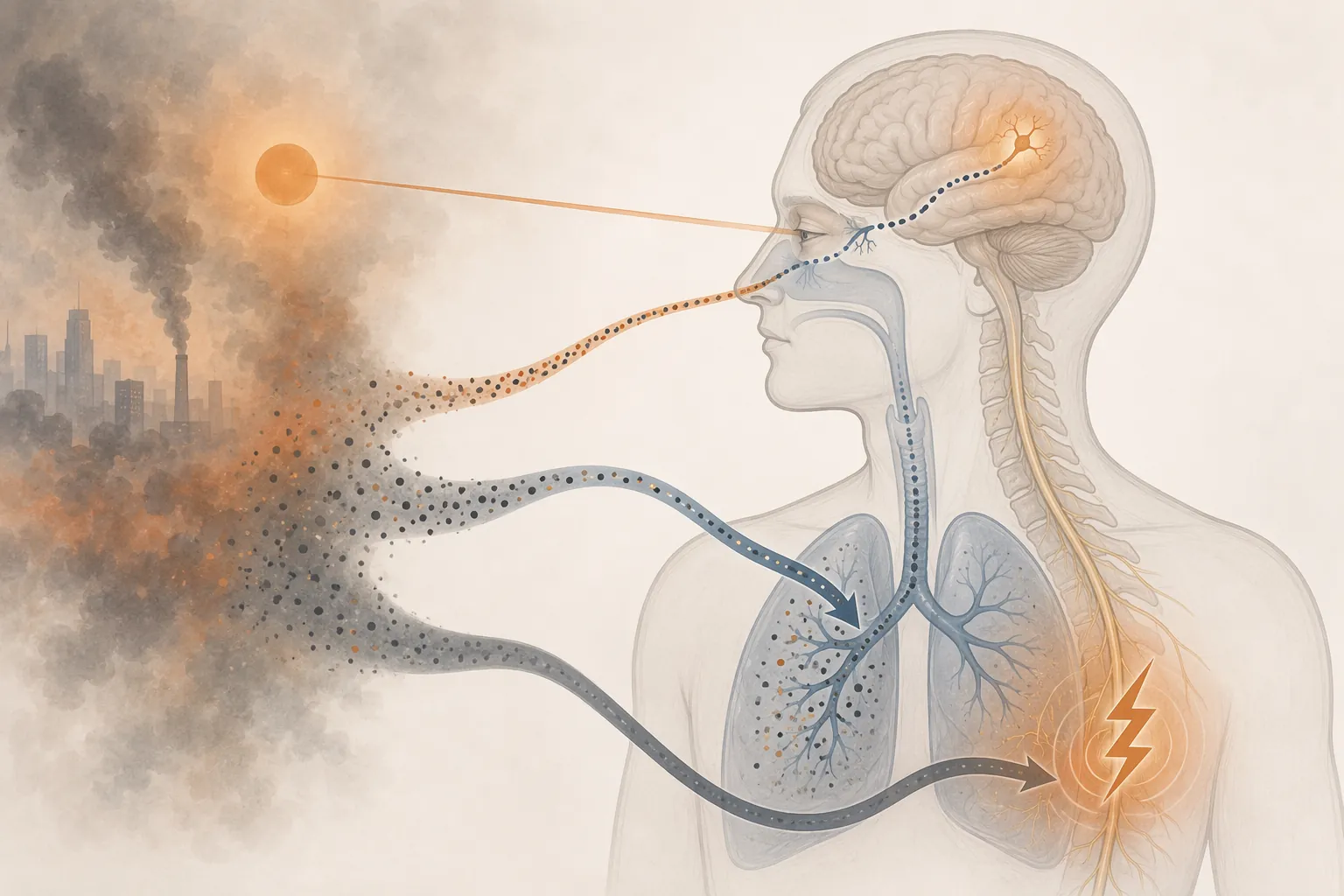
That does not mean the room work failed. It often means wildfire smoke is disturbing sleep through more than one pathway. For practical purposes, the four most useful pathways are respiratory irritation, neuroinflammation, circadian disruption, and increased sympathetic tone. That is a synthesis from separate lines of evidence, not one definitive wildfire-sleep study that proves every step in humans.
| If the night feels like this | Likely pathway | Countermeasure that matches the pathway |
|---|---|---|
| Dry throat, coughing, congestion, wheeze, mouth breathing | Respiratory irritation and airway narrowing | Reduce fine particles in the bedroom; consider nasal saline before bed |
| Light sleep, headache, foggy morning, feeling unrefreshed without much coughing | Particle-related brain and inflammatory effects | Push harder on particle control; avoid treating it only as a bedtime-routine problem |
| Sleep timing drifts, daytime sleepiness rises, nights feel late or flat | Circadian disruption from smoke-dimmed light | Protect morning light when air quality allows; use darkness at night more deliberately |
| Heart feels revved, sleep is shallow, early waking follows a stressful smoky day | Increased sympathetic tone and cardiovascular strain | Reduce exposure load, cool the room, avoid extra stimulation, and monitor vulnerable symptoms |
A sealed room mainly helps the first job: lowering exposure. It does not automatically calm an irritated nose, reset a mistimed body clock, or quiet a nervous system that has spent the day under environmental stress. The point is not to collect more sleep tips. It is to match tonight’s symptom to the pathway most likely pushing it.
Pathway 1: Fine Particles Irritate the Airways
Wildfire smoke carries fine particles that are small enough to move deep into the respiratory tract. The EPA describes wildfire smoke exposure as a respiratory and cardiovascular health concern, with fine particle pollution central to that risk.[1] For sleep, the immediate problem is often less dramatic than an emergency-room scene: the lining of the nose, throat, and airways becomes irritated, and the sleeper has to keep reopening the airway all night.
That can look like coughing, but it can also look quieter. A person may wake to sip water because the nose is blocked and the mouth has taken over breathing. Someone with asthma, COPD, allergies, or a sensitive upper airway may not need visible smoke in the room to feel the effect. Once particles have entered the indoor space, a closed window does not remove them; it only stops some of the new outdoor air from joining them.
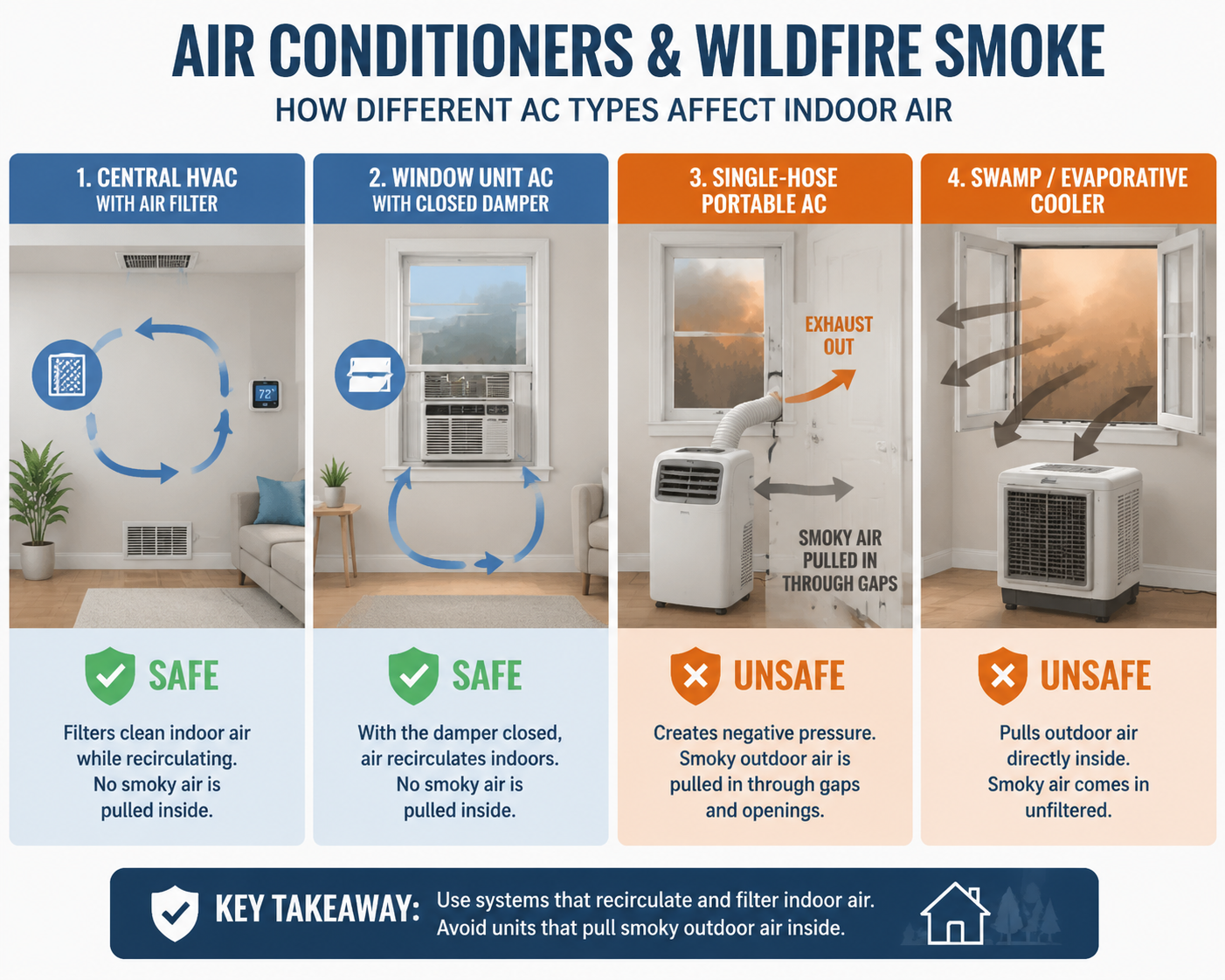
This is where filtration earns its place. A portable HEPA purifier sized for the bedroom targets the particle load closest to the sleeper. If the home HVAC system has an appropriate filter and can be run safely in fan-only mode, continuous air circulation through that filter may also help reduce indoor particles. Bedroom sealing helps most when it supports filtration rather than replacing it: fewer leaks mean the filter is not trying to clean an endless supply of smoky air.
The bedroom may also have an indoor-air-quality problem that is not only smoke. If the room is sealed tightly for hours, ventilation falls. That can matter for comfort and cognition, especially in small bedrooms with more than one sleeper. For readers balancing smoke control with stale indoor air, our guide to keeping bedroom CO₂ below 800 ppm covers the overlap without treating all indoor air problems as the same problem.
For the airway itself, nasal saline irrigation before bed is a mechanism-matched tool. It does not clean the room and it does not make outdoor air safe. Its job is narrower: rinse irritants and mucus from the nasal passages so the sleeper has a better chance of breathing through the nose. That is a different kind of intervention from a purifier, and the difference matters. One changes the exposure; the other helps the irritated tissue recover enough to stay quieter overnight.
Pathway 2: Smoke May Keep the Brain and Immune System on Alert
Some smoky-night sleep complaints do not sound respiratory at first. The person is not coughing much. The purifier is on. Still, sleep is thin, dreams feel agitated, or the morning brings headache and fog. That is where the second pathway becomes important: fine particles and smoke-related inflammation may affect sleep regulation beyond the airway.
Sleep Foundation summarizes evidence that inhaled particulate matter can contribute to airway inflammation and may also reach the central nervous system through the olfactory pathway, with particles moving from the nose toward brain regions involved in regulation.[2] In plain bedroom terms, the nose is not just a pipe to the lungs. It sits close to neural routes that help explain why inhaled pollution can feel like a whole-body exposure rather than a throat problem alone.
This is also the place to be careful. The available material supports a plausible mechanism, not a neat bedside test that says, “Your 3 a.m. waking was neuroinflammation.” Direct human evidence measuring wildfire-smoke-related brain inflammation and tying it to that night’s sleep architecture remains limited. The useful judgment is narrower: if sleep feels neurologically disturbed during smoke exposure, and the airway signs are mild, it is still reasonable to treat particle reduction as the first lever rather than jumping straight to sleep aids.
The scale of particle exposure during major fires can be large enough to justify that seriousness. A Harvard T.H. Chan School of Public Health report on California’s record 2020 wildfire season described wildfire-related PM2.5 levels reaching 17 times above EPA standards and linked smoke-specific PM2.5 exposure with mental health emergency department visits.[3] That study should not be stretched into proof that wildfire smoke directly caused insomnia in every exposed household. Its value here is different: it shows that smoke particle exposure can become extreme and that health effects are not confined to the lungs.
For this pathway, the countermeasure is still environmental control, but the standard is stricter. “I can’t smell smoke” is not enough. Fine particles can remain relevant even when odor fades. If the bedroom is the recovery space, keep the clean-air zone small, close unnecessary doors, run the purifier continuously during smoke periods, and avoid particle-generating indoor activities near bedtime. Candles, frying, incense, and dusty cleaning all ask the same irritated system to handle more work.
Pathway 3: Smoke-Dimmed Light Can Mistime Sleep
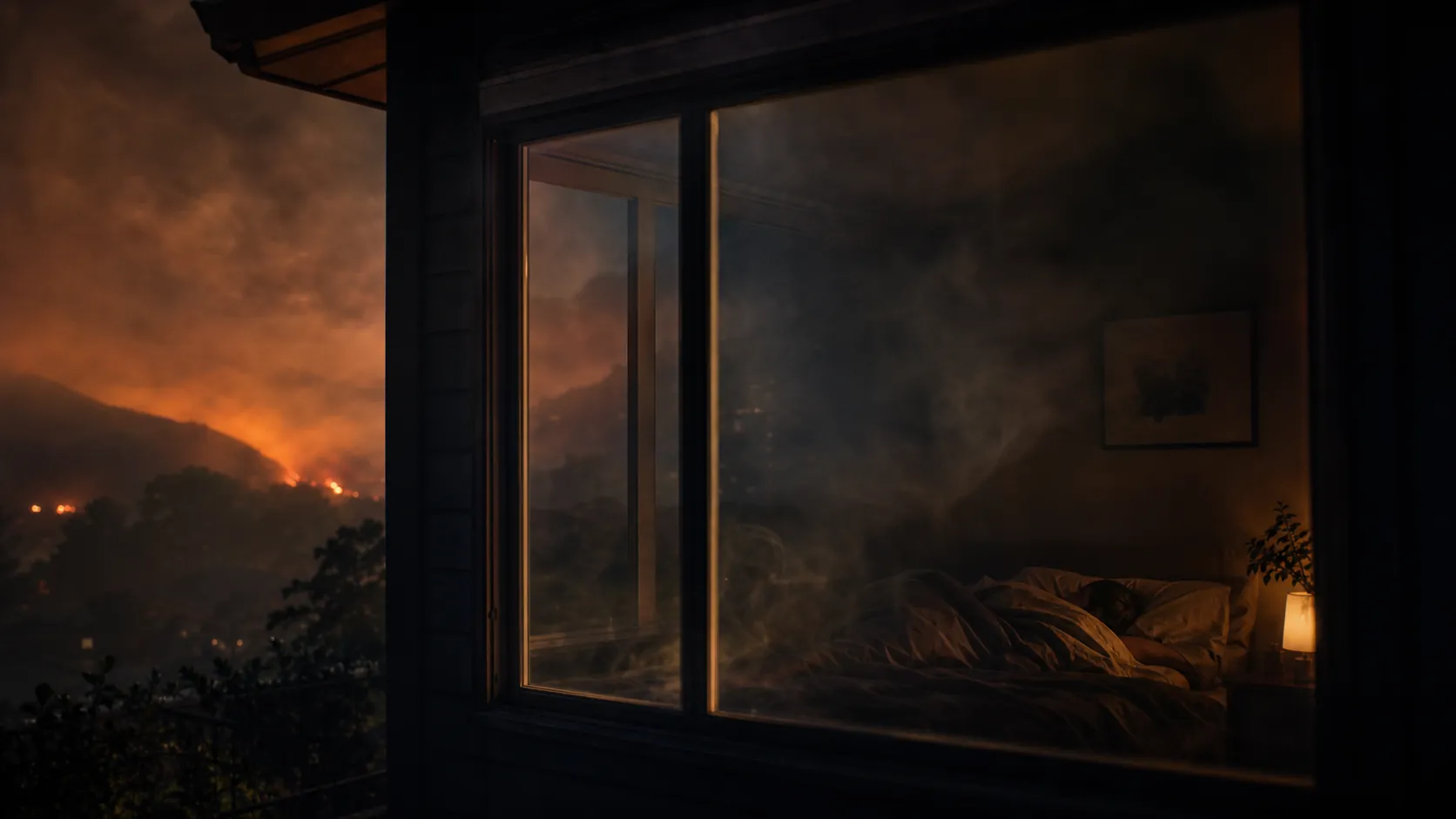
The circadian pathway is quieter, and it is easy to miss because it does not feel like “smoke in the lungs.” Thick smoke changes the light environment. ANC Sleep describes smoke canopy conditions reducing ambient light transmission by up to 90%, which can interfere with the light cues the body uses to time sleep and wakefulness.[4]
Light is one of the body’s strongest time signals. When daytime is dim and orange-gray, the brain receives a weaker “this is day” message. If the evening is then filled with bright indoor light and screens, the timing signal can flatten further: too little strong daytime contrast, too much light at the wrong end of the day. The result may be a later-feeling night, groggier morning, or a sleep period that does not anchor well.
This is not a reason to go outside into unhealthy air for sunlight. The air-safety decision comes first. When outdoor conditions are safe enough, morning light exposure can help re-anchor timing. When they are not, sit near the brightest available indoor window without opening it, turn indoor lights up earlier in the day, and keep evenings dimmer and more predictable. Blackout curtains belong at night, especially if evacuation lighting, streetlights, or a disrupted household keeps the room bright; they do not solve the daytime light deficit by themselves.
Circadian support is often where generic sleep advice sneaks back in. A stable wake time and a calmer evening can help, but on smoky days the reason is specific: the body may have received weak or confusing light cues. The intervention should rebuild contrast between day and night as safely as conditions allow.
Pathway 4: The Body May Stay in a Higher-Alert State
The fourth pathway is the one people often describe as “I was exhausted but wired.” Wildfire smoke exposure can overlap with heat, sirens, evacuation alerts, property worry, and a day spent checking maps. Even without a dramatic event, the body may carry more sympathetic activation into the night: higher alertness, more cardiovascular demand, and shallower sleep.
Martin et al. tested a related mechanism in a 2023 rodent study. In sleep-disrupted rats, wildfire-related smoke inhalation worsened cardiovascular risk markers, including an elevated morning blood pressure surge and increased cardiac sympathetic tone.[5] That is useful evidence for direction, not a direct human sleep prescription. Rats are not people, and cardiovascular markers are not the same thing as a person’s sleep diary. Still, the study fits a clinical pattern many people recognize: smoke exposure and poor sleep can push the body in the same unfavorable direction rather than acting as separate nuisances.
The countermeasure here is to reduce the total load before bed. Keep the clean-air room cool if heat is also present, because heat adds another arousal signal. Move air-quality checks earlier when possible instead of refreshing maps in bed. Avoid late alcohol as a “knockout” strategy; it can worsen sleep fragmentation and does not remove the exposure. If the day included heavy smoke exposure, treat the evening like recovery from a physiological stressor, not a willpower test.
Older adults and people with heart or lung disease deserve a lower threshold for caution. AARP’s wildfire-smoke health guidance emphasizes that older adults face higher risk from smoke exposure, especially when cardiovascular or respiratory conditions are already present.[6] For these sleepers, a racing heart, chest discomfort, worsening shortness of breath, confusion, or oxygen concerns are not sleep-hygiene problems. They are reasons to follow medical advice and local public-health guidance.
If heat is part of the same night, the plan changes again. Smoke may push you to seal the room; heat may make that room unsafe or unlivable. Our guide to sleeping during an excessive heat warning is most relevant when the choice is no longer simply “open or close the window,” but how to reduce several environmental stressors at once.
When the Problem Is Not Just the Bedroom
Wildfire sleep disruption can come from smoke exposure, but it can also come from displacement, fear, noise, and uncertainty. If you have evacuated, the bedroom mechanism map only covers part of the night. The sleep problem may be an unfamiliar room, shared shelter space, medication disruption, family separation, or repeated alerts. In that situation, start with our piece on why fire evacuation disrupts sleep before assuming filtration is the missing step.
If road closures or evacuation timing force you to sleep in a vehicle, the risk picture changes again. Smoke, carbon monoxide, heat, traffic exposure, and personal safety all matter. Use a dedicated safety plan such as sleeping safely in your vehicle during wildfire road closures rather than trying to adapt bedroom advice to a car.
For readers who want the broader physical and trauma framing, our related article on how wildfire smoke disrupts sleep through two pathways sits beside this one. The four-pathway model here is more mechanical: it asks which body system is being irritated, mistimed, inflamed, or held on alert tonight.
What the Evidence Can and Cannot Say Yet
The sleep-specific wildfire literature is still smaller than the lived problem. Isaac et al.’s 2021 systematic review found only five cross-sectional studies on wildfire exposure and sleep disturbance.[7] Cross-sectional studies can show associations at a point in time, but they cannot tell us how an individual sleeper’s recovery changes night by night as smoke levels rise, fall, and return.
That limitation is why the mechanism-first approach is useful without pretending to be complete. Respiratory irritation has clearer public-health grounding. Brain and inflammatory pathways are biologically plausible but not fully mapped in human wildfire sleep studies. Circadian disruption follows from smoke-altered light exposure, though the sleep outcome evidence is not as central as the particle evidence. Autonomic strain is supported in part by animal work and needs human corroboration.
So the practical claim should stay calibrated: wildfire smoke can impair sleep through multiple overlapping biological routes. Better sleep during recovery depends less on finding one perfect sleep tip and more on matching the intervention to the pathway most active that night. On many nights, more than one pathway is operating at once.
References
- Health Effects Attributed to Wildfire Smoke, EPA.
- How Wildfire Smoke Pollution Can Impact Your Sleep, Sleep Foundation.
- Exposure to Wildfire Smoke Linked with Worsening Mental Health Conditions, Harvard T.H. Chan School of Public Health, 2025.
- The Burning Consequence: How Wildfires Impact Your Sleep, ANC Sleep.
- Wildfire-related Smoke Inhalation Worsens Cardiovascular Risk in Sleep Disrupted Rats, Frontiers, 2023.
- Wildfire Smoke Health Risks for Older Adults, AARP.
- The Association between Wildfire Exposure and Sleep Disturbances: A Systematic Review, 2021.

Comments
Join the discussion with an anonymous comment.