
If you are exercising for better sleep, the most evidence-backed routine is more specific than “move more”: combine aerobic and resistance training, do it 4 times per week, keep each session to 30 minutes or less, work at a high intensity you can repeat safely, and sustain the plan for 9 to 10 weeks.
That prescription comes from a 2024 Frontiers network meta-analysis of 58 randomized controlled trials with 5,008 participants. It did something unusually useful for tired readers: it ranked exercise type, frequency, duration, intensity, and program length instead of stopping at the familiar conclusion that exercise helps sleep. Combined aerobic plus resistance exercise ranked highest by type, 4 sessions per week ranked highest by frequency, sessions of 30 minutes or less ranked highest by duration, high intensity ranked highest by intensity, and 9- to 10-week programs ranked highest by program length.[1]
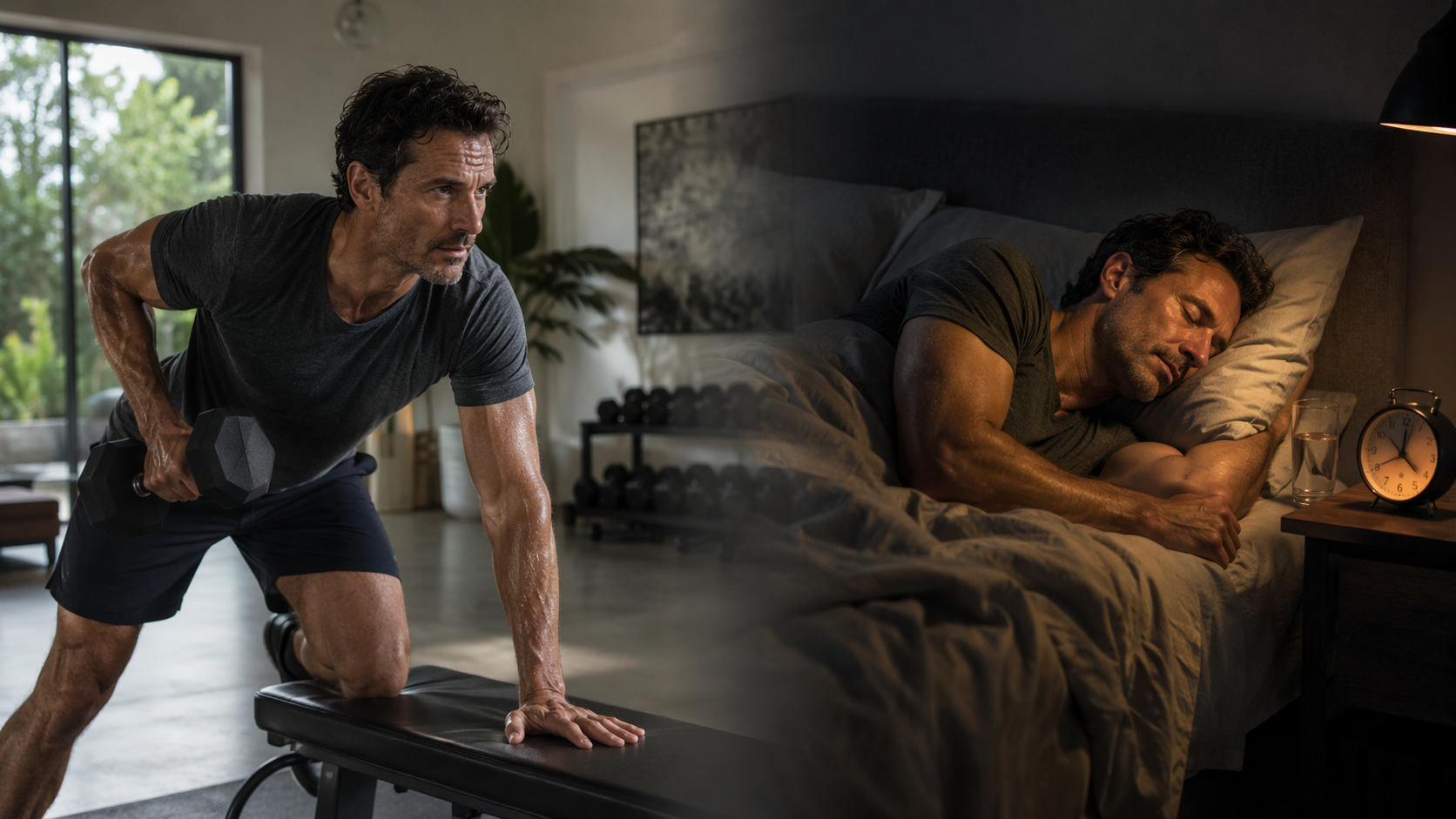
This is not a promise that one workout will fix tonight. It is a 9- to 10-week sleep-hygiene practice built from exercise science: short, repeated sessions that ask enough of the body to matter, without turning bedtime into another performance project.
The Routine, In Plain Terms
| Dose element | Best-ranked option for sleep quality | How to make it practical |
|---|---|---|
| Type | Combined aerobic + resistance exercise | Pair a cardio interval with a strength move, or alternate cardio and lifting blocks. |
| Frequency | 4 times per week | Use nonconsecutive days if recovery is an issue; consistency matters more than perfect spacing. |
| Duration | 30 minutes or less per session | A 20- to 30-minute session is enough room for warm-up, work, and a brief cool-down. |
| Intensity | High intensity | Work hard enough that talking is difficult during the work intervals, while keeping technique controlled. |
| Program length | 9 to 10 weeks | Judge the routine after a full block, not after two restless nights. |
A Tuesday version could be simple: 5 minutes of easy movement, 18 to 20 minutes alternating brisk cardio bursts with strength exercises such as squats, rows, presses, deadlift variations, or step-ups, then 3 to 5 minutes easing down. The point is not to copy a specific gym plan. The point is to preserve the dose: aerobic work plus resistance work, short session, challenging effort, repeated 4 times weekly.
“High intensity” should still be honest. For a trained person, that may mean hard intervals. For someone returning after a long break, it may mean a brisk hill walk paired with bodyweight strength work. The evidence ranks the dose category; it does not require a reckless workout.
Why This Prescription Rises Above Generic Exercise Advice
The Frontiers analysis used SUCRA rankings, a method used in network meta-analysis to estimate how likely each option is to be among the best choices. The exact rankings are unusually clear: combined aerobic plus resistance exercise scored 82.7 for type, 4 times per week scored 84.7 for frequency, 30 minutes or less scored 92.2 for duration, high intensity scored 92.9 for intensity, and 9 to 10 weeks scored 89.9 for program length.[1]
Those numbers should be read as rankings, not guarantees. They do not mean every person must train hard 4 times weekly or fail. They mean that, across the trials included, this combination of choices looked most favorable for improving sleep quality. That is a better starting point than a vague instruction to be active.
The session length finding is especially helpful. Sleep advice often quietly assumes people have spare time and spare willpower. Here, the best-ranked duration was not a long workout; it was 30 minutes or less.[1] That makes the routine easier to place before dinner, at lunch, after work, or early evening without letting it swallow the day.
What “Combined Aerobic Plus Resistance” Can Look Like
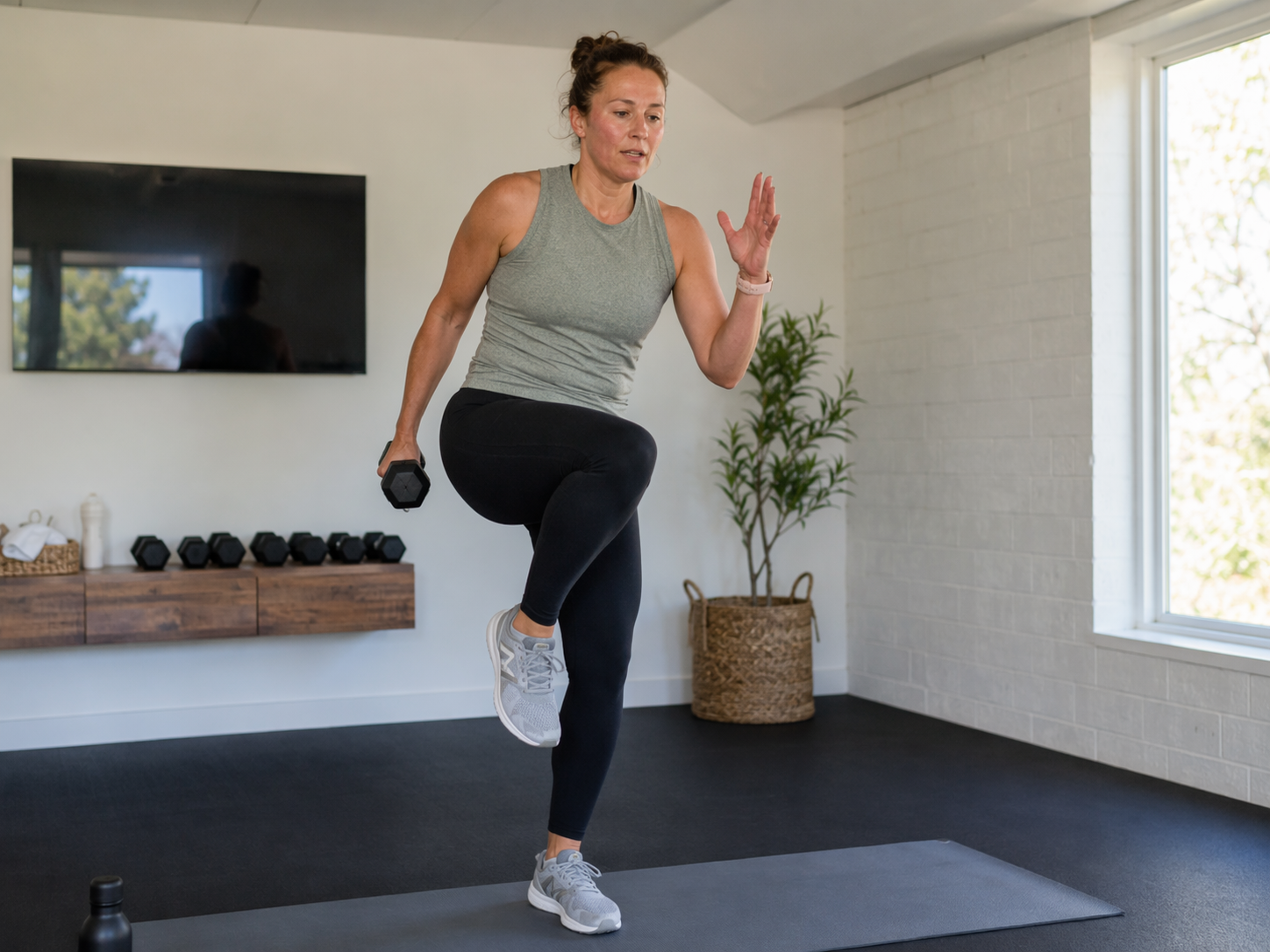
Combined training does not need to be complicated. It can be a circuit, a split session, or a short workout that alternates between breathing-heavy movement and load-bearing strength work. The aerobic part raises heart rate. The resistance part asks muscles to work against force. Together, they match the exercise type that ranked highest for sleep quality in the Frontiers analysis.[1]
- Home version: brisk marching or step-ups, followed by squats, push-ups against a counter, rows with bands, and loaded carries.
- Gym version: bike or treadmill intervals, followed by leg press, chest press, cable rows, and hip-hinge work.
- Outdoor version: fast walking or jogging intervals, followed by bodyweight lunges, incline push-ups, and stair climbs.
These are sample routines, not trial protocols. They are ways to translate the evidence into a routine a person could actually repeat.
If the Ideal Routine Is Too Much, Start Smaller Without Quitting the Idea
There is a useful difference between the best-ranked routine and the smallest meaningful entry point. A July 2025 University of Texas at Austin study using Fitbit data from college students found that even 10 minutes of daily moderate-to-vigorous activity was associated with improved deep sleep.[2] That does not prove the same effect for every age group, and college-student Fitbit data should not be treated like a clinical sleep-lab trial. It does, however, make the first step less precious.
For someone who is exhausted, 10 minutes can be the ramp: a brisk walk with two short uphill pushes, a brief bike interval session, or a fast bodyweight circuit. Once that is repeatable, extend toward the fuller pattern: combined training, 4 days weekly, no more than 30 minutes.
That small start is not a consolation prize. It is a way to protect consistency. Fragile sleep and overambitious exercise plans often collide: the person trains too hard once, sleeps badly, feels defeated, and abandons the routine before it has a chance to become a sleep signal.
How to Adjust for Insomnia, Older Age, or Gentler Preferences
Insomnia changes the stakes. Exercise can help, but chronic insomnia usually needs more than a fitness plan. The useful question is not whether exercise is “good” or “bad” for insomnia; it is which form is realistic enough to do consistently and strong enough to move sleep quality.
A 2025 BMJ Evidence-Based Medicine network meta-analysis reported that, among people with insomnia, yoga added nearly 2 hours of total sleep time, tai chi effects persisted up to 2 years, and walking or jogging reduced insomnia severity by about 10 points.[3] Those findings do not replace the combined-training prescription; they identify credible alternatives for people who will not stick with high-intensity mixed workouts or who need a gentler first block.
For older adults with insomnia, strength training deserves particular attention. A 2025 FMCH network meta-analysis found that strength training reduced Pittsburgh Sleep Quality Index scores by 5.75 points in older adults with insomnia, exceeding the 3-point threshold commonly treated as clinically meaningful.[4] That result is a reminder not to reserve resistance exercise for people chasing muscle or athletic performance. For sleep, strength work can be a serious behavioral tool.
| If this describes you | Reasonable adjustment | What to preserve |
|---|---|---|
| You are new to exercise or very tired | Start with 10 minutes of moderate-to-vigorous movement daily, then build. | Keep the entry point repeatable. |
| You prefer gentler exercise | Try yoga, tai chi, or walking/jogging as a first consistent block. | Use the same 9- to 10-week mindset. |
| You are an older adult with insomnia | Prioritize safe, progressive strength training, with support if needed. | Track sleep quality, not just workout completion. |
| You like harder workouts | Use combined aerobic plus resistance sessions 4 times weekly. | Keep sessions short enough to recover from. |
The BMJ analysis also reported a caution that matters: 68% of included trials had methodological limitations.[3] That does not erase the signal, but it should keep the advice grounded. Exercise is a strong candidate for improving sleep quality; it is not a magic hierarchy where one activity is perfect for every sleeper.
Timing: Do Not Let a Bedtime Rule Ruin a Good Routine
Many people have absorbed a strict rule: never exercise at night. The evidence is more flexible. Analyses summarized by the Sleep Foundation and research notes from the American Academy of Sleep Medicine indicate that moderate evening exercise within 90 minutes of bedtime does not impair sleep for most people.[5][6]
That finding has two important limits: moderate and most. If late hard intervals leave you wired, move them earlier. If a gentle evening lift or walk helps you discharge the day, there is no need to treat the clock as a moral test. Timing is a personalization variable, not a rule powerful enough to cancel the rest of the exercise evidence.
Morning exercise may have its own advantage. AASM research notes indicate that exercise around 10:00 to 12:00 may lower cortisol and support circadian alignment.[6] For someone whose evenings are crowded or whose nervous system stays keyed up after late workouts, that late-morning window is worth testing if life allows.
- If evening workouts help and sleep does not worsen, keep them.
- If high-intensity evening workouts delay sleep, move hard sessions earlier and keep evening movement gentle.
- If mornings are realistic, test a 10:00 to 12:00 workout window for 2 weeks before judging.
- If no timing option is perfect, protect weekly consistency before chasing the ideal hour.
Why Exercise Can Change Sleep
The practical routine comes first because mechanisms do not put shoes on after work. Still, the biology is credible. A 2024 narrative review in npj Biological Timing and Sleep describes several pathways by which exercise may influence sleep: thermoregulation, melatonin, cortisol reduction, and circadian entrainment.[7]
In plain terms, exercise can raise and then help lower body temperature, interact with hormonal signals involved in sleep timing, reduce stress physiology, and strengthen the body’s sense of day-night rhythm. None of those mechanisms requires a wearable, supplement, or elaborate evening ritual. They require a repeated enough signal.
This also explains why the 9- to 10-week program length matters. A single workout may affect one night, but a routine gives the body repeated cues. If sleep quality is the outcome, the habit block is part of the dose.
What to Track During the 9 to 10 Weeks
Most of the sleep-quality evidence in these analyses relies on self-reported measures such as the Pittsburgh Sleep Quality Index rather than objective polysomnography. That is a limitation, but it is not useless. If the question is whether a routine helps you feel and function better, your own sleep diary still matters.
- Workout completion: Did you finish 4 sessions this week?
- Session dose: Did each session combine aerobic and resistance work and stay at 30 minutes or less?
- Sleep onset: Did you fall asleep more easily, less easily, or about the same?
- Night waking: Did awakenings decrease, increase, or stay unchanged?
- Daytime recovery: Did mornings feel more restored, or are you accumulating fatigue?
Do not change every variable at once. If sleep worsens, first adjust timing or intensity. If soreness accumulates, reduce load before abandoning the routine. If the plan feels too large, return to the 10-minute entry point and rebuild.
The Boundaries Matter
The strongest prescription comes with real caveats. The Frontiers analysis included participants across a wide age range, from 13 to 85, so its top-ranked dose should not be treated as equally tested in every life stage.[1] The UT Austin Fitbit finding came from college students, which limits how confidently it can be applied to middle-aged adults, older adults, or people with diagnosed sleep disorders.[2]
Those limits do not weaken the practical conclusion as much as they sharpen it. For general fitness and sleep quality, the best-supported starting prescription is combined aerobic and resistance exercise, 4 times weekly, high intensity, 30 minutes or less, for 9 to 10 weeks. For insomnia, older age, low fitness, pain, or strong exercise preferences, the prescription should bend before it breaks.
If sleep remains poor after a consistent 9- to 10-week block, especially if insomnia is persistent, exercise should not be asked to do the full job of clinical care. Cognitive behavioral therapy for insomnia is a first-line treatment pathway, and the American Academy of Sleep Medicine provides CBT-I resources for people who need more targeted help.
For the next 9 to 10 weeks, the job is concrete: 4 short combined workouts per week, hard enough to count, easy enough to repeat, adjusted by your sleep rather than by someone else’s perfect schedule.
References
- Frontiers network meta-analysis of exercise dose elements for sleep quality, Frontiers, October 2024.
- University of Texas at Austin Fitbit study on daily moderate-to-vigorous activity and deep sleep, University of Texas at Austin, July 2025.
- BMJ Evidence-Based Medicine network meta-analysis of exercise for insomnia, BMJ Evidence-Based Medicine, July 2025.
- FMCH network meta-analysis of exercise interventions in older adults with insomnia, FMCH, 2025.
- Sleep Foundation analysis of evening exercise and sleep, Sleep Foundation.
- American Academy of Sleep Medicine research notes on exercise timing, cortisol, and circadian alignment, American Academy of Sleep Medicine.
- Narrative review on exercise, biological timing, and sleep mechanisms, npj Biological Timing and Sleep, 2024.


Comments
Join the discussion with an anonymous comment.