
The first hospital night often feels less like bedtime and more like a series of interruptions: the IV pump beeps, a cart rolls past the door, someone comes in for vital signs, pain rises as anesthesia wears off, and a blood draw may arrive before dawn. That does not mean sleep and rest during hospital recovery are out of your hands. It means the goal is not a perfect, uninterrupted night. The goal is to reduce the disruptions that are optional, prepare for the ones that are predictable, and keep safety-critical care intact.
The main causes are not mysterious. Pain is the most commonly reported reason patients sleep poorly in the hospital, followed by vital signs and testing, noise, and medications; only 58% of hospitalized Americans report that their room is quiet at night, making quietness the worst-performing HCAHPS measure cited in Harvard Health’s review of the issue.[1]
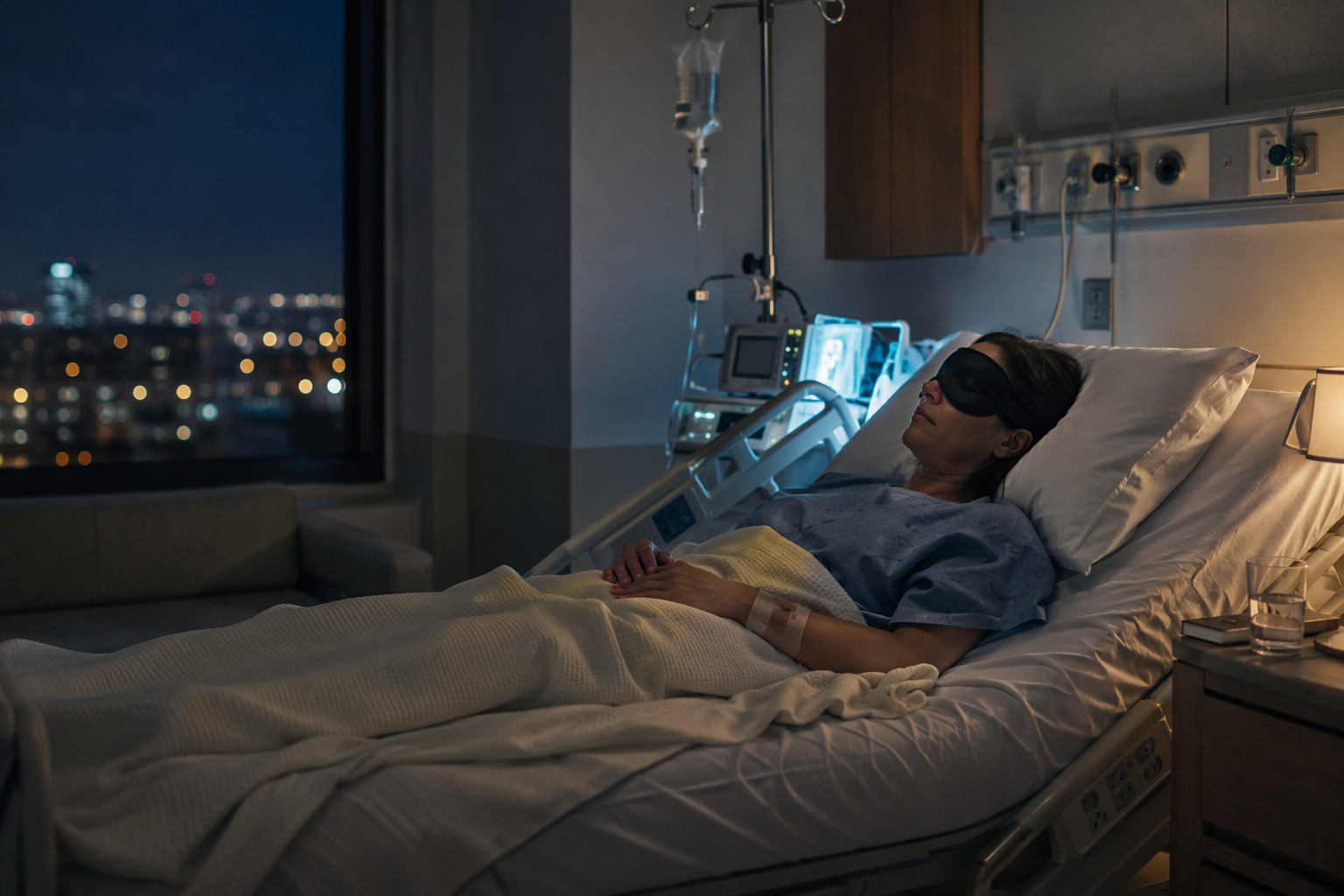
If you are reading this before admission, pack a small sleep kit and plan a few questions. If you are already in the room, start with the nurse caring for you tonight. The useful question is not “Can nobody wake me up?” It is “Which checks tonight are medically necessary, and which ones might be clustered or timed differently?”
Start With The Disruptions Most Likely To Be Fixable
Pain deserves attention first because it is both common and easy to underreport. Patients sometimes wait until pain is severe because they do not want to bother staff, then spend the next few hours trying to catch up. A better approach is to ask how your pain plan works before the night shift settles in: which medications are scheduled, which are as-needed, how long they usually take to work, and what level of pain should prompt you to call.
That conversation can also prevent a second sleep problem: medication timing. Some drugs can keep people awake, some increase bathroom trips, and some must be given on a strict schedule. Diuretics are a common example worth asking about. If they are safe to take earlier in the day, moving them may reduce overnight urination. If they are being timed for a clinical reason, that reason matters more than convenience.
Noise is harder because you do not control the hallway, the monitor alarms, the roommate, or the fact that nurses are caring for several people at once. Still, the 58% quiet-room figure is useful because it shows this is not personal sensitivity. Hospital rooms are noisy systems. You are allowed to ask for the door to be closed, the TV to be lowered, alarm volumes to be checked when appropriate, and quiet hours to be honored if the unit has them.[1]
What To Do Before Admission, Or As Soon As You Can
A sleep kit is not a cure, but it gives you options at 2 a.m. when the room is bright, the hallway is active, and you are too tired to problem-solve. The American Academy of Sleep Medicine’s patient guidance recommends bringing familiar sleep items and planning for light and noise control during a hospital stay.[4]
- Eye mask: choose one that does not press on surgical sites, tubing, oxygen equipment, or facial dressings.
- Earplugs or comfortable noise-reducing earbuds: ask staff whether you need to keep one ear free for alarms, instructions, or mobility safety.
- White noise or calming audio: keep volume low enough that you can hear staff enter and respond to questions.
- Phone charger with a long cord: keep it positioned so it does not create a fall or tubing hazard.
- A familiar pillowcase, light blanket, or scent-free comfort item: avoid anything that interferes with infection-control rules or equipment.
- Glasses, hearing aids, and dentures within reach: disorientation at night is worse when you cannot see, hear, or communicate clearly.
The tool itself is only half the intervention. In a study summarized by Harvard Health, patients who received eye masks, earplugs, and white noise plus education reported less fatigue and sleep impairment than patients who received the tools alone.[1] The practical lesson is simple: bring the items, but also ask how to use them safely on that unit.
The Nighttime Checks You May Be Able To Negotiate
This is where hospital sleep improves or does not. Many interruptions happen because they are medically necessary. Some happen because the system runs on default schedules. The patient’s job is not to sort that out alone; it is to ask the team to sort it out explicitly.
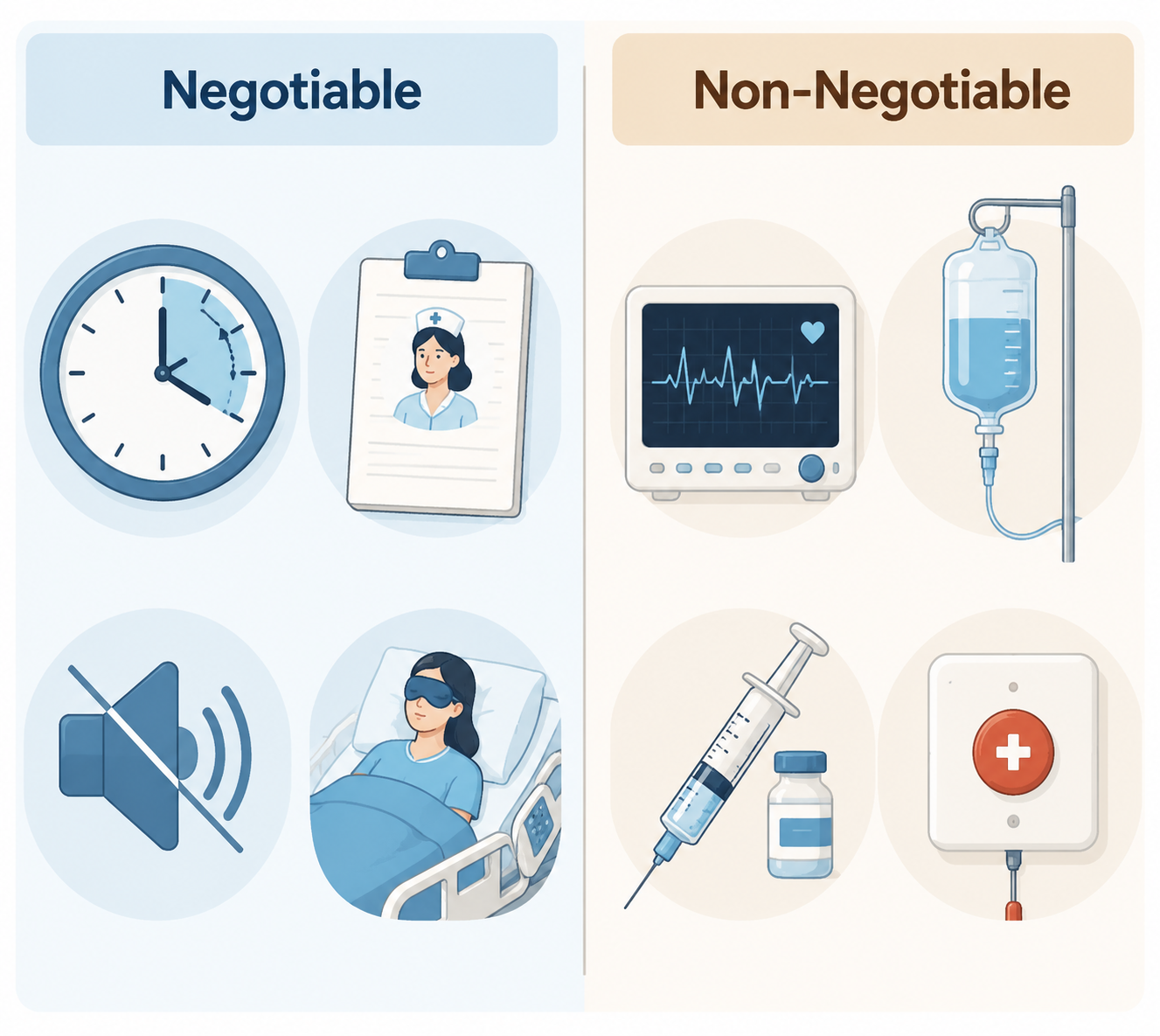
| Ask About | What Might Be Possible | When To Stop Pushing |
|---|---|---|
| Vital signs overnight | Longer intervals, fewer awakenings, or timing checks with medication rounds if your condition is stable | If you are unstable, newly post-op, on certain medications, or being watched for a specific complication |
| Early blood draws | Moving labs later or coordinating them with another planned wake-up | If the result is needed before morning rounds, a procedure, medication dosing, or urgent decision-making |
| Nursing care tasks | Clustering wound checks, toileting help, repositioning, medications, and assessments | If skin safety, fall prevention, pain control, or monitoring requires a separate check |
| Diuretics or stimulating medications | Earlier daytime dosing when clinically appropriate | If the timing is tied to fluid status, blood pressure, heart or kidney concerns, or another safety reason |
| IV placement, transfusion, or non-urgent procedures | Scheduling at a less disruptive time when medically reasonable | If the treatment is urgent or delaying it could affect recovery |
A real example shows why these requests are worth making. Somerville Hospital used a disruption-reduction protocol that included clustered nursing care, changes to vital-sign timing, and quiet hours; Harvard Health reports that the protocol reduced as-needed sedative use by about 50%.[1] That is not just a nicer bedtime environment. It suggests that when a hospital reduces avoidable wake-ups, some patients need fewer rescue sleep medications.
Useful Scripts That Do Not Put Staff On The Defensive
The best requests are specific, safety-aware, and easy for the nurse to pass along. Try one of these before the night gets busy:
- “I know some checks are necessary. Could you tell me which ones I should expect overnight so I am not startled awake?”
- “If my vital signs are stable, is it safe to stretch the timing or combine them with medications?”
- “Are any of my morning labs flexible, or do they need to be drawn before rounds?”
- “Can we make a plan for pain control before I try to sleep, so I am not waiting until it becomes severe?”
- “If I use earplugs or white noise, is there anything I still need to be able to hear?”
If a family member is staying with you, they can ask the same questions, especially when you are groggy, in pain, or recovering from anesthesia. The tone matters less than the clarity. “Please do not wake her up” is understandable, but it gives the nurse very little room to work. “Can we cluster anything that is safe to cluster?” gives the team a task they may actually be able to act on.
Protect Daytime Cues So Night Has A Chance
Hospital days can blur: shades stay half-closed, naps happen whenever pain medication peaks, meals arrive on a tray, and activity depends on tests and staff availability. You do not need a complicated circadian plan. You need enough daytime signal that your body can still recognize night.
- Open the shades in the morning if your room and condition allow it.
- Sit in the chair for part of the day if your mobility orders permit it.
- Ask physical therapy, nursing, or your clinician how much daytime walking or movement is safe.
- Keep naps restorative rather than unlimited when you can; long late-day naps can make the next hospital night harder.
- Dim your own screens and room lights in the evening, even if the hallway stays bright.
A 2026 UTMB Pepper Center report adds a recovery reason to care about this beyond comfort: in a study of 52 older adults, inpatient sleep quality predicted physical function after discharge.[5] That finding should be treated as supporting context, not proof that one quiet night changes the whole recovery course. Still, it fits what many patients feel: poor sleep makes it harder to participate in therapy, manage pain, eat, and think clearly the next day.
Use Low-Risk Night Methods Before Reaching For A Pill
Non-drug methods are sometimes dismissed as “nice extras,” but several have randomized-trial support in hospitalized patients. A systematic review by Tamrat and colleagues found evidence for non-pharmacologic interventions including relaxation techniques, guided imagery, music, and massage to improve sleep in hospital settings.[2]
Pick one method before you are exhausted. A five-minute breathing routine, a guided imagery recording, or quiet music is easier to use if it is already loaded on your phone and you have practiced it once. If massage is available through the hospital, ask whether it is appropriate for your condition; after surgery, with lines, drains, wounds, blood-clot precautions, or certain cancer treatments, touch therapies need clearance.
A simple hospital-friendly routine can look like this: ask for pain medication timing before sleep, use the bathroom with help if you are a fall risk, adjust the room light, put on the eye mask only if safe, start low-volume calming audio, and use slow breathing while expecting that someone may still need to enter. The expectation matters. If every sound feels like a failed night, frustration becomes another stimulant.
Be Careful With Hospital Sleep Medications
It is tempting to ask for “something to knock me out,” especially after two bad nights. Sometimes medication is appropriate. But in the hospital, sleep drugs are not just sleep drugs; they interact with fall risk, delirium risk, breathing, pain medicines, confusion, urinary retention, and morning participation in therapy.
This is especially important for older adults. Arora and Stewart’s review of sleep in hospitalized older adults notes that diphenhydramine, benzodiazepines, and Z-drugs are considered inappropriate for many older patients under Beers Criteria concerns, while low-dose melatonin, 1–3 mg, is preferred when a pharmacologic option is needed because of its minimal side-effect profile.[3]
Diphenhydramine is the active ingredient many people recognize from Benadryl and some over-the-counter sleep aids. In older adults, the problem is its anticholinergic burden: it can contribute to confusion, cognitive impairment, urinary problems, and falls. Benzodiazepines and Z-drugs such as zolpidem or eszopiclone can also increase safety concerns in older hospitalized patients, particularly when combined with opioids, nighttime bathroom trips, weakness, or unfamiliar surroundings.[3]
Melatonin deserves a narrower recommendation than it usually gets. It may be a safer option for some older hospitalized patients at low doses, but more is not automatically better, and supplement quality can vary because melatonin products are not regulated like prescription medications. If you already take melatonin at home, tell the team the dose and timing. If you do not, ask whether it fits your situation rather than starting it as a general hospital sleep fix.
A useful medication question is: “Given my age, diagnosis, fall risk, breathing status, and pain medicines, what is the safest sleep option if non-drug steps are not enough?” That invites the clinician to weigh the actual risks instead of treating sleep as a side complaint.
Shared Rooms, Alarms, And The Awkward Human Parts
Some sleep disruption comes from the room itself. A roommate may need urgent care, use the TV late, receive visitors, or have different sleep habits. You can be considerate and still ask for help. Start with staff rather than confronting another patient directly: “I am having trouble sleeping because of the TV/noise/light. Is there a way to reduce it tonight?” If the situation is severe or ongoing, ask whether a room change is possible, but do not assume one is available.
Alarms are similar. Some are nuisance alarms; some are warning signs. Do not silence equipment yourself. Call the nurse and say what you hear. If the same pump or monitor alarms repeatedly, it is reasonable to ask whether the settings, tubing position, battery, or sensor can be checked. The answer may be no, but the question is appropriate.
What A Realistic Hospital Sleep Plan Looks Like
Before night shift, ask what will happen overnight. Clarify pain control. Ask whether vital signs, labs, medications, toileting help, and nursing care can be clustered. Set up light and noise tools in a way that does not interfere with care. Use a low-risk relaxation method. If you are still not sleeping, discuss medication as a safety decision, not a shortcut.
Some wake-ups are part of safe recovery. A nurse may need to check your neurological status after surgery, respond to a monitor, give time-sensitive medication, assess breathing, prevent a fall, or act on a change in your condition. Better hospital sleep usually comes from small negotiated protections layered together, not from demanding an uninterrupted night or accepting the first sedative offered. Clear advocacy is allowed. So is being woken up when your body needs watching.
References
- Getting sleep in the hospital, Harvard Health
- Non-pharmacologic Interventions to Improve the Sleep of Hospitalized Patients: A Systematic Review, Tamrat et al., 2014
- Sleep in Hospitalized Older Adults, Arora & Stewart, 2017
- Sleep in the Hospital, AASM Sleep Education
- Study shows sleep plays key role in post-hospital recovery, UTMB Pepper Center, May 25, 2026





Comments
Join the discussion with an anonymous comment.